
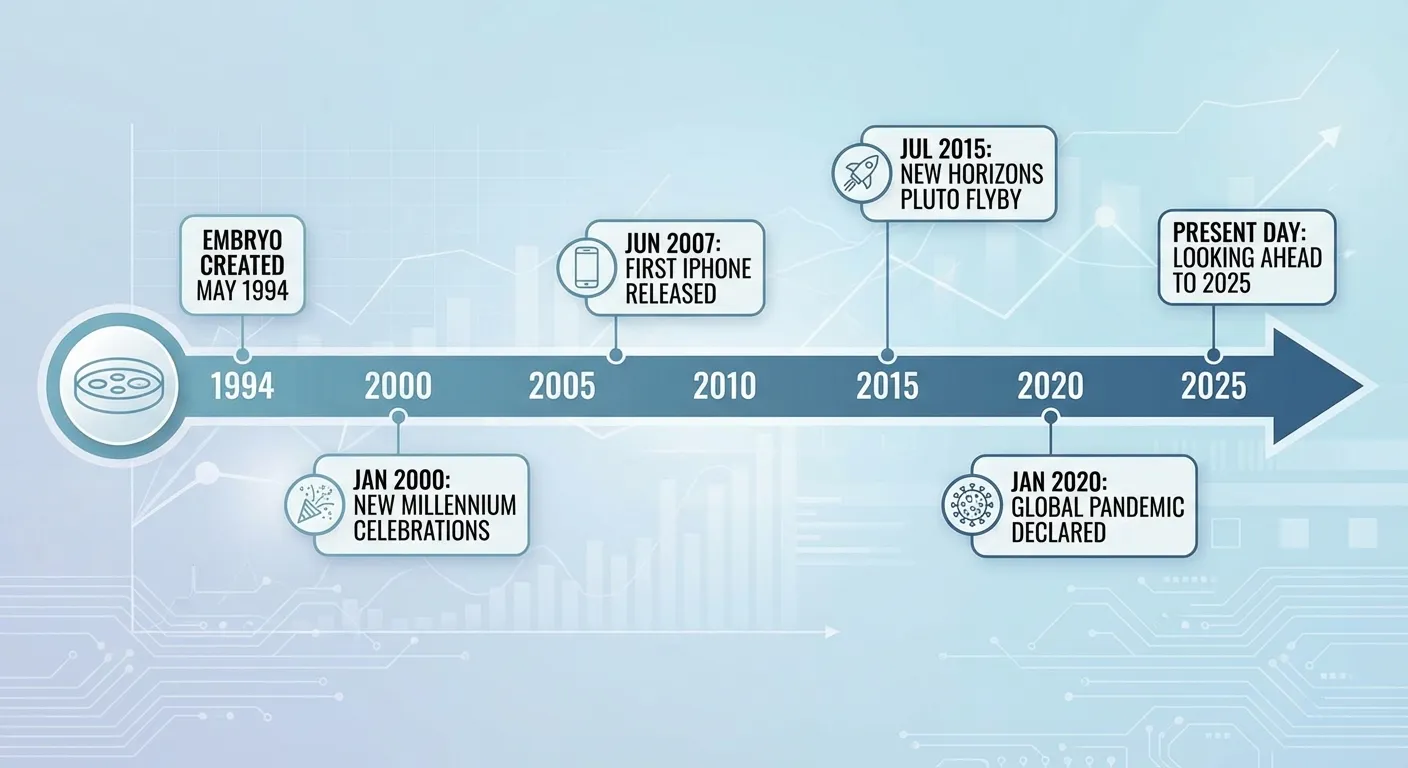
The baby born in July 2025 was, in a sense, older than both of her parents. Conceived in May 1994, the embryo had been frozen and stored for over 30 years before being thawed, implanted, and carried to term by a couple who were themselves toddlers when the embryo was created. The original parents, who had successfully conceived through IVF in the 1990s, donated their remaining embryos. Decades later, one of those embryos became a person.
The case breaks previous records for the longest-frozen embryo to result in a live birth, though such records are broken periodically as the frozen embryo population ages. More significantly, it raises questions that reproductive technology has outpaced our ability to answer. What does it mean to have biological parents you've never met and were strangers to your birth parents? How should we think about siblings born decades apart to different families? The technology of embryo preservation works reliably. The social and ethical frameworks for understanding it are still catching up.
The 30-year embryo is an extreme case, but it represents a broader reality: there are millions of frozen embryos in storage worldwide, and the number grows every year. Each one is a potential person in suspended animation, waiting for decisions that may never be made or may come from people the original creators never imagined.
How Embryo Freezing Works
Embryo cryopreservation has been routine in fertility medicine since the 1980s. When couples undergo IVF, clinicians typically fertilize multiple eggs to increase the chances of success. This often produces more viable embryos than can be safely implanted in a single cycle. The extras are frozen for potential future use.
The freezing process itself has improved dramatically. Early methods used slow cooling that allowed ice crystals to form inside cells, sometimes damaging them. Modern vitrification, pioneered by fertility specialist Masashige Kuwayama in the 2000s, cools embryos so rapidly that water turns directly to a glass-like solid without crystallizing. Survival rates after thawing now exceed 95%, and babies born from vitrified embryos show no difference in health outcomes from those conceived fresh.
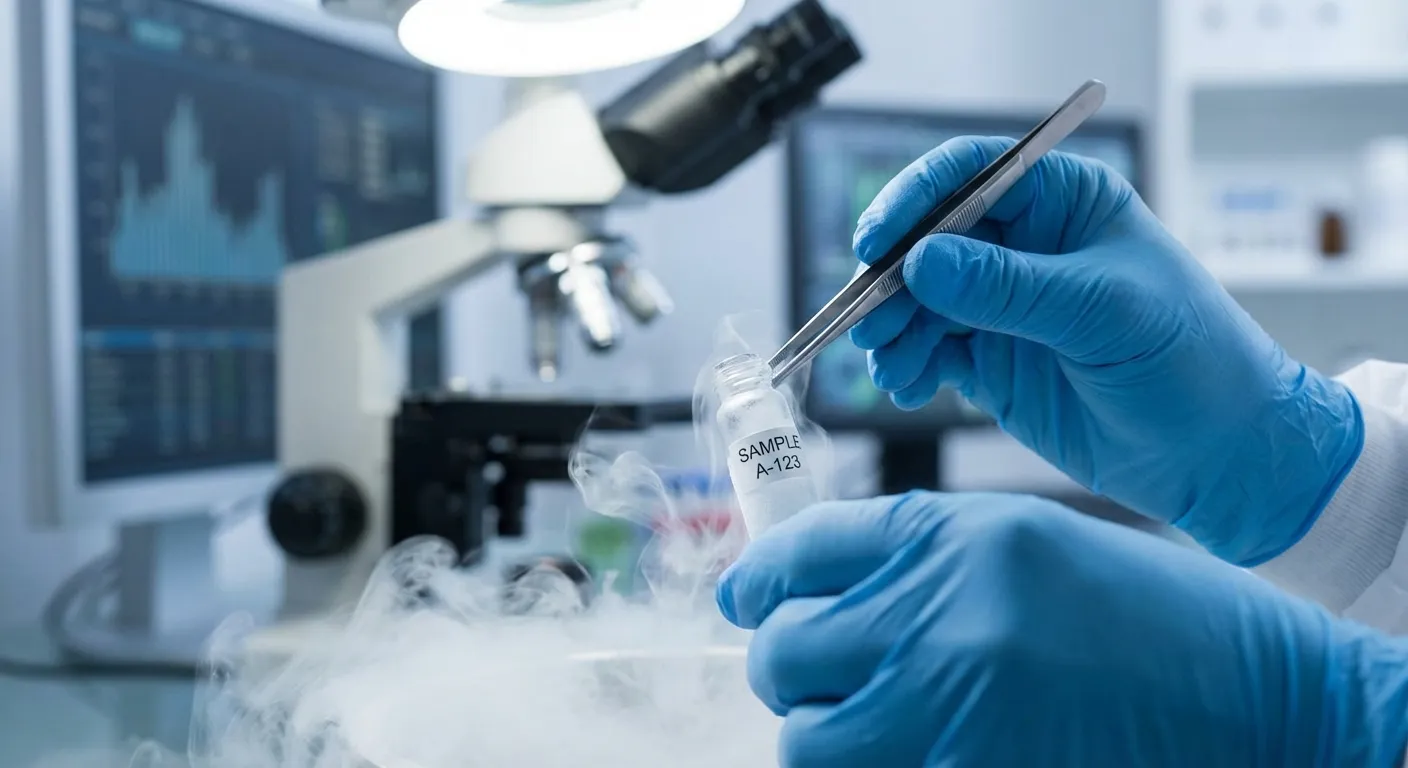
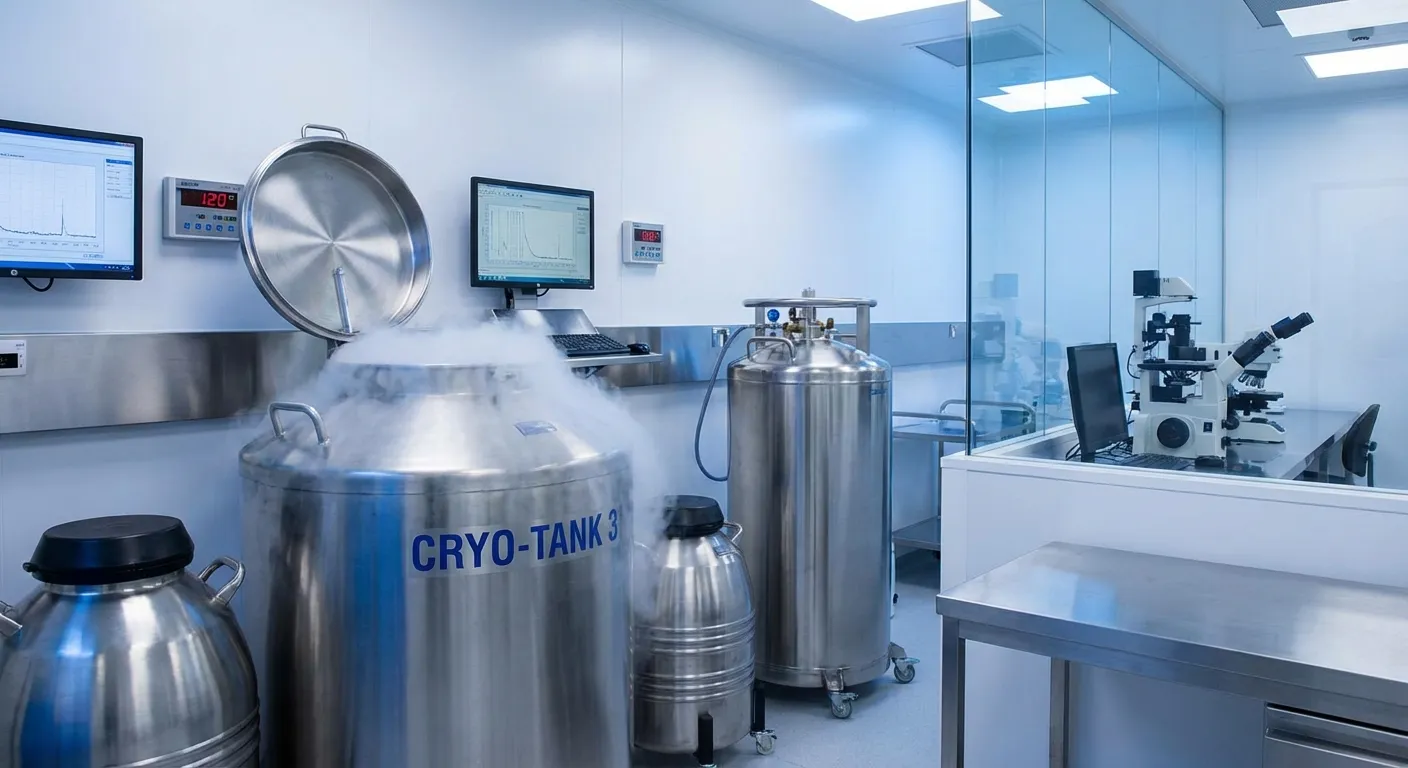
Once frozen at minus 196 degrees Celsius in liquid nitrogen, embryos enter a state of suspended animation. Metabolic processes halt completely. In theory, a frozen embryo could remain viable indefinitely, as there's no degradation occurring at those temperatures. The practical limit is set by storage facilities and the choices of embryo owners, not by biological deterioration.
The 30-year embryo was frozen using the earlier slow-cooling method, which makes its successful development even more remarkable. It survived not only three decades of storage but a freezing process that modern techniques have since improved upon. The embryo was resilient, or lucky, or both.
The Families Involved
After successfully having their own children through IVF in the 1990s, the original parents chose to donate their remaining embryos rather than discard them or keep them frozen indefinitely. Many couples in their position face this difficult choice. The National Embryo Donation Center, a nonprofit that facilitated the adoption, reports that inquiries about embryo donation have increased roughly 30 percent since 2020, driven partly by couples who find adoption waiting lists prohibitively long and partly by families with religious convictions that embryos should not be destroyed.
Embryo donation creates a form of family building that fits no existing legal or social template cleanly. The receiving parents carry the pregnancy and give birth, but have no genetic relationship to the child. The genetic parents contributed biological material decades ago and have no ongoing legal rights. The process resembles adoption in some ways and surrogacy in others, but matches neither one exactly, leaving families to navigate a patchwork of state laws that were written before this kind of arrangement was common.
The case highlights a kinship puzzle that no legal system or cultural tradition was built to handle. The baby's genetic siblings, born from the same IVF cycle in the 1990s, are now adults in their 30s, raised by different parents in a different era. They share full genetic inheritance with a child who will grow up in a world those siblings could not have imagined when they were born. DNA testing services like 23andMe and AncestryDNA have already made half-sibling discovery common among donor-conceived individuals, but full genetic siblings separated by three decades occupy entirely new territory.
The legal frameworks are equally unprepared. In some states, the genetic parents retain residual rights over donated embryos until transfer is complete. In others, the receiving parents assume all legal parentage at implantation. A handful of jurisdictions have no specific embryo donation statutes at all, forcing families to rely on adoption law or contract law depending on which judge hears their case. The inconsistency means that families like this one could face different legal realities simply by crossing a state line.
The Frozen Population
The 30-year embryo isn't alone in its extended suspended animation. Fertility clinics worldwide store an estimated 4 to 5 million frozen embryos, and the number grows each year. Many will eventually be thawed for use by their original creators or donated to other families. Some will be donated for research. Many more sit in indefinite storage, their creators unable or unwilling to decide their fate.
The stored embryos represent a kind of deferred potential. Each one could theoretically become a person, given the right decisions and circumstances. But most won't. Studies suggest that a significant majority of frozen embryos will never be used for reproduction, either because their creators complete their families without needing them, because the creators divorce and can't agree on disposition, or because the storage fees lapse and the embryos are eventually discarded or donated to research.

The legal status of frozen embryos varies widely. Some jurisdictions treat them as property that can be divided in divorce like other assets. Others grant them special status as potential persons, with implications for who can make decisions about their fate. A few countries limit how long embryos can be stored before they must be either used or destroyed. The United States has relatively few regulations, leaving most decisions to fertility clinics and the families who created the embryos.
Questions Without Easy Answers
The case of the 30-year embryo brings into focus questions that have been building since reproductive technology began outpacing our ethical frameworks. The technology works, but what should we do with it?
One question concerns genetic siblings. The baby born in 2025 may have full genetic siblings who were born in the 1990s, raised by different parents, and have lived complete lives as adults while she was still frozen. Should they know about each other? Should they have the opportunity to meet? Donor-conceived people have increasingly sought out their genetic relatives, finding half-siblings through DNA testing services. The phenomenon echoes how hindsight bias shapes our understanding of family decisions made under genuine uncertainty. The 30-year age gap makes such relationships even more unusual.
Another question concerns the original genetic parents. They made their contribution three decades ago and have presumably moved on with their lives. Their genetic offspring is being raised by strangers. Do they have any relationship to this child, even if they have no legal rights or responsibilities? The moral intuition that genetic connection matters runs deep, but the 30-year embryo case stretches that intuition to its breaking point.
What This Means
The case exposes a gap between what reproductive technology can do and what society has decided it should do. For all of human history, conception and birth were temporally linked. The gap between them was nine months, give or take. Now that gap can be decades. The biological event of fertilization and the social event of birth have been decoupled, and institutions have barely begun adapting.
The most pressing policy question is what happens to the millions of embryos currently in storage whose creators have stopped paying fees, divorced without agreeing on disposition, or simply lost contact with their clinic. A 2023 survey by the American Society for Reproductive Medicine found that nearly 40 percent of fertility clinics had embryos in storage for which no dispositional instructions existed. Those embryos sit in legal limbo, too ethically charged for clinics to discard unilaterally but too numerous and unclaimed for indefinite maintenance. Several states have begun drafting "abandoned embryo" statutes, but the legal and moral definitions remain contested.
Meanwhile, the underlying technology keeps advancing. In a different context, scientists have achieved something comparable with biological material, recovering 40,000-year-old RNA from a woolly mammoth preserved in permafrost. Vitrification techniques continue to improve, and newer protocols can freeze embryos at stages previously considered too fragile for cryopreservation. The technical capability exists for embryos frozen today to be born a century from now, carried by people not yet born themselves. Whether our ethical frameworks will have caught up by then is an open question, one that the 4 to 5 million embryos currently in storage make increasingly urgent.
Sources
- MIT Technology Review - Exclusive: A record-breaking baby has been born from an embryo that's over 30 years old
- The Conversation - World's oldest baby: what a 30-year-old embryo tells us about the future of fertility
- MIT Technology Review - Inside the strange limbo facing millions of IVF embryos
- MIT Technology Review - How decades-old frozen embryos are changing the shape of families