
For nearly fifty years, a hypothesis called the Late Heavy Bombardment has shaped how scientists understand the early solar system. The idea is straightforward: around 3.9 billion years ago, the inner planets experienced a sudden spike in asteroid and comet impacts, a cosmic storm that cratered the Moon, battered Mars, and may have sterilized Earth's surface. The evidence seemed solid, based largely on dating of lunar samples brought back by the Apollo missions. Nearly all the impact-melted rocks from those missions clustered around the same age, suggesting a single catastrophic period.
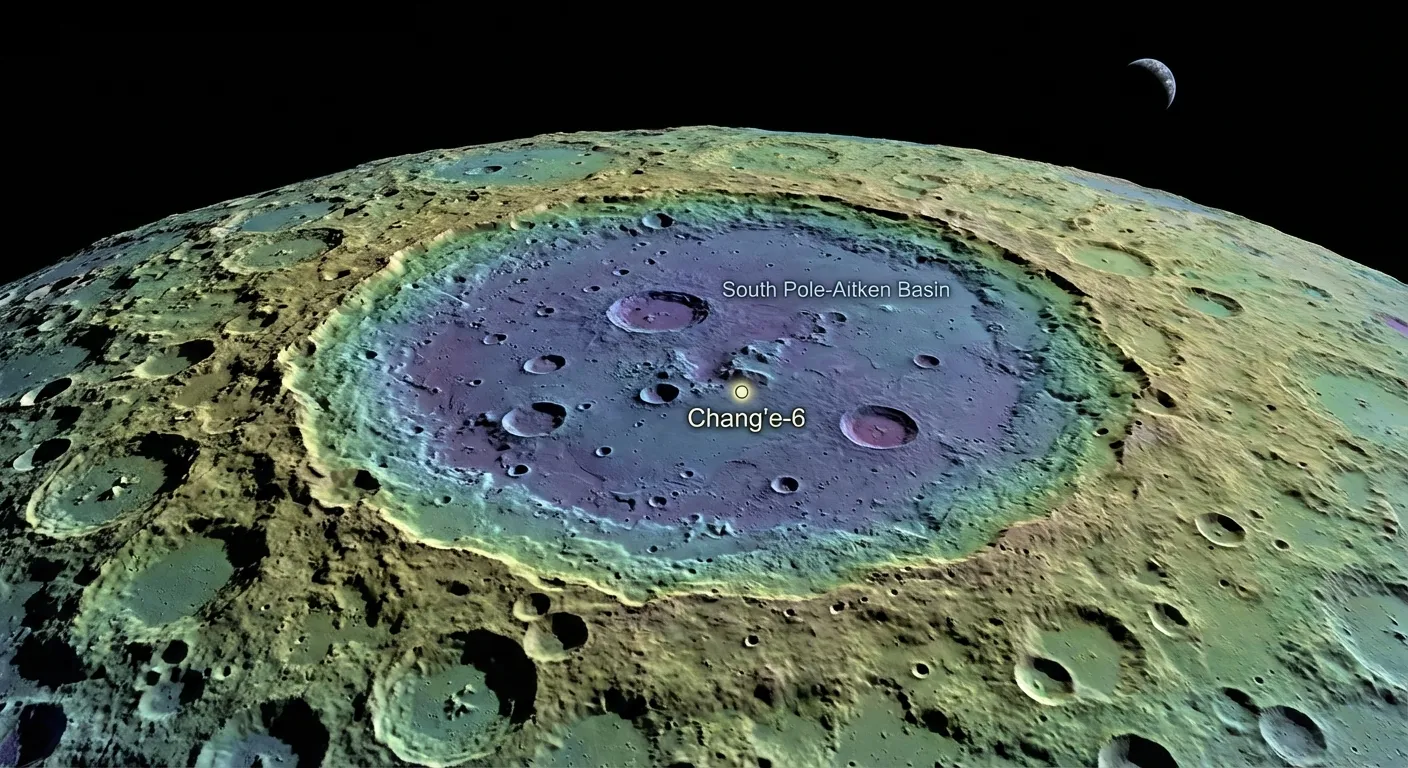
Now, samples from a place no human has ever visited, the far side of the Moon, are challenging that narrative. China's Chang'e-6 mission returned 1,935 grams of lunar material from the Apollo Basin, a crater nestled within the much larger South Pole-Aitken Basin, the Moon's oldest and largest impact structure. Analysis of those samples, published in Science Advances in February 2026, reveals that the basin formed 4.25 billion years ago and that the bombardment history of the Moon follows a pattern quite different from what the Late Heavy Bombardment hypothesis predicts.
The findings don't just revise a date. They call into question one of planetary science's most influential ideas, one that has shaped our understanding of when life could have first appeared on Earth, how Mars got its giant craters, and why the inner solar system looks the way it does today.
What the Samples Revealed
The Chang'e-6 samples represent the first material ever returned from the Moon's far side. Previous lunar sample-return missions, six American Apollo missions and three Soviet Luna missions, all collected material from the near side, the hemisphere permanently facing Earth. The far side's geology is significantly different: its crust is thicker, its volcanic history is distinct, and it hosts the South Pole-Aitken Basin, a structure roughly 2,500 kilometers across and up to 8 kilometers deep.
Researchers at the Institute of Geology and Geophysics at the Chinese Academy of Sciences, led by Chen Yi, meticulously analyzed approximately 1,600 fragments from two soil samples collected by Chang'e-6. Among these fragments, they identified 20 clasts of norite, a type of ignite rock with specific mineral characteristics that point to an impact origin. These norites contain highly anorthite-rich plagioclase and magnesium-rich pyroxene, a mineral composition distinct from similar rocks collected on the near side.
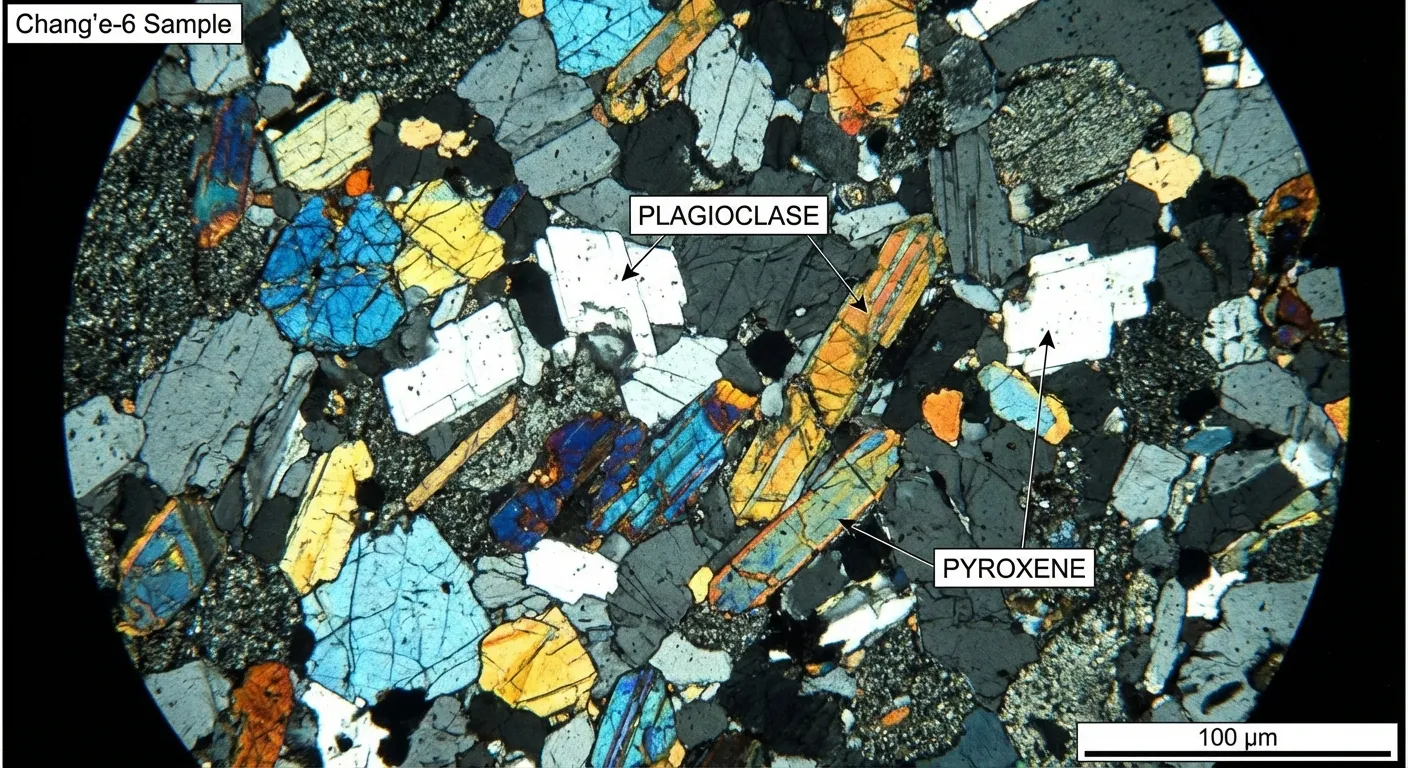
The critical evidence came from dating. Using lead-lead isotope analysis of zirconium-bearing minerals within the norite clasts, the team identified two distinct impact events. The older event dates to 4.25 billion years ago, corresponding to the formation of the South Pole-Aitken Basin itself. The younger event dates to 3.87 billion years ago, likely associated with the formation of the Apollo Basin within the larger structure.
The 4.25-billion-year date is significant because it pushes the formation of the Moon's largest impact scar back considerably earlier than some previous estimates, placing it firmly in the period when the solar system was still assembling itself from the disk of debris orbiting the young Sun.
The Rise and Trouble of the Late Heavy Bombardment
The Late Heavy Bombardment (LHB) hypothesis emerged from a puzzling observation in Apollo samples. When scientists dated impact-melted rocks from multiple Apollo landing sites scattered across the Moon's near side, the ages clustered suspiciously around 3.9 billion years. This "spike" in impact ages suggested that something dramatic happened around that time, perhaps a gravitational reshuffling of the giant planets that sent a swarm of asteroids into the inner solar system.
The hypothesis gained theoretical support from the Nice model, named after the French city where it was developed by Alessandro Morbidelli and colleagues. The Nice model proposed that Jupiter and Saturn migrated through orbital resonances roughly 3.9 billion years ago, destabilizing the asteroid belt and hurling debris inward. This elegant mechanism seemed to explain both the impact spike and the current orbital architecture of the outer planets.
But the LHB has faced growing skepticism over the past decade. Critics pointed out that the Apollo samples all came from a relatively small region of the near side, raising the possibility that the age clustering reflected a local event rather than a global bombardment. Others noted that the dating methods used on early Apollo samples had limitations that might artificially compress the apparent age range.
The Chang'e-6 results add powerful new evidence to this skeptical camp. By providing the first dated samples from the far side, far from any Apollo landing site, they offer an independent test of whether the bombardment pattern holds globally. The answer appears to be no.
A Monotonic Decline Instead of a Spike
The researchers didn't just date individual samples. They combined their new data with all existing sample data from Apollo, Luna, and Chang'e-5 missions, along with high-resolution remote sensing imagery of crater densities across the Chang'e-6 landing area and the broader South Pole-Aitken Basin. The goal was to construct a comprehensive lunar impact chronology model, essentially a timeline of how frequently impacts occurred at different points in lunar history.
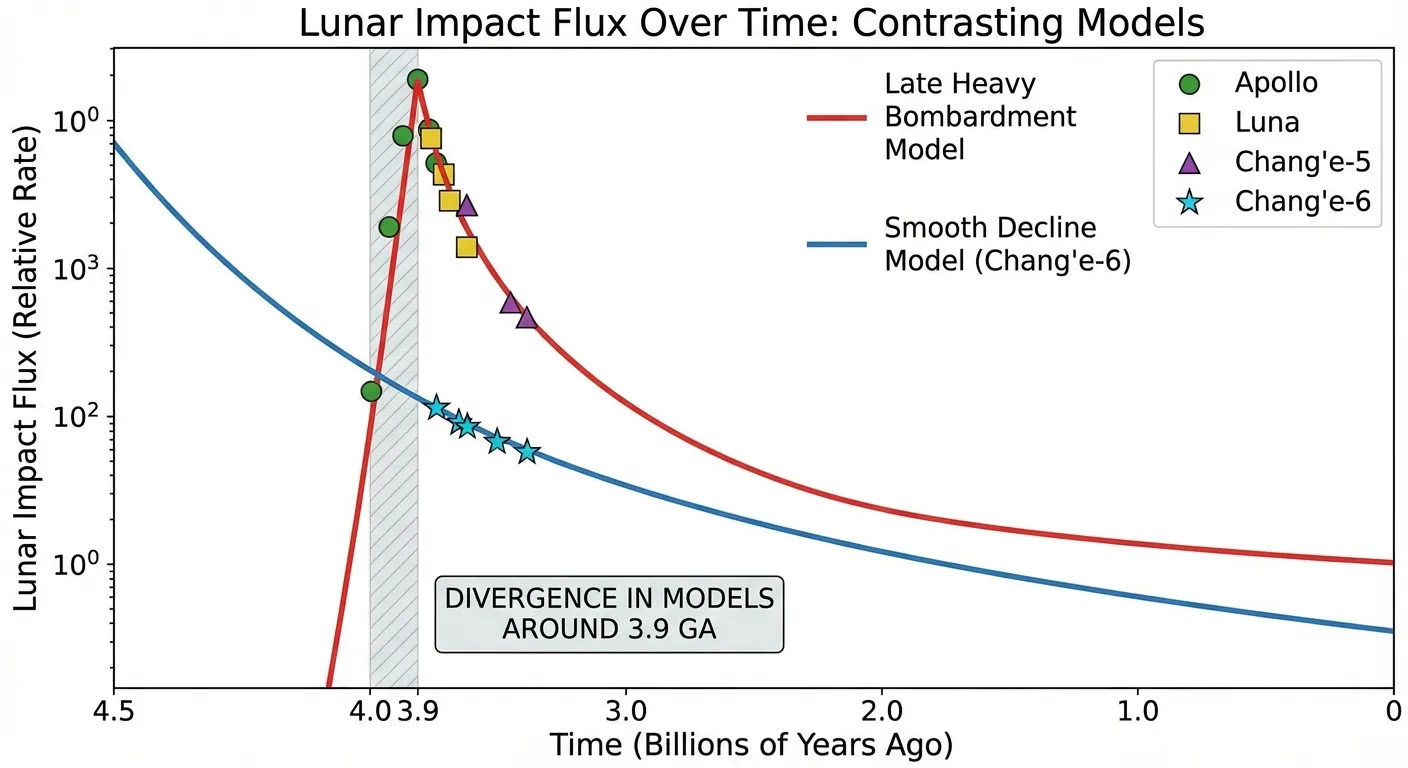
The result challenges the LHB directly. The new chronology model shows no evidence of a bombardment spike around 3.9 billion years ago. Instead, the impact rate declined steadily over time following the Moon's formation, a pattern scientists describe as "monotonic decrease." The early Moon was hit frequently because the solar system was still full of debris, but the rate of impacts fell progressively as that debris was swept up, scattered, or ejected. There was no sudden late surge.
This finding has implications beyond the Moon. The LHB hypothesis was applied to the entire inner solar system. If the Moon experienced a bombardment spike, so did Earth, Mars, Mercury, and Venus. The LHB was invoked to explain everything from the sterilization of early Earth (potentially wiping out any life that had already formed) to the formation of Martian impact basins. If the bombardment was actually a gradual decline, these narratives need revision.
For Earth specifically, the absence of a Late Heavy Bombardment means the period between 4.2 and 3.8 billion years ago may have been less catastrophically violent than previously assumed. Life may have had a longer, calmer window in which to emerge. The connection to research on prebiotic chemistry is direct: if early Earth wasn't being repeatedly sterilized by giant impacts around 3.9 billion years ago, the chemical processes that led to life's origin could have proceeded more continuously.
Why the Far Side Matters So Much
The Chang'e-6 mission's significance extends beyond its specific findings. It demonstrates why sampling the Moon's far side was scientifically essential. The Apollo missions, for all their achievements, sampled a biased region of the Moon. All six Apollo landing sites are on the near side, within a relatively narrow latitude band, and several are near or within the Imbrium Basin, one of the Moon's largest impact structures.
This geographic bias matters because Imbrium's formation, dated to approximately 3.9 billion years ago, may have scattered impact-melted debris across a wide area of the near side. Some of the "3.9-billion-year-old" impact samples from Apollo sites may actually be Imbrium ejecta, not evidence of multiple independent impacts at that time. If much of the near-side impact record is contaminated by a single large event, the apparent clustering of ages around 3.9 billion years could be an artifact of sampling bias.
The far side provides an independent check. The South Pole-Aitken Basin is on the opposite hemisphere from Imbrium, with no geological connection to it. Samples from this region reflect a different set of impacts, a different portion of lunar history. The fact that far-side samples tell a different story than near-side samples suggests the near-side record was indeed biased.
This lesson extends to how we do science in general. Conclusions drawn from limited data can hold up for decades if no one collects contrasting data. The LHB survived largely because all lunar samples came from similar locations. It took a mission to the far side to reveal that the pattern didn't hold globally.
Rewriting the Solar System's Childhood
The Chang'e-6 findings fit into a broader reassessment of the early solar system. Over the past decade, multiple lines of evidence have converged to suggest that the solar system's earliest period was less neatly organized into discrete events than previously thought.
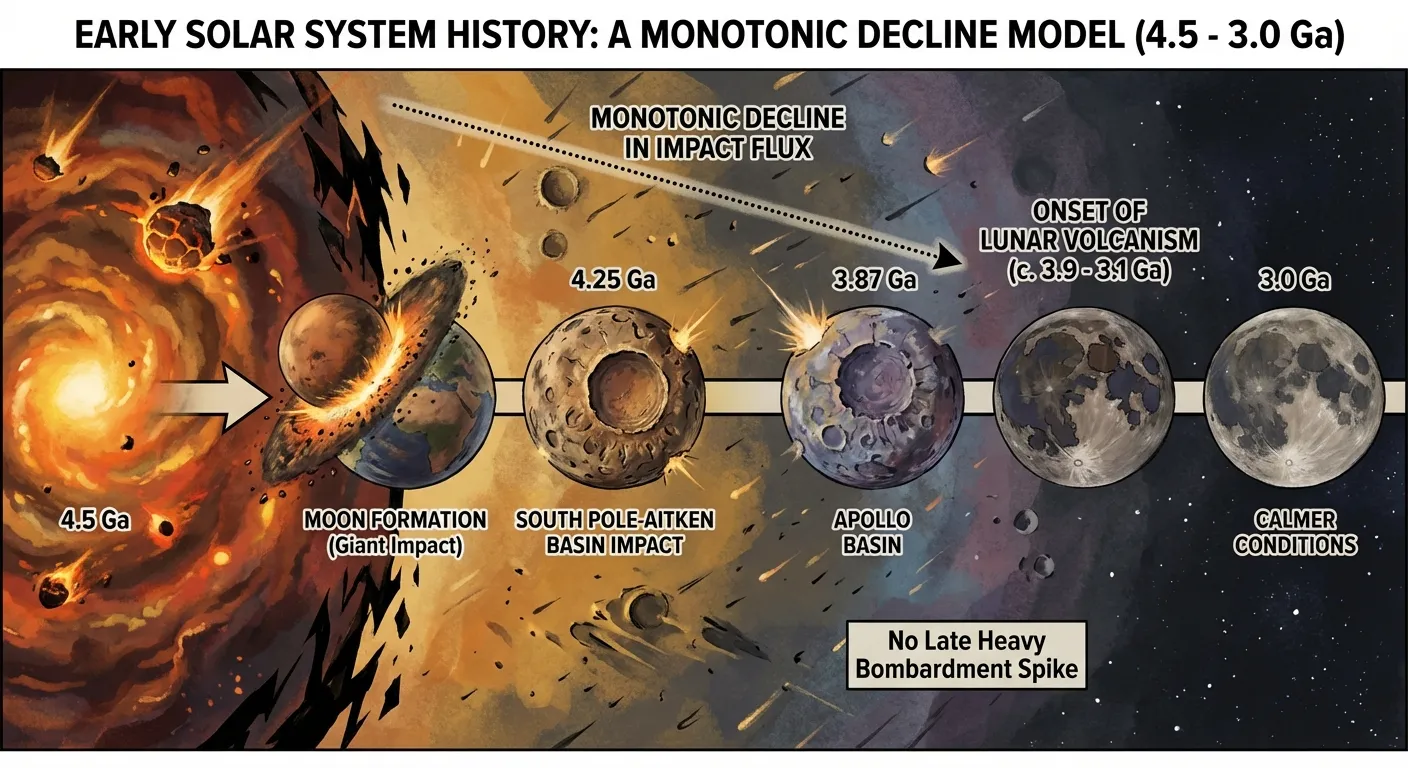
Updated versions of the Nice model no longer require the giant planet migration to happen precisely at 3.9 billion years ago. More recent simulations by Morbidelli and others suggest the migration may have occurred much earlier, possibly within the first 100 million years of solar system history. This "early instability" model is more consistent with a monotonically declining bombardment rate.
Asteroid belt dynamics also support the revised picture. Studies of meteorite ages and asteroid family distributions suggest that the flux of material from the asteroid belt to the inner planets has declined gradually, without a sharp late spike. The discovery of increasingly ancient rocks on Earth, some dating to 4.4 billion years ago, provides additional evidence that Earth's surface wasn't completely reset by impacts as recently as 3.9 billion years ago.
The Chang'e-6 results are not the final word. Future sample-return missions, including planned Chinese missions to the lunar south pole and potential missions to Mars, will provide additional data points. Each new sample from a new location fills in the timeline with greater precision. But the direction of travel is clear: the Late Heavy Bombardment, one of planetary science's most influential hypotheses, is losing ground to a simpler, more gradual narrative.
What This Means
The revision matters for reasons beyond academic debate. If the bombardment timeline changes, so does the geological history of every rocky body in the inner solar system. Mars crater chronologies, which planetary scientists use to estimate the age of Martian surfaces, were calibrated against the lunar impact record. A revised lunar timeline means Martian surface ages may also need recalculation, with implications for planning future landing sites and understanding when Mars might have been habitable.
The methodology matters as much as the results. For decades, lunar science relied on samples from a handful of near-side locations. The Chang'e-6 mission demonstrated that a single collection from a genuinely new region can reshape a framework that resisted challenge for fifty years. The lesson extends beyond planetary science: conclusions drawn from geographically limited data can appear robust until someone finally samples from the other side.
The Chang'e-6 mission carried 1,935 grams of lunar soil back to Earth. That modest amount of material, collected by a robotic lander on the hemisphere of the Moon that no human can see from Earth, has contributed to reshaping a scientific framework that has stood for half a century. China's planned follow-up missions to the lunar south pole and, eventually, sample returns from Mars will continue filling in the timeline. Each new sample from a new location narrows the gap between what we assume and what we know.
The biggest crater on the Moon is also one of the oldest. And for the first time, we have rocks from it in a laboratory on Earth, telling a story that no one expected to hear.
Sources
- Science Advances: Lunar chronology model with Chang'e-6 farside samples (2026)
- National Science Review: South Pole-Aitken massive impact 4.25 billion years ago revealed by Chang'e-6 samples
- Phys.org: Chang'e-6 samples constrain lunar impact flux and illuminate early impact history
- ScienceDaily: Chang'e-6 lunar samples reveal a giant impact reshaped the Moon's interior