
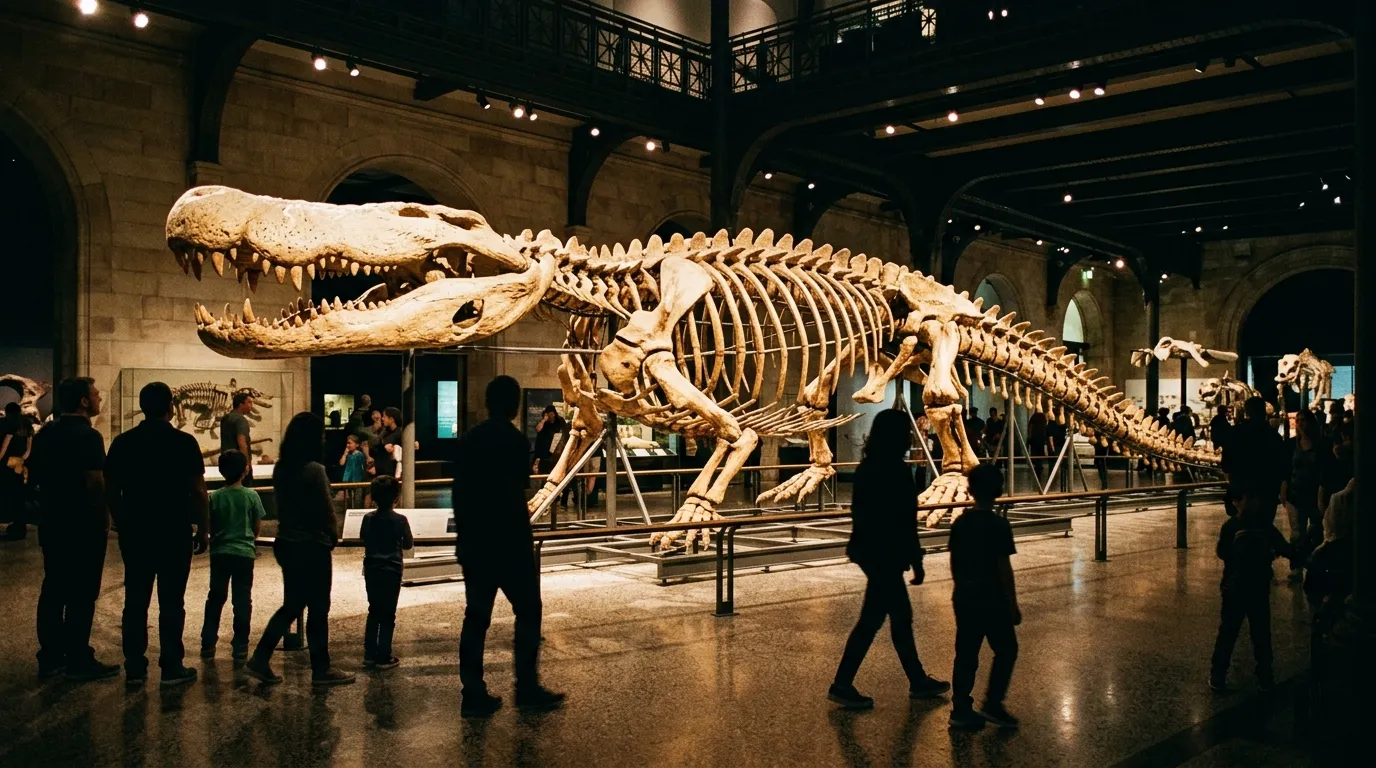
When David Schwimmer first picked up a single 15-centimeter crocodile tooth from a Cretaceous riverbed in western Georgia in 1979, he thought it belonged to a known species. It did not. Forty-seven years later, in a museum hall in Cartersville, a 31-foot skeleton stands above visitors who walk under it without quite believing the size. That skeleton is the first scientifically accurate full mount of Deinosuchus schwimmeri, the species eventually named for the geologist whose quiet, decades-long work made it possible.
The mount was unveiled this spring at the Tellus Science Museum. It is the outcome of a two-year collaboration between Schwimmer, a professor at Columbus State University, and Triebold Paleontology Inc., a Colorado company that builds replica skeletons for natural history museums around the world. Everything about it is stranger than the word "crocodile" suggests. The animal was not a scaled-up version of anything alive today. It was a different kind of predator entirely, and the skeleton now makes that visible in a way that bones in drawers never could.
The Bones That Waited Forty Years
The story of Deinosuchus schwimmeri starts not with a single skeleton but with fragments, many of them, scattered across what was once the eastern shore of the Western Interior Seaway. During the Late Cretaceous, about 75 million years ago, North America was split in half by a shallow sea. The landmass to the east, Appalachia, was an island continent for more than 20 million years, home to its own dinosaur lineages, its own ecosystems, and, as Schwimmer slowly established, its own giant crocodilian.
For decades, the fragments he and his students collected were treated as an eastern variant of a single Deinosuchus species long thought to have ranged across North America. The genus was first described in 1909 from fragmentary material in New Jersey, and for most of the twentieth century paleontologists simply referred to anything very large and ancient-crocodile-shaped as Deinosuchus. Schwimmer disagreed. Writing in his 2002 book King of the Crocodylians, he argued that the eastern and western populations were different enough, in tooth shape, skull proportion, and vertebral structure, to be treated as separate species.
In 2020, a team led by Adam Cossette at the New York Institute of Technology published a formal revision that confirmed what Schwimmer had been arguing for nearly two decades. They named the eastern species Deinosuchus schwimmeri in his honor. The act of naming does not, by itself, produce a skeleton. What it does is commit the community to treating that animal as a distinct biological entity with its own anatomy, behavior, and evolutionary history. Everything about the Tellus mount follows from that commitment.
How to Reconstruct an Animal from Scraps
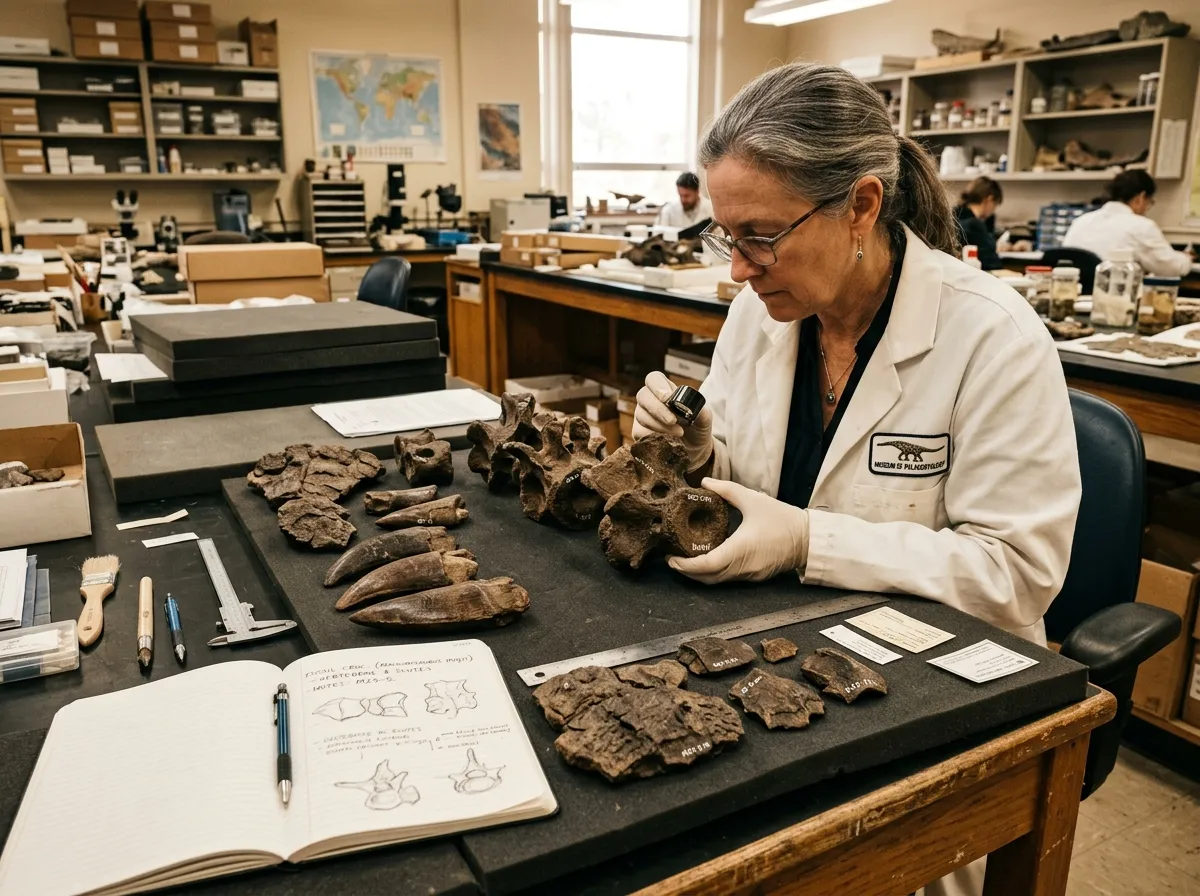
No one has ever found a complete Deinosuchus schwimmeri skeleton. The mount at Tellus is what paleontologists call a composite. Triebold's team, led by preparator Michael Triebold, gathered high-resolution 3D scans of every well-preserved fragment Schwimmer and his colleagues had documented: isolated teeth, partial skulls, vertebrae, limb elements, and the distinctive bony plates (osteoderms) that armored the animal's back. They then scaled and mirrored those elements, filling gaps with reference material from closely related alligatoroids, to produce a digital model that could be cast and mounted.
This kind of reconstruction is defensible only when the reference choices are argued carefully. Crocodilians are an unusually well-studied group, with a skeletal architecture that has changed surprisingly little over 80 million years. If you know which species sits closest to Deinosuchus on the family tree, and you know the proportions of a few key bones in your specimen, you can reason your way from a handful of fragments to a plausible whole animal. Schwimmer's role over two years was to walk the team through which modern and fossil alligatoroids were the right templates for each missing piece, and to flag places where the easy assumptions would lead the reconstruction astray.
The most delicate part was the skull. Deinosuchus had a blunt, broad-snouted head, unlike the long, narrow jaws of modern gharials and nothing like the mid-range shape of today's alligators. Schwimmer told the Columbus State University press office that the skull reconstruction went through several iterations before the team settled on proportions they could defend. "Bones and fossils tell us only part of the story," he said. "Fully assembled, life-size replicas become a blueprint for better understanding the dynamic animals that creatures like Deinosuchus really were."
The dermal armor was the other reconstruction challenge, and the one with the biggest payoff. Deinosuchus osteoderms are thick, keeled, and heavily pitted. On a living animal they would have formed a continuous shell along the back and tail. Mounting them in their likely arrangement, rather than leaving them as abstract fragments in a drawer, reveals an animal that looks less like a supersized alligator and more like a terrestrial tank that happened to live in the water.
A 31-Foot Predator With Dinosaur in Its Diet
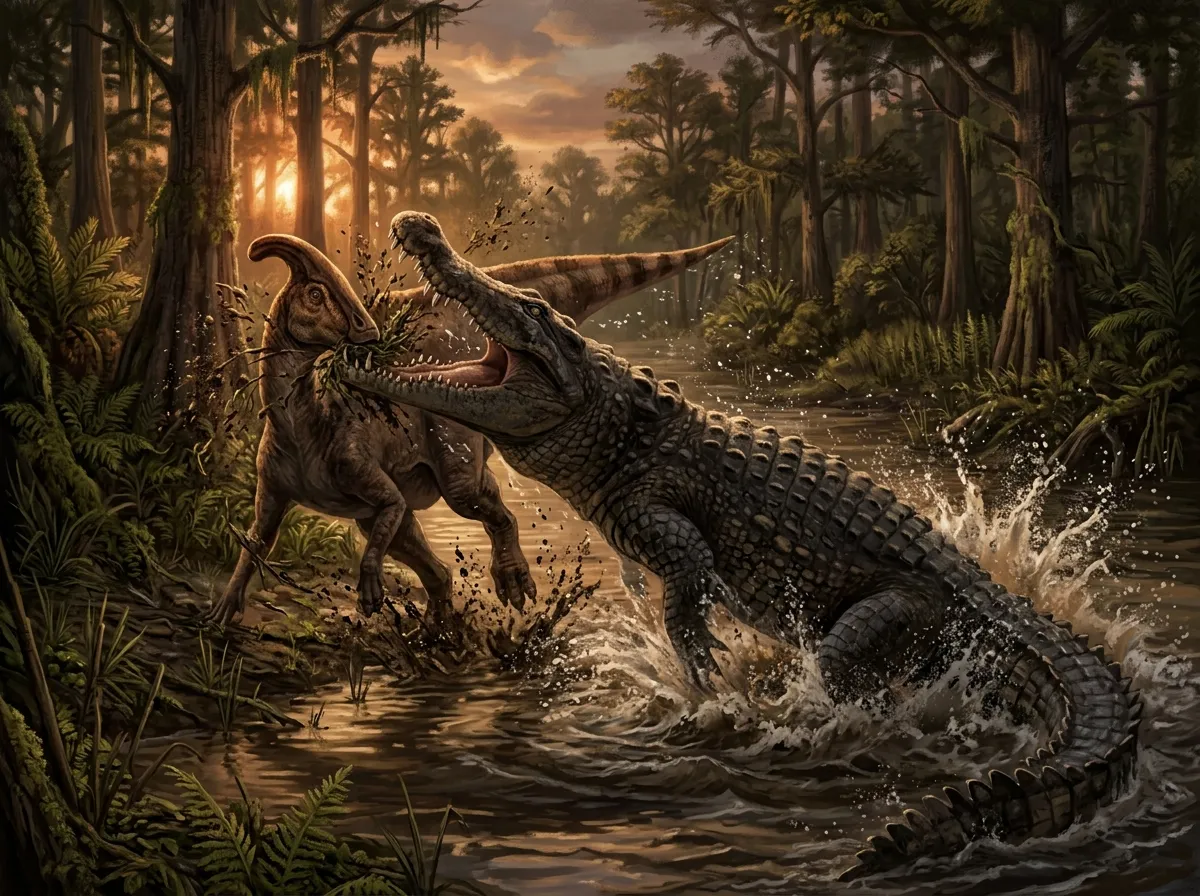
The most widely quoted fact about Deinosuchus is that it ate dinosaurs. This is true, and the evidence for it is unusually direct. Schwimmer's own 2002 book documented dozens of hadrosaur and theropod bones from Alabama and Georgia that carry deep tooth marks matching the size and spacing of Deinosuchus dentition. Some of the bones show healed bite wounds, meaning the attacked animal escaped, which tells us something about the ambush dynamics as clearly as a full skeleton does. A crocodile the length of a city bus was grabbing duck-billed dinosaurs at the water's edge, and sometimes failing to hold on.
The skeleton now makes the scale of this predation legible in a way paper diagrams never did. At roughly 9.5 meters nose to tail, Deinosuchus schwimmeri was about twice the length and eight to ten times the mass of the largest modern saltwater crocodiles. Bite-force estimates, calculated from jaw muscle attachment sites, run into the 18,000-newton range, comparable to the most extreme bite-force estimates for Tyrannosaurus rex. That is not a coincidence. In the Appalachian ecosystems of the Late Cretaceous, Deinosuchus was the apex predator. There was no tyrannosaur east of the Western Interior Seaway for it to compete with.
Paleontologists sometimes describe evolution as opportunistic. If a niche is vacant, something will expand to fill it. The Deinosuchus story is a clean illustration. A cross-continental sea opened up, cutting off Appalachia from the large theropods that dominated the western landmass. Within a few million years, a crocodilian lineage that had been occupying a modest river-predator niche pushed into the top of the food web. It grew, its teeth thickened, and its jaw geometry shifted toward crushing bone rather than catching fish. The resulting animal was not a fish-eater with an attitude. It was a dinosaur specialist.
Why the Eastern Species Is Its Own Story
One of the most interesting results of treating Deinosuchus schwimmeri as a distinct species, rather than an eastern variant of a pan-continental one, is what it says about evolution on Appalachia. For most of the Late Cretaceous, Appalachia hosted its own dinosaur fauna, including unusual tyrannosauroids, nodosaurs, and hadrosaurs that do not appear in the western fossil record. The Deinosuchus schwimmeri findings put the top predator in that picture, too.
The western species, Deinosuchus riograndensis, lived in what is now Texas and northern Mexico. It was also enormous, but its fossils show differences in tooth curvature and skull shape that, in the Cossette team's 2020 analysis, track a separate evolutionary trajectory. The two populations likely descended from a shared ancestor that was already crocodile-shaped and large-river-adapted, but they were isolated from each other for roughly 20 million years by the Western Interior Seaway. That is plenty of time for independent adaptation.
This is the same pattern paleontologists have been documenting for decades: island continents grow their own ecosystems. Madagascar has its lemurs. Australia has its marsupials. Appalachia, in the Late Cretaceous, had its tyrannosauroids and its giant crocodile, and the mount at Tellus is the first place most visitors will be able to see one of them at full scale.
There is a quiet secondary point embedded in the new skeleton. For much of the twentieth century, East Coast paleontology was treated as the poor cousin of the western Cretaceous fossil beds. The western sites had more dramatic exposures, better preservation, and larger institutional backing. Schwimmer's career is in part the story of what you can find in Georgia and Alabama if you are willing to spend forty years looking.
What Replica Skeletons Actually Give Us
It would be easy to read this as a story about a museum display. It is more than that. Replica skeletons at this level of scholarly fidelity do things that scattered bones in drawers cannot. They let biomechanists measure gait plausibly. They let comparative anatomists look at proportion at a glance. They let undergraduate students stand next to a thing they will eventually study, and walk around it, and ask questions they would not have thought to ask looking at photographs.
Triebold Paleontology has been producing these mounts for museums for decades, including the widely copied Tyrannosaurus rex "Peck's Rex" casts that inform how many people picture that animal today. The step forward with Deinosuchus schwimmeri is not the casting technique but the collaboration with a domain specialist. Every placement of every vertebra was argued through with Schwimmer. That is expensive and slow. It is also what makes the difference between an impressive sculpture and a reconstruction that other researchers can cite.
The ongoing question is whether more extinct species will get this treatment. There are plenty of fossil animals known only from partial remains where a careful composite reconstruction would change how the field and the public think about them. Funding is the bottleneck. A mount of this quality costs hundreds of thousands of dollars and takes years. If museums and paleontologists keep pushing the collaborative-reconstruction model, though, the Deinosuchus schwimmeri skeleton at Tellus will not be the last.
The Pattern Hidden in Old Fossil Collections
Perhaps the most lasting thing to take from this story is that fossils collected decades ago are not finished. The fragments Schwimmer pulled out of Georgia creek beds in the 1980s did not change. What changed is that the interpretive tools around them got sharper: better statistical methods for species separation, 3D scanning, collaborative reconstruction pipelines, and a willingness among paleontologists to accept that what was once assumed to be one animal might turn out to be several. The bones waited. The field caught up.
Natural history museums are full of drawers like Schwimmer's. Many of them contain animals whose shape and behavior have not yet been worked out, not because the material is missing, but because no one has taken forty years to sit with it. The new skeleton in Cartersville is, among other things, an argument for doing that more often. The animals are already there. They are just waiting to be reassembled.
Sources
- This 31-foot "terror croc" ate dinosaurs. Now it's back, ScienceDaily
- Schwimmer's decades-long quest leads to first scholarly accurate replica of 'dinosaur-killer' croc, Columbus State University
- US museum unveils first accurate replica of dinosaur-killer crocodile, Interesting Engineering
- 'Dinosaur-killer' crocodile has been reconstructed in fossil replica, Earth.com
- Decades-long quest leads to first scholarly accurate fossil replica of 'dinosaur-killer' croc, Phys.org