
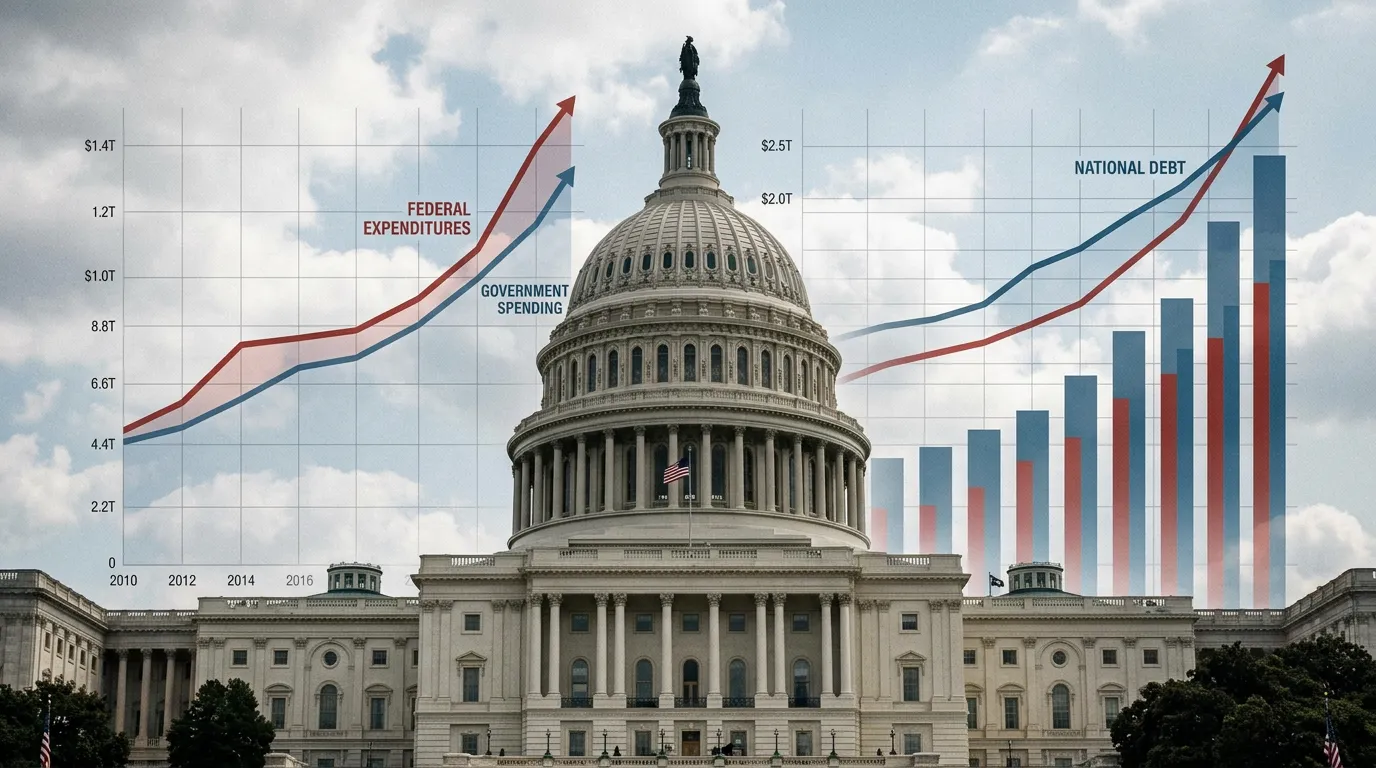
Claim: The Department of Government Efficiency (DOGE) has saved taxpayers over $160 billion through government spending cuts.
Verdict: Mostly False. Independent analyses from NPR, CBS News, the Cato Institute, and the American Enterprise Institute all found DOGE's claimed savings are dramatically overstated. Federal spending actually increased by $301 billion in fiscal year 2025 compared to the previous year. Of 30 programs Trump proposed cutting in the 2026 budget, Congress eliminated just one.
The gap between DOGE's public claims and verifiable data is one of the largest in recent fiscal policy. Here's exactly what happened, according to the numbers.
What DOGE Claimed vs. What Independent Audits Found
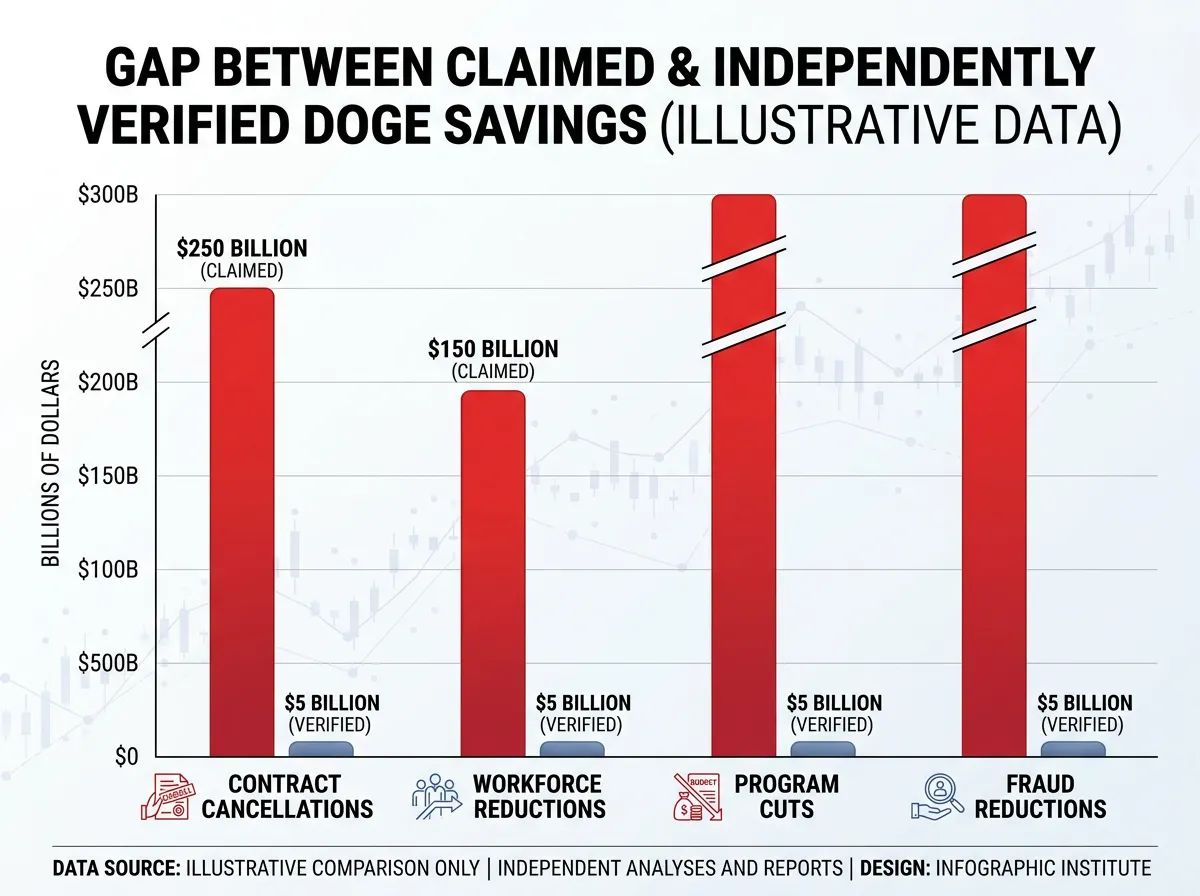
DOGE's public-facing website, doge.gov, has posted a running total of claimed savings that grew from $105 billion in its first six weeks to $160 billion by mid-2025, eventually reaching $199 billion on its "wall of receipts." The receipts consisted primarily of canceled federal contracts, workforce reductions, and program eliminations.
NPR conducted one of the most thorough audits, matching DOGE's published contract cancellation claims against the Federal Procurement Data System and USASpending.gov records. Their finding: only approximately $2 billion in savings could be verified from canceled contracts, a fraction of DOGE's $55 billion claim in that category alone. Over half the contracts listed on the "wall of receipts," worth $6.5 billion, hadn't actually been terminated or closed out. In one case, an ICE contract was listed at $8 billion when the actual value was $8 million.
CBS News examined three major Health and Human Services contracts where DOGE claimed $6.4 billion in savings. The verified savings came to approximately $165 million, less than 3% of the claim. The discrepancy came from DOGE counting the full contract ceiling values (the maximum a contract could theoretically cost over its entire lifespan) rather than the realistic spending that was actually projected. Nat Malkus at the American Enterprise Institute characterized DOGE's accounting method as "transparency theater."
Christopher Byrne, a retired senior federal contracting officer quoted by NPR, offered a structural explanation: the DOGE team lacks understanding of "how things work, they don't understand contracts." Federal contracts aren't like subscriptions you cancel to stop payments. They have complex obligations, penalty clauses, and multi-year structures that make simple cancellation both legally difficult and sometimes more expensive than completion.
The $301 Billion Reality Check
While DOGE claimed to be cutting spending, the federal government was actually spending more. According to Treasury Department data analyzed by Reason magazine's Eric Boehm, FY2025 ended with $301 billion more in spending than FY2024, pushing total federal expenditures above $7 trillion. The federal deficit fell by only $8 billion, and that slight improvement came from increased tax collections, not reduced spending.
The Cato Institute's Dominik Lett confirmed this trajectory: federal outlays showed no meaningful decline during DOGE's entire tenure. Treasury data show the federal government spent $7.6 trillion in the first 11 months of 2025, exceeding prior years and closely tracking Congressional Budget Office projections made before DOGE existed. Lett concluded that DOGE "fell short of its core goal to reduce federal spending."
Why couldn't DOGE actually move the spending needle? The answer is structural. Roughly 70% of federal spending goes to mandatory programs: Social Security, Medicare, and Medicaid, which collectively increased by $245 billion in FY2025 alone. Add $38 billion more for the Pentagon, $41 billion for Veterans Affairs, and $80 billion in additional interest on the national debt, and the math becomes clear. Even dramatic cuts to discretionary programs and federal payroll can't offset mandatory spending growth. Federal personnel costs represent only about 4% of the total budget. A 10% workforce cut, roughly what DOGE achieved, saves approximately $40 billion annually, which is real money but nowhere near the trillions initially promised.
Jessica Riedl of the Manhattan Institute put the scale problem into sharp perspective: "Think of Congress and its budget as the debt-ridden dad on the way to buy a $250,000 Ferrari on the credit card, and DOGE is the $2-off gas card he used along the way."
What Congress Did With the Proposed Cuts
DOGE recommended cuts, but Congress holds the actual power of the purse. And Congress said no to almost everything. The Washington Times reported on February 19, 2026 that of 30 programs Trump proposed slashing or eliminating in his 2026 budget, only one was actually eliminated. Only two of the remaining 29 were cut by more than half. Most funding was held flat or increased. The 2026 spending bills, when tallied, actually increased total spending from 2025 levels.
Specific examples illustrate the pattern. The National Endowment for Democracy, which Trump wanted eliminated entirely, received $315 million from Congress, the same amount as 2024. The National Endowment for the Arts and the National Endowment for the Humanities, both targeted for zero funding, received their full allocations above $200 million each. These aren't obscure programs; they were headline items in DOGE's public campaign for cuts.
Congress did approve one significant rescission package: approximately $9 billion total, including $1.1 billion from the Corporation for Public Broadcasting (which funds NPR and PBS) and $8.3 billion from the State Department and USAID. That $9 billion is real, but it's less than 0.13% of total federal spending, and it's a fraction of what DOGE claimed to have already saved through its own actions.
The Hidden Costs of Cost-Cutting
One of the least-discussed aspects of DOGE's record is what the cost-cutting effort itself cost. The Partnership for Public Service, a nonpartisan organization that studies government management, estimated that DOGE's actions cost taxpayers approximately $135 billion in FY2025. Max Stier, the organization's president, stated: "We haven't seen much focus on the waste [DOGE] is creating. This is an effort that was created to address waste, but we were seeing the opposite."
Where did the costs come from? DOGE reduced the federal workforce by roughly 271,000 positions, the largest peacetime workforce reduction on record, cutting civilian employment from 3.1 million to approximately 2.9 million. But workforce reductions aren't free. Approximately 24,000 employees who were fired had to be rehired after courts ruled the terminations were improper, generating legal costs, back pay, and operational disruption. Workers placed on administrative leave continued collecting salaries while contributing nothing. Institutional knowledge walked out the door with experienced employees, creating capability gaps that required expensive contractor replacements.
The most expensive single consequence may be lost tax revenue. The IRS lost approximately 22,000 employees during the DOGE period. The agency's own projections estimate this will cost $8.5 billion in lost revenue collections for 2026 alone, and independent analysts at the Congressional Budget Office project the 10-year revenue loss at $198 billion. Cutting the people who collect taxes doesn't reduce government spending; it reduces government income while spending obligations remain unchanged.
Even DOGE's allies acknowledged the gap between rhetoric and results. Rep. Blake Moore, who leads the House DOGE Caucus, admitted on June 5, 2025 that Republicans "always knew it was a massive exaggeration" regarding DOGE's claimed savings.
Where DOGE Did Have Measurable Impact
Credit where it's documented: the federal workforce reduction was real and historically significant. The 271,000-job cut represented a 9% decline in civilian government employment, the largest such reduction during peacetime. Whether those cuts improved government function or degraded it depends on which agency you examine. Some agencies had genuine redundancies. Others, like the IRS and FEMA, lost capacity that directly affected their ability to serve the public.
DOGE also succeeded in drawing public attention to specific examples of wasteful contracts and spending. Several of the contracts it flagged were genuinely questionable, even if the dollar amounts claimed were inflated. The initiative forced agencies to justify spending in ways they hadn't been required to before, and some internal reforms may persist beyond DOGE's tenure.
But the core claim, that DOGE saved taxpayers $160 billion or more, doesn't survive contact with the data. Federal spending increased, Congress rejected most proposed cuts, and independent audits found verified savings at a small fraction of the claimed total. The question isn't whether government waste exists. It does. The question is whether DOGE's approach, rapid, high-profile, and often legally challenged, actually reduced it. On the spending side, the answer from the Treasury's own numbers is no.
The Short Answer
DOGE claimed $160 billion or more in savings, but federal spending rose by $301 billion in FY2025. Independent audits verified only a small fraction of the claimed contract cancellation savings. Congress rejected nearly all proposed program cuts. The workforce reduction was real at 271,000 jobs but generated its own costs through rehiring, lost tax revenue, and operational disruption that one analysis pegged at $135 billion.
The federal budget is driven by mandatory programs like Social Security, Medicare, and debt interest payments that DOGE couldn't touch. Until those structural drivers are addressed by Congress, discretionary cuts and workforce reductions, however dramatic they appear, won't reverse the trajectory of federal spending. The numbers don't lie, even when the "wall of receipts" does.
Sources
- DOGE Overstates Savings on Federal Contracts - NPR, February 19, 2025
- DOGE Cuts Have Cost Taxpayers $135 Billion, Analysis Says - CBS News, April 25, 2025
- After All Those DOGE Cuts, Federal Spending Still Increased by $300 Billion - Reason, October 10, 2025
- DOGE Produced the Largest Peacetime Workforce Cut on Record, but Spending Kept Rising - Cato Institute, Dominik Lett
- DOGE Defeat: Congress Rejected Most of Trump's Spending Cuts - Washington Times, February 19, 2026