
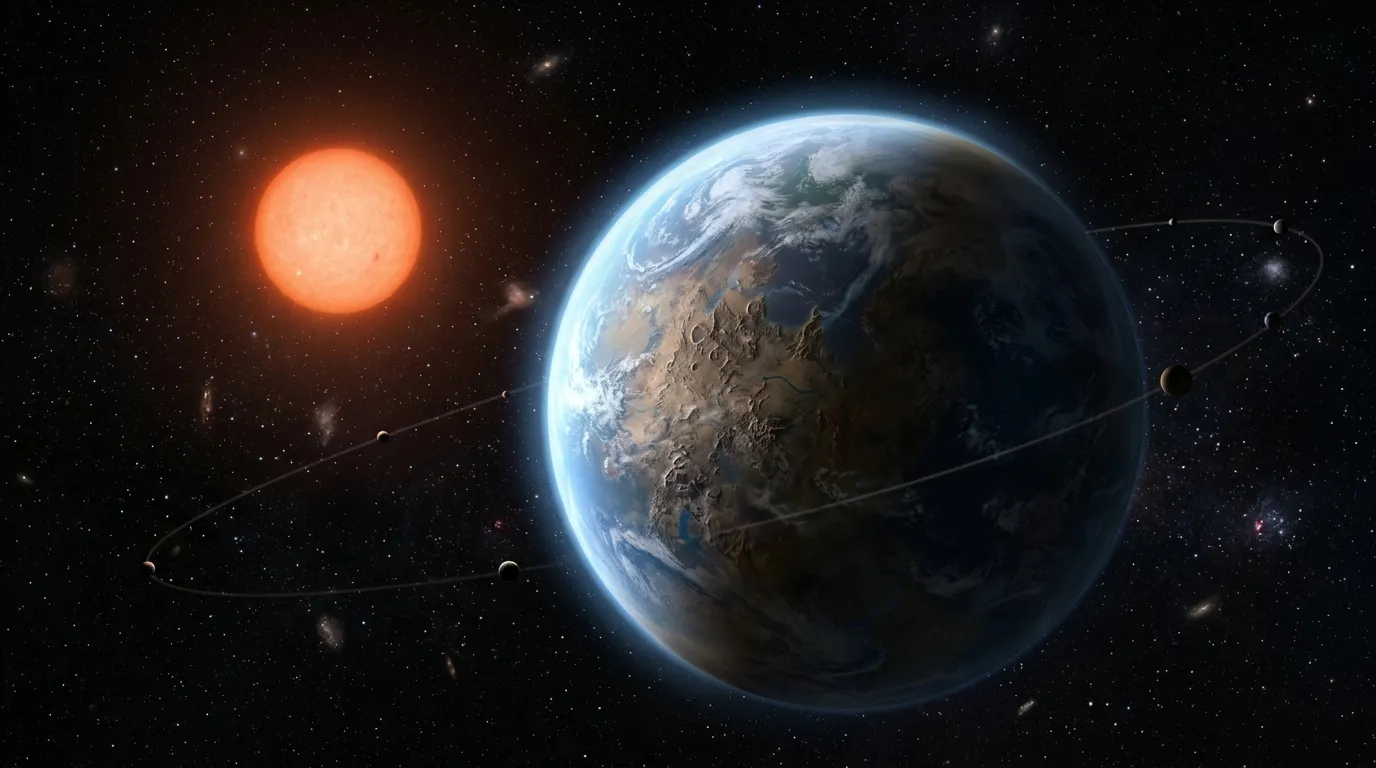
Most red dwarf stars are violent neighbors. They lash their planets with X-ray flares powerful enough to strip entire atmospheres, turning what might have been habitable worlds into scorched, airless rocks. So when astronomers confirmed a super-Earth sitting in the habitable zone of a red dwarf just 10.7 light-years from our solar system, the first question wasn't whether the planet existed. It was whether its star would let it keep an atmosphere long enough for anything interesting to happen.
The answer, published in Astronomy and Astrophysics in March 2026, surprised even the research team. GJ 887, the host star, is one of the quietest red dwarfs ever studied. And its outermost confirmed planet, GJ 887 d, orbits squarely in the zone where liquid water could persist on a rocky surface. That combination, a calm star and a well-placed planet, makes this one of the most compelling targets for life detection in our immediate cosmic neighborhood.
Finding Planets Through Wobbles
GJ 887 d wasn't spotted through a telescope's eyepiece. Nobody has ever seen it directly, and with current technology, nobody can. The planet was detected through the radial velocity method, a technique that measures the subtle gravitational tug a planet exerts on its star. As GJ 887 d orbits, it pulls its host star toward and away from Earth by tiny amounts, shifting the star's light in measurable ways.
The research team, led by C. Harth and colleagues, combined data from four separate instruments to tease out the signal. Two ground-based spectrographs did the heavy lifting: HARPS (High Accuracy Radial velocity Planet Searcher) and ESPRESSO (Echelle SPectrograph for Rocky Exoplanets and Stable Spectroscopic Observations), both operated by the European Southern Observatory in Chile. Additional data from the Transiting Exoplanet Survey Satellite (TESS) and the All-Sky Automated Survey (ASAS) helped rule out false positives caused by stellar activity rather than orbiting planets.
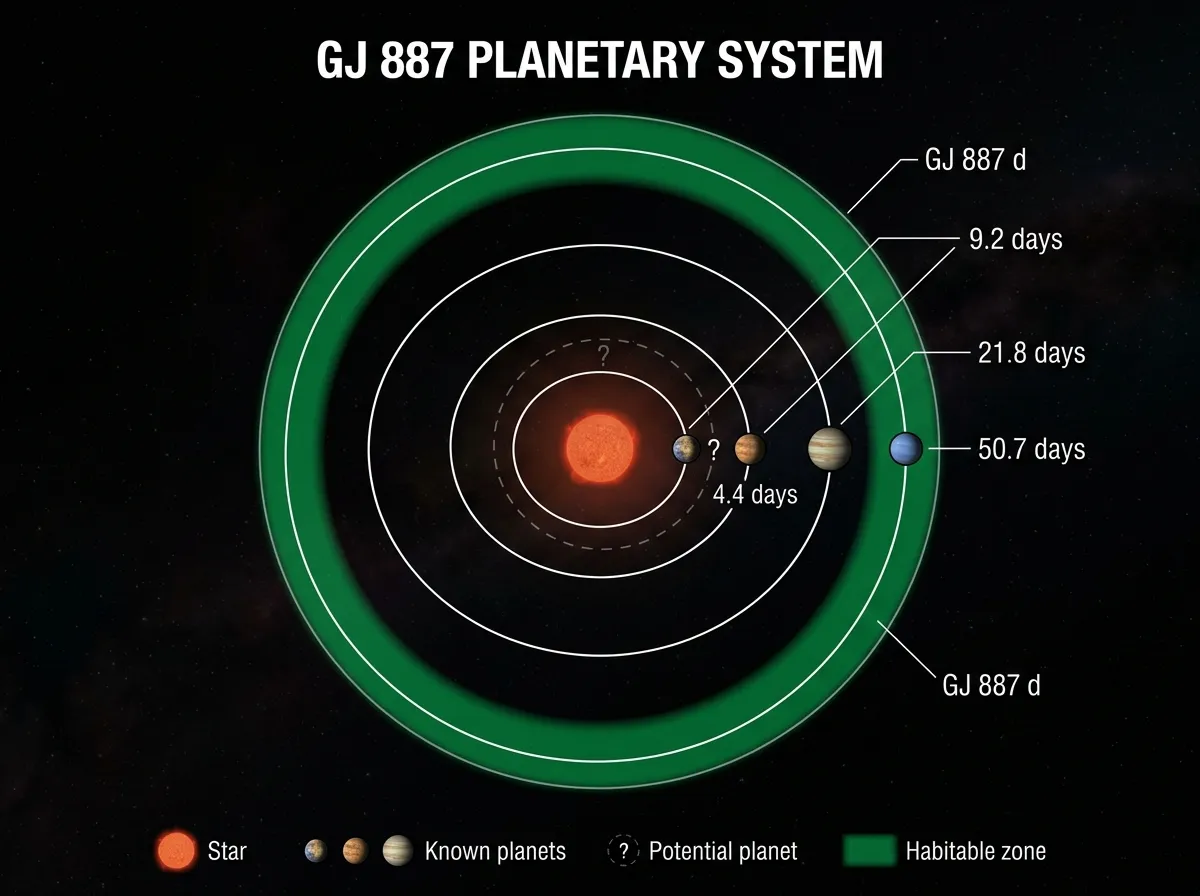
The combined analysis revealed not one planet but at least four, with orbital periods of 4.4, 9.2, 21.8, and 50.7 days. A fifth candidate at a 2.2-day period remains unconfirmed. GJ 887 d, the outermost of the confirmed worlds, completes its orbit in just 50.7 days, far faster than Earth's year, but at the right distance from this cooler, dimmer star to sit within the habitable zone.
Why a Quiet Star Changes Everything
The habitability of an exoplanet depends on far more than its distance from its star. For planets orbiting red dwarfs, the star's temperament may matter even more than the planet's position.
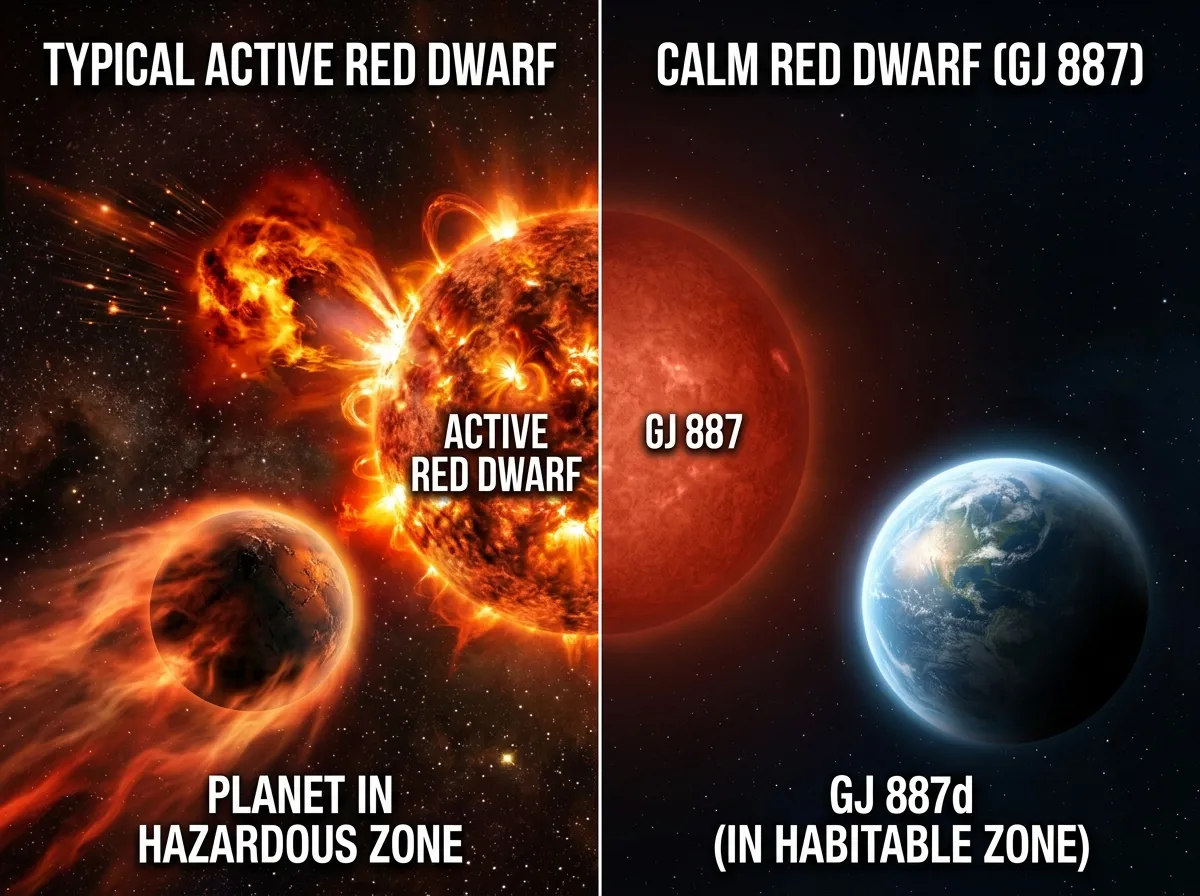
Red dwarfs are the most common stars in the galaxy, accounting for roughly 70% of all stellar objects. They're small, cool, and extraordinarily long-lived, burning their hydrogen fuel so slowly that some will outlast our Sun by trillions of years. These traits make them attractive hosts for habitable worlds. The problem is that many red dwarfs are also prone to violent flare events, sudden eruptions of magnetic energy that can blast a nearby planet with radiation hundreds of times more intense than anything Earth experiences from the Sun.
Over time, repeated flaring can erode a planet's atmosphere entirely. Mars, which likely lost much of its atmosphere to solar wind over billions of years, offers a local example of how atmospheric stripping works, though our Sun is far calmer than a typical red dwarf. For planets orbiting at habitable-zone distances around active red dwarfs, the process happens faster and more completely.
GJ 887 breaks this pattern. Observations show it has "very low flare activity," a quality the research team identified as the key factor in determining whether GJ 887 d can retain an atmosphere capable of supporting life. This stellar calm is unusual enough to be scientifically noteworthy on its own. Combined with a habitable-zone planet, it creates a rare alignment of conditions.
The planet's mass adds another layer of optimism. At a minimum of six Earth masses, GJ 887 d has enough gravitational pull to hold onto a substantial atmosphere even under moderate stellar stress. Earth's atmosphere is held in place partly by our planet's mass; a world six times heavier would have a correspondingly stronger grip on whatever gases surround it.
Only the Second of Its Kind
The confirmation makes GJ 887 d only the second known habitable-zone planet within 10 light-years of our solar system. The first is Proxima Centauri b, orbiting the nearest star to our Sun at 4.2 light-years. But Proxima Centauri is precisely the kind of star that keeps astrobiologists awake at night: it's highly active, regularly blasting Proxima b with flares that dwarf anything in our solar system.
This is what makes GJ 887 d genuinely different. It isn't just in the right place. It orbits the right kind of star. The combination of a habitable-zone orbit, a high-mass planet capable of retaining atmosphere, and a quiet host star is rare enough that astronomers have struggled to find even theoretical analogs in exoplanet catalogs.
The broader context matters, too. As of 2026, astronomers have confirmed more than 5,700 exoplanets. Of those, only a small fraction orbit within their star's habitable zone, and a smaller fraction still orbit stars quiet enough to leave their atmospheres intact. GJ 887 d sits at the intersection of multiple favorable conditions, making it a priority target for the next generation of space telescopes.
What We Can and Can't See
Here's the catch: GJ 887 d doesn't transit its star. From Earth's vantage point, the planet never passes between GJ 887 and our line of sight. That matters because transit observations, watching a planet's silhouette cross its star, are the primary way astronomers currently characterize exoplanet atmospheres. When starlight filters through a transiting planet's atmosphere, it picks up chemical fingerprints that reveal composition: water vapor, carbon dioxide, methane, or the tantalizing biosignature of oxygen alongside methane.
Without transits, GJ 887 d's atmosphere remains a black box for now. The radial velocity method that discovered it can tell us about the planet's mass and orbit, but not what it's made of or whether it has clouds, oceans, or any of the conditions we associate with life.
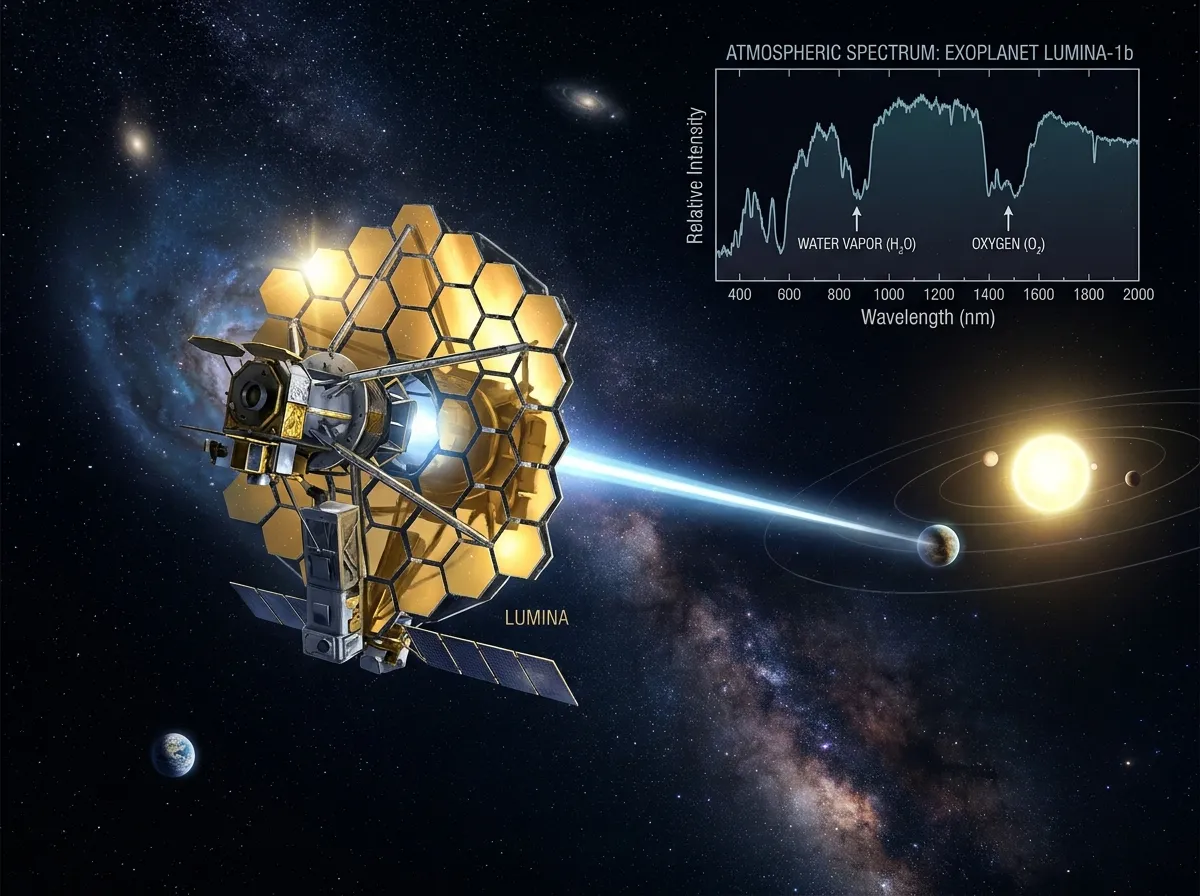
This limitation isn't permanent. The proposed Habitable Worlds Observatory (HWO), a NASA mission concept currently in early planning stages, would use a coronagraph to block starlight and directly image nearby exoplanets. If funded and built, HWO could potentially resolve GJ 887 d as a point of light separate from its star, and even analyze the spectrum of whatever light the planet reflects.
The LIFE (Large Interferometer for Exoplanets) mission, a European Space Agency concept, takes a different approach: an array of free-flying telescopes that would combine their signals to detect thermal infrared emissions from nearby rocky worlds. Both missions are at least a decade from launch, but GJ 887 d's proximity makes it a candidate for both.
The Bigger Picture
The search for habitable exoplanets has always been constrained by a frustrating paradox. The planets most likely to support life are also the hardest to study. They're small, faint, and close to stars that overwhelm them with light. Every new space exploration milestone brings us closer to resolving this problem, but the gap between detection and characterization remains wide.
GJ 887 d doesn't close that gap. What it does is place a high-priority target within reach of technology that's already being designed. At 10.7 light-years, this is not a world we'll visit in any foreseeable future, but it's close enough that the next generation of telescopes could tell us whether it has an atmosphere, and possibly what that atmosphere contains.
The discovery also reinforces a pattern that's emerged from two decades of exoplanet research: habitable-zone planets aren't rare. They're common enough that two exist within a ten-light-year bubble around our Sun. If that density holds across the galaxy, there could be billions of similar worlds in the Milky Way alone. The challenge isn't finding them. It's building the instruments precise enough to tell us whether any of them are alive.
What makes GJ 887 d worth watching isn't just its position or its mass. It's the star it orbits. In a galaxy full of volatile red dwarfs that cook their planets, GJ 887 is the quiet house on a noisy street. And its largest confirmed planet sits in exactly the right place to benefit from that calm. Whether anything has taken advantage of those conditions is a question only better telescopes, and perhaps better luck, can answer.
Sources
- Astronomers confirm potentially habitable exoplanet in the solar neighborhood - Astronomy Magazine
- Nearby red dwarf star hosts at least four planets, with one in the habitable zone - Phys.org
- Astronomers Discover One of the Quietest Stars, a Strong Candidate for Life - The Daily Galaxy
- GJ 887 d - NASA Exoplanet Catalog - NASA