

In 1908, a New England cotton mill did something no factory in the United States had done before. It shut down on Saturday. The reason was not generosity or progressive labor policy. It was a practical accommodation for the mill's Jewish immigrant workers, who observed Shabbat from Friday evening through Saturday and were already taking the day off regardless. By closing Saturday and keeping the existing Sunday closure for Christian workers, the mill stumbled into an arrangement that would, within a few decades, reshape the rhythm of life across the industrialized world. The two-day weekend, now so embedded in our culture that it feels like a law of nature, was an accident of religious negotiation that happened to solve an economic problem.
The idea that workers deserve regular days of rest is ancient. The concept of a unified, secular, two-day weekend is not. It is barely a century old, the product of specific historical pressures involving religion, industrial capitalism, labor organizing, and one automaker's gamble that resting workers would buy more cars. Understanding how the weekend was invented reveals something uncomfortable about how we structure time: the divisions between work and rest that feel inevitable are, in fact, contingent, fought over, and now under pressure from forces that the weekend's inventors could not have imagined.
Before the Weekend
For most of human history, the distinction between "work time" and "rest time" was blurry. As historian E.P. Thompson argued in his influential 1967 essay "Time, Work-Discipline, and Industrial Capitalism," pre-industrial societies organized labor around natural rhythms: sunlight, tides, weather, seasons. A farmer worked when crops needed tending and rested when they did not. A fisherman went out when the tide was right. The idea of fixed hours applied uniformly across every day of the week was alien to this world. Task-orientation, not time-orientation, governed daily life.
Religious traditions did impose regular rest days. The Jewish Shabbat, observed from Friday evening to Saturday evening, is among the oldest codified rest days in human history, described in the Torah as a divine commandment to cease from labor. Christianity adapted this tradition, shifting the day of rest to Sunday in honor of the resurrection. Islam designated Friday as the day of congregational prayer, though it did not historically mandate a full day of rest. These religious observances provided periodic breaks from labor, but they were not "weekends" in any modern sense. They were sacred obligations, not leisure time.
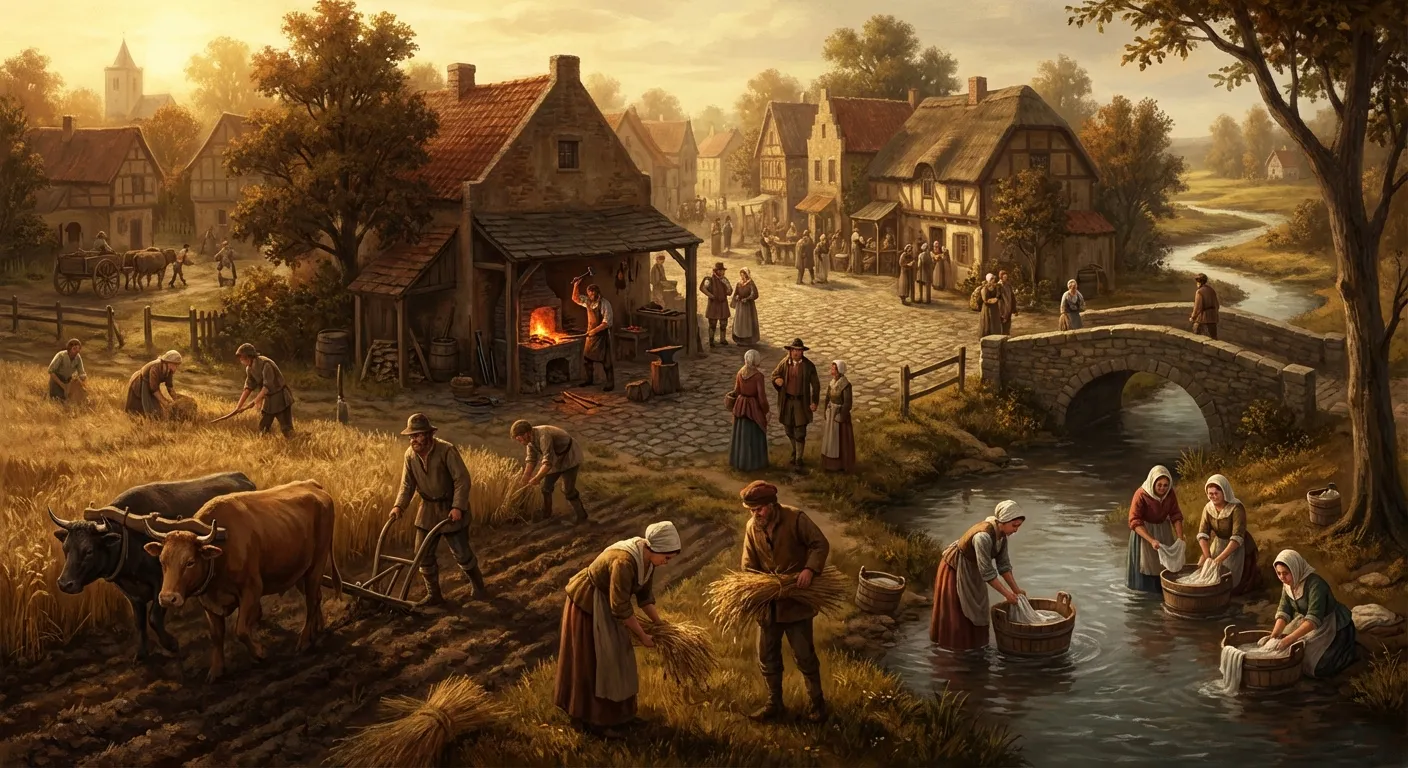
The Industrial Revolution shattered this framework. Factories required synchronous labor: every worker needed to arrive at the same time, operate machines on the same schedule, and leave together. Thompson described how factory owners imposed clock-discipline through fines, bells, and surveillance, transforming the internal experience of time itself. Workers who had once measured their days by the progress of a task now measured them by the hands of a clock they did not control. The workweek stretched to six days, often with shifts of 12 to 16 hours. Sunday remained nominally a rest day, enforced more by social convention and blue laws than by labor protections.
The result was a world in which the vast majority of working people had one day off per week, and that day was dominated by religious obligations and recovery from exhaustion. Leisure, in the sense we understand it today, was a luxury confined to those who did not work in factories.
The Saturday Struggle
The path to a two-day weekend began with Saturday, and it began with conflict. Throughout the 19th century, the labor movement's primary demand was not a second day off but fewer hours per day. The slogan "Eight hours for work, eight hours for rest, eight hours for what we will" became the rallying cry of labor organizers in the 1860s. Illinois passed an eight-hour-day law in 1867. The federal government passed its own version the same year. Neither was enforced. Employers in Illinois required workers to sign waivers of the law as a condition of employment.
The fight for the eight-hour day produced one of the bloodiest episodes in American labor history. In 1884, the Federation of Organized Trades and Labor Unions called for a nationwide strike on May 1, 1886. On that day, an estimated 80,000 workers marched up Michigan Avenue in Chicago. Three days later, at a rally in Haymarket Square protesting police violence against strikers at the McCormick Harvesting Machine Company, a bomb was thrown by an individual never identified. Police opened fire. Seven officers and an estimated four to eight civilians died. Eight anarchist labor leaders were convicted of conspiracy despite most of them not being present at the rally. Four were hanged. The event gave the world May Day as an international workers' holiday, celebrated in most countries except the United States, which chose Labor Day in September partly to distance itself from the radical associations.
Saturday, meanwhile, was being won piecemeal. That New England cotton mill in 1908 was not alone. Jewish workers across the garment industry were already taking Saturday off, and the practical difficulty of running a factory with a portion of the workforce absent on Saturday and another portion absent on Sunday pushed employers toward a compromise. By the 1920s, the five-and-a-half-day week (with Saturday afternoon off) was becoming common in industries with significant Jewish workforces, particularly in the Northeast.
Ford's Bet
The person who did the most to normalize the five-day week was not a labor organizer or a legislator. It was Henry Ford. In 1926, Ford Motor Company announced that its factories would operate on a five-day, 40-hour schedule, with Saturday and Sunday off, effective immediately. Ford's reasoning was characteristically blunt and entirely self-interested. "It is high time to rid ourselves of the notion that leisure for workmen is either 'lost time' or a class privilege," he told his biographer Samuel Crowther. The logic was circular in the best capitalist sense: workers who had leisure time would spend money; spending money would grow the economy; a growing economy would sell more cars.
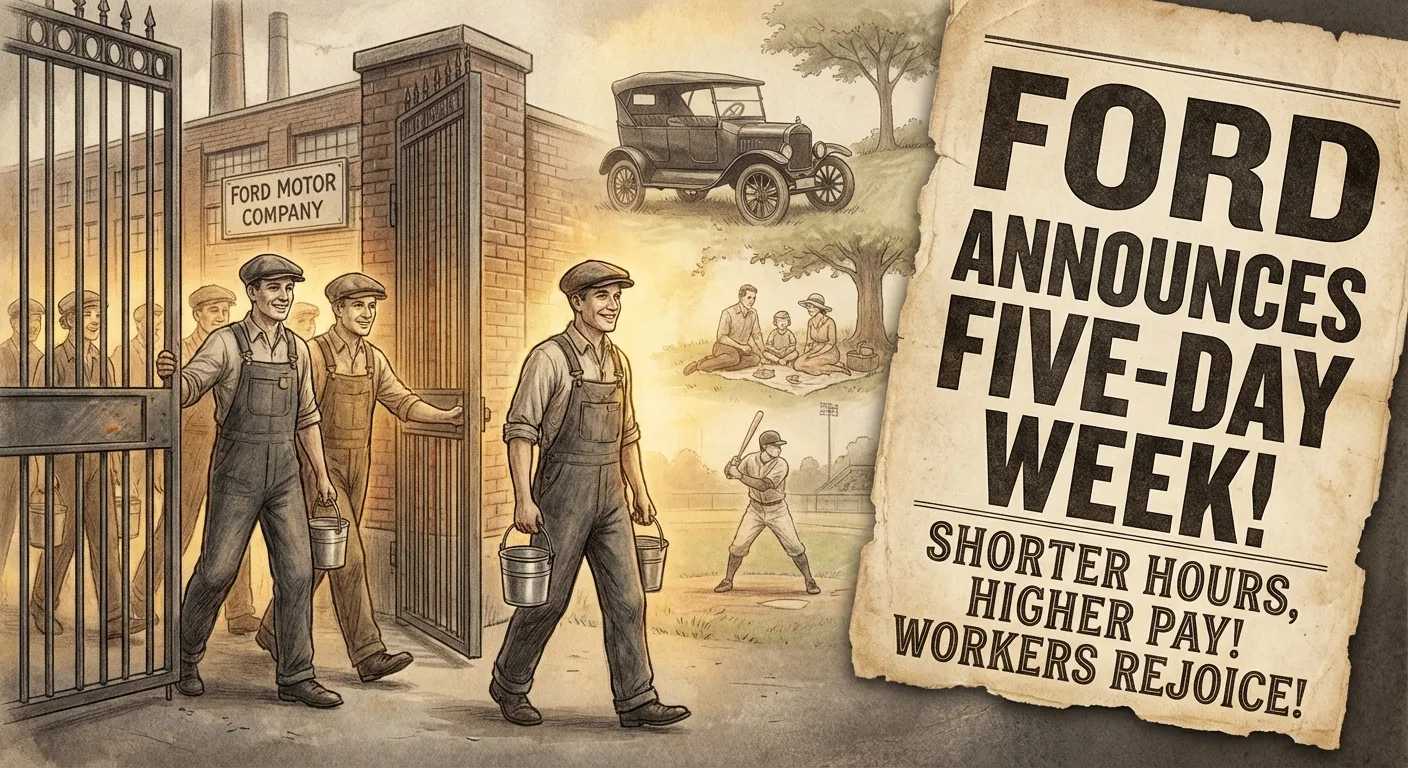
Ford was not acting from altruism, and his decision was not popular with other industrialists. But his factories were the most productive in the world, and when the five-day week did not reduce output, other manufacturers took notice. By the early 1930s, the five-day week was spreading through American industry, driven less by regulation than by competitive pressure and the dawning realization that exhausted workers made more mistakes.
The legislative backstop came later. In 1933, Senator Hugo Black of Alabama introduced a bill mandating a 30-hour work week. The Senate passed it 53-30. The bill would have given the United States one of the shortest work weeks in the world, but Franklin Roosevelt withdrew his support after determining that business leaders would not cooperate with his broader recovery program if the bill became law. The compromise that eventually emerged was the Fair Labor Standards Act of 1938, which established the 40-hour work week and required overtime pay beyond that threshold. It did not mandate a two-day weekend explicitly, but by making the sixth and seventh days of work more expensive, it created an economic incentive that achieved the same result.
The Weekend Goes Global (Sort Of)
The two-day weekend is not universal, and the days it falls on are not fixed. The world's weekend structure is a map of religious and colonial history. Most Western and East Asian countries observe Saturday-Sunday weekends, a legacy of Christian sabbath traditions and American economic influence. Israel's weekend is Friday-Saturday, reflecting the Jewish Shabbat. Workers follow a Sunday-through-Thursday schedule, with 42-hour weeks and Friday functioning as a preparation day for Shabbat rather than a day of leisure in the Western sense.
Most Muslim-majority countries historically observed a Thursday-Friday or Friday-Saturday weekend. But this is changing. In January 2022, the United Arab Emirates became the first country in the world to adopt a 4.5-day work week with a Saturday-Sunday weekend, a shift explicitly designed to align the UAE's business calendar with Western financial markets. Government employees now work Monday through Friday morning, with Friday afternoon off for congregational prayers. The move was practical: when your weekend overlaps with only one day of London's and zero days of New York's, international business suffers.
This global variation reveals that the weekend is not a natural unit of time. It is a social technology, shaped by the specific pressures of each society. The way cultures invent and assign meaning to time has always been contingent on economic, religious, and political forces. The two-day weekend is one particular solution to the tension between productivity and rest, and it is neither the oldest nor necessarily the final one.
The Weekend Under Siege
The weekend that took a century of struggle to build is being eroded in ways that would have been unrecognizable to the factory workers who fought for it. The erosion does not come from employer mandates or legislative rollbacks. It comes from smartphones.
Recent research paints a stark picture. A 2024 study published in SAGE Open by researchers Elizabeth Marsh, Elvira Perez Vallejos, and Alexa Spence found that information overload and the fear of missing out on work communications (IFoMO) are significant risk factors for occupational burnout and elevated digital workplace stress. Surveys from 2025 indicate that 81% of remote workers check email outside regular hours, 63% work on weekends, and 34% work during vacations. Job burnout has reached an all-time high of 66%.

The gig economy has created its own assault on the weekend. For the growing share of the workforce that drives for rideshare companies, delivers food, or freelances through digital platforms, there is no weekend at all. There is only the algorithm, which offers work continuously and penalizes those who decline it. The 19th-century factory worker's problem was too many mandated hours. The 21st-century gig worker's problem is different but structurally related: the work is technically optional at any given moment, but the economic pressure to accept it is constant. The boundary between work time and free time, which the weekend was designed to enforce, dissolves when your employer is an app that is always open.
This is what makes the history of the weekend relevant beyond antiquarian interest. The weekend was not a gift. It was extracted through strikes, legislative battles, religious negotiations, and one automaker's self-interested wager. Every generation since has treated the resulting arrangement as natural and permanent, but the forces that produced it, the tension between employers seeking maximum productivity and workers seeking time for themselves, have not disappeared. They have simply changed shape.
The Deeper Question
The most ambitious current challenge to the five-day work week comes not from labor unions or religious communities but from national-scale experiments. Iceland conducted the world's largest trial of a four-day work week between 2015 and 2019, involving over 2,500 workers across more than 100 workplaces. Productivity remained the same or improved in the majority of trial sites. Worker well-being increased significantly. By 2022, nearly 90% of Iceland's workforce had gained the right to negotiate reduced hours. The United Kingdom's 2022 pilot program, coordinated by the nonprofit 4 Day Week Global, produced similar results: 92% of the 61 participating companies chose to continue the four-day week after the trial ended.
These experiments suggest that the 40-hour, five-day week may be as arbitrary as the six-day week it replaced. The argument that drove Henry Ford's decision in 1926, that rested workers are more productive, applies with equal force to the case for a four-day week. And the evidence from Iceland and the UK suggests that the remaining productivity after cutting one day is real, not merely a short-term novelty effect.
But the deeper lesson of the weekend's history is not about the optimal number of days off. It is about power. Every reduction in work time in the past two centuries has been opposed by employers who argued that it would destroy productivity, raise costs, and weaken competitiveness. Every reduction has been proven, in retrospect, to be compatible with economic growth. The pattern is consistent enough to warrant skepticism toward any claim that the current arrangement is the only viable one. The sunk cost of having always done it this way is a powerful psychological force, but it is not an argument.
The weekend is an invention. Like all inventions, it can be modified, extended, or, if we are not careful, taken away. The factory workers who fought for Saturday off understood something that the always-connected remote worker checking Slack at 10 PM on a Sunday might have forgotten: the boundary between work and rest does not maintain itself. It has to be built, defended, and periodically rebuilt as the nature of work changes. The two-day weekend is one of the most successful social technologies in human history. Whether it survives the next century in recognizable form depends on whether the people who benefit from it are willing to fight for it the way their predecessors did.
Sources
- Time, Work-Discipline, and Industrial Capitalism (E.P. Thompson, 1967)
- The Haymarket Affair (Britannica)
- Black Thirty-Hour Bill (Encyclopedia.com)
- UAE Announces 4.5-Day Workweek, Saturday-Sunday Weekend (Al Jazeera, 2021)
- Information Overload, IFoMO, and Burnout in the Digital Workplace (Marsh et al., 2024)