
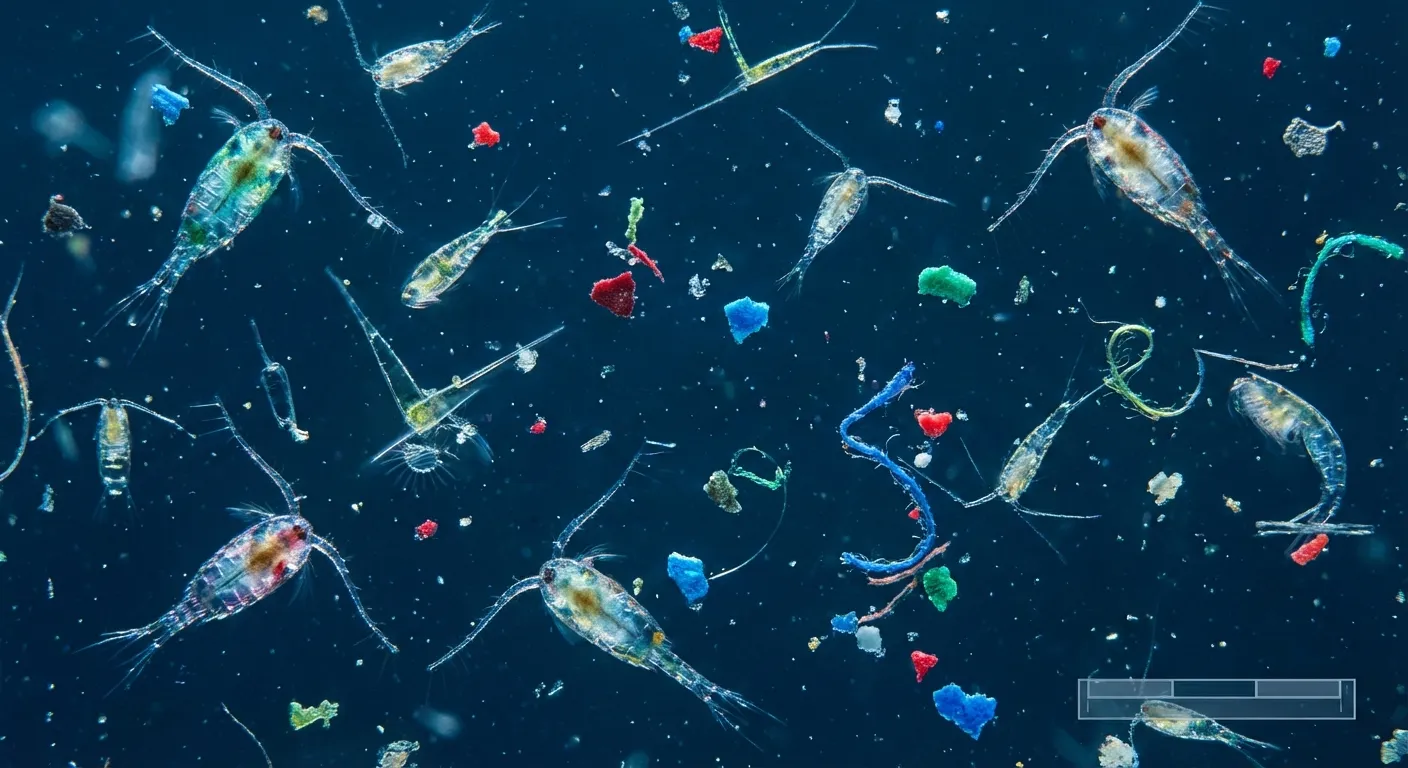
Every year, the ocean absorbs roughly 25 percent of the carbon dioxide humans emit. Without this service, atmospheric CO2 levels would be dramatically higher, and climate change would be accelerating even faster than it already is. The ocean is Earth's largest carbon sink, a planetary-scale climate defense system that operates silently beneath the waves.
This system depends on living things. Phytoplankton at the ocean surface absorb CO2 through photosynthesis, just like plants on land. When these organisms die, they sink toward the ocean floor, carrying their carbon with them. This "biological pump" has been pulling carbon from the atmosphere and sequestering it in the deep ocean for hundreds of millions of years.
New research from marine biogeochemist Kara Lavender Law at the Woods Hole Oceanographic Institution and colleagues suggests microplastics may be disrupting this process. Tiny plastic particles, drifting through the oceans in quantities that beggar imagination, appear to be interfering with the marine organisms that drive the biological pump. If confirmed, this means plastic pollution isn't just harming individual animals; it's potentially weakening one of Earth's most important climate defense mechanisms.
The Biological Pump Explained
The ocean's carbon cycle is more complex than the terrestrial one. On land, carbon moves between atmosphere, plants, and soil in relatively straightforward ways. In the ocean, carbon takes multiple pathways, some physical, some chemical, some biological. The biological pump is the most important of these pathways for removing carbon from surface waters where it can exchange with the atmosphere.
Phytoplankton are the key players, part of the deep ocean ecosystems that remain poorly understood. These microscopic photosynthetic organisms float near the ocean surface, using sunlight to convert CO2 and water into organic matter. They're responsible for roughly half of all photosynthesis on Earth, making them as important for oxygen production and carbon capture as all terrestrial plants combined.
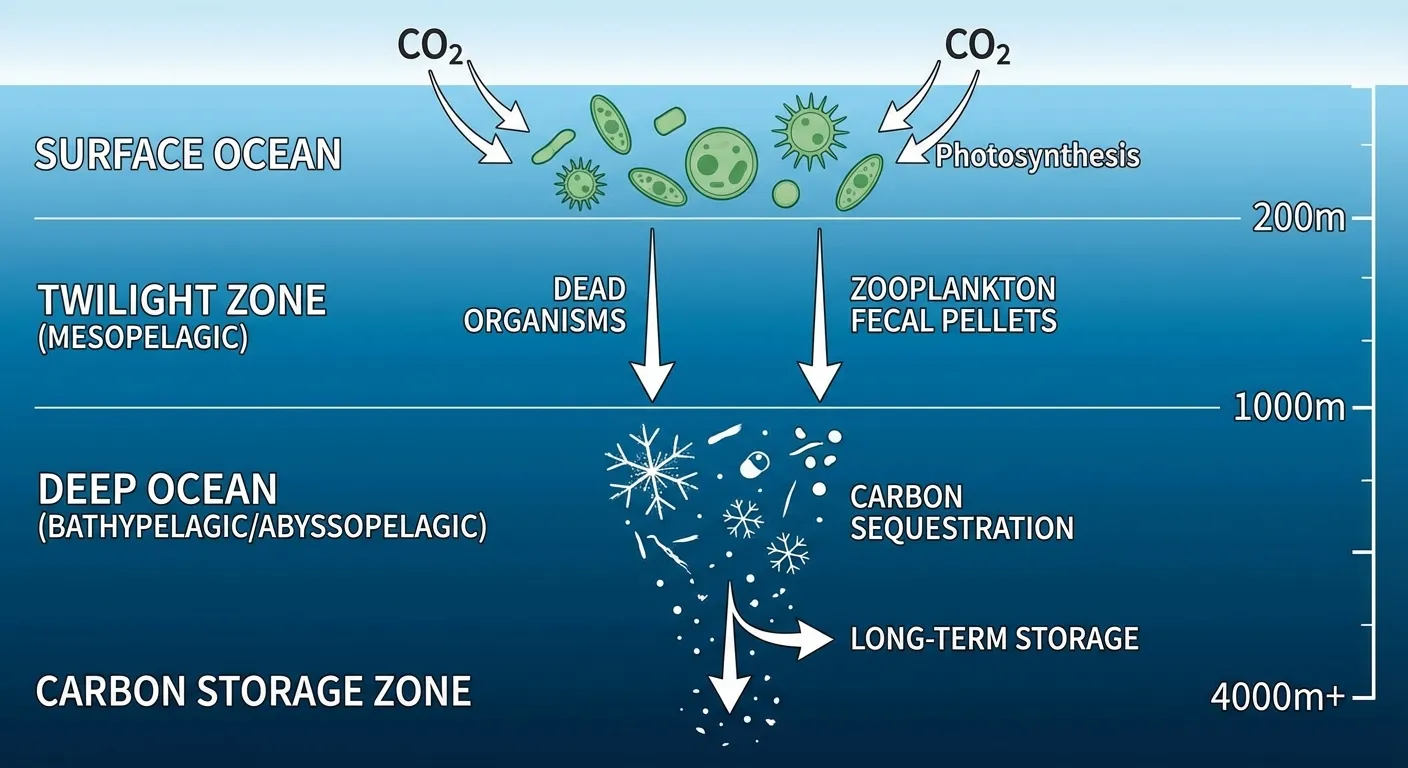
When phytoplankton die, they begin sinking. On their own, individual cells sink slowly and tend to decompose before reaching the deep ocean, releasing their carbon back into the water. But several processes speed this transport. Zooplankton (tiny animals) eat phytoplankton and excrete fecal pellets that sink much faster than individual cells. Phytoplankton also clump together into aggregates called "marine snow," which sink rapidly.
The faster material sinks, the more likely it is to reach the deep ocean before decomposing. Once carbon reaches depths below the thermocline (the boundary between warm surface waters and cold deep waters), it's effectively removed from contact with the atmosphere for centuries to millennia. The biological pump is thus a race between sinking and decomposition, and anything that slows sinking or speeds decomposition weakens the pump.
How Microplastics Enter the Picture
Microplastics are plastic particles smaller than 5 millimeters, though most are much smaller, some microscopic. They come from multiple sources: larger plastics breaking down in the environment, synthetic fibers released during laundry, microbeads from personal care products, and direct industrial emissions. By some estimates, there are now more microplastic particles in the ocean than stars in the Milky Way.
These particles don't just drift passively. They interact with marine organisms in multiple ways. Zooplankton, which can't distinguish microplastics from food, ingest them. Phytoplankton may become coated with plastic particles or have their growth affected by chemicals leaching from nearby plastics. Even bacteria, the organisms responsible for decomposing organic matter, may behave differently in the presence of microplastics.
The new research documents several mechanisms by which microplastics could weaken the biological pump. First, zooplankton that consume microplastics instead of phytoplankton contribute less to carbon transport. Their fecal pellets contain less organic carbon and more inert plastic. Since fecal pellets are major drivers of carbon transport, this represents a direct reduction in pump efficiency.
Second, microplastics may alter the buoyancy of sinking organic matter. Plastics are generally less dense than seawater and tend to float. When incorporated into marine snow or fecal pellets, they could slow sinking rates, giving decomposers more time to release carbon before it reaches the deep ocean.
The Research Findings
Multiple studies have contributed to the emerging picture of microplastics affecting carbon cycling. Laboratory experiments have shown that zooplankton exposed to microplastics produce fecal pellets with lower carbon content and altered sinking characteristics. Field observations have found microplastics incorporated into marine snow at various ocean locations. Modeling studies have attempted to estimate the overall impact on carbon flux.
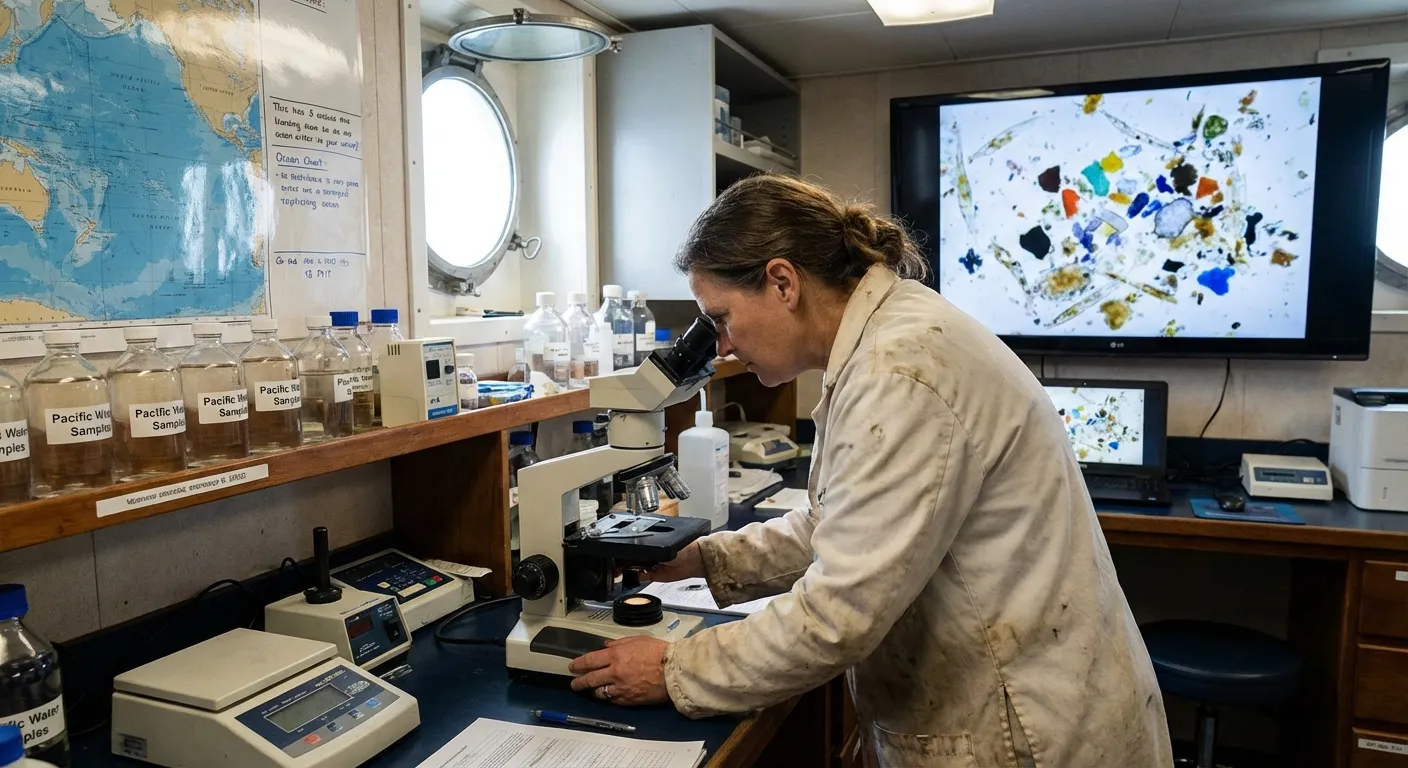
The most concerning findings relate to fecal pellet transport. Zooplankton fecal pellets are responsible for a disproportionate share of carbon transport to the deep ocean because they sink so quickly. Research by marine ecologist Penelope Lindeque at the Plymouth Marine Laboratory has shown that microplastic-laden pellets sink up to 25 percent slower than clean pellets in laboratory conditions. Over the thousands of meters these pellets must travel, reduced sinking speed means significantly more decomposition and carbon release before reaching the deep ocean.
The spatial distribution of the effect matters. Microplastics are concentrated in certain ocean regions, particularly the centers of major gyres (the large circular current systems in each ocean basin). These "garbage patches" are also regions where the biological pump operates, meaning the heaviest microplastic pollution coincides with important carbon cycling areas.
Quantifying the total impact remains challenging. The ocean is vast, microplastics are unevenly distributed, and the biological pump varies by region and season. Current estimates suggest that microplastics could be reducing biological pump efficiency by a few percent globally, with higher impacts in heavily polluted areas. A few percent might seem small, but given the scale of oceanic carbon absorption, it translates to millions of tons of CO2 that might otherwise have been sequestered.
Implications for Climate
The ocean's carbon absorption has been partially masking the full impact of human emissions. If this absorption weakens, atmospheric CO2 will rise faster for any given level of emissions. We would need to reduce emissions even more aggressively to achieve the same climate outcomes.
This creates a feedback loop. More plastic pollution means less efficient carbon absorption, which means faster climate change, which stresses marine ecosystems further, potentially reducing their capacity to absorb carbon through additional mechanisms. The system could enter a declining spiral where pollution and climate change reinforce each other.
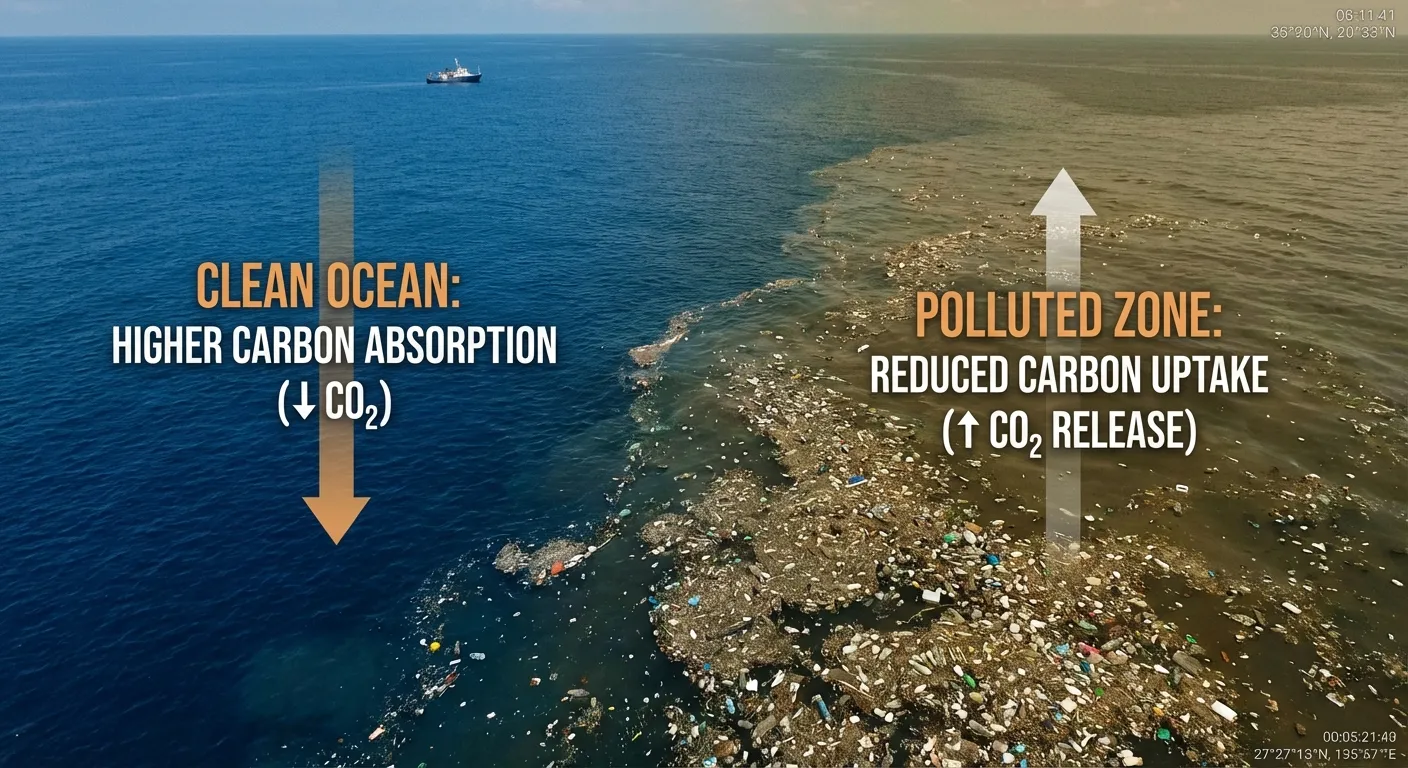
The research also highlights an underappreciated connection between environmental problems. Plastic pollution and climate change are often discussed as separate issues, requiring separate solutions. But if plastics are weakening the ocean's climate defense, these problems are linked. Addressing plastic pollution becomes, in part, a climate mitigation strategy. Failing to address it makes climate targets harder to reach.
This doesn't mean we should abandon efforts to reduce emissions and focus instead on plastic pollution. The scale of emissions reduction needed for climate stability dwarfs any impact from improved carbon absorption. But it does mean that plastic pollution has consequences beyond the visible harms to marine wildlife. The invisible effects on ocean biogeochemistry may ultimately be more significant.
Where This Leads
The numbers frame the problem concretely. Approximately 11 million metric tons of plastic enter the ocean annually, and that figure is projected to triple by 2040 without major policy intervention. Current estimates place between 82 and 358 trillion microplastic particles in ocean surface waters, with concentrations highest in the North Pacific and North Atlantic gyres where biological pump activity is also significant. If Lindeque's laboratory finding of a 25 percent reduction in fecal pellet sinking speed holds at ocean scale, the implied reduction in deep-ocean carbon transport is between 1 and 5 percent in heavily polluted regions. Applied globally, even a 1 percent reduction in biological pump efficiency translates to roughly 30 to 50 million additional tons of CO2 remaining in surface waters each year, comparable to the annual emissions of a mid-sized industrial nation.
This quantification has direct policy implications. The UN Global Plastics Treaty, currently under negotiation, has focused primarily on visible harms to marine wildlife and coastal ecosystems. The carbon cycling evidence adds a climate dimension that strengthens the case for binding production caps rather than voluntary cleanup commitments, much as the underground communication networks that trees depend on revealed hidden ecological connections. Integrated Earth system models used by the IPCC do not yet include microplastic effects on ocean carbon uptake; incorporating these effects would worsen projected warming scenarios by a measurable, if modest, margin.
The research gap that matters most now is measuring actual sinking rates in open-ocean conditions rather than laboratory tanks. The Woods Hole team plans to deploy sediment traps paired with microplastic concentration sensors across the North Atlantic subtropical gyre starting in 2027. Those field measurements will determine whether laboratory results scale to the real ocean or whether natural turbulence and biological adaptation reduce the impact. Until that data arrives, the conservative estimate is that microplastics are already costing the ocean measurable carbon absorption capacity, and that cost grows with every year of increasing plastic production.