
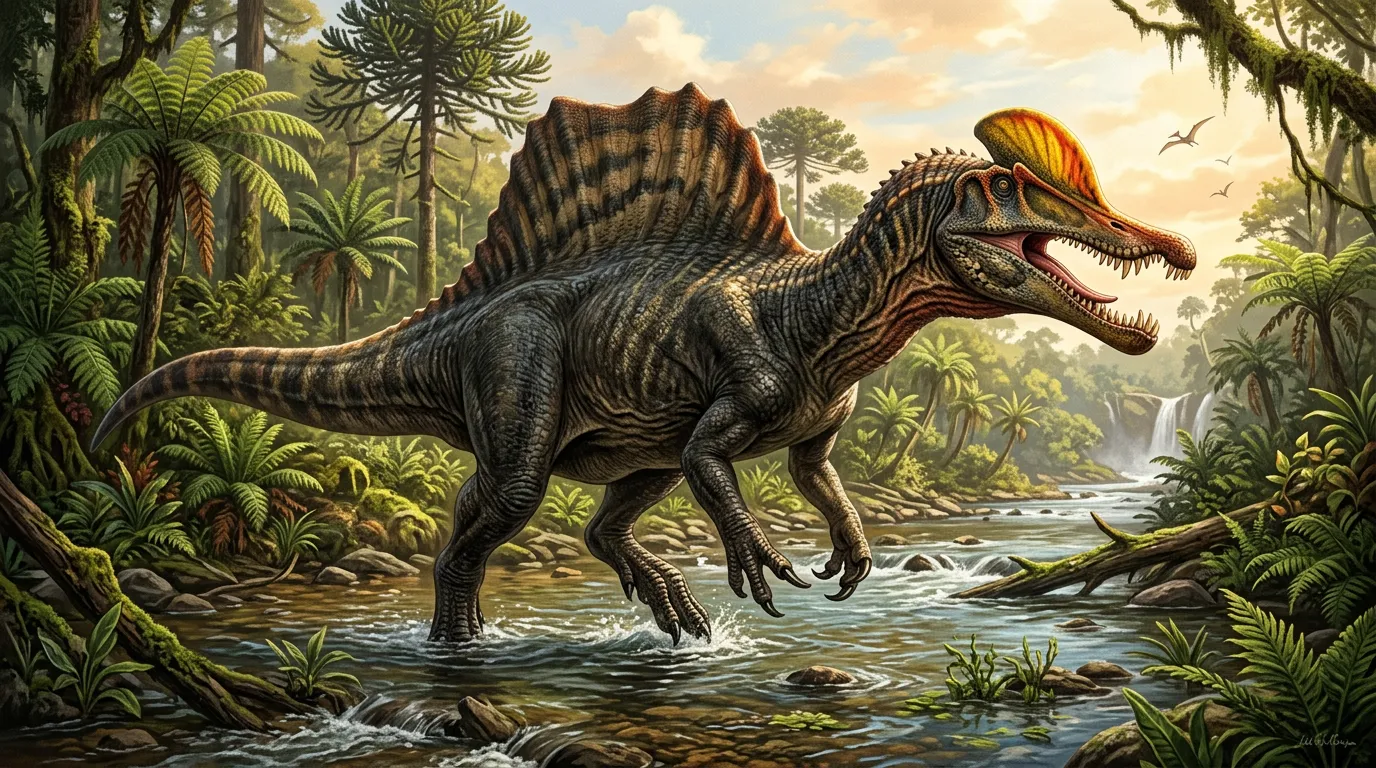
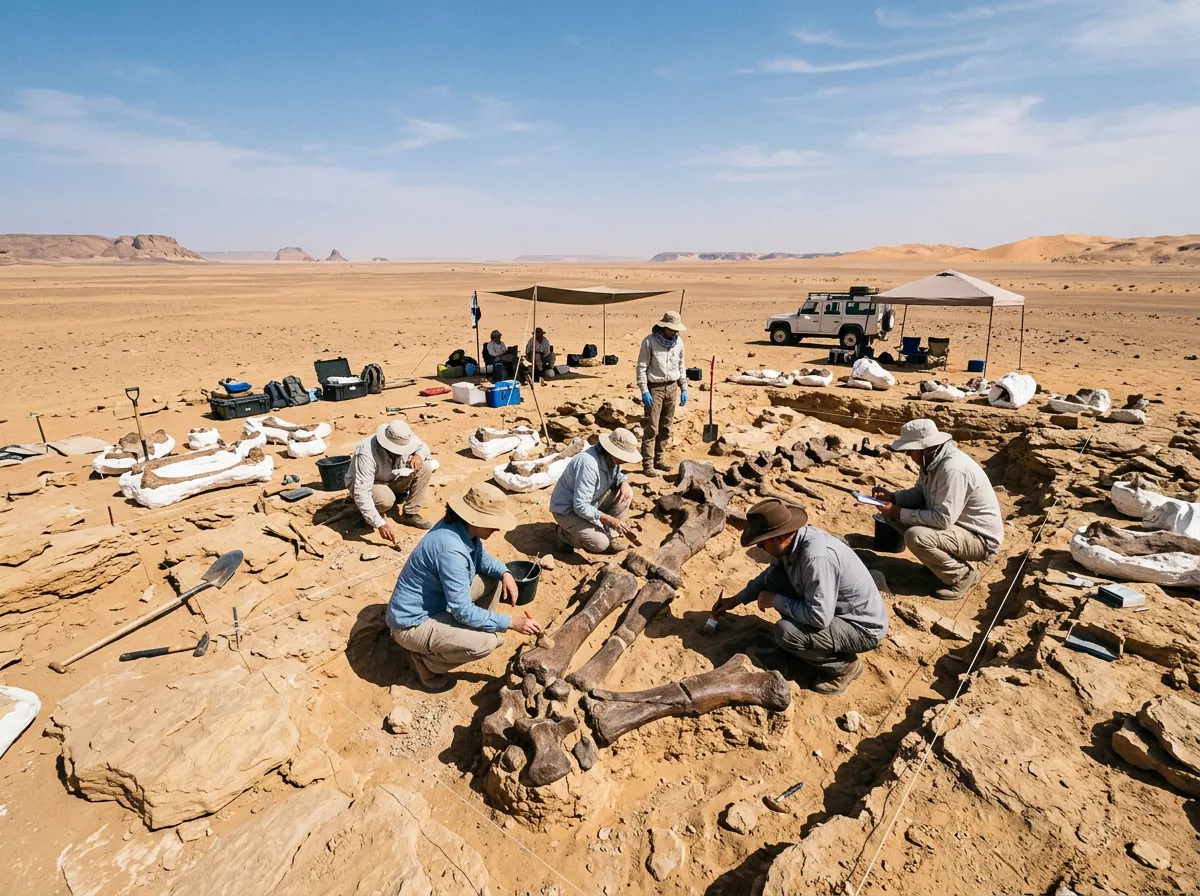
In November 2019, paleontologist Paul Sereno's team was crossing a stretch of remote desert in Niger when they spotted something strange on the surface: a massive, curved bone fragment unlike anything in their reference materials. It was so unusual that they initially couldn't identify what part of the animal it came from. Three years later, after a return expedition uncovered two more specimens, the team realized they had found something paleontology hadn't seen in over a century: an entirely new species of spinosaur.
The animal is called Spinosaurus mirabilis, the "wonderful spine lizard." But it's the nickname that stuck: the hell heron. Published in Science in February 2026, the discovery is forcing researchers to rethink nearly everything they thought they knew about how the largest predatory dinosaurs lived, hunted, and evolved. This wasn't a coastal predator clinging to ancient shorelines. It was an inland giant, stalking rivers hundreds of miles from the nearest ocean, crowned with a crest so tall it has no parallel in the entire dinosaur fossil record.
A Site Lost for 70 Years
The story of S. mirabilis begins not in 2019, but in the 1950s. A French geological survey had documented fossil-bearing sediments in a remote part of central Niger, publishing the findings in a monograph that gathered dust for decades. No one had returned to the site in over 70 years. When Sereno's team, based at the University of Chicago, cross-referenced old geological maps with satellite imagery, they identified the area as promising and organized an expedition.
The Farak Formation, where the fossils were found, dates to the Cenomanian stage of the Late Cretaceous, roughly 95 million years ago. At that time, the central Sahara was no desert. It was a vast, humid floodplain crossed by wide rivers and fringed by dense forests of conifers and ferns. Long-necked sauropods browsed the canopy. Crocodilians patrolled the waterways. And among them, wading through the shallows, was something enormous.
The initial 2019 discovery yielded jaw fragments, several teeth, and that puzzling curved bone. It wasn't until the 20-person team returned in 2022, better equipped and specifically searching for more material, that the picture came together. Two additional crests emerged from the sandstone, along with enough comparative anatomy to confirm: this was a new species, closely related to the famous Spinosaurus aegyptiacus but distinct in ways that matter enormously.
The Tallest Crest of Any Dinosaur
The defining feature of S. mirabilis is its crest: a single, blade-like structure rising from the top of the skull in a curved, scimitar shape. At 50 centimeters (about 20 inches) in height, it is the tallest cranial crest ever documented in a non-avian dinosaur. For context, the famous crests of hadrosaurs like Parasaurolophus extended backward rather than upward, and even the most elaborate ceratopsian horns don't match this sheer vertical height relative to skull size.
Analysis of the crest's internal structure reveals a network of vascular canals, blood vessel channels that indicate the bone was covered in life by a sheath of keratin, the same protein that makes up human fingernails and bird beaks. The vascularization pattern suggests the keratin covering was thick and likely brightly colored. Paleontologist Paul Sereno and his co-authors propose the crest functioned primarily as a display structure, visible from a distance and probably used in species recognition and mate selection.
This interpretation fits a broader pattern in paleontology. Many large predatory dinosaurs had display features that seem energetically expensive and functionally useless for hunting or defense. The crest of S. mirabilis would have been visible above the waterline even when the animal was partially submerged, making it an effective signal in the riverine environments where it lived. Think of it as the dinosaur equivalent of a peacock's tail: metabolically costly, but reproductively essential.
The skeleton itself is remarkably similar to S. aegyptiacus in most respects. The interlocking teeth, designed to trap slippery fish rather than tear through flesh, are essentially the same. The robust limbs, the elongated skull, the overall body plan, all closely match. The crest is what separates the two species, and it separates them dramatically.
The Hell Heron: A New Model for Spinosaur Behavior
For years, the dominant narrative about spinosaurs cast them as semi-aquatic predators, something like enormous crocodilians that spent most of their time fully submerged in water. A controversial 2020 study of S. aegyptiacus proposed that its flattened tail functioned as a propulsive organ, suggesting the animal swam like a newt. The debate has raged ever since, with some researchers arguing for a fully aquatic lifestyle and others pushing back toward a wading model.
S. mirabilis tilts the balance firmly toward the waders. Sereno described the animal as "a kind of 'hell heron' that had no problem wading on its sturdy legs into two meters of water, but probably spent most of its time stalking shallower traps for the many large fish of the day." The heron analogy is apt. Great blue herons are powerful, patient predators that stand in shallow water and strike with explosive speed. Scale that up to a 14-meter predator with a crocodilian skull, and you have something genuinely terrifying.
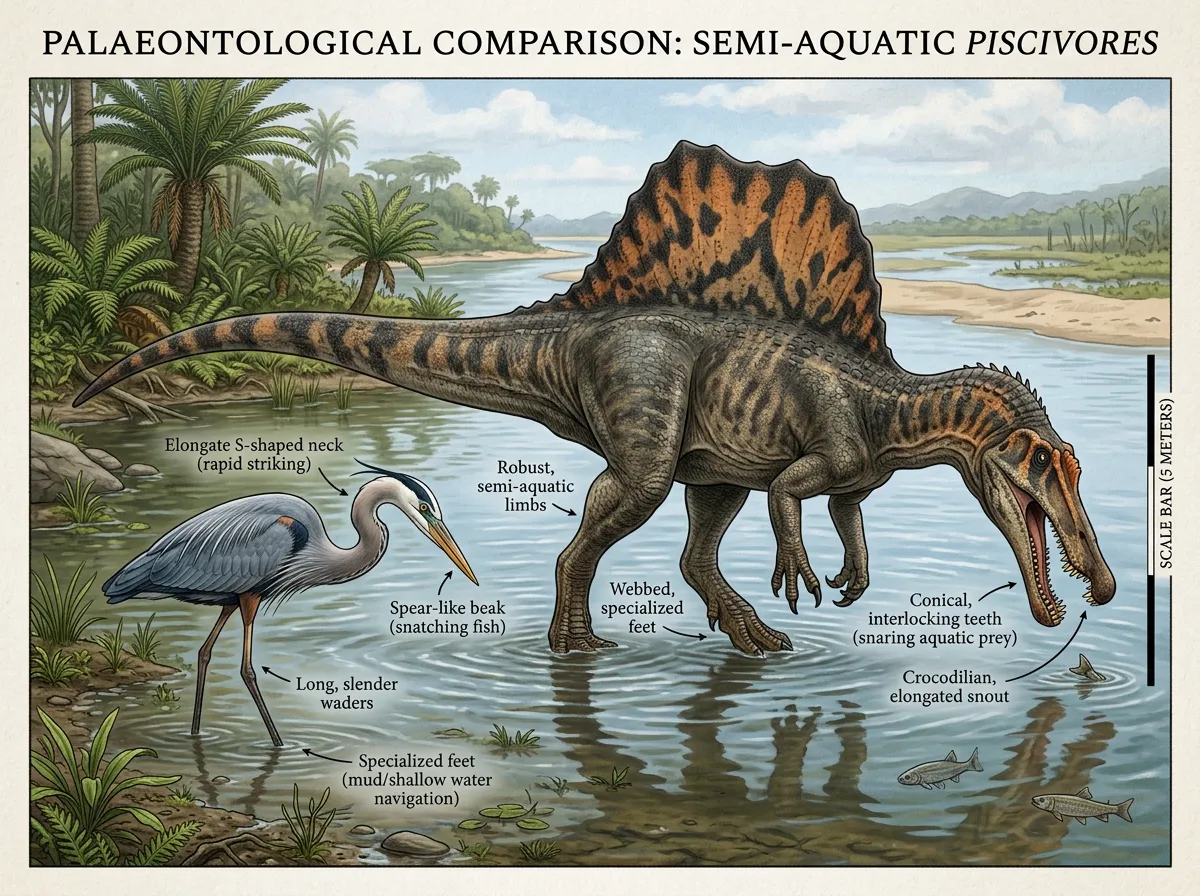
The heron model also explains the crest better than the aquatic model does. A fully submerged predator gains nothing from a tall, fragile display structure that creates drag and turbulence in the water. A wading predator, by contrast, keeps its head above the waterline most of the time, exactly where a colorful crest would be visible to other members of the species. The anatomy and the behavior tell the same story.
The Inland Paradox
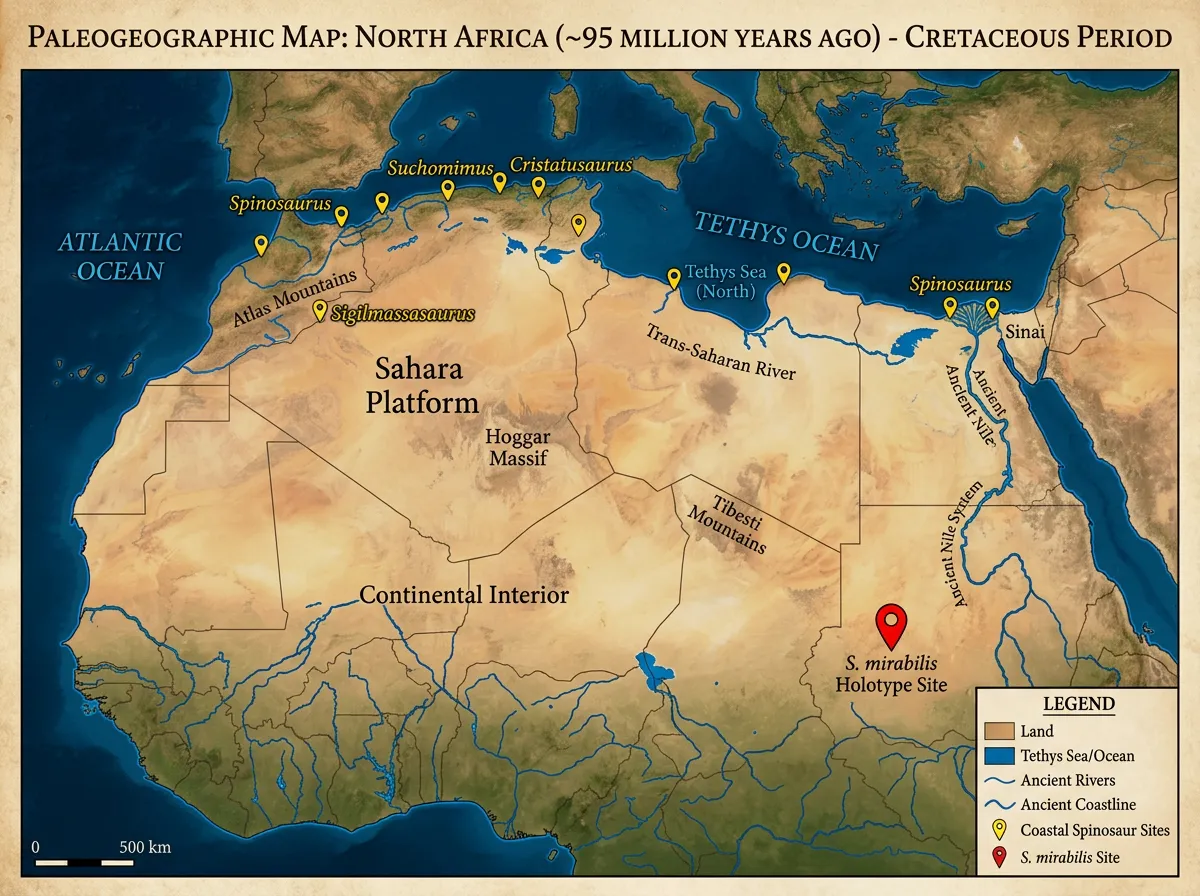
Perhaps the most surprising aspect of the discovery is where it happened. Every previous spinosaurid specimen, from Baryonyx in England to Suchomimus in Niger to S. aegyptiacus in Egypt and Morocco, has been found in ancient coastal deposits near prehistoric shorelines. Spinosaurs were understood as coastal animals, fishing in estuaries and tidal zones.
S. mirabilis breaks that pattern completely. The Farak Formation deposits where it was found represent an inland river system, somewhere between 500 and 1,000 kilometers from the nearest Cenomanian-era marine shoreline. This is the equivalent of finding a great white shark fossil in Kansas (which, incidentally, has happened, but in marine sediments from when Kansas was underwater). The point is that S. mirabilis was not a coastal animal. It lived deep in the continental interior, in freshwater river systems that had no connection to the ocean.
This changes the map of spinosaur ecology. Rather than a single ecological niche, tightly linked to marine environments, spinosaurs apparently occupied a range of aquatic habitats from coastal estuaries to inland rivers. The discovery suggests these animals were more ecologically flexible than anyone realized, capable of thriving in freshwater ecosystems far from the sea.
The find also raises questions about species diversity. If spinosaurs lived in inland habitats that are rarely sampled by paleontologists (who tend to focus on coastal deposits where preservation is better), how many species have we missed? The central Sahara is one of the least-explored fossil regions on Earth. The fact that a 20-person team found a new species on essentially their first targeted search suggests the Farak Formation may hold many more surprises.
What S. mirabilis Tells Us About Spinosaur Evolution
The study published in Science doesn't just describe a new species. It proposes a new framework for understanding how spinosaurs diversified. Sereno and his co-authors argue for what they call a "stepwise radiation," a pattern in which spinosaurs gradually expanded from coastal to inland habitats over millions of years, adapting to new environments and food sources as they went.
This model has a parallel in modern ecology. Herons, the very birds that inspired the nickname, follow a similar pattern. Great blue herons fish in salt marshes, freshwater lakes, and mountain streams. Different populations adapt to local conditions while retaining the same basic body plan and hunting strategy. The spinosaur radiation may have worked the same way: a successful coastal body plan that gradually colonized freshwater systems across the continent.
The crest adds another dimension. If S. mirabilis and S. aegyptiacus lived in different habitats (inland vs. coastal), the crest may have served as a species-recognition signal that prevented hybridization where their ranges overlapped. This is a common pattern in birds, where closely related species in overlapping ranges often develop exaggerated visual signals to maintain reproductive isolation. The tallest crest in dinosaur history may not have been about attracting mates at all. It may have been about saying, clearly and unmistakably, "I'm not the other one."
The Bigger Picture
Spinosaurus mirabilis is a reminder that the Mesozoic world still holds enormous surprises, even in the most studied groups of dinosaurs. Spinosaurs have been headline-grabbing fossils for decades, from the original S. aegyptiacus specimens destroyed in World War II bombing raids to the tail-propulsion controversy of the 2020s. And yet a species with the most dramatic head crest in dinosaur history was sitting in the Saharan sandstone, unrecognized, for at least 70 years after its habitat was first surveyed.
The discovery also illustrates something about how science works that often gets lost in the headlines. The initial 2019 find was confusing, not triumphant. The team didn't know what they had. It took a second expedition, years of preparation, and a 20-person collaborative effort spanning multiple countries to turn a puzzling bone fragment into a named species published in one of the world's top scientific journals. The "eureka moment" is a myth. The reality is patience, funding, and the willingness to return to a site that hasn't been visited in seven decades because an old monograph said the rocks looked interesting.
What remains unknown is substantial. How large was S. mirabilis compared to its coastal cousin? Was the crest sexually dimorphic, present in only one sex, as in many modern birds? Did other large predators share its inland river habitat? The Farak Formation has barely been scratched. If the first targeted search produced a species new to science, the next expedition could reveal an entire ecosystem we didn't know existed.
Sources
- A giant blade-crested spinosaurus, the "hell heron," discovered in the Sahara - ScienceDaily
- Scimitar-crested Spinosaurus species from the Sahara caps stepwise spinosaurid radiation - Science
- 'Hell-heron' dinosaur discovered in the central Sahara - University of Chicago News
- New sabre-crested Spinosaurus species named from desert dinosaur fossils - Natural History Museum
- New Spinosaurus species had a massive head crest - NPR