
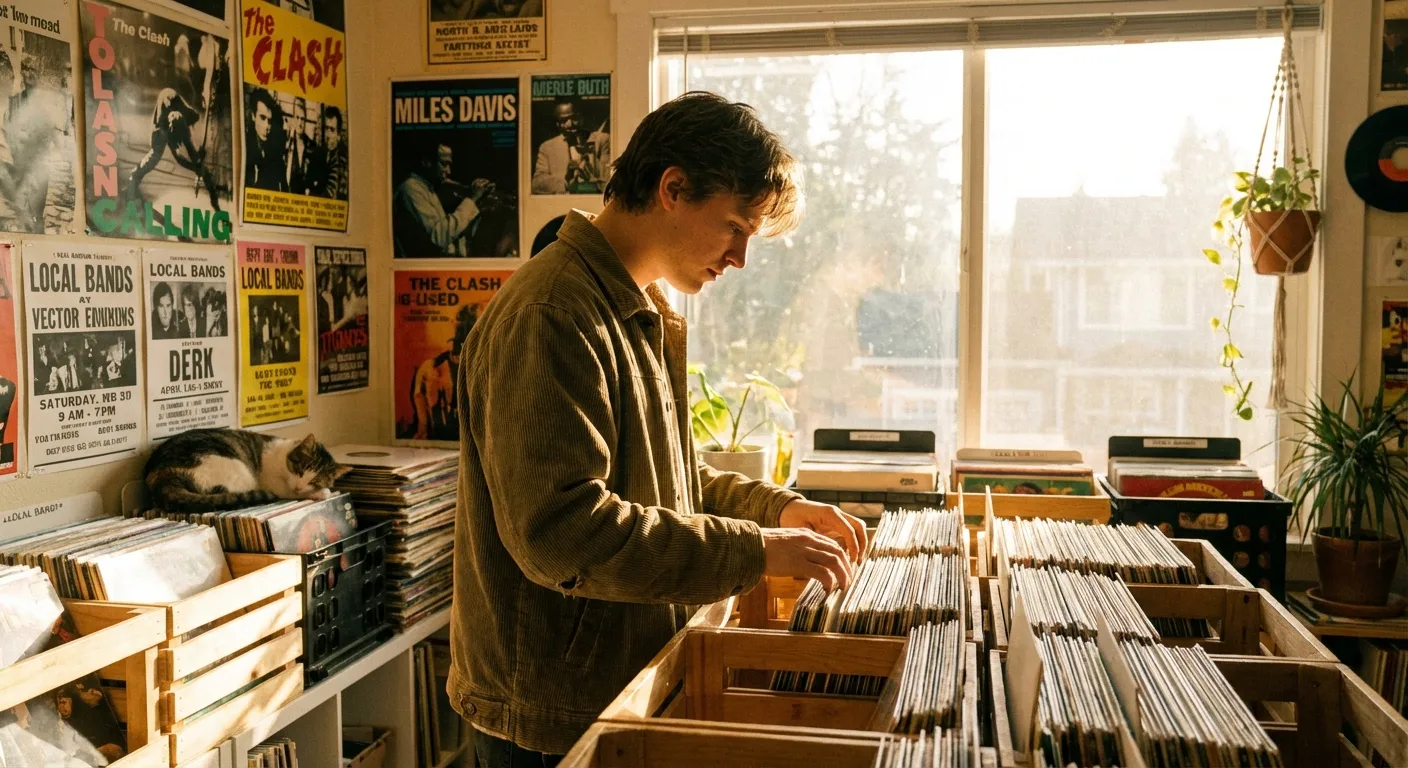
Something strange is happening among the generation raised entirely on smartphones and streaming. They are buying vinyl records, even though digital music is free and instantly accessible. They are joining knitting circles and pottery classes. They are reading print books and subscribing to paper magazines. They are, in short, doing everything the digital revolution was supposed to make obsolete.
The trend has acquired various names: analog wellness, the physical turn, the tangible movement. Whatever the label, the pattern is clear. After two decades in which every aspect of life migrated online, a countercurrent is emerging. Young people who have never known a world without the internet are seeking out the physical, the handmade, the emphatically non-digital. The question is why.
The Vinyl Paradox
The vinyl revival is perhaps the most visible manifestation of this shift. In 2025, vinyl record sales continued their remarkable resurgence, with younger buyers driving much of the growth. This makes no obvious sense. Vinyl is expensive, inconvenient, and objectively inferior to digital audio by most technical measures. You cannot skip tracks easily, you cannot create playlists, and the records themselves require careful handling and dedicated equipment.
Yet sales keep climbing. Record stores, once written off as nostalgic curiosities, are thriving. New pressing plants have opened to meet demand. Artists who built their careers on streaming are releasing elaborate vinyl editions. Something about the format appeals to people who have no memory of vinyl's original dominance.
Part of the appeal is aesthetic. Album art at twelve inches square is more impressive than a thumbnail on Spotify. The ritual of removing a record from its sleeve, placing it on the turntable, and lowering the needle creates a relationship with music that passive streaming cannot match. But there is also a social and economic dimension. Record stores have become community gathering spaces, hosting listening parties and in-store performances. Vinyl collecting fosters identity and curation in a way streaming's infinite library does not: your record shelf tells visitors who you are, what you value, what you chose when you could not choose everything.

The Craft Revival
The turn to analog extends far beyond music. Enrollment in craft classes has surged across Western countries. Knitting groups have multiplied. Pottery studios report long waitlists. Woodworking, bookbinding, calligraphy, and other hands-on skills that seemed destined for extinction are finding new enthusiasts.
The demographics defy expectations. These are not retirees pursuing long-deferred hobbies but twentysomethings and thirtysomethings carving time from busy schedules. Many work in digital industries: software development, social media management, content creation. What draws them to craft is not just the physicality but the learning curve. Pottery, woodworking, and knitting require months of practice before producing anything good. In an era of instant results and one-click solutions, the slow acquisition of a difficult skill has become its own reward, a form of personal development that cannot be shortcut or automated.
Researchers who study this phenomenon, including sociologist Sherry Turkle at MIT, point to several factors. One is the desire for competence in a world where many jobs feel abstract and their value is uncertain. Making something with your hands, whether a scarf or a bowl, produces undeniable proof of capability. Psychologists who study flow states and optimal experience recognize this kind of hands-on engagement as particularly conducive to deep satisfaction. Another factor is the social dimension. Craft groups provide community in an era of loneliness, and the shared activity gives people something to do together beyond staring at phones.
The Return of Print
Print media was supposed to be dead. Newspapers collapsed, magazines folded, and bookstores closed throughout the 2000s and 2010s. The Kindle and later the smartphone seemed to have made paper obsolete. Yet here, too, a reversal is underway.
Print book sales have stabilized and in some categories are growing. Independent bookstores, after years of decline, are opening again. Print magazines, particularly those with distinctive design and curation, are finding subscribers willing to pay premium prices. Even newsletters, the quintessential digital format, sometimes take physical form, with writers offering print editions to devoted fans.
The resurgence has a specific character. It is not mass-market paperbacks or celebrity memoirs driving the numbers but small-press literary fiction, independent nonfiction, and beautifully designed art books. Buyers are treating books as curated objects, choosing editions for their cover design, paper quality, and typography. The same impulse that drives vinyl collectors to seek out first pressings drives book buyers to independent publishers offering cloth-bound editions with deckle-edged pages. Ownership has become a form of taste expression, a visible signal of intellectual and aesthetic identity.

Digital Fatigue
Behind these trends lies a growing unease with digital life. The average person now spends many hours daily looking at screens. For knowledge workers, the proportion is even higher. Apps are designed to be addictive, optimized to capture and hold attention regardless of user wellbeing. The way recommendation algorithms can feel like mind-reading only deepens the unease. The result is widespread digital fatigue: a sense of being overwhelmed, scattered, and disconnected despite constant connectivity.
Young people, paradoxically, may feel this most acutely. They have no pre-digital baseline to romanticize, but they also have no illusions about technology as savior. They have grown up with social media and seen its costs: anxiety, comparison, the warping of self-presentation. They have watched attention spans fragment and deep focus become rare. They are, in a sense, the first generation to fully understand what digital life extracts from us.
The turn to analog can be understood as a response to this extraction. Physical objects do not demand engagement in the same way apps do. A knitting project can be picked up and put down without algorithm-driven notifications nagging you back. A vinyl record plays at a fixed pace; you cannot speed it up or skip to the best parts. These limitations, once seen as drawbacks, are now experienced as relief.
Meaning in Materiality
There is also something philosophical at stake. Economists have long studied the "paradox of choice," the finding that excessive options reduce satisfaction rather than increase it. The psychologist Barry Schwartz documented how unlimited selection produces anxiety, regret, and decision paralysis. The analog movement may be a mass-market response to this paradox. A vinyl collection is inherently bounded by shelf space and budget. A pottery class produces one bowl at a time. These constraints are not limitations to overcome but structures that make engagement satisfying.
The movement also reveals a generational shift in how value is perceived. For baby boomers, convenience was progress: microwaves, remote controls, and one-click purchases represented a better life. For younger consumers who have never known inconvenience, the opposite carries appeal. Difficulty, slowness, and physicality have become markers of authenticity. A hand-thrown mug from a local ceramicist carries social capital that a mass-produced equivalent does not, not because it functions better but because its imperfections testify to human effort.
This may explain why the analog movement is strongest among people who could easily avoid it. Those with disposable income and cultural capital are choosing to spend money and time on vinyl, crafts, and print precisely because they have alternatives. The choice becomes an act of curation in a world that otherwise resists it.

The Deeper Question
The analog wellness movement is not a rejection of technology wholesale. Most of its participants remain thoroughly digital in their work and much of their leisure. They stream music and watch videos online; they use social media and messaging apps. The turn to analog is not about going off-grid but about balance, about reclaiming some portion of life from the screen.
The market data confirms this is a structural shift, not a passing fad. Vinyl sales have grown every year for nearly two decades, reaching $1.4 billion in the U.S. alone in 2024. Independent bookstore openings have outpaced closures for eight consecutive years. Craft supply retailers report year-over-year growth driven by customers under 35. These are not niche numbers. They represent a consumer category that has grown alongside, not instead of, digital spending.
The analog movement reveals a specific failure of digital design: the inability to provide a sense of completion. Streaming libraries are infinite, social feeds never end, and notification cycles have no natural stopping point. Physical activities have built-in endings. A vinyl record has a Side B that runs out. A knitting project produces a finished scarf. A print book has a last page. That sense of completion, of doing something from start to finish, is what digital platforms have optimized away and what millions of people are now paying a premium to get back.
This is not nostalgia or Luddism. It is a market correction. Digital technology excels at access, speed, and scale but consistently fails at presence, satisfaction, and tangibility. The analog resurgence is consumers filling that gap with their wallets, choosing to spend more money and more time on experiences that deliver what screens cannot. As long as digital platforms prioritize engagement metrics over user fulfillment, the demand for analog alternatives will keep growing.