
The last time a human being saw the Moon from closer than low Earth orbit, Richard Nixon was president, the Vietnam War was still raging, and the average American home cost $27,600. That was December 1972, when Apollo 17 commander Gene Cernan climbed back into his lunar module and left the last bootprints on the Moon's surface. In the fifty-four years since, we've landed robots on Mars, built a space station the size of a football field, and sent a probe past Pluto. But we never went back to the Moon.
Tomorrow, that changes.
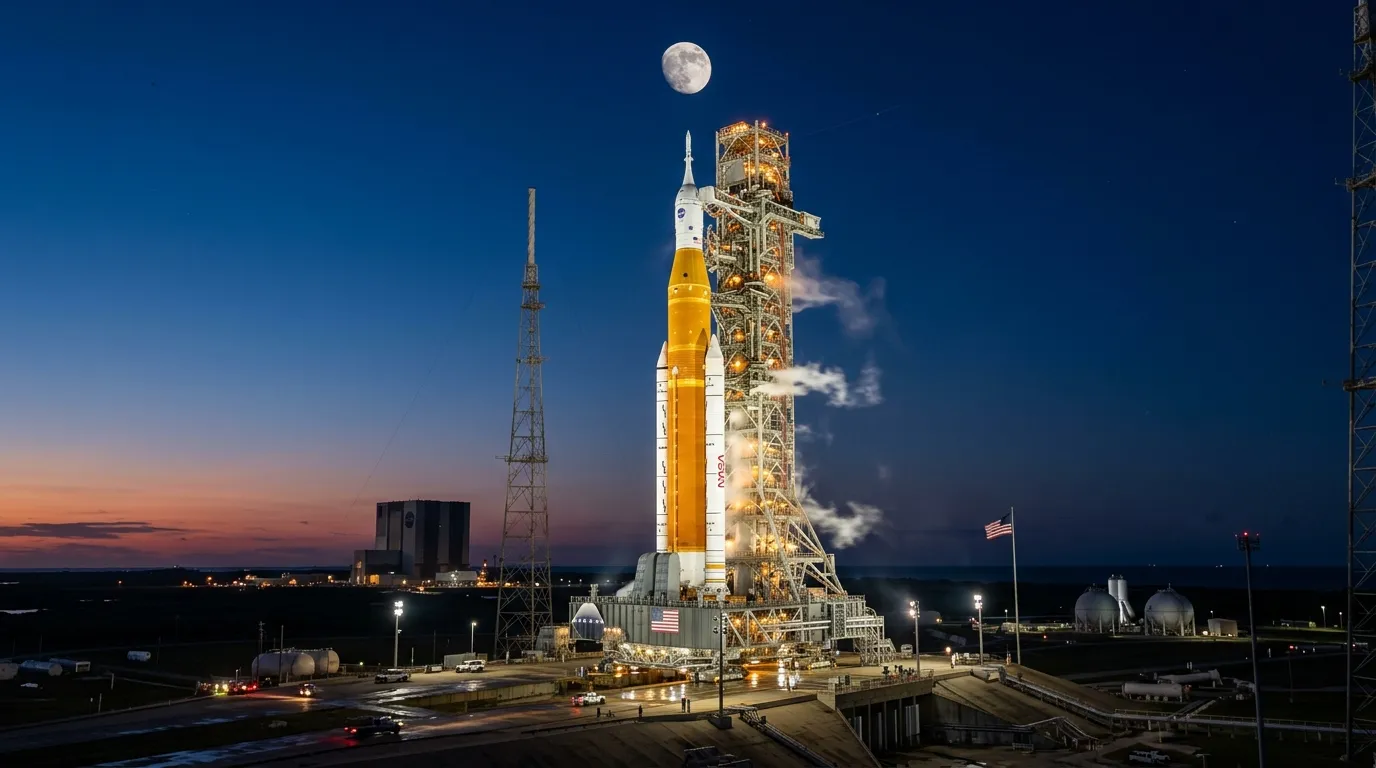
At 6:24 p.m. EDT on April 1, 2026, NASA's Space Launch System rocket will lift off from Kennedy Space Center carrying four astronauts on a nine-and-a-half-day journey around the Moon and back. Artemis II won't land on the lunar surface, but it will send humans farther from Earth than anyone has traveled since the Apollo program ended, testing the Orion spacecraft's life support, navigation, and heat shield with a crew aboard for the first time. If everything goes right, it sets the stage for actual lunar landings starting in 2028.
If everything doesn't go right, well, that's exactly why this mission exists.
The Crew That Rewrites the Record Books
Artemis II carries a crew of four, and every one of them represents a first.
Commander Reid Wiseman is a former Navy test pilot who spent 165 days aboard the International Space Station in 2014. He's the veteran presence, the one who has already lived the disorienting reality of microgravity and the specific loneliness of looking down at Earth from 250 miles up. For Artemis II, he'll be looking at Earth from roughly 252,000 miles away, more than a thousand times farther.
Pilot Victor Glover flew to the ISS in 2020 aboard the first operational SpaceX Crew Dragon mission. When Artemis II clears low Earth orbit, Glover will become the first Black astronaut to travel beyond it. Every person who has previously ventured past low Earth orbit, all 24 of them, has been a white American man. Glover's presence on this mission is not tokenism; he was selected because he is one of NASA's most experienced operational pilots, with more than 3,000 flight hours in over 40 aircraft types, including combat missions in Iraq.
Mission specialist Christina Koch holds the record for the longest single spaceflight by a woman: 328 consecutive days aboard the ISS from 2019 to 2020. She also participated in the first all-female spacewalk. When Orion reaches its closest approach to the Moon, Koch will become the first woman to travel beyond low Earth orbit.
Canadian Space Agency astronaut Jeremy Hansen rounds out the crew, and his story might be the most improbable. A former CF-18 fighter pilot, Hansen has never been to space before. His first spaceflight will take him farther than all but 24 humans in history have ever traveled, a distance that makes the ISS look like a backyard trampoline. He'll also be the first non-American to leave Earth orbit.
What Orion Has to Prove
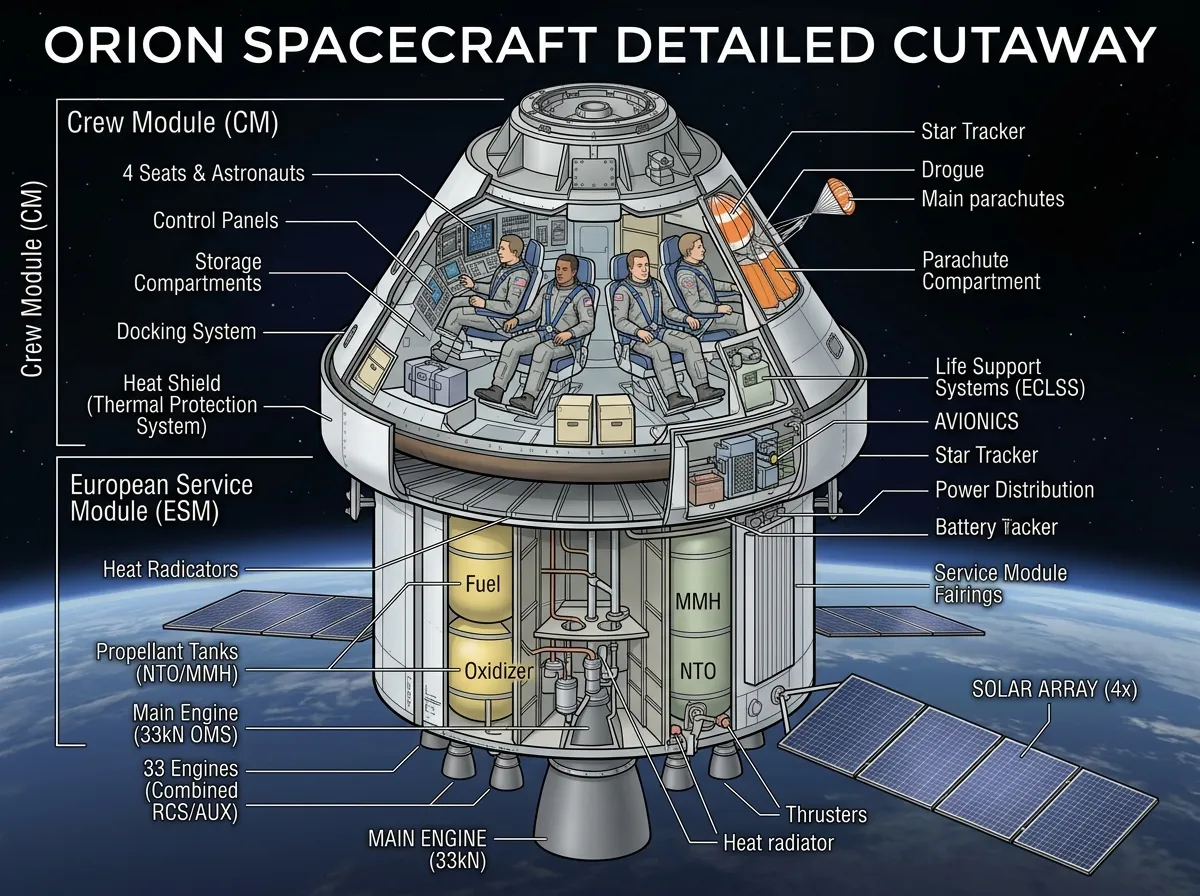
The Artemis II mission profile looks deceptively simple on a trajectory map: go to the Moon, swing around it, come home. But the engineering challenge is immense because this flight exists to answer a question that simulations and uncrewed tests can't fully resolve: can the Orion spacecraft keep four humans alive and functional during a deep-space journey?
Artemis I answered part of that question in late 2022, when an uncrewed Orion capsule flew to the Moon and back over 25 days. That flight validated the spacecraft's propulsion, navigation, and communication systems. It also revealed a problem. During reentry, Orion's heat shield lost more material than engineers expected. Chunks of the ablative coating charred unevenly, creating concerns about whether the shield could reliably protect a crew during the roughly 25,000 mph atmospheric reentry that lunar return demands.
NASA's solution was pragmatic rather than dramatic. Rather than redesigning the heat shield, engineers modified the reentry trajectory. Artemis I used a "skip" reentry profile where the capsule bounced off the upper atmosphere before plunging back in, and the skip caused the uneven heating. Artemis II will use a direct entry, hitting the atmosphere at a steeper angle that distributes heat more uniformly across the shield's surface. It's a proven approach: every Apollo capsule used direct entry.
The first 24 hours after launch will be the most critical testing window. The crew will run exhaustive checks on communications, navigation, life support, and waste management systems while still close enough to Earth for a quick return if something fails. Only after those systems check out will mission control authorize the trans-lunar injection burn that commits the spacecraft to its four-day coast toward the Moon.
The Far Side in Sunlight
Perhaps the most scientifically compelling moment of Artemis II will happen when the crew swings around the Moon's far side. At closest approach, roughly 4,100 miles from the lunar surface, the four astronauts will observe terrain that no human eyes have ever seen in direct sunlight.
Every Apollo mission approached the Moon from a trajectory that kept the far side mostly in shadow during their flybys. Artemis II's orbital geometry is different, placing approximately 21% of the far side in sunlight during the flyby window. The crew will photograph and observe features that have only ever been mapped by robotic probes, including the South Pole-Aitken Basin, the largest and oldest known impact structure in the solar system at roughly 1,600 miles across and 5 miles deep.
This matters beyond the photographs. The South Pole-Aitken Basin is the leading candidate region for future Artemis landing missions because radar data suggests it contains water ice in permanently shadowed craters. Human observations during the flyby, even from 4,100 miles, will help calibrate the robotic data that mission planners are using to select specific landing sites. The connection between what the Artemis II crew sees and where the Artemis IV or V crew eventually sets down is direct and intentional.
For a broader look at everything happening beyond Earth's atmosphere this year, including the lunar gateway station and Mars sample return debates, see our 2026 space exploration overview.
Why It Took 54 Years to Go Back
The gap between Apollo 17 in December 1972 and Artemis II in April 2026 is not a story of lost interest. It's a story of lost infrastructure, political whiplash, and the brutal economics of deep-space travel.
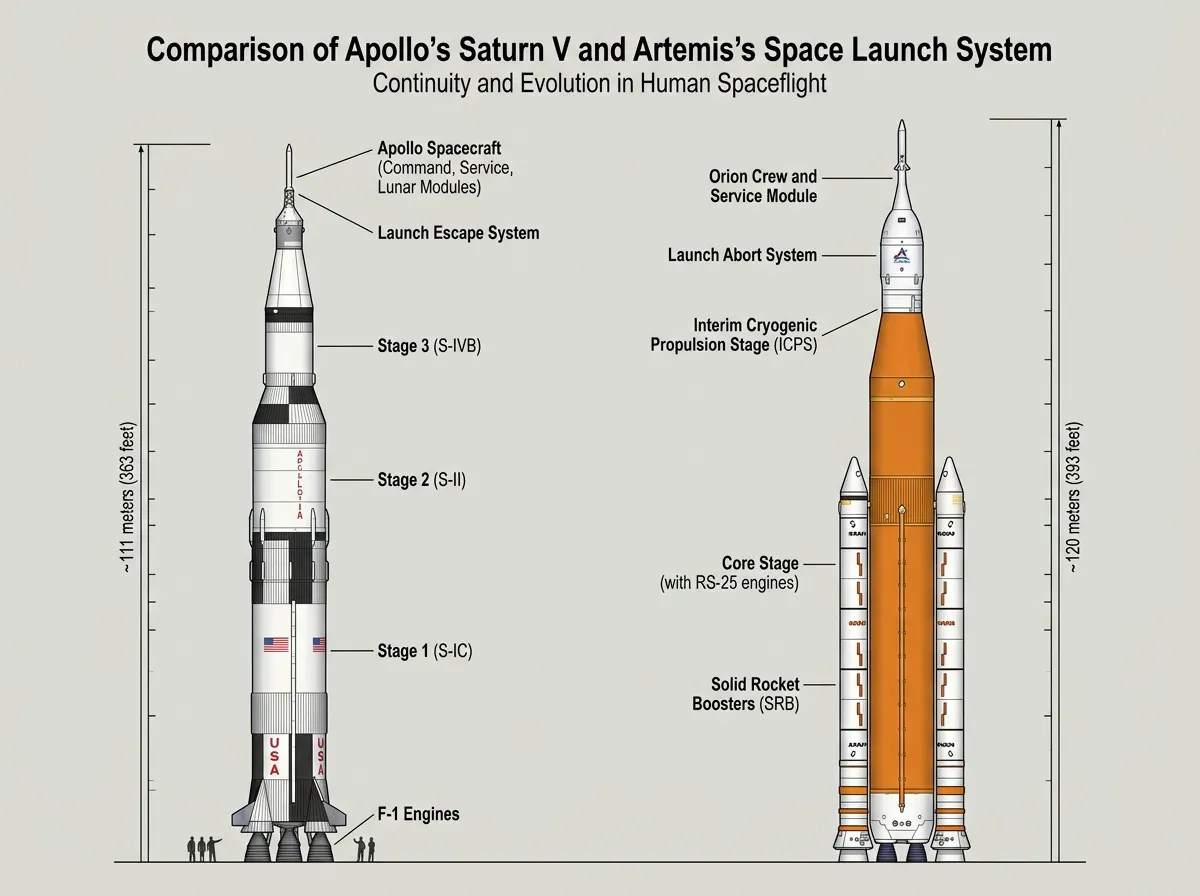
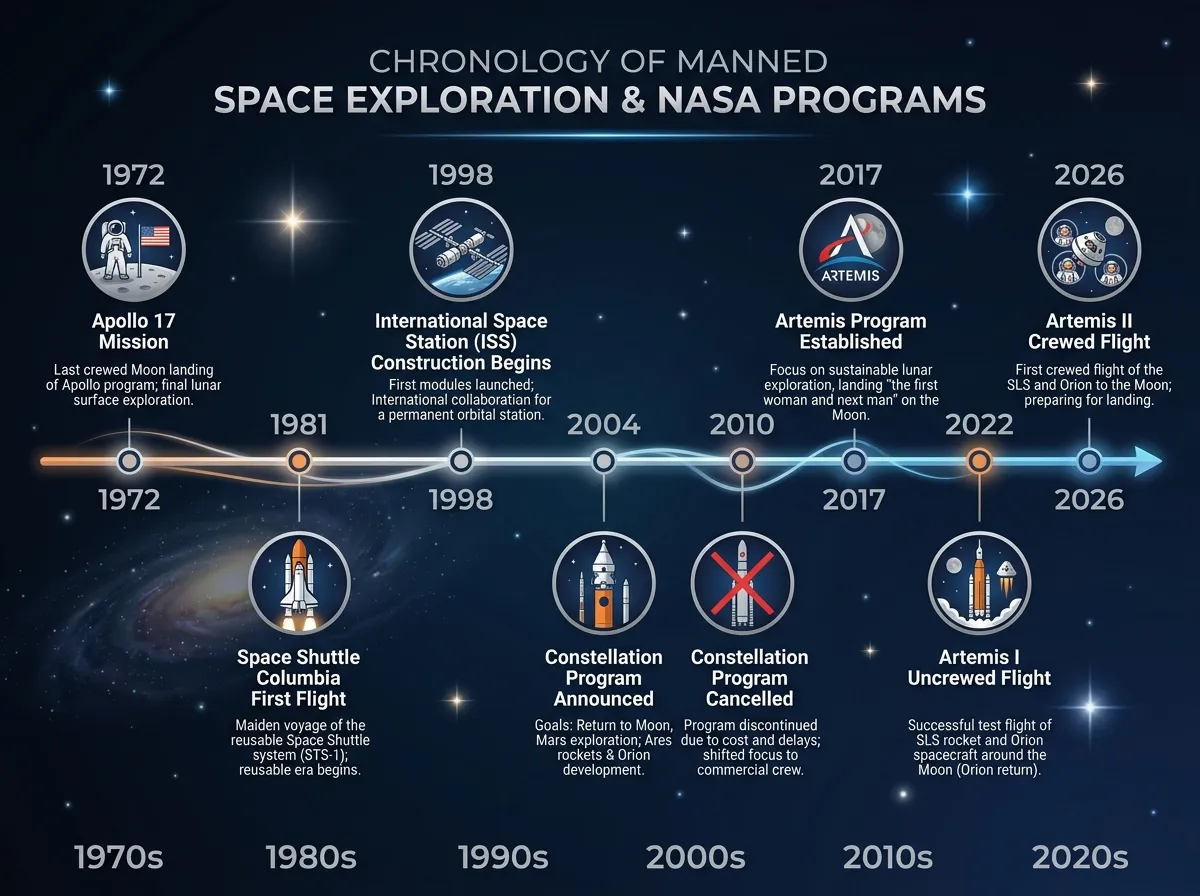
When Nixon cancelled Apollo 18, 19, and 20 to redirect funding toward the Space Shuttle program, NASA didn't just stop going to the Moon. It dismantled the production lines for the Saturn V, the only rocket powerful enough to get there. The engineers who built it retired or moved on. The institutional knowledge of how to send humans beyond low Earth orbit slowly evaporated from the agency like propellant from an untended tank.
Every subsequent president had a different vision for NASA's future. George H.W. Bush proposed a Moon-to-Mars initiative in 1989 that Congress defunded. George W. Bush launched the Constellation program in 2004, which was cancelled by Obama in 2010 in favor of an asteroid-redirect mission. Trump revived the lunar goal with the original Artemis program in 2017, and Biden kept it alive despite initial skepticism.
The result is that Artemis II is flying hardware that has been in development, in one form or another, since 2005. The SLS rocket traces its lineage to the Ares V concept from the Constellation era. The Orion capsule was originally called the Crew Exploration Vehicle. Both programs survived cancellation and resurrection multiple times, accumulating delays and cost overruns that have made SLS one of the most expensive rockets ever built, at an estimated $4.1 billion per launch.
Whether that cost is justified depends on what you think the search for habitable worlds beyond our solar system is worth. Artemis isn't just about returning to the Moon. It's about building the infrastructure, the heavy-lift rockets, the deep-space habitats, the life support systems, that could eventually carry humans to Mars and beyond.
The Race That Changed the Timeline
Artemis II was originally supposed to fly in 2024. Then early 2025. Then late 2025. Hydrogen fuel leaks in the SLS plumbing and problems with the upper-stage propellant pressurization system pushed the launch to February 2026, and then to April after engineers needed additional time to verify fixes.
What accelerated the program through its final delays was not engineering, but geopolitics. China's Chang'e program has been landing increasingly sophisticated robotic missions on the Moon since 2013, and in 2024, the China National Space Administration announced a crewed lunar landing target of 2030. The Long March 10 rocket that will carry Chinese taikonauts to the Moon completed its first successful test flight in early 2026.
The prospect of China planting a flag on the Moon before America returns has injected bipartisan urgency into NASA's funding. The Artemis program received its full budget request for fiscal year 2026 with minimal congressional debate, a stark contrast to the years of cuts and continuing resolutions that had slowed the program. NASA Administrator Bill Nelson has repeatedly framed Artemis as a demonstration of democratic values in space, though the more straightforward read is that neither political party wants to explain to voters why China got to the Moon first.
The competition is not purely symbolic. Whoever establishes a sustained presence near the lunar south pole gains first-mover advantage on potential water ice extraction, a resource that could be converted into rocket propellant and dramatically reduce the cost of future deep-space missions. China, the United States, and the European Space Agency are all targeting the same region. Artemis II doesn't land there, but it validates the spacecraft and systems that the landing missions will use.
The Bigger Picture
At 6:24 p.m. tomorrow, four people will strap into a capsule atop the most powerful rocket ever launched and point it at the Moon. Nine and a half days later, if all goes well, they'll splash down in the Pacific at roughly 25,000 mph, their heat shield absorbing temperatures that would melt steel, before eleven parachutes slow them to a gentle 15-mph landing on the water's surface.
Between those two moments lies the most ambitious crewed spaceflight since the Apollo program, a mission designed not as an end in itself but as a proof of concept for everything that comes after. Artemis III, currently targeting 2028, will attempt the first crewed lunar landing in over half a century. Artemis IV will begin assembling the Lunar Gateway, a small space station in lunar orbit that will serve as a staging point for surface missions. And somewhere beyond that, using the systems Artemis is building and testing, lies the eventual goal that has animated NASA's long-range planning for decades: sending humans to Mars.
All of that depends on what happens this week. The Orion capsule has to prove it can keep four people alive in deep space. The heat shield has to hold during a reentry no crewed spacecraft has attempted since 1972. The communication systems have to maintain contact across a quarter-million miles of void. These are not theoretical concerns. They are the specific, testable questions that Artemis II exists to answer.
Fifty-four years is a long time between visits. But the door that Apollo closed in 1972 is about to reopen, and this time, the plan is to walk through it and stay.
Sources
- NASA: Artemis II Mission Page - Official mission overview, crew details, and spacecraft specifications
- CBS News: NASA Artemis II Moon Launch Flight Plan - Detailed mission timeline, crew backgrounds, and heat shield analysis
- Space.com: Artemis 2 Live Launch Updates - Real-time countdown and pre-launch status
- NASA Blog: Artemis II Launch Countdown - Technical countdown milestones and weather assessment