
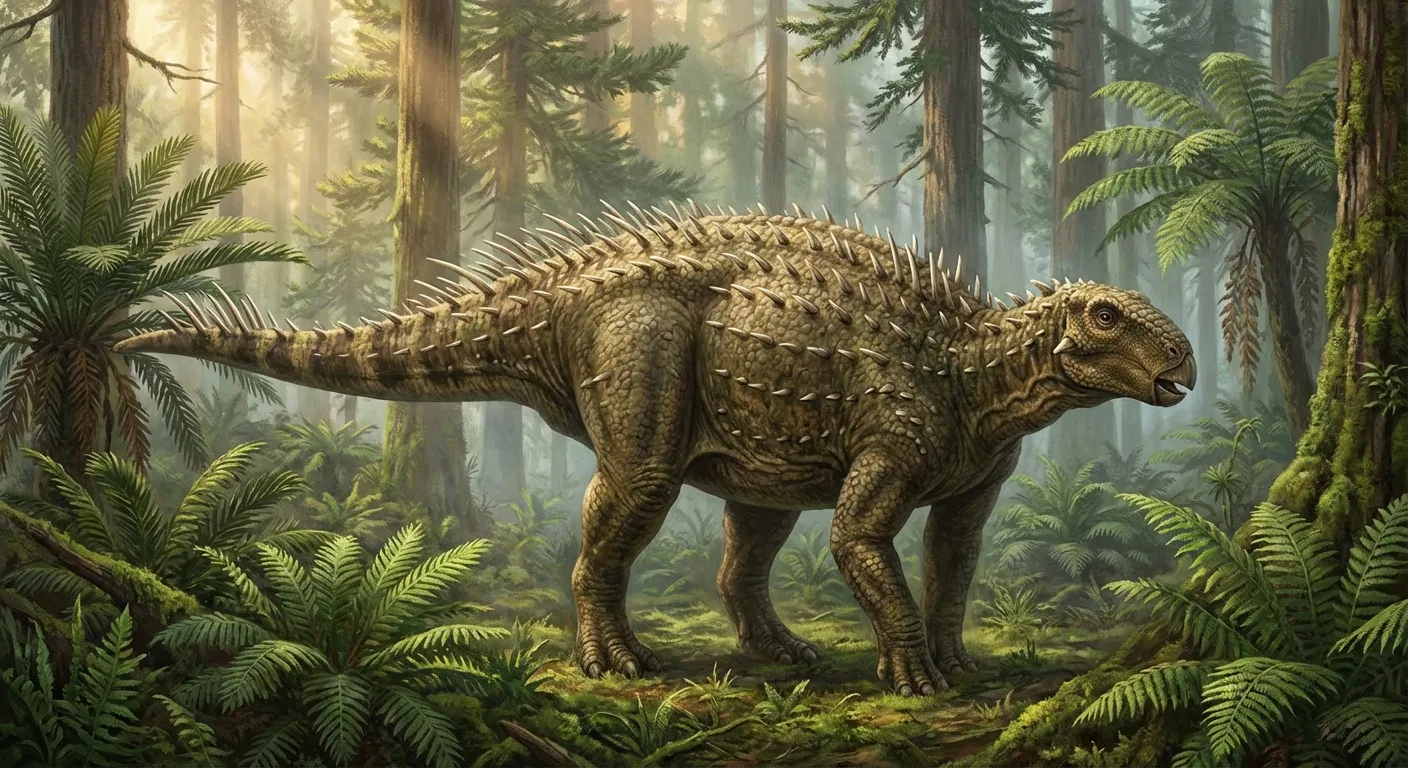
We think we know what dinosaurs looked like. Museum reconstructions, documentary animations, and decades of paleoart have created a mental image of these animals that feels almost real: scaly, armored, often drab. But that image is built on surprisingly thin evidence. Fossilized skin is exceedingly rare, and when it does preserve, the detail is usually limited to surface impressions, the texture without the underlying structure.
A discovery published in Nature Ecology & Evolution on February 6, 2026, changes the equation. Researchers from the French National Centre for Scientific Research (CNRS) and an international team of collaborators have described a new species of dinosaur from northeastern China that preserves skin not just at the level of texture but at the cellular level. The animal, named Haolong dongi, was an iguanodontian herbivore that lived approximately 125 million years ago during the Early Cretaceous. Its skin is covered in hollow, cutaneous spikes unlike anything previously observed in a non-avian dinosaur.
These spikes are not scales, and they are not feathers or protofeathers. What they are, and why their internal architecture matters so much, requires looking at the specimen closely. And because the preservation extends to individual skin cells, complete with visible nuclei, the find lets researchers examine dinosaur integument with a level of detail that has simply not been available before.
The Specimen and Its Extraordinary Preservation
Haolong dongi was discovered in the Jehol Biota deposits of Liaoning Province, a region in northeastern China famous for producing some of the most spectacularly preserved fossils on Earth. The Jehol deposits formed when volcanic eruptions periodically buried entire ecosystems in fine ash, creating conditions that preserve soft tissues with extraordinary fidelity. The same deposits have yielded feathered dinosaurs, complete insects, and plants with flowers still attached.
The Haolong specimen is a nearly complete juvenile skeleton, small enough to suggest the animal was not fully grown. But it's the skin that makes it exceptional. Large patches of integument survive across the body, particularly along the tail and around the neck and thorax. This skin shows two distinct types of scales: large, overlapping scutate scales along the tail, and smaller tuberculate scales around the neck. Neither type is unusual on its own. Many dinosaur skin impressions show similar scale patterns.
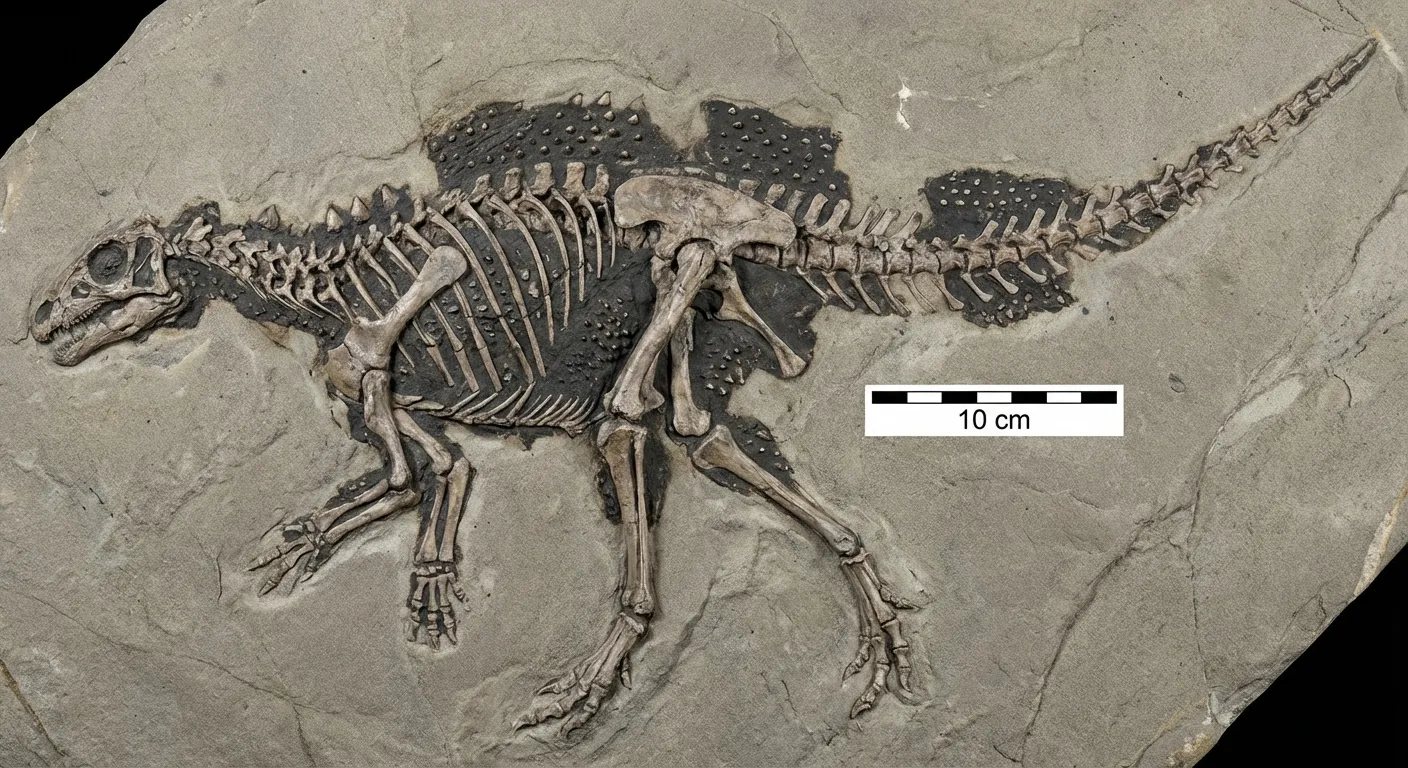
What sets Haolong apart are the spikes interspersed among the scales. These cutaneous projections range from tiny, just 2 to 3 millimeters in length, to substantial structures approximately 4 centimeters long. They likely resembled short porcupine quills in life: stiff, pointed, and projecting outward from the body surface.
The species name honors Dong Zhiming, a pioneer of Chinese paleontology who spent decades cataloguing the dinosaur fauna of China and whose work laid the foundation for the discoveries that followed.
Hollow Spikes and Preserved Cells
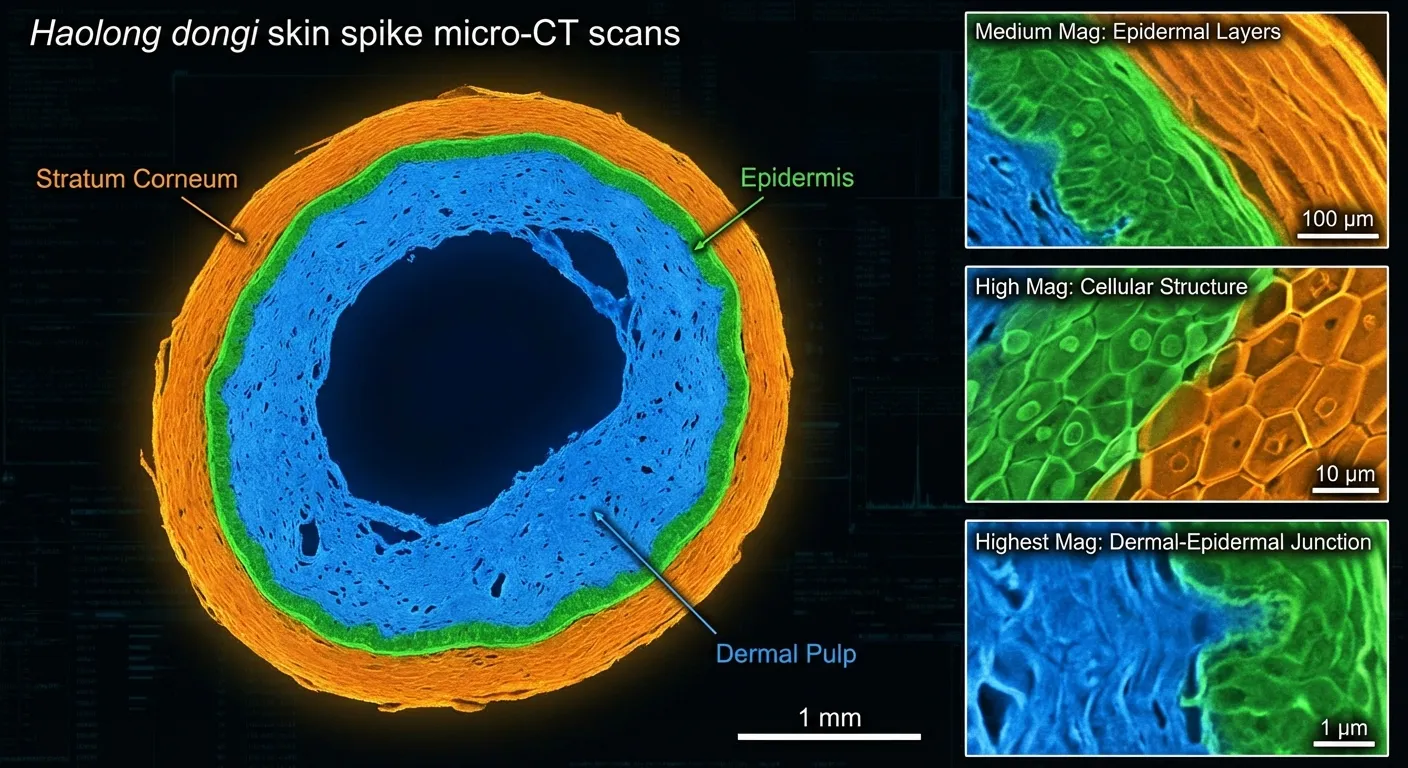
The researchers used X-ray micro-computed tomography (micro-CT) and histological thin sections to examine the spike structure at high magnification. What they found inside was startling: the spikes are hollow.
Each spike consists of an outer wall of cornified tissue (essentially hardened keratin, the same protein that makes up human fingernails and bird feathers) surrounding a central cavity filled with a porous dermal material. The outer layer, called the stratum corneum, is the same layer that forms the surface of skin in modern reptiles and mammals. Beneath it lies a pluristratified epidermis, multiple layers of skin cells stacked on top of each other.
The preservation quality is remarkable. Individual keratinocytes, the cells that produce keratin, are visible with internal structure intact. Cell nuclei can be identified within some cells. This level of preservation in a 125-million-year-old specimen is nearly unprecedented and provides direct information about the cellular architecture of dinosaur skin.
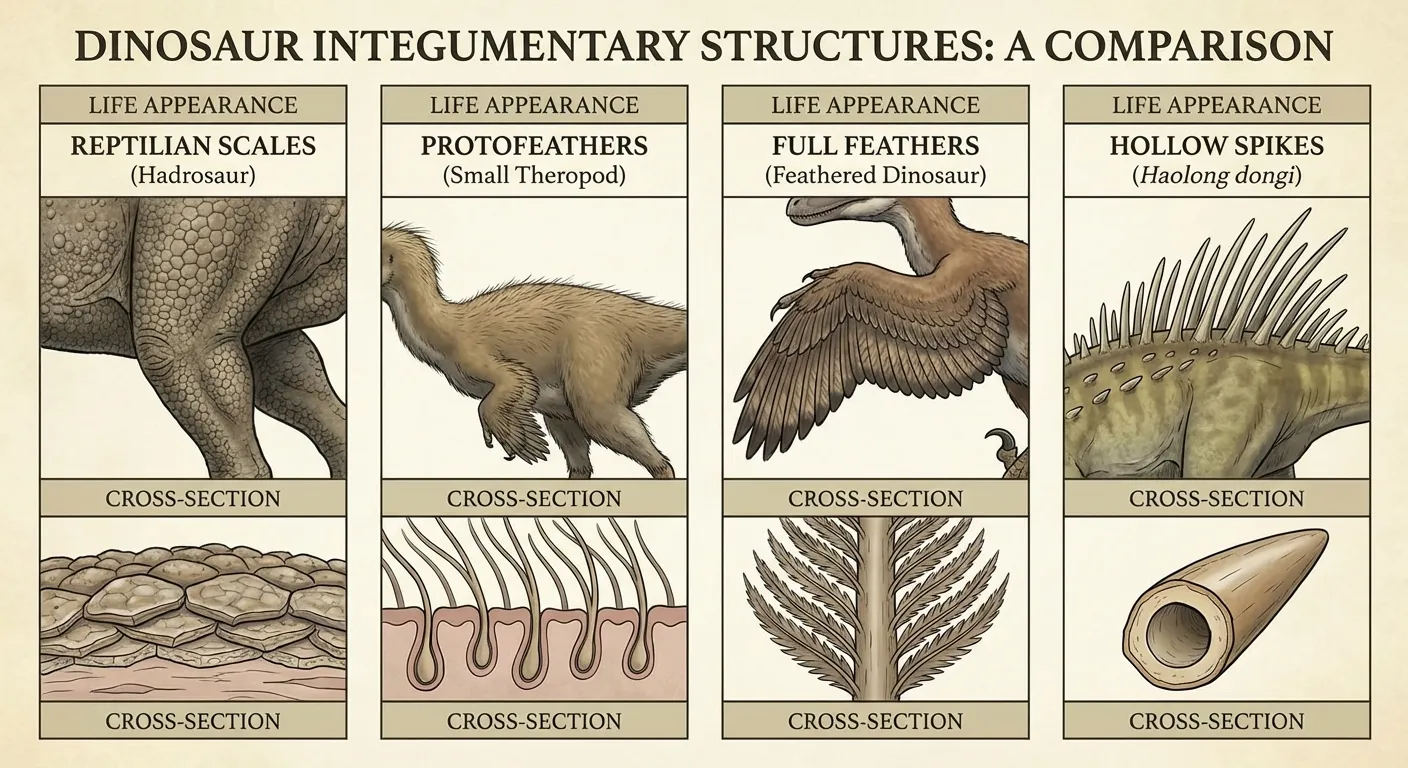
The hollow structure is what makes the spikes truly novel. Feathers and protofeathers, found in many theropod dinosaurs, are also keratinous structures but develop from follicles and have a fundamentally different architecture. The scaly spines found on modern lizards, such as the spiny-tailed iguana, are solid keratinous projections. The hollow, quill-like structures in Haolong don't match either pattern. They appear to represent a distinct evolutionary innovation, a way of making skin armor that no known living animal or previously described fossil uses.
What the Spikes Were For
Understanding the function of these structures requires reasoning about ecology and behavior, since no direct experimental test is possible on an extinct animal. Several hypotheses emerge from the physical evidence.
Defense is the most intuitive explanation. Haolong dongi was a herbivore living in an environment populated by small carnivorous dinosaurs, including various feathered theropods known from the same deposits. A body covered in sharp, projecting spikes would make an unappealing target. The hollow structure might have been advantageous in this context: hollow spikes could be longer and more conspicuous than solid ones while weighing less, providing a defensive display without excessive metabolic cost.
Display offers another possibility. Many modern animals use integumentary structures, from peacock feathers to porcupine quills, for communication. The spikes could have served a role in species recognition, mate selection, or territorial signaling. Their distribution across the body, varying in size by region, is consistent with structures that convey visual information.
Thermoregulation is a less obvious but plausible function. The hollow interior could have allowed air circulation close to the body surface, potentially assisting with heat dissipation in warm environments. Modern animals use various integumentary structures for temperature management, and the Early Cretaceous climate of northeastern China was warm enough to make thermal regulation relevant.
The most likely answer is that the spikes served multiple functions simultaneously, a pattern common in biological structures. Feathers, for example, originally evolved for insulation or display before being co-opted for flight. The hollow spikes of Haolong may have provided defense, visual signaling, and thermal benefits in varying proportions depending on context.
Filling In the Missing Picture
The Haolong discovery contributes to a broader revolution in how paleontologists understand dinosaur appearance. For most of the history of paleontology, dinosaurs were reconstructed as essentially giant lizards: gray or green, covered in uniform scales, and visually boring. This image began to change in the 1990s with the discovery of feathered dinosaurs in China, revealing that many theropods were covered in plumage rather than scales.
But feathers are only part of the story. The integument of dinosaurs, like that of modern animals, was almost certainly diverse, varying between species, body regions, and ecological contexts. Some dinosaurs had scales. Some had feathers. Some had a mix of both. The Haolong discovery adds another option to the catalog, and it comes from a group of dinosaurs, the iguanodontians, that nobody was looking at for integumentary surprises. Most iguanodontian skin impressions show conventional scales, making this find a reminder that even well-studied lineages can hold hidden complexity.
The cellular-level preservation in Haolong provides information that no amount of skeletal anatomy could offer. Bones tell us about shape and movement. Skin tells us about appearance, ecology, and physiology. The distinction matters because our understanding of dinosaurs has been overwhelmingly shaped by bones, which preserve far more readily than soft tissue. Every well-preserved skin specimen adds disproportionately to our knowledge.
The Jehol Biota continues to be the most important source of these discoveries. The volcanic ash that buried these ecosystems created preservation conditions that are globally rare and scientifically invaluable. More than 60 species of feathered dinosaurs have been described from these deposits, along with the earliest known flowers, the oldest known placental mammal, and countless other organisms preserved in extraordinary detail.
The connection to how we understand biological evolution and adaptation is fundamental. Every new integumentary discovery forces paleontologists to reconsider assumptions about dinosaur ecology, behavior, and evolutionary relationships. If a herbivorous iguanodontian could evolve hollow skin spikes, what other integumentary innovations remain undiscovered in the fossil record?
The Significance of Cellular Preservation
The preservation of individual cells in a 125-million-year-old specimen raises questions about the chemistry of fossilization itself. How do cellular structures survive for geological time? Under normal conditions, cells decompose within days of death, broken down by bacteria, enzymes, and simple chemistry.
The answer involves a combination of rapid burial and chemical replacement. The volcanic ash that buried the Jehol organisms was extremely fine-grained, excluding oxygen and bacteria almost immediately. Under these anaerobic conditions, the organic molecules in cells were gradually replaced by minerals, silica and iron compounds primarily, that replicated the original structures at submicron resolution. The cell shapes are preserved, but the original organic material has been replaced by stone.
This process, called authigenic mineralization, works best when burial is rapid and the surrounding sediment chemistry favors mineral precipitation. The Jehol deposits provide ideal conditions, which is why they consistently produce fossils of exceptional quality.
Understanding how fossilization preserves cellular detail helps calibrate expectations for other discoveries. Not every fossil deposit will produce cellular-level preservation, but knowing the conditions required helps paleontologists identify deposits where such preservation might occur. Future excavations targeting similar volcanic ash beds in other parts of the world could yield comparable specimens.
The Bigger Picture
Haolong dongi, the "spiny dragon," is a single species from a single time and place. But what it reveals has implications that extend across the entire history of dinosaurs. The Jehol Biota deposits have produced more than 60 feathered dinosaur species, and each new find has expanded the known range of integumentary diversity. With Haolong, that expansion jumps into genuinely uncharted territory, raising the question of how many other body coverings existed in lineages whose fossils typically preserve only bone.
The discovery also challenges the assumption that the most interesting aspects of dinosaur biology are captured by skeletal anatomy. Bones are the foundation of paleontology for practical reasons: they are the structures most likely to fossilize. But the skeleton of Haolong dongi, while interesting, would not have predicted the hollow spikes that covered its body. The animal's most remarkable feature is invisible in its bones.
This gap between what fossils typically preserve and what organisms actually looked like is worth keeping in mind when we imagine the prehistoric world. The golden age of species discovery is not limited to finding new skeletons. It includes finding new ways to see the organisms those skeletons belonged to. A dinosaur covered in hollow quills, looking more like a spiny hedgehog than a scaly lizard, is a reminder that the past was stranger and more varied than our imagination typically allows.
Dong Zhiming, the paleontologist honored in the species name, spent his career arguing that China's fossil record held surprises that the scientific world hadn't yet appreciated. He was right. Haolong dongi, with its porcupine-quill skin preserved down to individual cell nuclei, is exactly the kind of surprise he predicted. The spiny dragon waited 125 million years to be seen as it truly was. The view was worth the wait.
Sources
- Nature Ecology & Evolution: Cellular-level preservation of cutaneous spikes in an Early Cretaceous iguanodontian dinosaur
- CNRS: A dinosaur with spikes exhibiting unprecedented properties discovered in China
- Phys.org: A dinosaur with spikes exhibiting unprecedented properties discovered in China
- Sci.News: Paleontologists Unearth New Dinosaur Species with Never-Before-Seen Skin Structures