
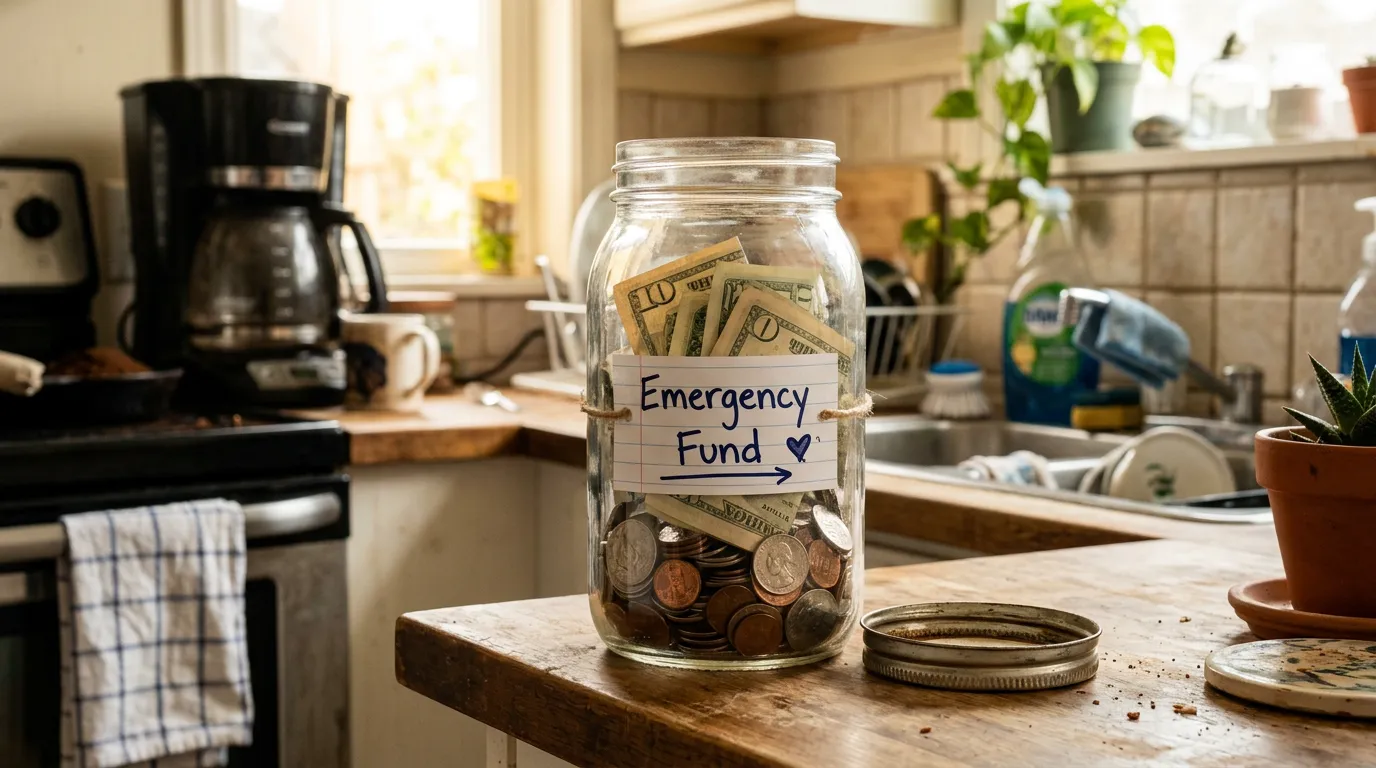
If you've ever searched "how to build an emergency fund" while knowing you barely have enough to cover this month's bills, most of the advice probably felt useless. Articles telling you to "just save 20% of your income" aren't helpful when your income is already spoken for. But here's what those articles get wrong: an emergency fund doesn't start at $10,000. It starts at $25.
The Federal Reserve's most recent survey found that 37% of Americans can't cover a $400 emergency expense with cash or equivalent savings. A Bankrate report from early 2026 found that 24% of Americans have zero emergency savings. A U.S. News survey from January 2026 puts it starkly: 43% of Americans can't pay for a $1,000 emergency with savings. These aren't people who are bad with money. Many are working full-time jobs that simply don't leave much margin.
This guide is for people in that situation. The strategies here are designed for tight budgets, and they work because they start absurdly small and build through automation rather than willpower.
Why $500 Changes Everything
Financial advisors typically recommend three to six months of essential expenses as an emergency fund target. For a household spending $3,000 monthly, that's $9,000 to $18,000. That number can feel paralyzing when you're living paycheck to paycheck, so ignore it for now. Your first target is $500.
Why $500? Because it covers the most common financial emergencies: a car repair, a medical copay, a broken appliance, or an emergency vet visit. Research from the Consumer Financial Protection Bureau shows that households with even modest emergency savings are significantly less likely to miss bill payments or take on high-interest debt when something goes wrong. The CFPB's own guidance emphasizes that there's no one-size-fits-all amount and that "even small amounts provide meaningful security."
The psychological shift matters too. Once you have $500 set aside and something breaks, you pay for it from savings instead of a credit card. You skip the interest charges, the stress spiral, and the feeling that you'll never get ahead. That single experience of covering an emergency without debt often becomes the motivation to keep building. Dave Ramsey's "Baby Step 1," saving an initial $1,000 as a starter emergency fund, follows the same logic: make the first goal achievable so that saving becomes a habit before it becomes a lifestyle.
Five Methods That Work on Any Income
These strategies don't require you to find hundreds of extra dollars. They work by redirecting money you're already spending, automating decisions so you don't have to think about them, and starting so small that you can't talk yourself out of it.
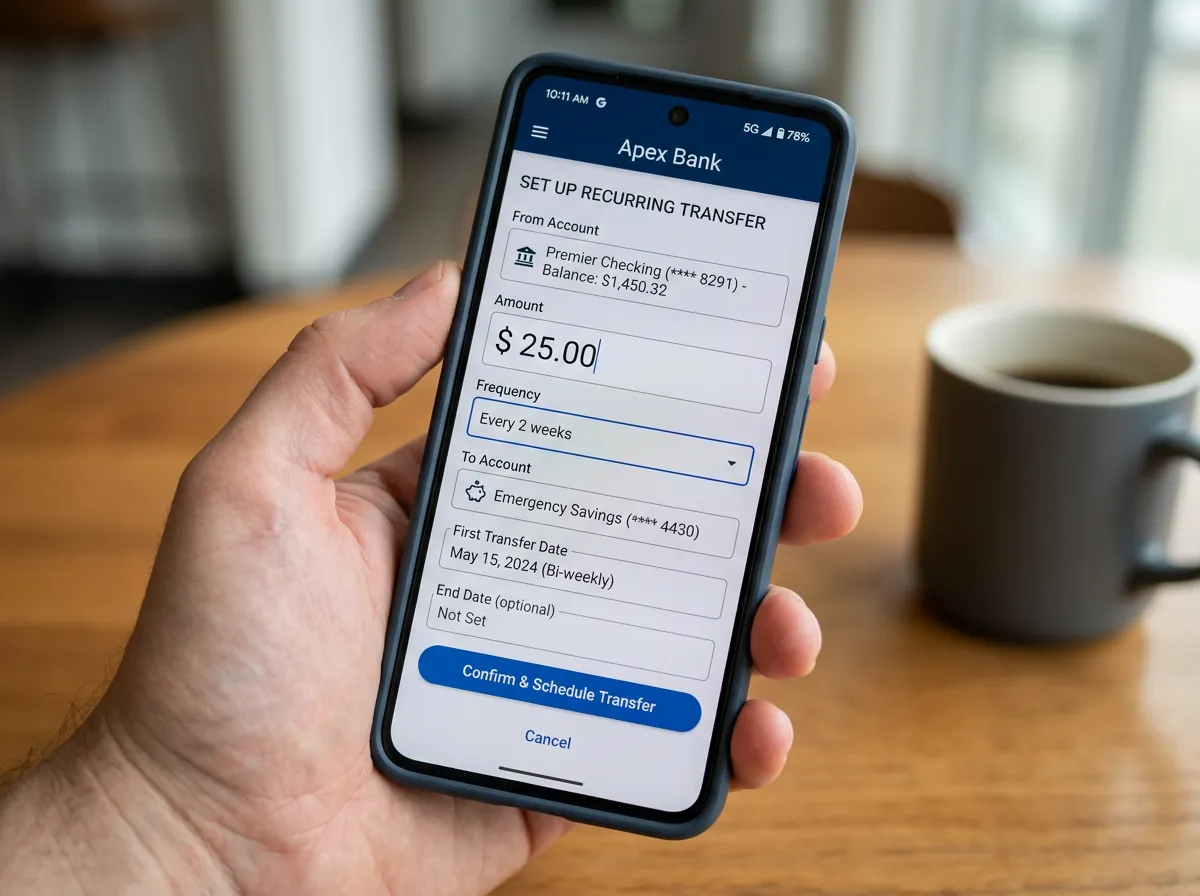
Method 1: The Automatic $25. Set up a recurring transfer of $25 from your checking account to a savings account on the day after each payday. Most banks let you do this through their app in under two minutes. Twenty-five dollars per paycheck is $650 per year if you're paid biweekly. You'll hit $500 in about 10 months. The key is choosing an amount small enough that you genuinely won't notice it missing. If $25 feels tight, start at $10. The amount matters less than the automation. The CFPB specifically recommends this approach: set up the transfer, forget about it, and let consistency do the work.
Method 2: Direct Deposit Splitting. Most employers allow you to split your paycheck between multiple accounts through direct deposit. Have $25 or $50 of each paycheck deposited directly into a separate savings account. The money never hits your checking account, so you never see it as spendable. This is the single most effective savings strategy for people who struggle with willpower, because it removes the decision entirely. Contact your HR department or payroll provider to set this up.
Method 3: The Subscription Audit. The average American spends nearly $200 per year on subscriptions they don't actively use. Check your bank and credit card statements for recurring charges you've forgotten about: streaming services you don't watch, gym memberships you don't use, apps that renewed after free trials. Cancel everything you haven't used in the past 30 days and redirect that money to savings. Even finding $15 per month in unused subscriptions gives you $180 a year toward your emergency fund.
Method 4: The Windfall Rule. Any unexpected income, a tax refund, a birthday check, overtime pay, a rebate, goes directly to your emergency fund. You weren't counting on that money in your budget, so sending it to savings doesn't change your daily life. If your tax refund hits in March and you haven't started an emergency fund yet, that single deposit could put you at or past your $500 target immediately. The IRS lets you split your refund across multiple accounts using Form 8888, so you can send a portion to savings without touching your checking account.
Method 5: Micro-Saving Round-Ups. Several banks and apps (Chime, Acorns, Bank of America's "Keep the Change") automatically round up your debit card purchases to the nearest dollar and transfer the difference to savings. A $4.30 coffee saves $0.70. Across dozens of transactions per month, round-ups typically add $20 to $50 monthly without any conscious effort. It's not life-changing money on its own, but combined with other methods, it accelerates your timeline meaningfully.
Where to Put Your Emergency Fund
Your emergency fund needs to be accessible but not too accessible. Keeping it in your regular checking account means you'll spend it. Investing it in the stock market means you might need it when the market is down. The right home for emergency savings is a high-yield savings account at a different bank than your primary checking account.
Why a different bank? Because the small friction of transferring money between institutions (typically one to two business days) is enough to prevent impulsive spending while still being accessible for genuine emergencies. You don't want to be able to tap into it with a single swipe.
High-yield savings rates remain attractive in early 2026. Online banks like Varo (up to 5.00% APY), Axos Bank (4.21% APY), and Synchrony Bank (3.5% APY) offer rates far above the FDIC national average of 0.39% APY. On a $1,000 balance, the difference between 0.39% and 4% is roughly $36 per year in free money. It's not transformative, but it's better than nothing, and it means your emergency fund grows slightly even when you're not adding to it.
Look for accounts with no minimum deposit requirements, no monthly fees, and FDIC insurance. Ally Bank, SoFi, and Marcus by Goldman Sachs all offer these features. Avoid accounts that charge maintenance fees, which eat into small balances and defeat the purpose of saving.
The Biggest Mistake: Waiting Until You Can "Afford" to Save
The most common reason people give for not having an emergency fund is that they can't afford to save. This feels true in the moment, but it misses a critical point: you also can't afford not to save. Every month without emergency savings is a month where a flat tire, a dental bill, or a broken water heater goes on a credit card at 20% or higher interest, creating a debt hole that's harder to climb out of than the original expense.
Mark Hamrick, Bankrate's senior economic analyst, summarized the state of things directly: "We are essentially a paycheck-to-paycheck nation." His organization's 2026 emergency savings report found that 81% of Americans did not increase their emergency savings this year, 29% have more credit card debt than emergency savings, and 60% are uncomfortable with their current savings level.
The fix isn't earning more money, though that helps. The fix is starting before you feel ready. The first $25 transfer feels pointless. The second one feels slightly less pointless. By the time you have $200 saved, you're invested in the process. By $500, you've changed a behavior pattern. The habit of saving is the real product here, not the dollar amount. Everything that comes after, building a real budget, automating larger savings, eventually reaching three to six months of expenses, grows from that first automated transfer.
A Realistic 12-Month Timeline
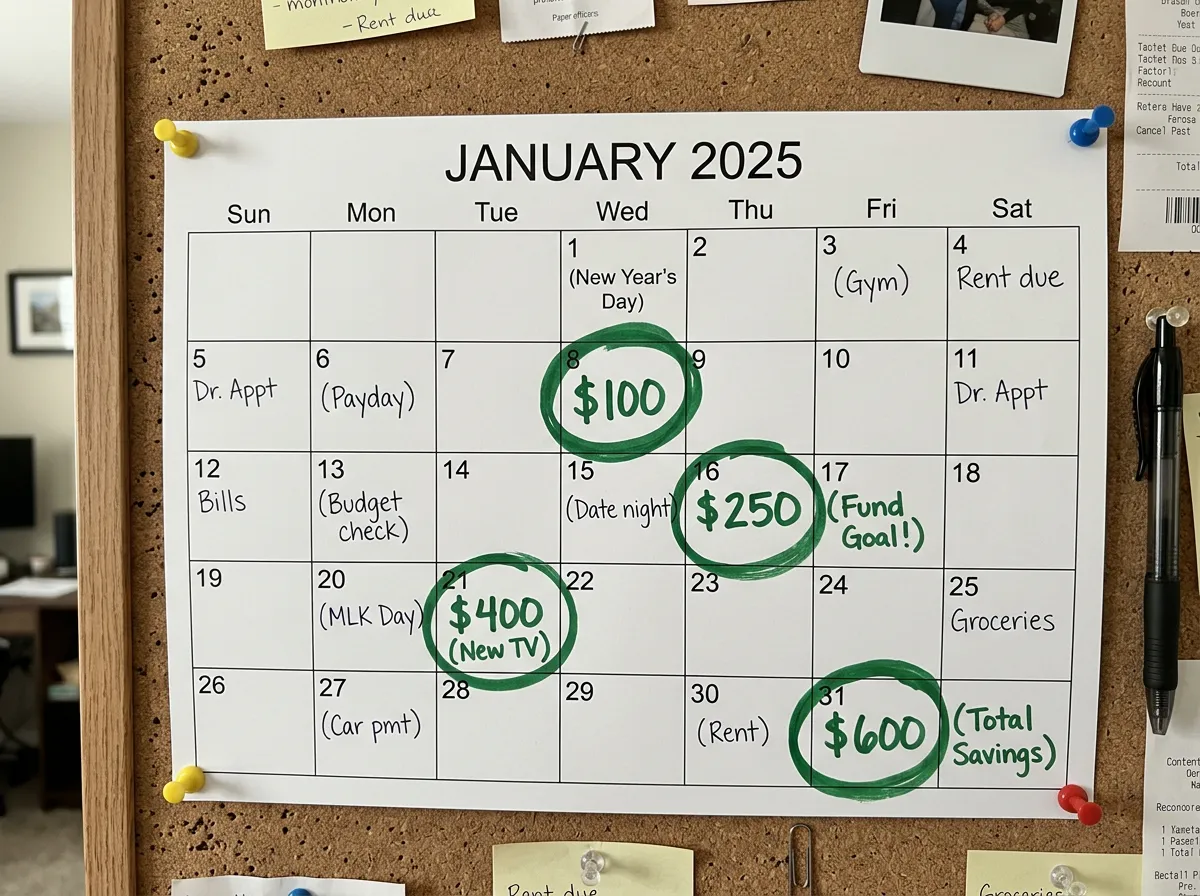
If you combine just two of the methods above, here's what a realistic first year looks like for someone saving $50 per month through automatic transfers plus one $1,500 tax refund windfall:
Months 1-3: Automatic transfers build to $150. You're still in the "this feels pointless" phase, but your account exists and it's growing. Month 4: Tax refund arrives. You direct $500 of it to your emergency fund (keeping the rest for immediate needs). Balance jumps to $650, past your first target. Months 5-12: Automatic transfers continue, adding another $400. You end the year at roughly $1,050.
That timeline assumes no other windfalls, no side income, and no spending cuts beyond the initial subscription audit. One thousand dollars in 12 months on a tight budget is real, achievable progress. It won't make you wealthy, but it will mean the next time your car breaks down or your kid needs an urgent prescription, you won't have to choose between groceries and fixing the problem.
Once you hit $1,000, increase your automatic transfer by $5 or $10. Not because you have more money, but because you've proven you can live without the current amount. The same principle that got you from $0 to $1,000 will get you from $1,000 to $3,000 and eventually to a fully funded three-to-six-month buffer. The math is slow. The security is real.
Summary
You don't need a high income to build an emergency fund. You need a system. Start with an amount small enough that you can't justify skipping it, automate the transfer so you don't have to decide every payday, and put the money in a high-yield savings account at a separate bank so it's accessible but not tempting.
Your first target is $500. Use automatic transfers, direct deposit splitting, subscription audits, windfall redirects, or round-up apps, ideally two or more of these together. Direct your next tax refund to savings. The 43% of Americans who can't cover a $1,000 emergency aren't there because they're careless. They're there because nobody set up the system for them. Set up yours today, even if the first transfer is just $10.
Sources
- Economic Well-Being of U.S. Households in 2024: Savings - Federal Reserve, May 2025
- An Essential Guide to Building an Emergency Fund - Consumer Financial Protection Bureau
- Bankrate's 2026 Emergency Savings Report - Bankrate, 2026
- 43% of Americans Can't Pay for a $1,000 Emergency - U.S. News, January 2026
- DOGE Mass Federal Workforce Cuts May Cost Taxpayers Billions - Fortune, 2025