
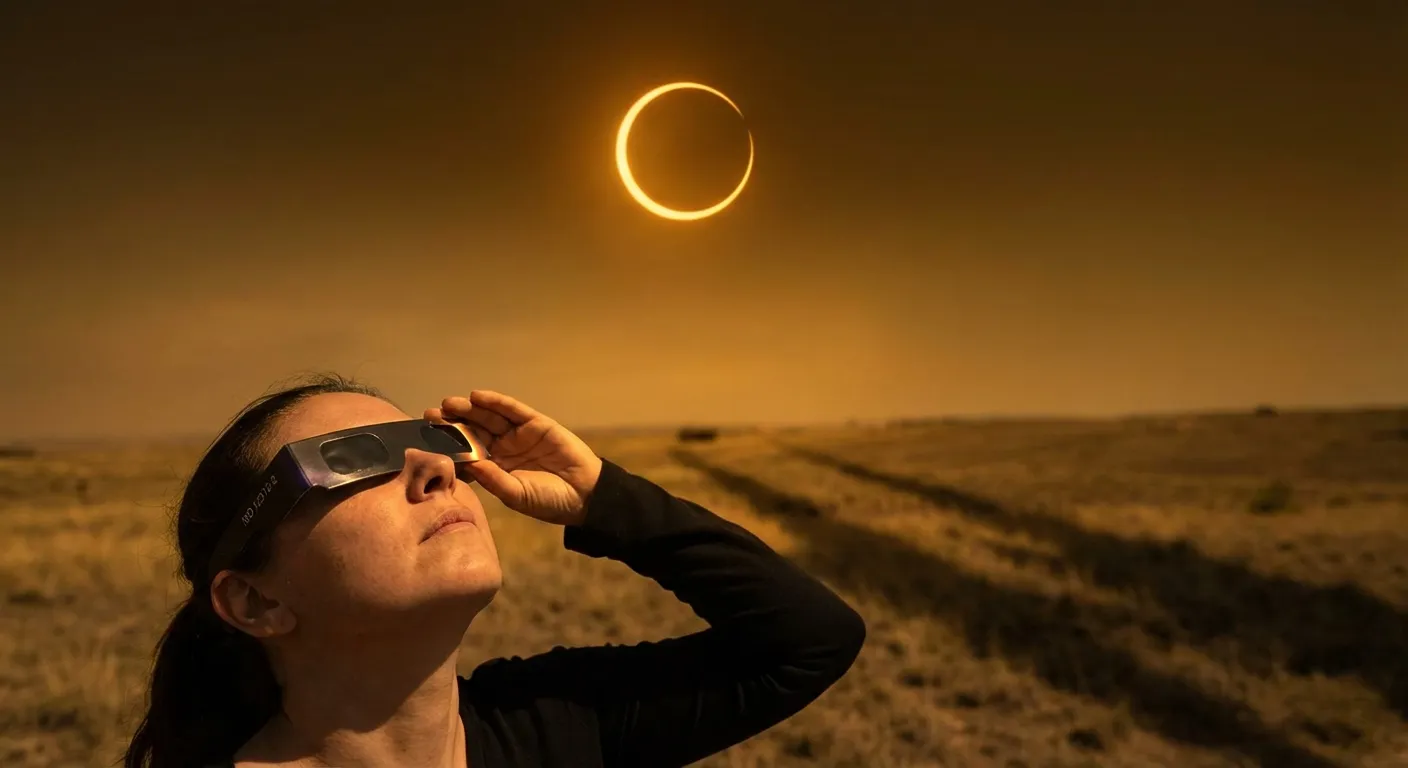
How can you safely watch the annular solar eclipse on February 17, 2026? You need ISO 12312-2 certified eclipse glasses or a pinhole projector. Regular sunglasses, even very dark ones, do not provide adequate protection. This annular eclipse will be visible as a partial eclipse from parts of southern Africa and Antarctica, with the full "ring of fire" effect visible along a narrow path crossing those regions. For viewers in North America, Europe, and Asia, livestreams from NASA, the European Space Agency, and astronomy organizations will be the best way to watch.
Unlike a total solar eclipse where the moon completely covers the sun, an annular eclipse happens when the moon is slightly farther from Earth in its orbit and appears too small to fully block the sun. The result is a bright ring of sunlight surrounding the dark disk of the moon, often called a "ring of fire." Because the sun is never fully blocked, you must use eye protection throughout the entire event. There is no safe moment to look at an annular eclipse with bare eyes.
Where the Eclipse Will Be Visible
The February 17, 2026 annular eclipse follows a path that primarily crosses the southern Atlantic Ocean, the southern tip of Africa, and parts of Antarctica. According to NASA's eclipse prediction data, the annular phase begins over the South Atlantic and tracks southeast toward the Antarctic coast.
Observers in South Africa, Mozambique, and Madagascar will see a partial eclipse where the moon covers a significant portion of the sun without creating the full ring. The closer you are to the path of annularity, the more dramatic the partial eclipse will appear. In Cape Town, roughly 60% of the sun's disk will be obscured at maximum eclipse, which occurs around midday local time.
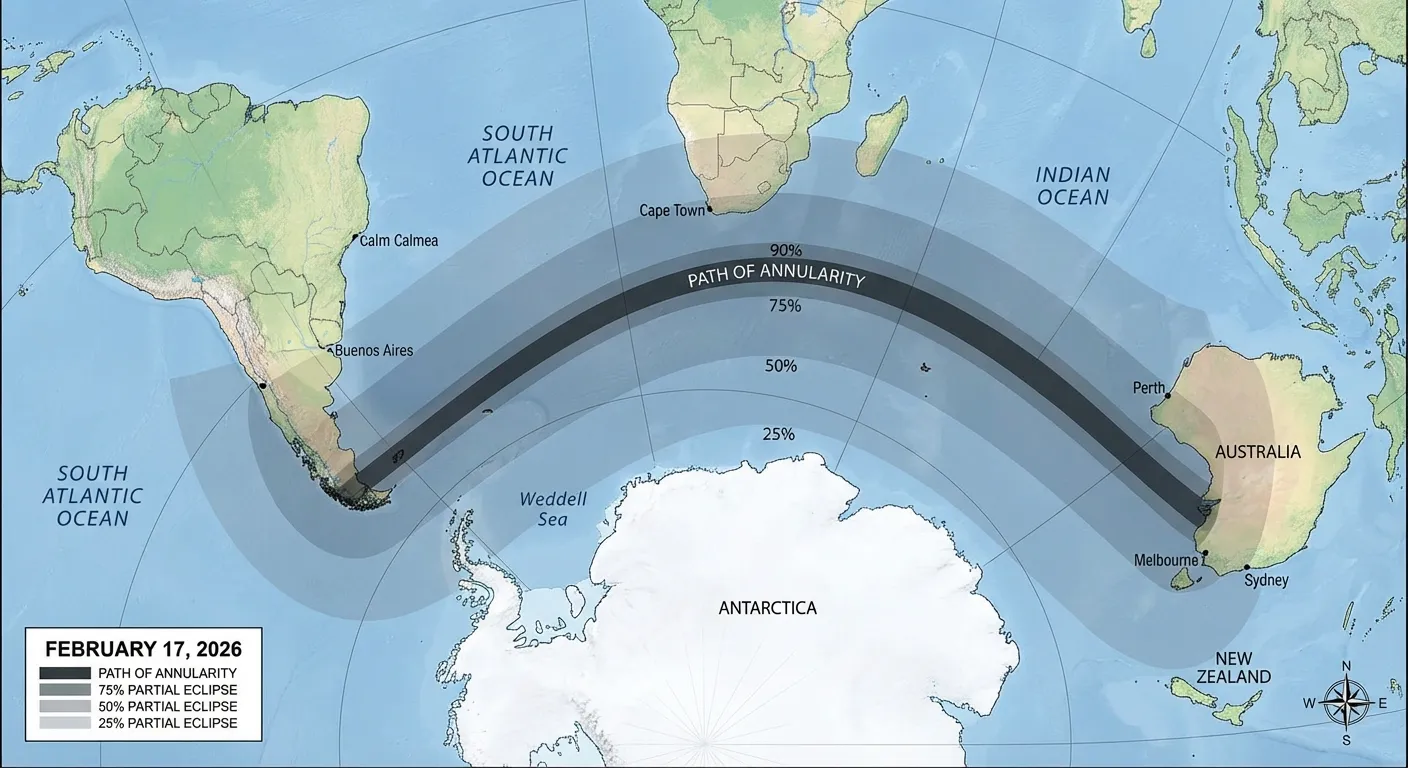
For most of North America, this eclipse won't be visible at all. The geometry simply places the shadow too far south. However, this is a good warm-up for the much more dramatic total solar eclipse on August 12, 2026, which will cross Greenland, Iceland, and Spain. That event will be far more accessible to viewers in the Northern Hemisphere.
Essential Safety Equipment
The American Astronomical Society and NASA both emphasize that the only safe way to look directly at any phase of an annular eclipse is through ISO 12312-2 certified eclipse glasses or handheld solar viewers. This international safety standard ensures the filters block 99.99% of visible light and all harmful ultraviolet and infrared radiation.
Eclipse glasses are the simplest option. They cost between $2 and $15 per pair and are available from astronomy retailers, science museums, and some libraries. Before buying, verify the manufacturer appears on the American Astronomical Society's list of reputable vendors. Counterfeit eclipse glasses have been a persistent problem, with the AAS documenting dozens of unsafe products sold through major online retailers.
Inspect your glasses before using them. If the filters are scratched, punctured, or peeling away from the frame, discard them. When you put them on, you should see nothing except the sun itself, as a bright orange or white disk against a completely black background. If you can see room lights, streetlights, or anything other than the sun, the glasses are damaged or counterfeit.
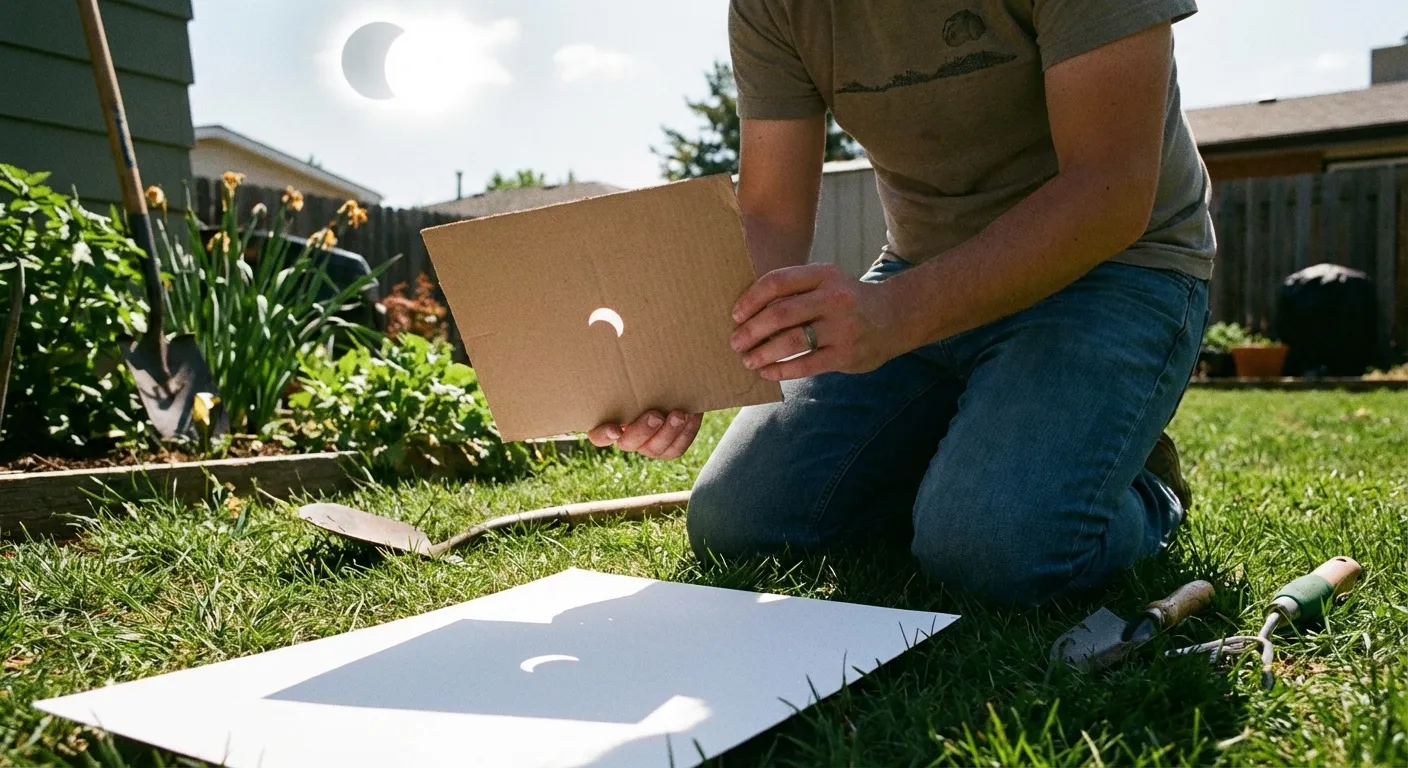
Pinhole projectors offer a completely safe indirect viewing method. Poke a small hole in a piece of cardboard or stiff paper, hold it up with the sun behind you, and look at the projected image on the ground or another piece of paper. During a partial eclipse, you'll see a crescent shape instead of a round dot. This method never involves looking at the sun directly.
Welding filters rated shade 12 or higher also work, though they produce a green-tinted image. Shade 14 is ideal for most solar viewing. Lower-rated welding filters do not provide sufficient protection.
Solar telescope filters designed to fit over the front of a telescope or binocular lens allow magnified views of the eclipse. Never use a telescope, binoculars, or camera viewfinder to look at the sun without a proper solar filter attached to the front of the instrument. The concentrated light can cause instant and permanent eye damage.
What NOT to Use
Certain items that seem like they should work are actually dangerous for eclipse viewing.
Regular sunglasses block only a fraction of visible light and almost none of the infrared radiation that damages your retina. Even stacking multiple pairs of sunglasses does not make them safe. Smoked glass, exposed film negatives, and CDs are similarly inadequate and have caused documented eye injuries during past eclipses.
Camera neutral density filters, even very strong ones, are designed for photography and do not block the specific wavelengths that cause retinal damage. Using a camera's LCD screen or your phone's camera to view the eclipse is generally safer than looking directly, but pointing a phone camera at the sun without a solar filter can damage the camera sensor over extended periods.
Watching Via Livestream
If you're outside the visibility zone or simply want a guaranteed clear view without weather concerns, several organizations will broadcast the eclipse live.
NASA typically streams major eclipses through its NASA Live website and YouTube channel, with expert commentary from astronomers. The European Space Agency and various national observatories in South Africa will likely offer additional streams. Astronomy communities on YouTube, including channels like Virtual Telescope Project, often provide telescope-quality views with real-time narration.
Livestreams actually offer advantages over in-person viewing for this particular eclipse. Because the path of annularity crosses remote areas of the ocean and Antarctica, most in-person observers will only see a partial eclipse. Livestream cameras positioned along the centerline will capture the full ring of fire that land-based viewers in populated areas won't experience.
Looking Ahead to August 2026
While the February 17 annular eclipse is primarily a Southern Hemisphere event, the August 12, 2026 total solar eclipse will be one of the most accessible in years for viewers in Europe. The path of totality will cross Greenland, Iceland, and northern Spain, with partial eclipse visibility extending across most of Europe, northern Africa, and eastern North America.
If February's eclipse sparks your interest, August gives you time to plan a trip to the path of totality. For tips on preparing your devices for eclipse photography, check out our guide on how to take a screenshot on any device for camera basics, and our piece on extending phone battery life so your phone lasts through the event.
What to Remember
The February 17, 2026 annular solar eclipse is best viewed from southern Africa or via livestream for anyone outside the visibility zone. Never look at the sun during an annular eclipse without ISO 12312-2 certified eclipse glasses or another approved solar filter. Pinhole projectors are a free, safe alternative for indirect viewing. For North American and European viewers, this eclipse is a preview of the far more dramatic total solar eclipse coming August 12, 2026.
Sources
- NASA Eclipse Page: Annular Solar Eclipse of February 17, 2026 - NASA Goddard Space Flight Center
- How to View a Solar Eclipse Safely - NASA Solar System Exploration
- Solar Eclipse Eye Safety - American Astronomical Society
- ISO 12312-2 Standard for Eclipse Glasses - International Organization for Standardization