
Archaeology almost never gives us individuals. It gives us settlements, layers, debris fields, the accumulated residue of thousands of people living and discarding over centuries. Extracting a single person from that record is like trying to identify one voice in a stadium. The signal gets lost in the noise of collective habitation.
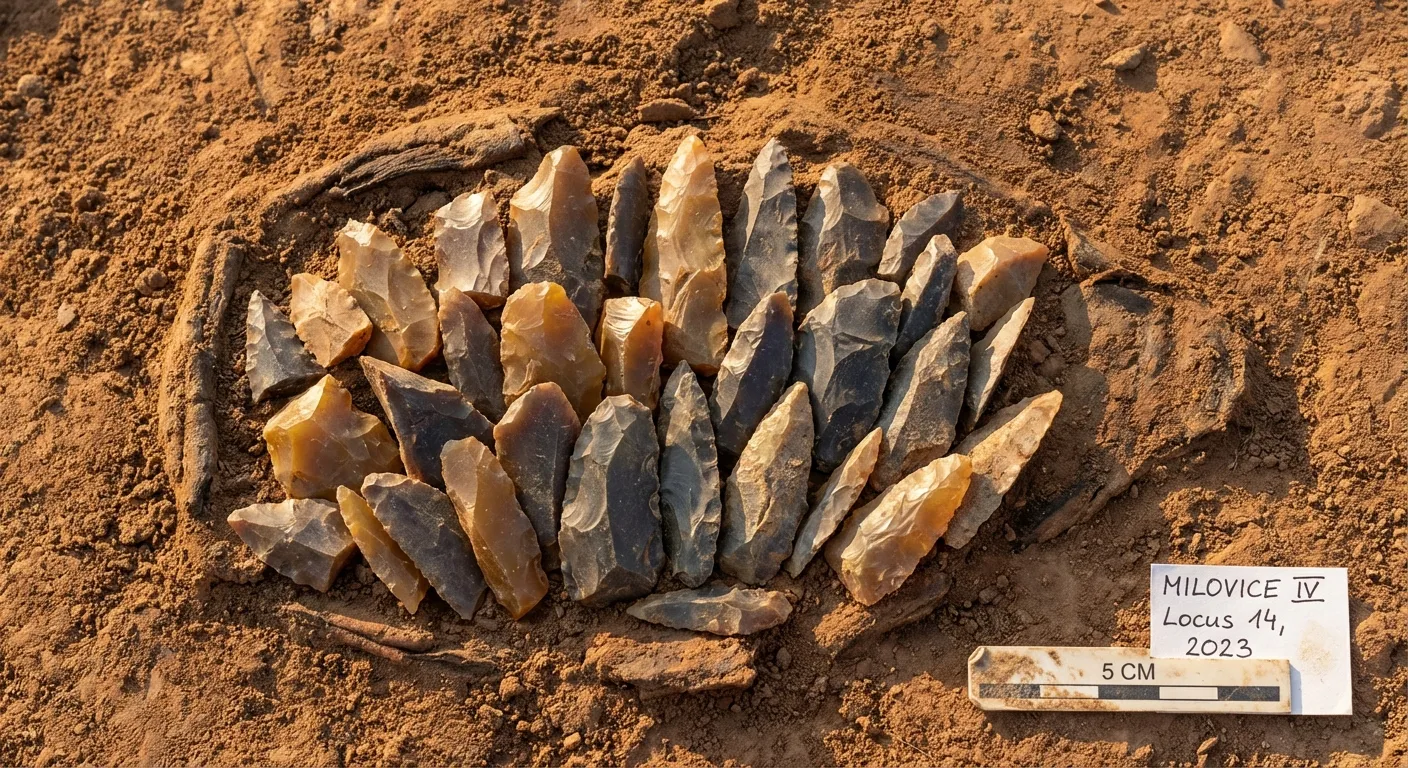
That is precisely what makes a discovery at Milovice IV in the Czech Republic so extraordinary. During a rescue excavation in 2021, archaeologists found a tight cluster of 29 stone tools, blades, and bladelets packed together so closely that they appeared to retain the shape of a container that had long since rotted away. Radiocarbon dating placed them between 30,250 and 29,550 years ago, deep in the Gravettian cultural period. These were not workshop scraps scattered across a cave floor. They were someone's personal belongings, carried, maintained, repaired, and eventually lost or abandoned at a residential camp in what is now South Moravia.
For the first time, archaeologists could examine not what a community made, but what one person chose to carry.
The Toolkit That Survived Its Owner
The 29 artifacts were found in Archaeological Horizon II at Milovice IV, a site that has yielded evidence of Gravettian occupation across multiple periods. What set this particular cluster apart was its arrangement. The tools lay in a configuration consistent with having been wrapped in leather or bark, a portable case that decomposed over millennia while the stones inside held their positions. Dominik Chlachula of the Czech Academy of Sciences, who led the analysis, described the find as "very rare" in the context of Upper Paleolithic archaeology.
The study, published in the Journal of Paleolithic Archaeology, employed techno-typological examination and use-wear analysis to determine what each tool was designed to do and how intensively it had been used. The results revealed a surprisingly diverse kit. Some blades served as projectile tips for spears, their fracture patterns consistent with high-velocity impact against bone or hide. Others showed edge dulling from sustained scraping, the kind of wear produced by processing animal hides or working wood. Still others bore marks of drilling and fine cutting work.
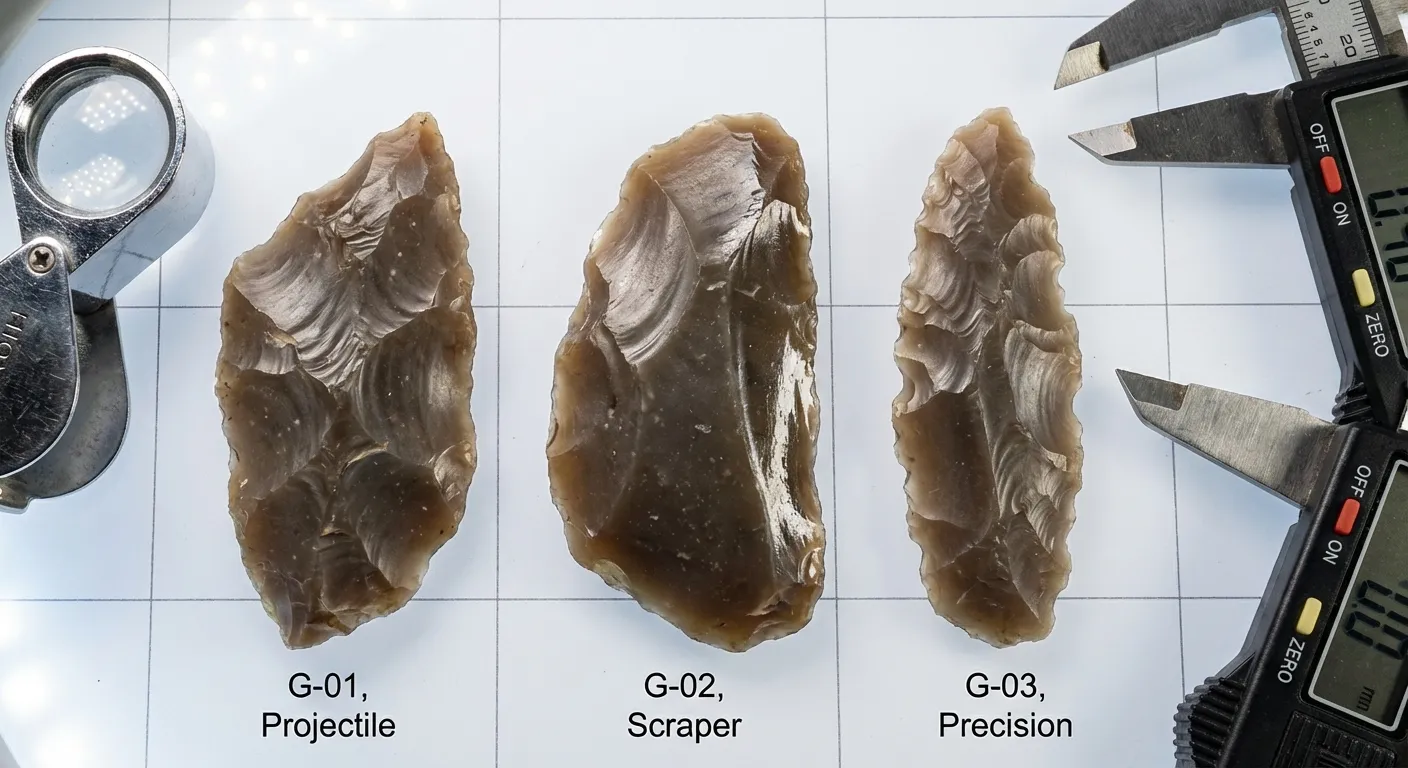
What made the assemblage genuinely unusual was the condition of the tools. Several blades were broken, their working edges exhausted or their tips snapped off from impact. Yet they had been kept. Some broken pieces showed signs of being repurposed: a snapped projectile tip resharpened into a scraper, a fractured blade reworked into a smaller cutting implement. The owner of this kit did not discard broken tools. They recycled them, extending the useful life of materials that were difficult to replace.
Flint from Far Away
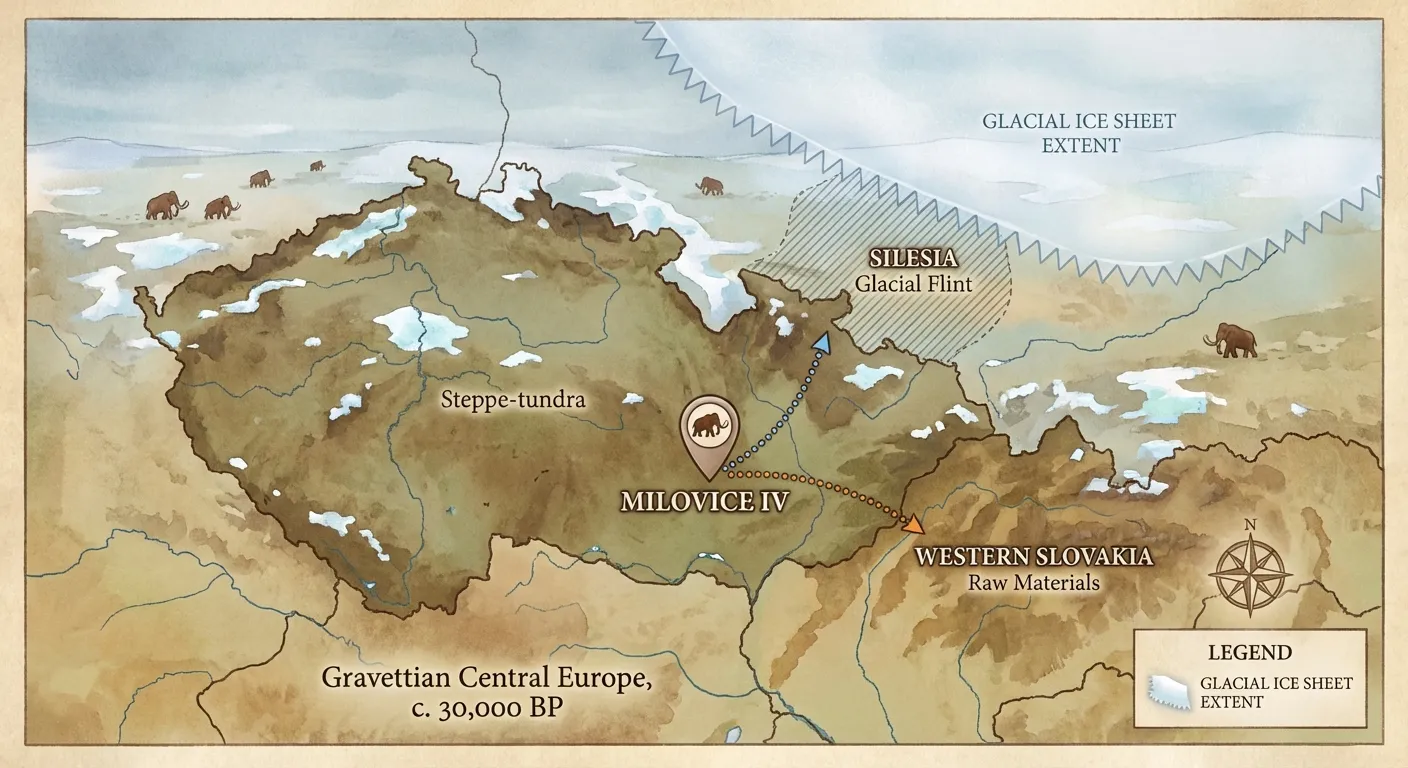
The raw materials in the toolkit tell a story as compelling as the tools themselves. Petrographic analysis identified the source rocks for the flint, and the results pointed to places far from Milovice IV. Roughly two-thirds of the stone originated from glacial deposits over 130 kilometers to the north. Additional pieces came from western Slovakia, approximately 100 kilometers to the southeast.
Those distances raise immediate questions. Did this hunter travel to those sources personally, collecting raw material along seasonal migration routes? Or did the flint arrive through exchange networks, passed hand to hand across social groups that maintained contact over vast stretches of Ice Age Europe?
The researchers remain uncertain, but either explanation reveals something important about Gravettian life. If the hunter collected the materials directly, it documents a mobility range spanning at least 130 kilometers, a substantial territory for someone navigating glacial landscapes without roads, maps, or pack animals. If the materials arrived through trade, it suggests social networks sophisticated enough to facilitate the movement of strategic resources across long distances, a kind of Stone Age supply chain linking communities that may never have met face to face.
This pattern of long-distance raw material sourcing has parallels at other Gravettian sites across central Europe, but the Milovice toolkit is rare in connecting those distant sources to a single person's belongings. It transforms an abstract pattern of material distribution into something human-scaled: one hunter, carrying stones from multiple distant places, relying on connections that extended far beyond the horizon.
Repair as Strategy, Not Desperation
The presence of broken and reworked tools in the kit challenges a common assumption about Stone Age technology: that stone tools were disposable, easily knapped from available material and discarded when dull or broken. The Milovice toolkit suggests something closer to the opposite. This hunter treated tools as investments, worth maintaining and modifying rather than replacing.
This makes practical sense when you consider the constraints. High-quality flint was not available locally at Milovice IV. Every blade in the kit represented material sourced from at least 100 kilometers away. Discarding a broken tool and knapping a fresh one was not a casual decision but a significant expenditure of scarce resources. The rational response, exactly what the archaeological evidence shows, was to extend each tool's lifespan through resharpening, repurposing, and creative modification.
Archaeologists have identified similar repair strategies at other Paleolithic sites, but finding them concentrated in one person's portable kit sharpens the insight considerably. This was not a community workshop where broken tools accumulated over generations. This was a curated set of implements that one individual judged worth carrying. Every item in the pouch represented a deliberate choice: this tool is still useful, or might become useful, or serves a purpose beyond its cutting edge.
That last possibility, that some tools held value beyond function, deserves consideration. Ethnographic studies of recent hunter-gatherer societies document widespread attachment to personal tools, objects that acquire significance through long use, successful hunts, or association with important events. The Milovice hunter kept broken tools that had been resharpened past the point of practical efficiency. Whether this reflects purely pragmatic stockpiling of material for future modification or something more personal, we cannot know. But the behavior itself is distinctly human: the reluctance to let go of something that has served you well.
The Gravettian World
To understand what this toolkit meant to its owner, it helps to understand the world they inhabited. The Gravettian culture, named after the French site of La Gravette, flourished across Europe from roughly 33,000 to 22,000 years ago. It was one of the most widespread and successful cultural traditions of the Upper Paleolithic, extending from the Iberian Peninsula to the Russian plains.
Gravettian people were not the stereotypical "cavemen" of popular imagination. They built complex dwellings from mammoth bones and hides, created some of the earliest known fired ceramics (the famous Venus figurines of Dolni Vestonice, found just 5 kilometers from Milovice IV), and developed sophisticated hunting strategies for megafauna including mammoths, woolly rhinoceroses, and herds of horses and reindeer.
The environment they navigated was the mammoth steppe, a vast, cold grassland that stretched from France to Siberia. It was richer in animal life than any modern ecosystem outside the African savanna, but it was also demanding. Temperatures were brutal, resources were distributed unevenly across the landscape, and survival required mobility, planning, and the maintenance of social networks that could provide information, mates, and material support across large distances.
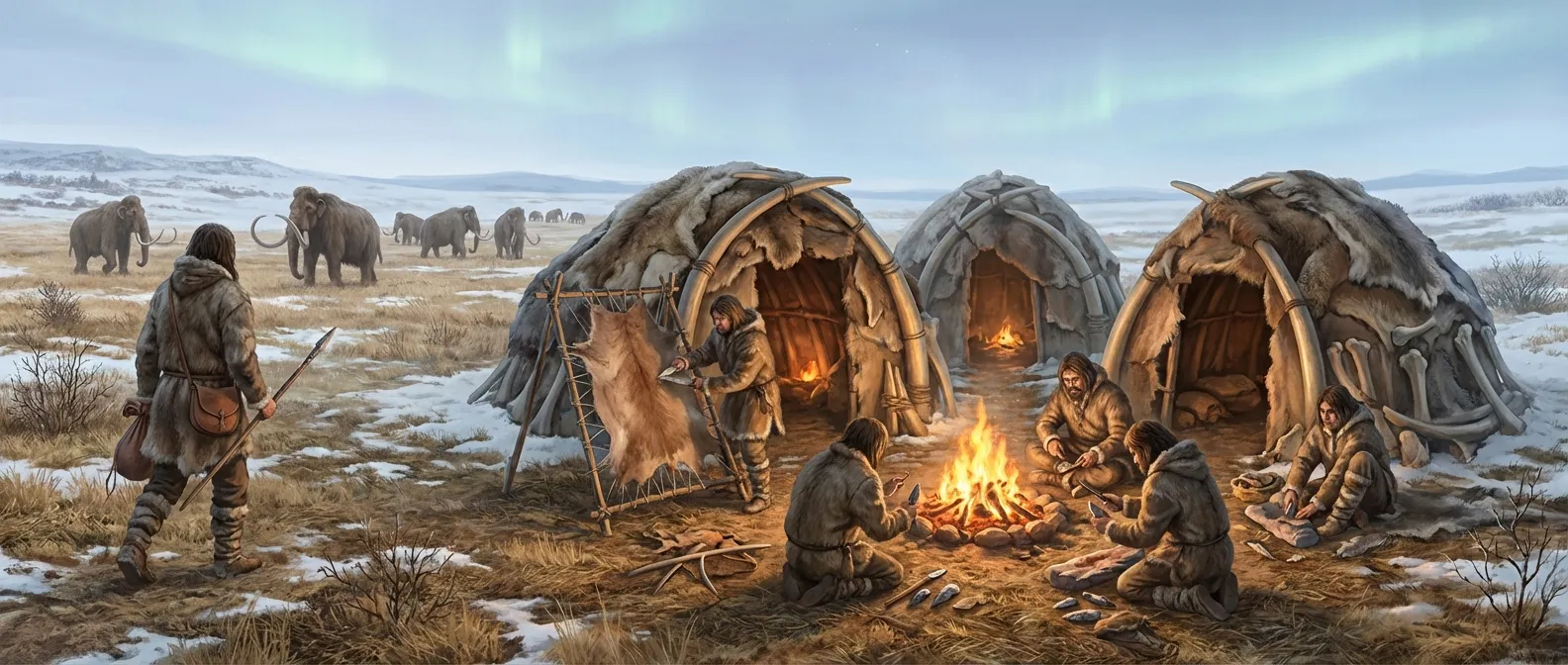
The Milovice IV toolkit fits neatly into this picture. A hunter operating on the mammoth steppe needed versatile, portable equipment. They needed projectile tips for hunting, scrapers for processing kills, cutting tools for working materials, and drilling implements for creating holes in leather, bone, or antler. They needed all of this to be light enough to carry, durable enough to last between resupply opportunities, and flexible enough to handle unexpected needs. The 29-piece kit found at Milovice IV reads like a direct response to those requirements.
What We Cannot Know
There are limits to what 29 stones can tell us. We do not know the hunter's sex, age, or physical condition. We do not know whether the toolkit was lost, deliberately cached for future retrieval, or abandoned because its owner died. We do not know whether this person traveled alone or as part of a group, though Gravettian sites generally suggest communal living.
We also cannot reconstruct the organic components of the kit. Stone preserves; leather, wood, bone, sinew, and plant fibers do not, at least not over 30,000 years in temperate climates. The blades in this toolkit were almost certainly hafted onto wooden or bone handles, bound with cord or resin. The projectile tips were mounted on spear shafts. The entire toolkit existed within a larger technological system of which only the stone elements survive. What we have is the skeleton of a far richer assemblage, like finding only the metal fittings of a medieval knight's equipment and trying to reconstruct the armor, the horse, and the man.
This limitation is inherent to Paleolithic archaeology, and it is worth acknowledging honestly rather than papering over with speculation. The stone tools are remarkable precisely because they are the only surviving elements of an individual's material world. Everything else, the clothing, the shelter, the food, the social bonds, the knowledge carried in memory rather than in stone, has vanished. What remains is enough to tell us that this person was resourceful, mobile, and connected to a world far larger than any single campsite. But it is a fragment, and reading too much into it risks projecting modern assumptions onto a life we can see only in outline.
The Deeper Question
The Milovice toolkit matters because it does something archaeology rarely achieves: it narrows the focus from civilizations to a person. Most of what we know about the deep past comes from patterns, the distribution of artifact types across sites, the statistical analysis of tool assemblages, the mapping of cultural zones across continents. These methods are powerful, but they are also impersonal. They tell us what Gravettian people did as a category, not what any particular Gravettian person experienced.
Twenty-nine stones packed into a pouch change the scale. They preserve the choices of someone who lived 30 millennia ago: which tools to keep, which to repair, which to carry across hundreds of kilometers of steppe. Those choices reflect skills, priorities, and a relationship with material possessions that is recognizably human. This person maintained their tools the way a modern craftsperson maintains theirs, not because broken objects are inherently valuable, but because they represent invested effort, irreplaceable materials, and hard-won knowledge about what works.
The find also underscores how much of the human past remains invisible. If a leather pouch had not happened to decompose in a way that kept 29 stones in position, this individual would be undetectable. Their tools would have scattered into the background noise of the site, indistinguishable from workshop debris. The accident of preservation gave us access to a life. How many thousands of similar lives left no trace at all?
That question, unanswerable but worth asking, is perhaps the most important thing the Milovice toolkit reveals. The deep past was populated not by abstract cultural categories but by people who carried their most important possessions in pouches at their sides, repaired what was broken, and traveled distances that still impress. We know about one of them now, because of 29 stones that stayed together after everything else was gone.
Sources
- Tracking the Hunter: A Study of the Personal Gear of a Gravettian Hunter-Gatherer from Milovice IV - Journal of Paleolithic Archaeology, Springer Nature
- 30,000-year-old personal toolkit found in the Czech Republic provides 'very rare' glimpse into the life of a Stone Age hunter-gatherer - Live Science
- Inside a Hunter's Pouch: What a 30,000-Year-Old Toolkit Reveals about Gravettian Life - Anthropology.net
- Buried for 30,000 Years, One Ice Age Traveler's Toolkit Is Altering Human History - The Daily Galaxy