

Every February, the same headlines reappear: "Chocolate is good for your heart!" It sounds like the perfect Valentine's Day excuse to demolish a box of truffles. But the relationship between chocolate and cardiovascular health is more complicated than a candy wrapper suggests, and the most important clinical evidence doesn't involve chocolate bars at all.
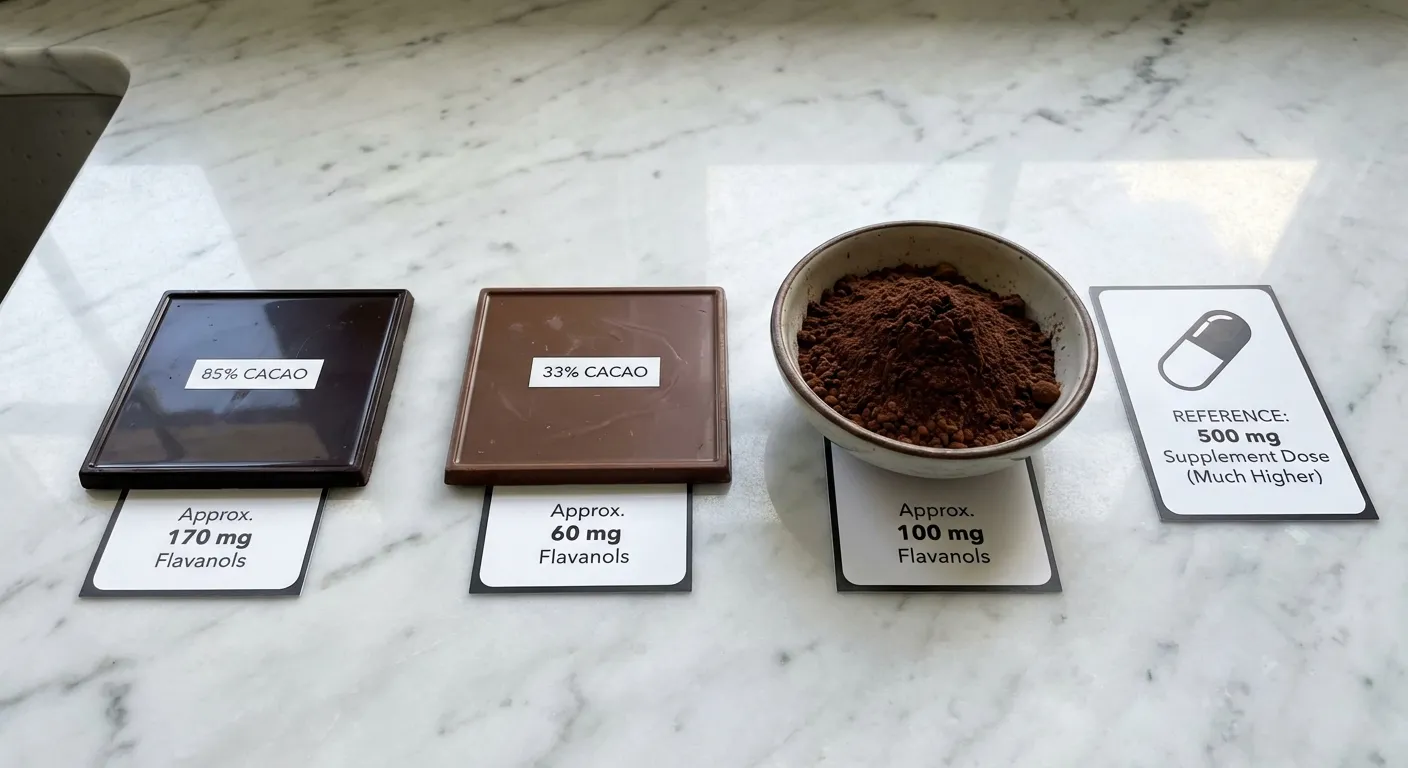
Verdict: Partially True. Cocoa flavanols, compounds found naturally in cacao, do appear to benefit cardiovascular health. The largest randomized trial on the subject found a 27% reduction in cardiovascular death among participants taking a daily cocoa extract supplement. But here's the critical distinction most headlines skip: the trial used a concentrated supplement containing 500 mg of cocoa flavanols per day, not chocolate. Getting that dose from a standard dark chocolate bar would mean consuming roughly 400 to 600 calories of chocolate daily, along with significant amounts of sugar and saturated fat. The science supports cocoa flavanols. It does not support eating chocolate as a heart health strategy.
What the COSMOS Trial Actually Found
The strongest evidence comes from the COcoa Supplement and Multivitamin Outcomes Study (COSMOS), a randomized, double-blind, placebo-controlled trial led by Dr. JoAnn Manson at Brigham and Women's Hospital. The study enrolled 21,442 older adults across the United States and followed them for over three years. Participants took either a daily cocoa extract supplement containing 500 mg of flavanols or a placebo.
The primary endpoint, total cardiovascular events, showed no statistically significant reduction. That's an important point that most news coverage glossed over. However, a pre-specified secondary endpoint told a different story: participants taking the cocoa supplement had a 27% lower rate of cardiovascular death compared to placebo. "Although our study suggests intriguing signals for cardiovascular protection with cocoa flavanols, any health benefits due to taking these supplements will need confirmation in a future trial," Manson said when the results were published in the American Journal of Clinical Nutrition in 2022.
A follow-up analysis published in Age and Ageing in 2025 added another layer. Researchers found that participants taking the cocoa extract saw their high-sensitivity C-reactive protein (hsCRP), a key marker of inflammation linked to cardiovascular disease, decrease by 8.4% per year compared to placebo. Since chronic inflammation drives much of cardiovascular disease progression, this anti-inflammatory effect may help explain the observed reduction in cardiovascular death.

How Cocoa Flavanols Work in the Body
The active compound driving these effects is (-)-epicatechin, a type of flavanol found in cocoa beans. When you consume epicatechin, it triggers a chain of biochemical events in the lining of your blood vessels. Specifically, it activates an enzyme called endothelial nitric oxide synthase (eNOS), which produces nitric oxide. Nitric oxide relaxes the smooth muscle cells surrounding blood vessels, causing them to dilate and improving blood flow.
This isn't theoretical. A study published in Proceedings of the National Academy of Sciences demonstrated that when researchers blocked nitric oxide production in test subjects, the vascular benefits of flavanol-rich cocoa disappeared entirely. The vasodilation effect is real, measurable, and mechanistically understood. Research has also linked regular flavanol intake to modest reductions in blood pressure, improvements in cholesterol profiles, and reduced platelet aggregation (which lowers clot risk).
The key insight that separates this from wishful thinking is the dose-response relationship. These benefits appear consistently in studies using 200 to 500 mg of cocoa flavanols daily. That's the range where the biological mechanisms engage. Below that threshold, you're unlikely to see meaningful cardiovascular effects. If you're interested in how other dietary compounds interact with cardiovascular health, our guide on reducing microplastics in food and water covers another area where what you consume has measurable biological effects.
Why Your Chocolate Bar Probably Doesn't Count
Here's where the Valentine's Day fantasy collides with food science. The manufacturing process that turns raw cacao into the smooth, sweet chocolate you buy at the store destroys most of the flavanols. Dutching (alkali processing), roasting, and conching all reduce flavanol content dramatically. A typical milk chocolate bar contains roughly 10% cocoa solids and minimal flavanols. Even dark chocolate, which contains 50 to 90% cocoa solids, delivers far less than what clinical trials use.
"While dark chocolate has more flavanols than other types of chocolate, the data to suggest there is enough to have a health effect is thin at this point," said Alice H. Lichtenstein, the Gershoff Professor of Nutrition Science and Policy at Tufts University. She added that the flavanol levels needed for cardiovascular benefits are "unlikely achievable with daily consumption of commercially available dark chocolate."
The calorie math makes the problem concrete. Dark chocolate contains 150 to 170 calories per ounce. To get anywhere near 500 mg of flavanols from a typical 70% dark chocolate bar, you'd need to eat three to four ounces daily. That's 450 to 680 calories, plus 24 to 48 grams of fat and a significant dose of sugar. Any cardiovascular benefit from the flavanols would likely be offset by the weight gain, metabolic effects, and increased saturated fat intake. Mira Ilic, RD, a registered dietitian at the Cleveland Clinic, recommends limiting dark chocolate to one ounce per day at most and choosing bars with 70 to 85% cocoa content.
The Heavy Metal Caveat Most Articles Ignore
There's another reason to think twice before eating dark chocolate daily for your heart. Harvard's T.H. Chan School of Public Health notes that dark chocolate, because it contains more cocoa solids, "tends to contain more metals than milk chocolate." Specifically, cocoa can contain cadmium and lead. Cadmium levels are particularly elevated in cocoa sourced from Latin America, while lead contamination appears to occur during post-harvest processing rather than being absorbed from soil.
For most adults eating an occasional piece of dark chocolate, this isn't a major concern. But for anyone considering daily consumption as a health strategy, especially over months or years, the cumulative heavy metal exposure is worth considering. Harvard specifically notes that "lead poses greater risks in children and the fetuses of pregnant women," who may want to consume smaller amounts or avoid frequent consumption altogether.
This caveat doesn't apply to the cocoa extract supplements used in the COSMOS trial, which were standardized and tested for contaminant levels. It's yet another reason why the "eat chocolate for your heart" framing is misleading: the research supports supplements, not candy.
What to Remember
Cocoa flavanols have genuine, evidence-backed cardiovascular benefits. The COSMOS trial provides the strongest clinical evidence to date, showing reduced cardiovascular death and lower inflammatory markers in participants taking standardized cocoa extract supplements. But the leap from "cocoa flavanols are beneficial" to "chocolate is good for your heart" skips over processing losses, calorie density, sugar content, and heavy metal exposure. If cardiovascular health is your goal, talk to your doctor about cocoa flavanol supplements rather than reaching for a candy bar. And if you enjoy chocolate, follow Lichtenstein's advice: "Choose the type you enjoy the most and eat it in moderation because you like it, not because you think it is good for you."
Sources
- Effect of Cocoa Flavanol Supplementation for the Prevention of Cardiovascular Disease Events: The COSMOS Randomized Clinical Trial - American Journal of Clinical Nutrition, 2022
- Cocoa Extract Supplement Reduced Key Marker of Inflammation and Aging - Mass General Brigham, 2025
- Dark Chocolate - Harvard T.H. Chan School of Public Health
- Are There Health Benefits from Chocolate? - American Heart Association
- Dark, Milk, or White: Which Chocolate Is Best for Your Heart? - Cleveland Clinic