
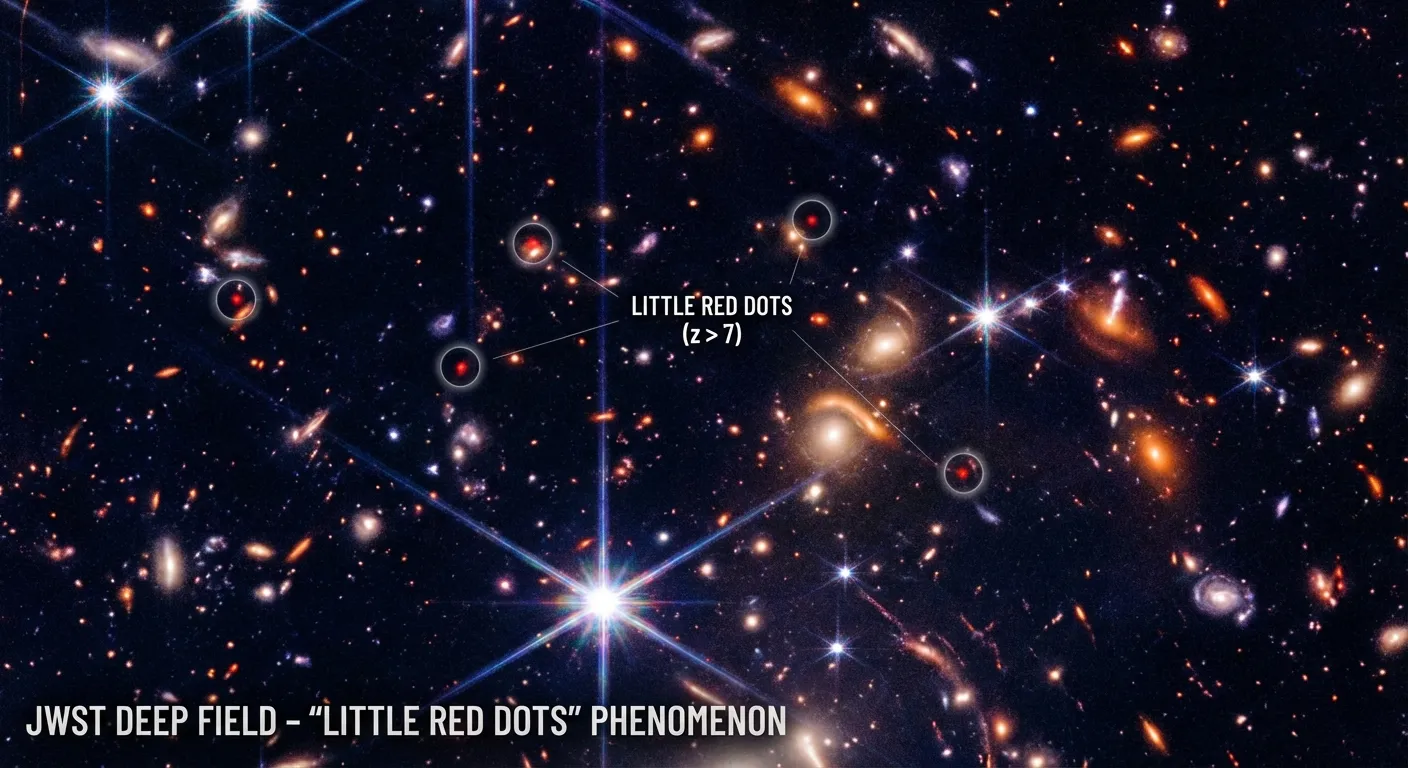
When the James Webb Space Telescope released its first deep-field images in July 2022, astronomers expected to be surprised. The telescope's infrared vision was designed to see further into the universe, and thus further back in time, than any previous instrument. What they didn't expect were the little red dots.
Scattered across JWST's deep-field images were strange objects that didn't fit any known category. They appeared point-like, suggesting they were very distant, but they were far brighter than expected for their redshift. Their red color was unusual, different from the red of normal distant galaxies. They seemed too bright, too red, and too common. For two years, these "little red dots" defied explanation.
Now, new research led by astrophysicist Jorryt Matthee at the Institute of Science and Technology Austria, along with a team including astronomers from the Space Telescope Science Institute, has solved the mystery. The little red dots are young black holes, actively devouring matter in the hearts of early galaxies, caught at a stage of their development that no telescope had ever witnessed before. Their identification rewrites assumptions about how quickly the universe's most massive objects can form and how they spend their earliest years.
What the Little Red Dots Actually Are
Black holes themselves are invisible; nothing escapes their gravitational grip, not even light. What astronomers see when they observe "black holes" is actually the material falling into them. This material, called an accretion disk, heats up as it spirals inward, glowing brighter than entire galaxies before crossing the event horizon and disappearing forever.
Normally, accreting black holes (called active galactic nuclei or AGN) are visible across the electromagnetic spectrum. Their accretion disks emit ultraviolet and X-ray light. When this light hits surrounding gas clouds, it excites the atoms, causing them to glow with characteristic emission lines. This combination of signatures makes AGN easy to identify, and astronomers have catalogued millions of them.
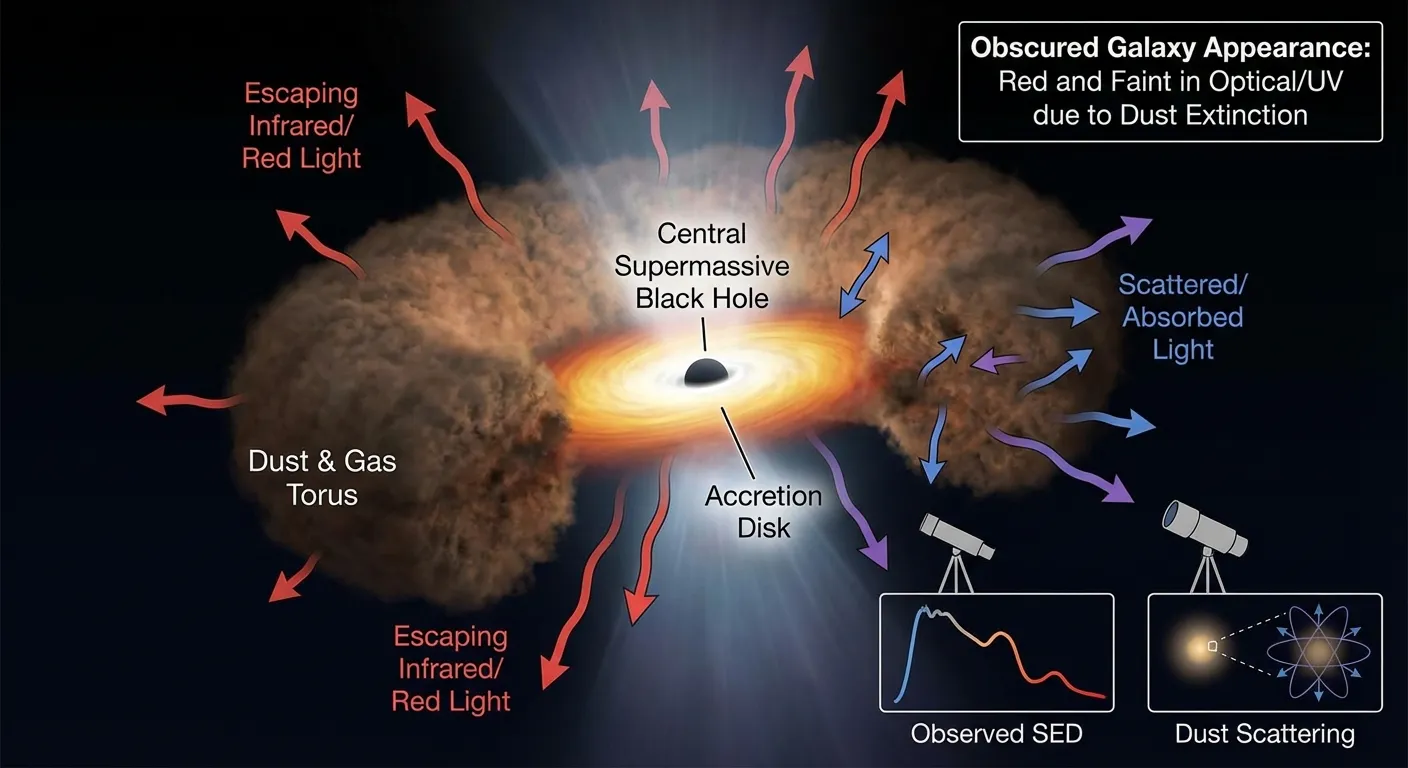
The little red dots don't follow this pattern. They show extremely red colors, indicating their light has been heavily absorbed and scattered by dust. They lack the X-ray emission expected from visible AGN. Their emission lines are unusual, suggesting the light we see has passed through enormous amounts of material before reaching us. They appear to be AGN that are almost completely hidden behind dense cocoons of gas and dust.
This explains their redness. Dust absorbs and scatters short-wavelength light (blue and ultraviolet) more effectively than long-wavelength light (red and infrared). The intense radiation from the accreting black hole illuminates the surrounding dust, which then re-emits that energy as infrared radiation. The process is similar to how the setting sun appears red: light passing through a thick atmosphere loses its blue wavelengths to scattering, leaving only red behind.
Why This Matters for Understanding the Early Universe
The little red dots appear at high redshifts, meaning they existed when the universe was very young, typically less than a billion years old. Finding large black holes this early in cosmic history has always been a puzzle, one that connects to the broader Fermi Paradox and questions about where complex structures emerge in the cosmos. Black holes grow by accreting matter, but this process takes time. How could massive black holes form so quickly after the Big Bang?
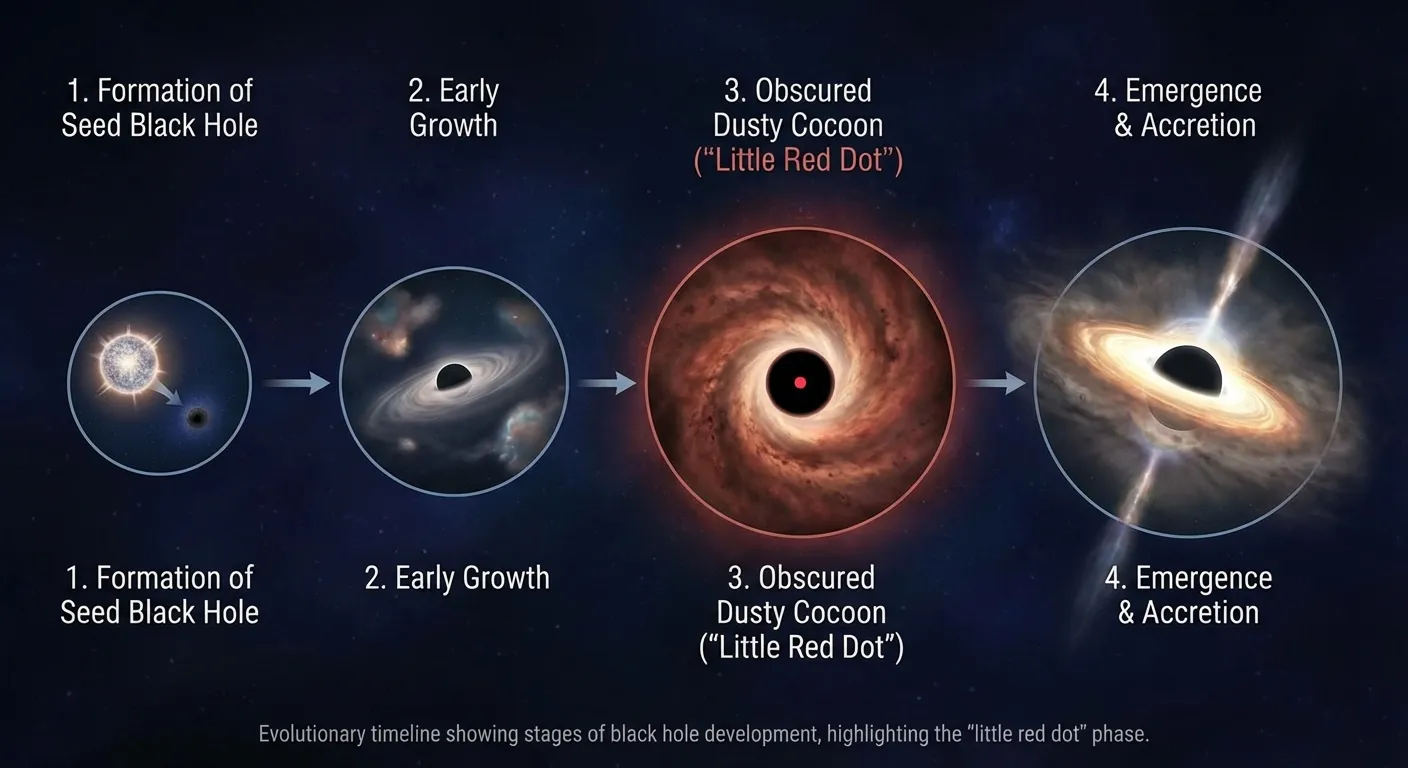
The little red dots may provide an answer. The dense gas enveloping these black holes does not merely obscure them; it feeds them, providing a constant supply of material to fuel rapid accretion. Crucially, the cocoon also traps the radiation that would otherwise blow away the feeding material. In exposed black holes, this radiation pressure creates a theoretical ceiling on growth rate called the Eddington limit. Inside a cocoon, that ceiling may not apply, allowing mass accumulation at rates several times faster than previously thought possible.
This "hidden growth phase" may be a common stage in black hole development. Every massive black hole we see today, including the four-million-solar-mass one at the center of our own Milky Way, may have passed through a similar phase in its youth. The little red dots are not anomalies; they are glimpses of a universal process, one whose prevalence was hidden in plain sight until JWST provided the right wavelength of light to detect it.
The research also reveals how common these objects are. The number of little red dots in JWST's deep-field images is far higher than anyone predicted before launch. Statistical analysis suggests they represent roughly half of all actively growing black holes in the first billion years of cosmic history. If that estimate holds, it means the total rate of black hole mass assembly in the early universe was approximately double what optical and X-ray surveys indicated.
How Astronomers Solved the Mystery
Identifying what the little red dots actually are required combining JWST observations with data from other telescopes and sophisticated theoretical modeling. The key evidence came from spectroscopy, splitting the light from these objects into its component wavelengths to reveal its chemical and physical properties.
The spectra showed emission lines characteristic of gas heated by an intense radiation source, consistent with AGN. But the line ratios were unusual, suggesting the gas was extremely dense and heavily obscured. Some lines that should have been present were missing entirely, absorbed by intervening dust. The spectra told a story of enormous energy production happening behind a thick veil.
X-ray observations provided crucial negative evidence. Most AGN are bright X-ray sources because X-rays are produced close to the black hole and can penetrate moderate amounts of obscuration. The little red dots were X-ray faint, indicating either that the obscuration was extreme or that something unusual was happening with the X-ray production. Follow-up deep X-ray observations showed that the obscuration explanation was correct: these objects are surrounded by so much dust that even X-rays struggle to escape.
Theoretical models of how young galaxies evolve helped complete the picture. Computer simulations of the early universe predict that the first massive black holes should form in environments rich with gas and dust. These simulations produce objects that look remarkably like the little red dots: compact, extremely luminous, heavily obscured. The observations and theory are converging on the same answer.
What This Tells Us About Black Hole Origins
The origin of supermassive black holes remains one of astrophysics' great mysteries. These objects contain millions to billions of solar masses, yet they appear in galaxies less than a billion years after the Big Bang. Getting that much mass into a black hole that quickly seems to require either impossibly rapid growth or starting from unusually massive seeds.
The little red dots favor the rapid growth explanation. The spectroscopic data show accretion rates consistent with, or even exceeding, the Eddington limit. If young black holes routinely sustain super-Eddington accretion during their obscured phase, a seed black hole of just a few hundred solar masses could reach a million solar masses in under 100 million years, fast enough to explain the supermassive black holes observed at high redshift.
This has implications for the "seed mass" problem. If black holes can grow rapidly in obscured phases, they don't need to start as massive as alternative theories suggest. Smaller seeds, perhaps the remnants of the first generation of stars, could grow to supermassive size through repeated obscured growth episodes. The little red dots may be showing us this process in action.
The connection between black hole growth and galaxy evolution also becomes clearer. The energy released by growing black holes can regulate star formation in their host galaxies, creating the observed correlations between black hole mass and galaxy properties. If much of this growth happens in obscured phases, we've been missing a crucial part of this co-evolution story. The little red dots reveal the hidden side of the black hole-galaxy relationship.
What This Means
The James Webb Space Telescope was built to see what previous telescopes couldn't: the first galaxies, the first stars, the earliest chapters of cosmic history. It joins a remarkable era in space exploration that is rewriting our understanding of the cosmos. The little red dots were an unexpected bonus, objects that no one predicted but that turned out to reveal something profound about how the universe's most massive objects grow.
Every astronomical advance opens new questions. If obscured growth is common for young black holes, how does the transition from obscured to visible phases work? What triggers the clearing of the dusty cocoon? How do these objects relate to the more familiar quasars that illuminate the later universe? The little red dots have answered one mystery while posing several new ones.
The discovery also raises a pointed question for future telescope design. If roughly half of early black hole activity was invisible to every instrument before JWST, what other populations remain hidden at wavelengths we are not yet observing? The planned Nancy Grace Roman Space Telescope and the proposed LISA gravitational-wave observatory will each probe different aspects of early black hole growth, potentially revealing additional stages of the process that even JWST cannot detect.
Two years ago, the little red dots were a puzzle, anomalous specks on deep-field images that defied categorization. Today they are recognized as a missing chapter in the story of how the universe built its largest structures. The next step is to determine how long the obscured phase lasts, what triggers its end, and whether the transition to visible quasar is gradual or sudden. Those answers will come from follow-up spectroscopy already underway with JWST's NIRSpec instrument, with initial results expected later in 2026.