
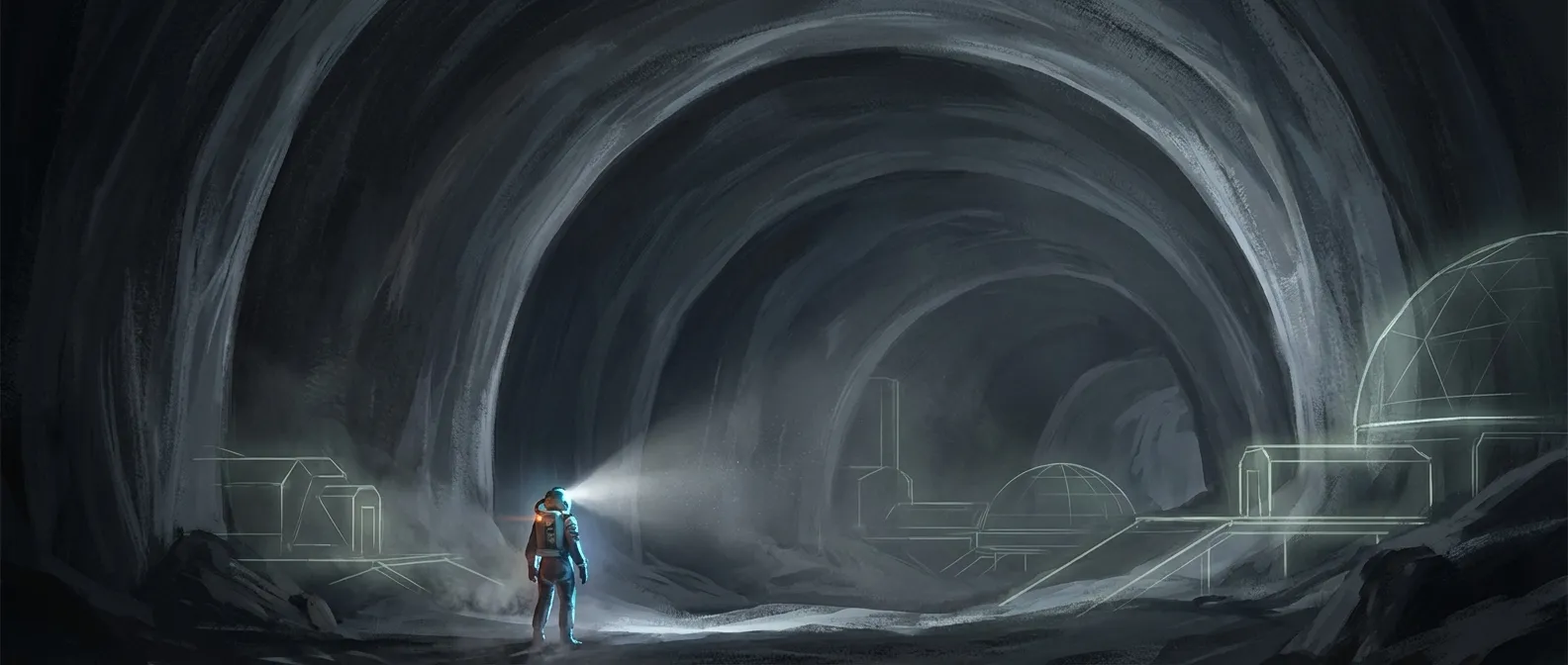
On Earth, lava tubes are modest things. When basaltic lava flows downhill and the surface cools while molten rock continues moving underneath, the result is a natural tunnel. You can find them in Hawaii, Iceland, the Canary Islands, and anywhere else with a volcanic past. They range from a few meters to perhaps 30 meters in diameter. Some are tourist attractions. Others shelter bats. They are interesting geological features but rarely awe-inspiring.
On the Moon, lava tubes are something else entirely. In the reduced gravity, one-sixth of Earth's, flowing lava behaved differently. The tubes it left behind are not meters wide but hundreds of meters, possibly kilometers. A single lunar lava tube could be spacious enough to contain a mid-sized city. And because these tubes sit beneath a layer of solid rock, they offer something the lunar surface cannot: a natural shield against virtually every hazard that makes building on the open surface so difficult. The surface is trying to kill you. The underground is not.
A new study published in Science Robotics in early 2026 describes a robotic system designed to enter and map these underground spaces, bringing us one step closer to answering a question that has intrigued planetary scientists for decades: could humanity's first permanent homes beyond Earth be not on another world's surface but beneath it?
Why the Surface Won't Work
The popular vision of lunar and Martian bases typically involves domes, pressurized habitats, and structures sitting on the surface. This vision makes for compelling illustrations but ignores serious engineering problems.
On the Moon, the surface is bombarded by cosmic radiation and solar particle events. Earth's magnetic field and thick atmosphere block most of this radiation, but the Moon has neither. Astronauts on the lunar surface would receive radiation doses far exceeding safe limits for long-term habitation. Building adequate shielding from surface materials is possible but requires moving enormous quantities of regolith, the loose, dustite layer covering the Moon's bedrock.
Temperature is another challenge. The lunar surface swings from roughly 127 degrees Celsius in direct sunlight to minus 173 degrees Celsius in shadow. These 300-degree swings happen every two weeks as the Moon rotates through its day-night cycle. Any surface structure must handle thermal expansion and contraction on a scale that would crack most building materials.
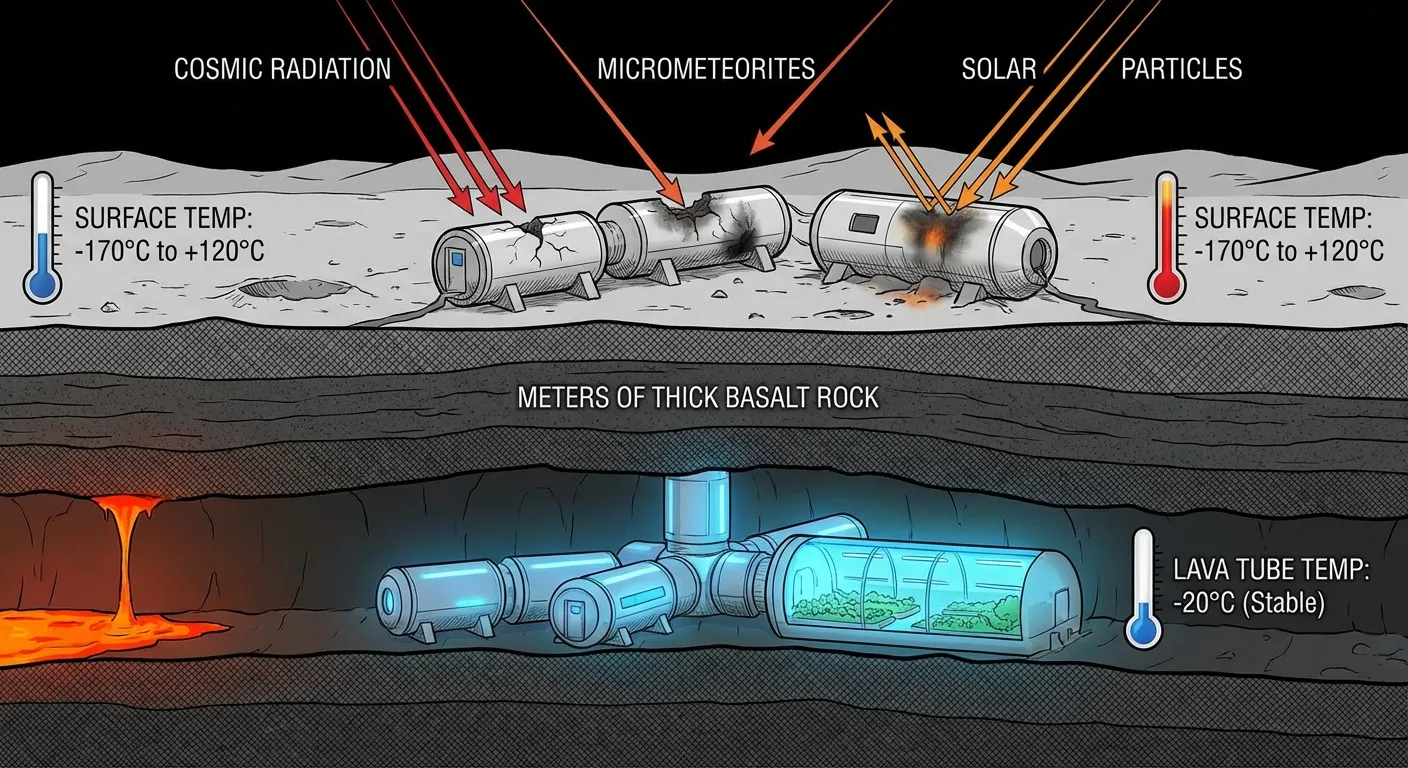
Micrometeorites present a constant threat. Without an atmosphere to burn up incoming particles, even tiny grains of cosmic dust hit the lunar surface at speeds of several kilometers per second. Over time, this bombardment erodes anything exposed to it. A habitat dome would need constant repair or extremely robust shielding.
Mars offers somewhat better conditions, with a thin atmosphere that provides limited radiation shielding and burns up the smallest micrometeorites. But Mars also presents challenges that the surface cannot easily solve: dust storms that can last months, reducing solar power to a trickle, and radiation levels still far higher than Earth's. For long-term settlement, the surface of either world is a challenging proposition.
Lava tubes solve all of these problems simultaneously. The rock overhead blocks radiation as effectively as several meters of concrete. Temperatures inside tubes remain stable, insulated from surface extremes by the surrounding basalt. Micrometeorites cannot penetrate the ceiling. And on Mars, tubes would be unaffected by surface dust storms. The best real estate on other worlds may be underground.
How Big Are They, Really?
The scale of lunar lava tubes has been a subject of both excitement and debate. Earth's lava tubes provide a poor analogy because gravity fundamentally changes the physics. In lower gravity, lava flows more freely, spreads further before solidifying, and creates larger voids. Theoretical models and orbital observations suggest that lunar lava tubes could be truly enormous.
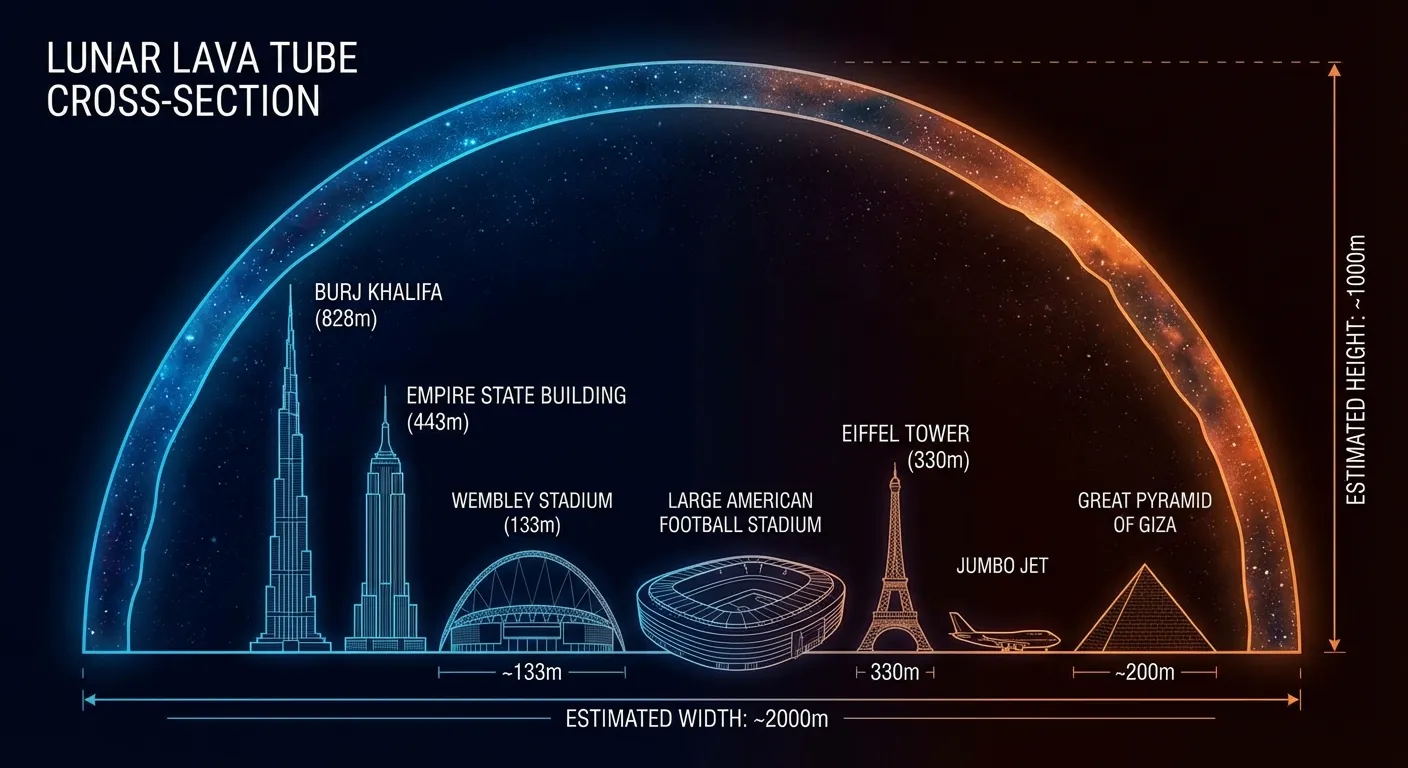
A 2020 study by Riccardo Pozzobon and colleagues at the University of Padova analyzed collapse features called "skylights" on the lunar surface, where portions of a lava tube roof have fallen in. By measuring the dimensions of these collapse pits and modeling the structural properties of basalt in lunar gravity, the team estimated that intact lunar tubes could range from 1 to 5 kilometers in width. Some models suggest even larger dimensions.
To put that in perspective: a tube 1 kilometer wide and 500 meters tall could accommodate the entire downtown core of a major city, buildings and all, with room to spare. The volume available in a single large lunar tube could dwarf any structure humanity has ever built. The tubes are not just big enough for a base. They are big enough for a city.
Mars tubes fall between Earth and lunar extremes. Martian gravity is about 38 percent of Earth's, stronger than the Moon's but still weak enough to allow much larger tubes than those found on our planet. Orbital imagery has identified features on Mars that may be lava tube skylights, particularly in the Tharsis volcanic region near Olympus Mons, the solar system's largest volcano. Estimated Martian tube widths range from hundreds of meters to potentially a kilometer or more.
The existence of these tubes is well supported by indirect evidence but not yet confirmed by direct observation. No rover or lander has entered a lava tube on either world. That is precisely what the new robotic research aims to change.
Robots Learning to Go Underground
The Science Robotics study, led by a European consortium including the Space Robotics Laboratory at the University of Malaga, describes a multi-robot system designed for autonomous subterranean exploration. The concept uses three different types of robots working together, each handling a different aspect of the exploration challenge.
The first robot type is a surface rover that approaches the skylight, the collapsed opening that provides access to the tube below. This rover maps the area around the skylight, identifies safe descent paths, and establishes a communication relay between the subterranean robots and the surface.
The second is a climbing or rappelling robot capable of descending through the skylight into the tube. The vertical drop from surface to tube floor could be tens or hundreds of meters, far too steep for a wheeled rover. This robot anchors itself and descends in a controlled manner, deploying sensors as it goes.
The third robot type is a ground-based explorer that operates on the tube floor, mapping the interior, analyzing rock composition, and identifying areas suitable for human habitation. This robot must operate in complete darkness, navigate rubble from ceiling collapses, and function without GPS or any other positioning system dependent on surface infrastructure.
The team tested this system in volcanic caves on Lanzarote, Spain, in environments that approximate some conditions found in planetary lava tubes: total darkness, uneven terrain, limited communication with the surface. The tests demonstrated that the robots could autonomously coordinate their movements, share map data, and explore unknown territory without human intervention.
The relevance to AI-driven exploration is clear. Robots operating inside lava tubes face communication challenges far more severe than surface rovers. Radio signals cannot easily penetrate hundreds of meters of rock. Any robot exploring a tube must be capable of making navigation decisions entirely on its own, without the option of consulting human operators. The autonomous capabilities being developed for Mars surface rovers and subterranean explorers are converging toward a common goal: machines that can explore independently in environments where human guidance is impractical.
From Shelter to Settlement
Finding a suitable lava tube is only the first step. Converting a natural cave into a habitable space requires solving several additional engineering problems, but the tube itself provides the hardest part: the structural shell.
Sealing a lava tube section to hold breathable atmosphere is conceptually straightforward, though technically challenging. The ends of a tube segment could be sealed with inflatable barriers or rigid bulkheads, creating an enclosed volume. The rock walls provide structural containment, eliminating the need to build a pressure vessel from scratch. On the Moon, where atmospheric pressure inside a habitat would be roughly 101 kilopascals (one Earth atmosphere) against zero outside, the pressure differential would push outward against the rock, which is exactly the kind of load basalt handles well.
Interior construction could use local materials. Lunar regolith can be sintered (heated until it fuses) into building blocks. Martian soil contains compounds that can be processed into construction materials. Experiments aboard the International Space Station have demonstrated that baker's yeast and other organisms can survive Mars-like conditions, suggesting biological manufacturing processes might eventually contribute to construction.
Power generation is another solvable problem. Solar panels on the surface could feed power underground through cables. On Mars, where dust storms can reduce solar output, nuclear power offers a more reliable alternative. NASA's Kilopower reactor, designed for surface use, could equally serve a subsurface base.
The Timeline and Its Uncertainties
The Lunar Vertex mission, scheduled for 2026, will deploy a rover designed to gather high-resolution data near a lunar pit, potentially providing the first direct observations of a tube entrance. Australia's 7 Sisters mission plans to deploy the SPIDER robot on the Moon as part of the Moon to Mars Demonstrator program. These near-term missions will gather the foundational data needed to plan actual tube entry.
Some projections suggest crewed missions could enter lunar lava tubes by the late 2030s, with permanent bases inside tubes possible by the early 2040s. These timelines are optimistic and depend on the success of precursor robotic missions, the development of reliable descent systems, and the broader trajectory of lunar exploration programs.
The uncertainties are real. We don't know what conditions inside lunar tubes actually look like. The floors may be covered in rubble from ancient ceiling collapses, making movement difficult. The tubes may contain unexpected hazards: unstable sections, fine dust, or ice deposits that could complicate construction. Only direct exploration will resolve these unknowns.
But the fundamental appeal of lava tubes is hard to argue with. They are pre-built structures, formed by natural processes billions of years ago, that happen to solve many of the hardest problems in extraplanetary habitation. They don't need to be constructed, only occupied. Nature has already done the engineering. Humanity just needs to figure out how to move in.
Why It Matters
The history of human settlement has always been shaped by shelter. Early humans occupied caves not because they lacked the ability to build but because caves offered ready-made protection from weather, predators, and temperature extremes. The first architecture was not construction but selection: finding the right natural space and adapting it to human needs.
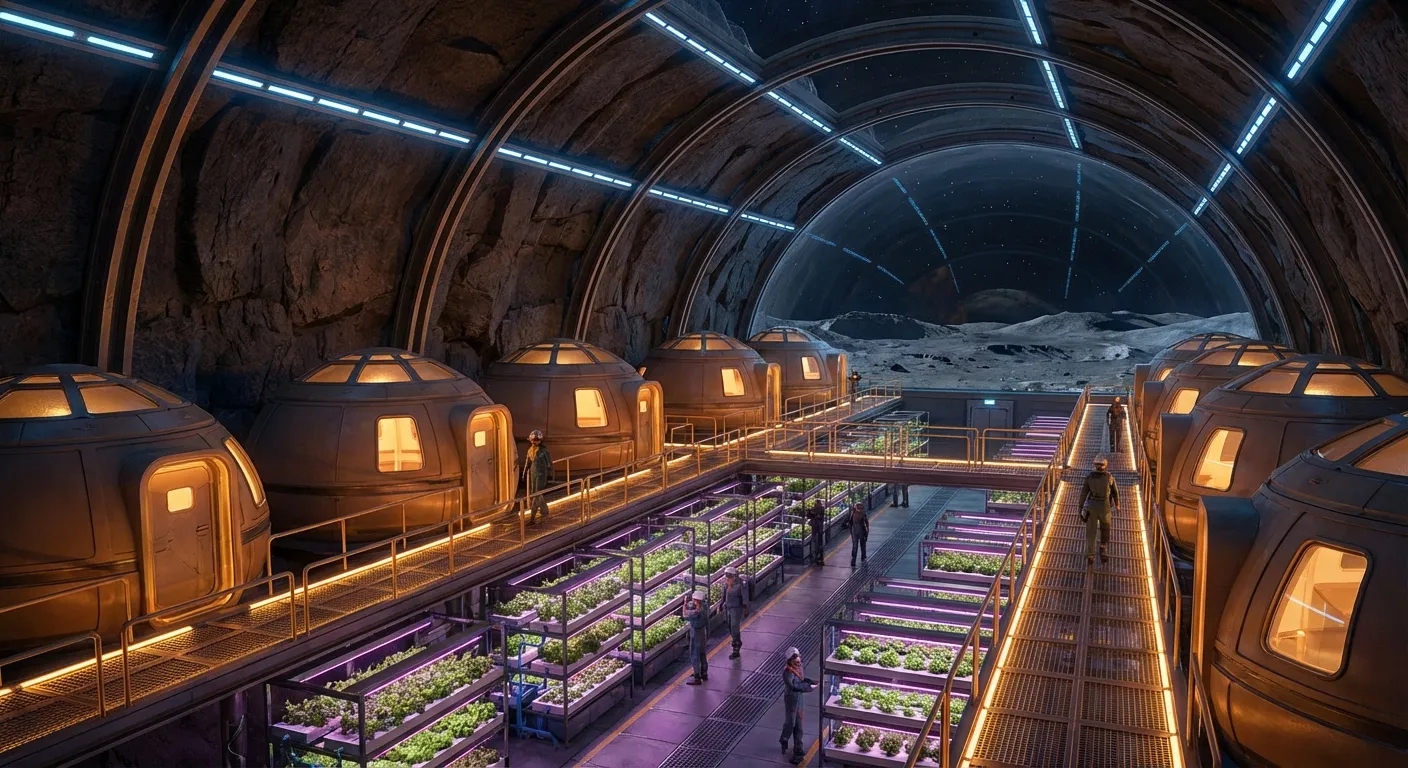
Lava tubes on the Moon and Mars may represent the same pattern on an interplanetary scale. The first permanent human presence beyond Earth may not live in gleaming surface domes but in natural tunnels, protected by the same basalt that flowed as lava billions of years before any human existed. The grandest structures available to us on other worlds were built by volcanoes, not engineers.
The robots now learning to descend into terrestrial lava tubes are rehearsing for missions that could define the future of human civilization. If the tubes prove accessible and structurally sound, a question that only direct exploration can answer, the economics of off-world settlement change dramatically. Building a habitat from scratch on the surface requires launching every gram of structural material from Earth or manufacturing it on site. Moving into a lava tube means the hardest part, the pressure-bearing shell, already exists. The question shifts from "can we live on the Moon" to "which tube should we move into first."
Somewhere beneath the gray surface of the Moon, and the red surface of Mars, there are tunnels large enough to hold cities. They've been waiting for 3 billion years. We're almost ready to knock on the door.
Sources
- Science Robotics: Cooperative robotic exploration of a planetary skylight surface and lava cave
- ScienceDaily: Robots descend into lava tubes to prepare for future Moon bases
- Astronomy.com: Lava tubes: Nature's shelters for cosmic colonization
- Earth-Science Reviews: Lava tubes on Earth, Moon and Mars (Pozzobon et al.)