
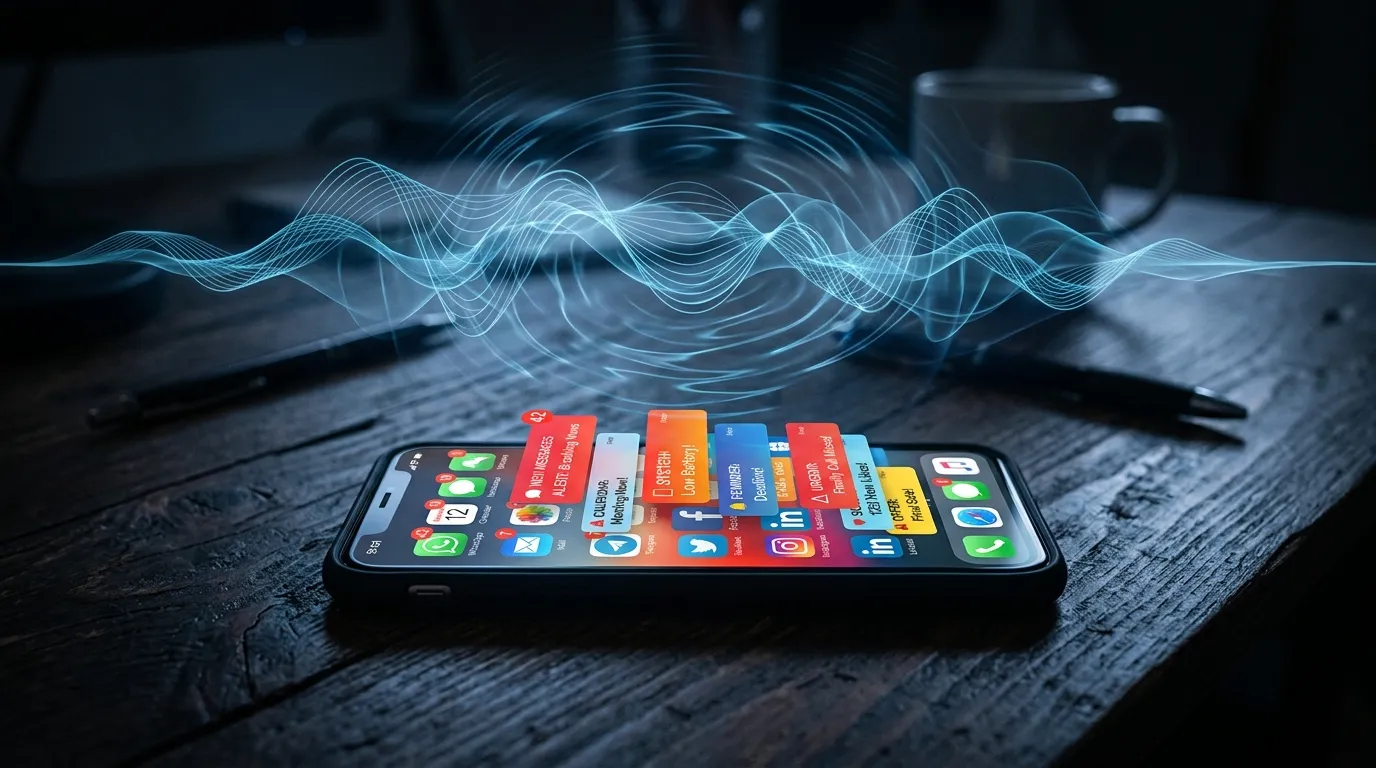
You're reading something that matters to you, a report, an article, a message from a friend, and your phone buzzes. You glance at the notification. It's nothing important, just an app reminding you about a sale. You go back to reading. But here's the thing: for the next seven seconds, your brain isn't actually back. It's still processing the interruption, still deciding whether that alert deserved your attention, still recovering from a cognitive hijack you never agreed to.
That seven-second window isn't a guess. It's the central finding of a new study published in Computers in Human Behavior that used a cleverly deceptive experimental design to measure exactly what happens inside your head when a notification arrives. The researchers didn't just track behavior. They tracked your pupils. And the pupils don't lie.
The Experiment That Tricked Your Brain
The study, titled "Attention hijacked: How social media notifications disrupt cognitive processing," was led by Hippolyte Fournier at the University of Lyon along with colleagues Arnaud Fournel, François Osiurak, Olivier Koenig, Flora Pâris, Vivien Gaujoux, and Fabien Ringeval. What made this experiment unusual wasn't the question it asked (researchers have been studying phone distraction for years) but how it went about answering it.
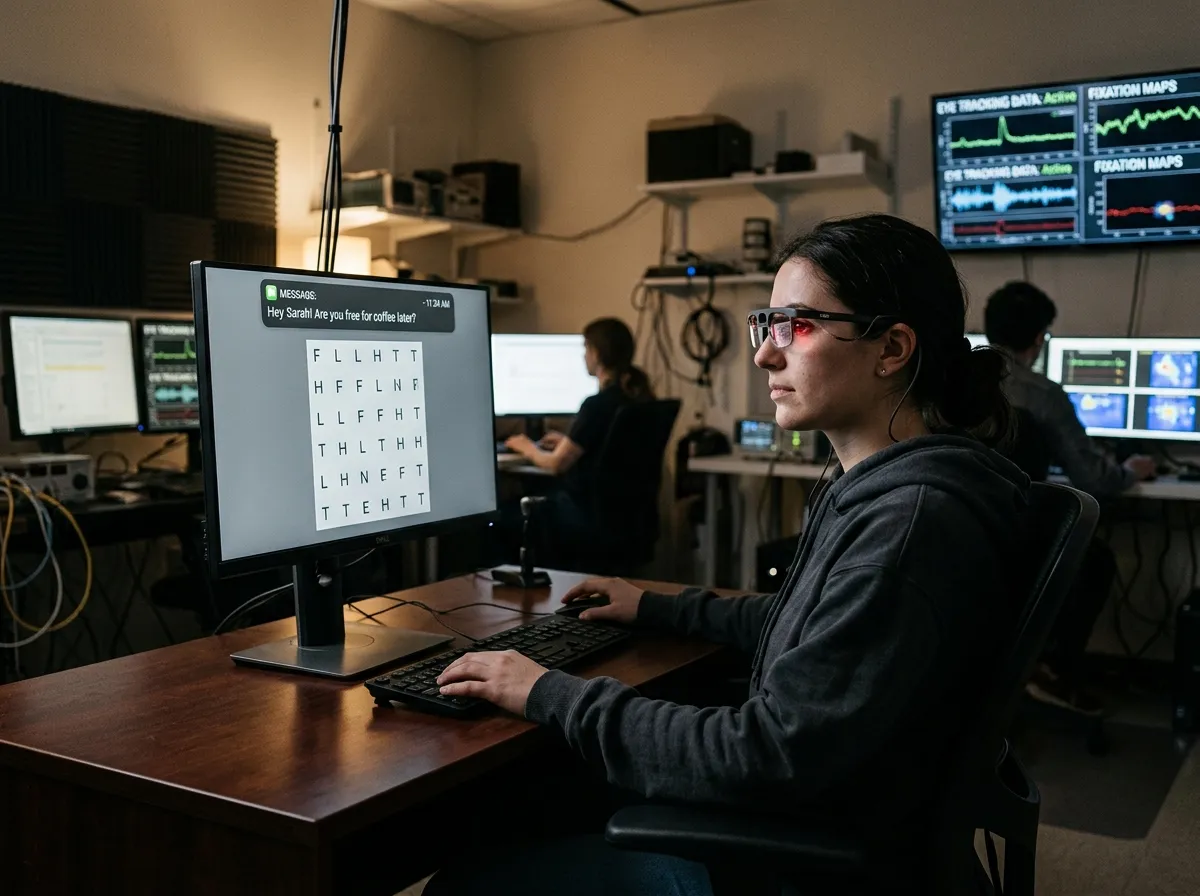
The researchers needed participants to believe the notifications they saw were real. So they lied. Sixty participants were told that their personal smartphones had been synced to the lab computer, and that any notifications appearing on screen during a cognitive task were their actual messages and alerts arriving in real time. In reality, the researchers controlled every notification. The deceptive setup was the key innovation, because people respond differently to notifications they believe are personally relevant versus ones they know are fake.
With participants convinced the alerts were genuine, the researchers asked them to complete a sustained attention task on the computer while notifications popped up at intervals. The team recorded reaction times, error rates, and, critically, changes in pupil diameter throughout the entire session using eye-tracking technology. This combination of behavioral and physiological measurement gave them an unusually complete picture of what a single notification does to a focused mind.
Seven Seconds of Stolen Thought
The core finding was precise and consistent: each notification triggered a transient slowdown in cognitive processing that lasted approximately seven seconds. During that window, participants responded more slowly to the task and made more errors. The disruption wasn't catastrophic in any single instance, but it was reliable and measurable every time a notification appeared.
Seven seconds might sound trivial. It's not. Consider the math. The average smartphone user receives between 50 and 80 notifications per day, according to data from app analytics firms. If each one costs seven seconds of degraded cognitive function, that's six to nine minutes daily of impaired thinking, scattered across the hours in fragments too small to notice individually but large enough to matter collectively. And that calculation only accounts for the notifications you actually see. Research from the University of Texas at Austin, published in the Journal of the Association for Consumer Research in 2017, found that the mere presence of a smartphone on your desk reduces available cognitive capacity, even when the phone is face-down and silent. The seven-second hijack is layered on top of a baseline drag that's already pulling your focus downward.
What drove the disruption wasn't just the sensory jolt of a notification appearing on screen. Fournier's team identified three overlapping mechanisms: perceptual salience (the visual pop of the alert), learned associations (your brain's trained response from thousands of prior notifications), and relevance appraisal (the rapid, automatic evaluation of whether this particular alert matters to you). All three fired in sequence within milliseconds, pulling cognitive resources away from whatever you were doing.
Your Pupils Tell the Truth
The most striking part of the study wasn't behavioral. It was physiological. Using precise pupillometry measurements, the researchers observed that pupil dilation patterns mirrored the behavioral delays almost exactly. When a notification appeared, participants' pupils dilated in a characteristic pattern associated with increased cognitive load and emotional arousal. The dilation persisted for the same seven-second window as the performance drop, then returned to baseline.
This matters because pupil responses are involuntary. You can decide to ignore a notification. You can train yourself not to look. But your pupils will dilate anyway, because the orienting response, the brain's automatic "what was that?" reflex, fires before conscious control has any say in the matter. The study essentially proved that notifications trigger a hardwired biological response that willpower alone cannot override.
The pupillary evidence also helped explain why the personal-notification group showed stronger effects than a control group that knew the alerts were simulated. When participants believed the notifications were their own, the relevance appraisal component fired more intensely, producing larger pupil dilation and longer cognitive recovery times. Your brain cares more about messages it thinks are for you, even when they turn out to be spam.
Why Screen Time Is the Wrong Metric
One of the study's most practically useful findings had nothing to do with the seven-second window. When the researchers analyzed which aspects of phone use best predicted susceptibility to notification disruption, they found that two factors stood out: how frequently a person checked their phone throughout the day, and how many notifications they received. Total daily screen time, the metric that dominates public conversation about digital wellness, was a weak predictor by comparison.
This distinction matters because it reframes the problem. The common advice to "reduce screen time" treats phones like a substance where the dose determines the harm. Fournier's data suggests a different model: phones are less like alcohol and more like an alarm system that keeps going off. It's not how long you spend looking at the screen that erodes your attention. It's how many times the screen demands that you look at it. A person who spends three hours on their phone in a single focused session may suffer less cognitive disruption than someone who spends one hour total but receives 90 notifications throughout the day.
This finding connects to a broader body of work on how habits form around automatic daily behaviors. The phone-checking reflex isn't a conscious choice for most people. It's a conditioned response, shaped by years of intermittent reinforcement (sometimes the notification is interesting, usually it's not, but you never know until you check). Breaking the cycle requires changing the trigger environment, not just the total time spent.

A Brief History of the Buzz
Notifications weren't always this aggressive. The earliest mobile phone alerts were simple and rare: a call coming in, or maybe a text message. The notification as we know it, a banner that slides down from the top of your screen bearing an app icon and a preview of content, was introduced by Apple with iOS 5 in 2011. Android's notification shade had existed since 2008, but Apple's implementation standardized the format that would come to dominate every smartphone on earth.
What followed was an arms race for attention. As the app economy exploded, developers discovered that notifications were the single most effective tool for driving re-engagement. A well-timed push notification could increase app opens by 88%, according to a widely cited 2016 analysis by Localytics. By 2018, the average smartphone had more than 80 apps installed, and the majority of them were configured to send push notifications by default. Users had to actively opt out of each one, a design pattern that behavioral economists call a "dark default" because it exploits the gap between what people would choose if asked versus what they tolerate when the choice requires effort.
The result is a notification environment that no single user designed or consented to, an ecosystem where dozens of independent apps compete for your attention simultaneously, each optimized to trigger exactly the kind of orienting response that Fournier's team measured in the lab. Tech companies have acknowledged the problem in recent years, with tools like Apple's Focus modes and Android's notification channels, but these tools still place the burden on users to manage a system that was built to be unmanageable.
Where This Leads
The seven-second finding is small enough to ignore and large enough to matter, which makes it a perfect example of the kind of cognitive erosion that accumulates invisibly. Nobody notices seven seconds. But the study suggests that our notification infrastructure imposes a constant, low-grade tax on human attention that we've simply normalized because it happened gradually.
Fournier's team stopped short of prescribing solutions, but their data points in a clear direction. If notification frequency rather than screen time is the real driver of cognitive disruption, then the most effective intervention isn't a screen-time limit. It's aggressive notification management: disabling non-essential alerts, batching notifications into scheduled delivery windows, and reconsidering which apps deserve the right to interrupt your thinking at will. Some researchers have gone further, arguing that push notification defaults should be opt-in rather than opt-out, a change that would require regulatory intervention since no individual app maker has an incentive to reduce its own re-engagement metrics.
The deeper question is whether seven seconds of cognitive disruption per notification is a cost we're willing to accept for the convenience of real-time alerts, or whether future historians will look back at the 2010s and 2020s as the era when we accidentally traded sustained thought for a steady drip of digital interruptions. The pupil data, at minimum, confirms one thing: your brain is paying a price for every buzz, ding, and banner, whether you realize it or not.
Sources
- Attention hijacked: How social media notifications disrupt cognitive processing - Computers in Human Behavior, Fournier et al.
- New psychology research reveals the cognitive cost of smartphone notifications - PsyPost
- Brain Drain: The Mere Presence of One's Own Smartphone Reduces Available Cognitive Capacity - Journal of the Association for Consumer Research, Ward et al. (2017)
- Beyond the Buzz: Investigating the Effects of a Notification-Disabling Intervention on Smartphone Behavior - Media Psychology