
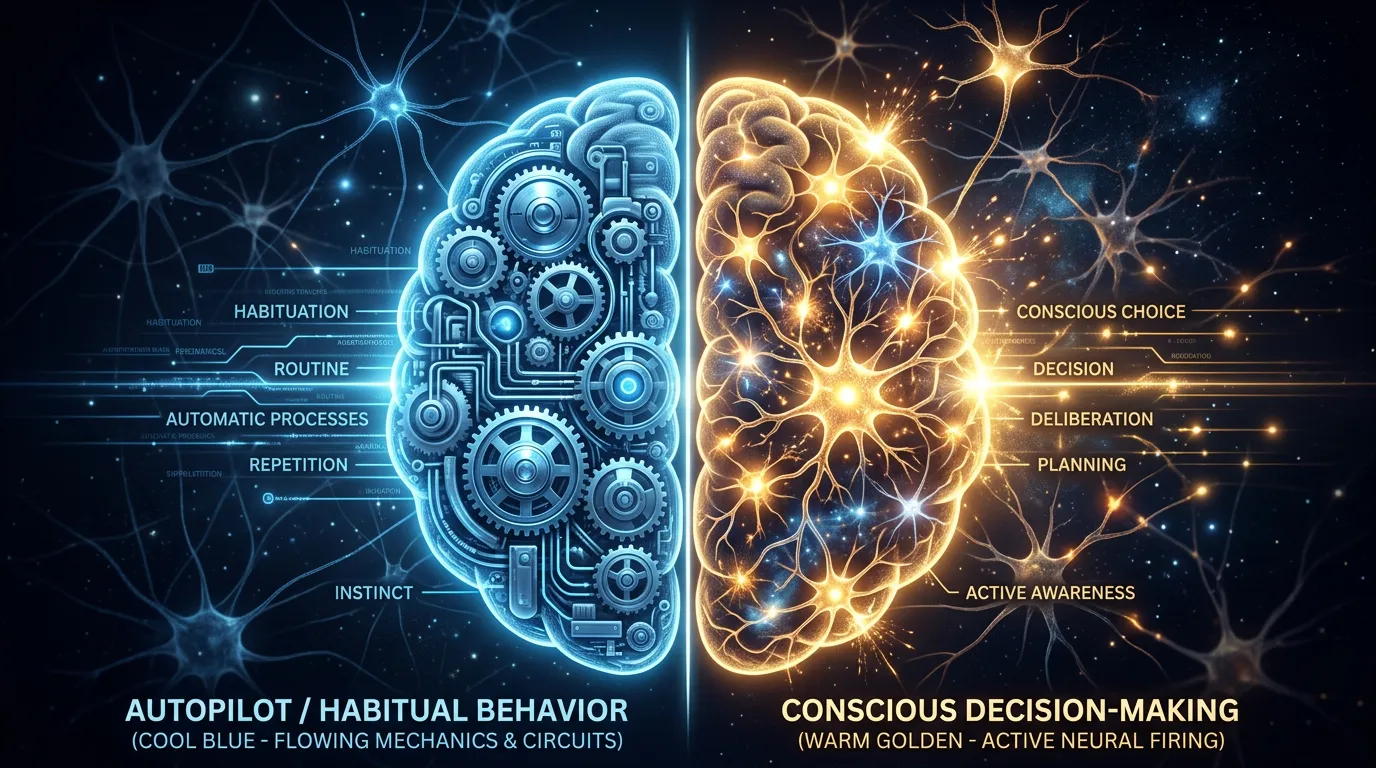
You probably made dozens of decisions before reading this sentence today. You got out of bed, maybe reached for your phone, brushed your teeth, made coffee, chose what to wear. Each one feels like a choice. But according to a study published in Psychology & Health by researchers from the University of Surrey, the University of South Carolina, and Central Queensland University, about two-thirds of those actions weren't really decisions at all. They were habits, triggered automatically by environmental cues, and executed with minimal conscious oversight. The study's central finding: 65% of daily behaviors are habitually initiated, and a startling 88% are habitually executed, meaning the vast majority of your day runs on autopilot whether you realize it or not.
That number challenges a deeply held assumption about human agency. We tend to believe we're in control of our actions, making rational choices based on our goals and preferences. The research suggests something more humbling: most of the time, your brain has already made the decision before "you" get involved. Understanding why that happens, and how it works neurologically, changes the way we think about everything from dieting to addiction to the design of public health programs.
The Study That Measured Autopilot
The research team, led by Dr. Amanda Rebar of the University of South Carolina, recruited 105 participants from the United Kingdom and Australia. Over seven consecutive days, each participant received six random prompts on their phone throughout the day. At each prompt, they reported what they were currently doing, whether the action was triggered by habit or by a deliberate decision, and whether they were performing it automatically or with conscious effort.
This method, called ecological momentary assessment, captures behavior in real time rather than asking people to recall what they did at the end of a day. Memory is unreliable, especially for habitual actions that barely register in conscious awareness. By catching people in the act, the researchers could measure the gap between what people think drives their behavior and what actually does.
The results were striking. Across all reported behaviors, 65% were habitually initiated, meaning the person didn't consciously decide to start doing them. Even more telling, 88% were habitually executed, meaning that once an action began, it proceeded without deliberate thought. "Our research shows that while people may consciously want to do something, the actual initiation and performance of that behaviour is often done without thinking," said Professor Benjamin Gardner of the University of Surrey.
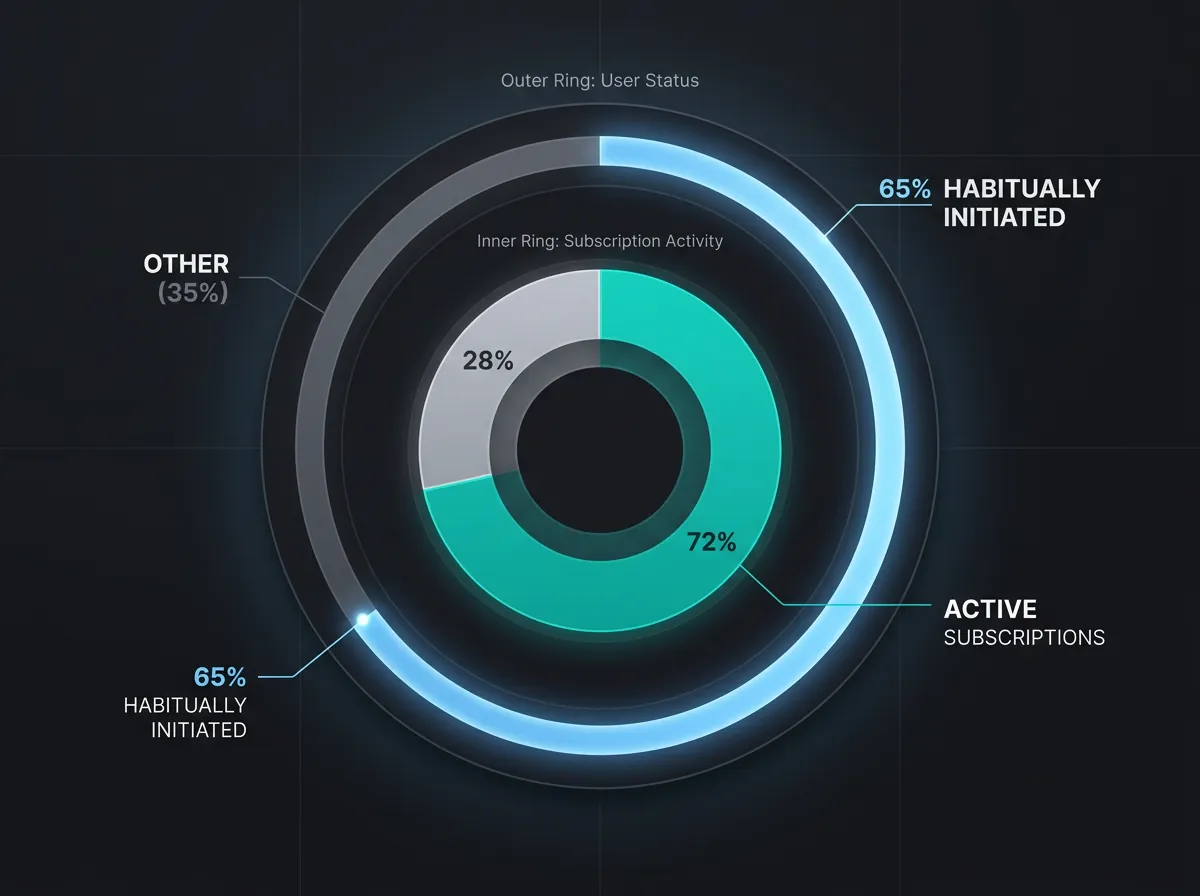
One finding offered a measure of reassurance. Roughly 46% of habitual behaviors also aligned with participants' conscious intentions. In other words, nearly half of the things people did on autopilot were things they would have chosen to do anyway. As Dr. Grace Vincent of Central Queensland University noted, "Two-thirds of what people do each day is sparked by habit," but most of those habits support the person's actual goals rather than undermining them. Your brain isn't sabotaging you. It's usually trying to help, just without asking permission first.
Exercise, however, was an exception. Unlike other habitual behaviors, exercise was more likely to be triggered by habit but less smoothly executed on autopilot. That finding aligns with what most people intuitively know: going to the gym can become routine, but the workout itself still requires effort and conscious engagement in a way that brushing your teeth does not.
Why Your Brain Prefers Shortcuts
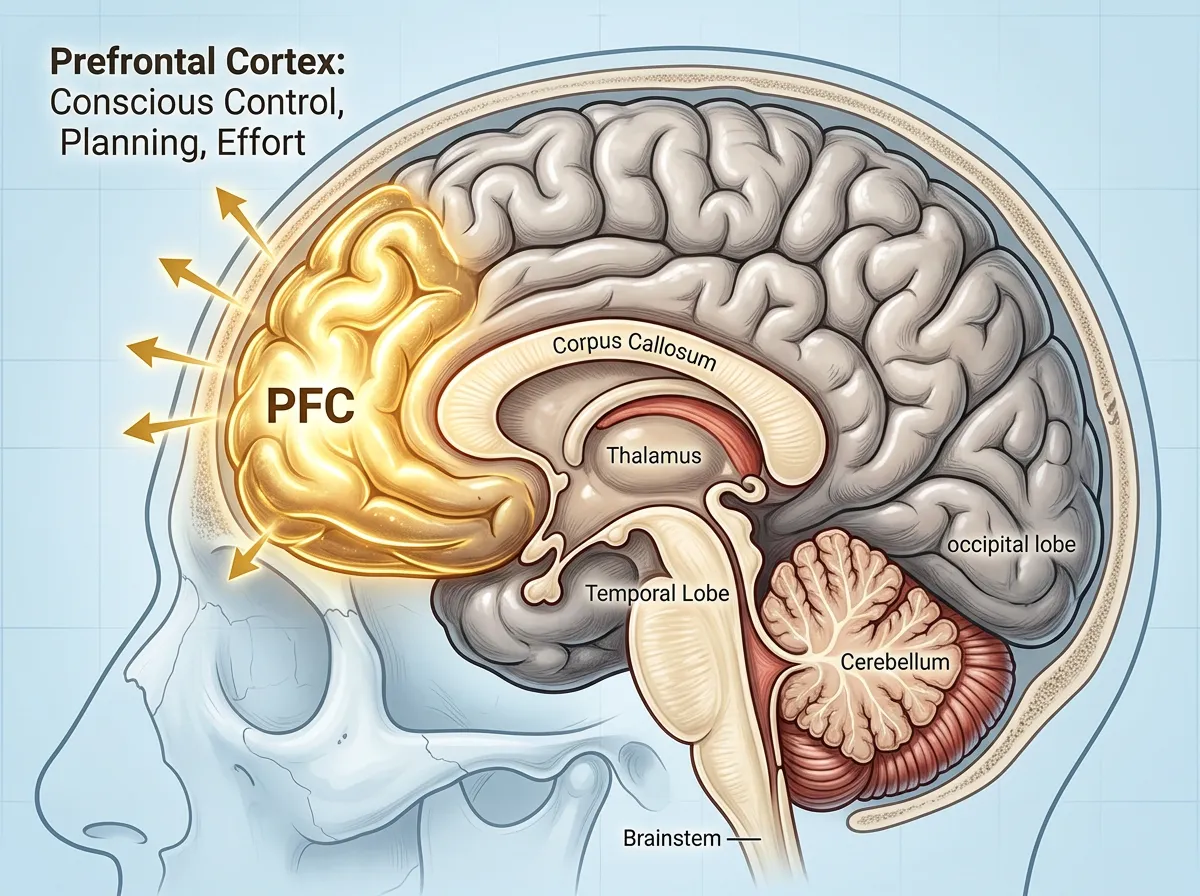
The neurological basis for habitual behavior runs deeper than simple repetition. When you first learn a new action, whether it's driving a car, playing a chord on a guitar, or navigating a new commute, the prefrontal cortex does most of the work. This brain region handles deliberate decision-making, planning, and conscious control. It's powerful but slow, energy-intensive, and easily overwhelmed. If every action you took all day required prefrontal engagement, you'd be mentally exhausted before lunch.
As a behavior is repeated, control gradually shifts from the prefrontal cortex to the basal ganglia, a group of structures deep in the brain that specialize in pattern recognition and automated sequences. This transfer is what neuroscientists call "chunking," where a complex sequence of actions gets compressed into a single automatic unit. Driving a car involves hundreds of individual micro-decisions about steering, braking, checking mirrors, and adjusting speed. Once the behavior is chunked, the basal ganglia runs the entire sequence without conscious input, freeing the prefrontal cortex to think about a podcast or plan dinner.
This architecture is an evolutionary advantage. The brain consumes roughly 20% of the body's energy despite accounting for only 2% of its mass. Offloading routine behaviors to the basal ganglia is an energy-conservation strategy that frees cognitive resources for genuinely novel or threatening situations. The problem is that the system doesn't distinguish between habits you want and habits you don't. The basal ganglia automates smoking a cigarette after lunch with the same efficiency it automates fastening a seatbelt. Once a behavior-cue association is encoded, it fires automatically in the presence of the cue, regardless of whether the conscious mind has decided to quit.
The Habit Loop and the Illusion of Willpower
The cue-routine-reward framework, popularized by Charles Duhigg in The Power of Habit and grounded in decades of behavioral neuroscience, explains why habits are so resistant to willpower-based interventions. Every habit follows the same three-part structure: a contextual cue (a time of day, a location, an emotional state), a routine (the behavior itself), and a reward (the satisfaction, relief, or pleasure that reinforces the loop).
The critical insight from the Rebar study is that the cue, not conscious intention, is the primary trigger for most behavior. When you walk into your kitchen in the morning, the sight of the coffee maker is the cue. You don't decide to make coffee; the basal ganglia fires the routine automatically. The conscious experience of "wanting coffee" is often a post-hoc narrative your prefrontal cortex constructs to explain behavior that was already underway.
This reframing has significant implications for behavior change. Programs that rely on motivation, willpower, and conscious commitment are fighting against a system designed to bypass conscious input. A person who decides to stop eating cookies after dinner isn't fighting a lack of discipline. They're fighting an automated neural sequence that fires every time they sit on the couch after their meal. The cue (sitting on the couch, the time of day, the emotional state of relaxation) triggers the routine before the conscious mind has a chance to intervene.
The study's finding that 46% of habitual behaviors align with conscious intentions suggests that the solution isn't eliminating habits but redirecting them. The most effective behavior change strategies don't try to override the habit loop; they work with it. They modify the cue, substitute the routine, or create new cue-routine-reward sequences that gradually become automatic themselves.
When Autopilot Fails: Habits and Health
The practical stakes of habitual behavior are enormous in public health. Smoking, sedentary behavior, unhealthy eating, and excessive alcohol consumption all follow habit loop patterns. Traditional interventions that emphasize education and motivation (telling people smoking is dangerous, explaining the benefits of exercise) are fighting on the wrong battlefield. People who smoke generally know it's harmful. Their behavior persists not because of ignorance but because the habit loop bypasses the cognitive system where that knowledge lives.
The researchers explicitly noted this disconnect. Gardner emphasized that "interventions should focus on building positive habits and disrupting harmful ones rather than relying on willpower alone." Concrete strategies include establishing exercise routines tied to specific time-and-place triggers (gym bag by the door every Tuesday and Thursday), replacing the routine in a harmful habit loop (chewing gum instead of smoking after meals), and restructuring environments to remove cues that trigger unwanted behaviors (not keeping alcohol in the house).
These strategies draw from a broader body of research in implementation intentions, a concept developed by psychologist Peter Gollwitzer in the 1990s. An implementation intention is a specific plan in the format "When situation X arises, I will perform response Y." Meta-analyses have consistently shown that this simple formulation significantly increases the likelihood of behavior change, precisely because it creates a new cue-routine link that can eventually become habitual itself. The person isn't trying to resist the old habit through willpower; they're building a new automatic response that competes with the old one.
The exercise exception from the Rebar study adds nuance. While the habit loop can get you to the gym, the workout itself resists full automation because physical exertion requires ongoing conscious engagement. This suggests a two-stage model for exercise habits: the decision to exercise can be automated (habit), but the exercise itself will always require some degree of effortful engagement, meaning it will never feel as "easy" as brushing your teeth no matter how consistently you do it.
From Individual Habits to Designed Environments
The study's findings extend beyond individual psychology into the design of physical and digital environments. If 65% of behavior is cue-driven, then the people who design the spaces where we live and work have enormous influence over what we do, often more influence than our own conscious intentions.
Supermarkets have understood this for decades. Placing candy at the checkout counter exploits the habit loop: the cue (waiting in line, seeing colorful packaging) triggers an automatic reach-and-grab routine. Tech companies have refined the same principle for digital environments. The infinite scroll on social media, the autoplay function on streaming services, and the notification badge on your phone are all engineered cues designed to trigger habitual engagement patterns.
This raises ethical questions that the field of behavioral science is only beginning to address. If most behavior is habitual, and if environments can be designed to trigger specific habit loops, then the architects of our physical and digital spaces wield a form of influence that operates below conscious awareness. This isn't a conspiracy; it's the logical application of the same science the Rebar study describes. But it does mean that the individual responsibility framework, the idea that people simply need to "choose better," underestimates how much of behavior is shaped by context rather than character.
Urban planners who make stairs more visible and accessible than elevators aren't overriding people's choices. They're changing the cues that trigger habitual behavior, making the healthier option the automatic one. App designers who add friction to addictive features (requiring an extra tap to access infinite scroll, or displaying a "you've been scrolling for 30 minutes" notification) are disrupting the cue-routine loop. Both approaches work with the habit system rather than against it, and the Rebar study's data suggests they should be more effective than any amount of motivational messaging.
Where This Leads
The 65% finding isn't a verdict on human weakness. It's a description of how an efficient brain operates in a complex world. The cognitive resources required to make every daily action a conscious choice would be overwhelming. Habits free us to think about problems that actually need attention, to plan, create, and respond to novelty. The issue isn't that we're habitual creatures. It's that the same system that automates productive routines also automates destructive ones, and it doesn't distinguish between the two.
The practical takeaway is both liberating and sobering. If you want to change a behavior, attacking it with willpower is the hardest possible approach. The research consistently shows that modifying cues, designing environments, and building competing habit loops are far more effective strategies. The person who removes the cookie jar from the counter will outlast the person who stares at the cookie jar and tries to resist it through sheer determination, every time.
Gardner and Rebar's work also points toward a larger truth about the gap between how we experience our own behavior and how behavior actually works. We feel like the authors of our actions. The data suggests we're more like editors, occasionally revising the scripts that our habits have already written. That distinction matters, not because it diminishes human agency, but because understanding the real mechanics of behavior gives us better tools to change it. You can't fix a system you don't understand, and the first step to building better habits is accepting how much of your day already runs on the ones you have.
Sources
- Scientists say most of what you do each day happens on autopilot - ScienceDaily
- Most Daily Actions Run on Habit, Not Conscious Choice - Neuroscience News
- Daily actions are driven by habit rather than conscious choice - News-Medical.net
- How we form habits, change existing ones - ScienceDaily