
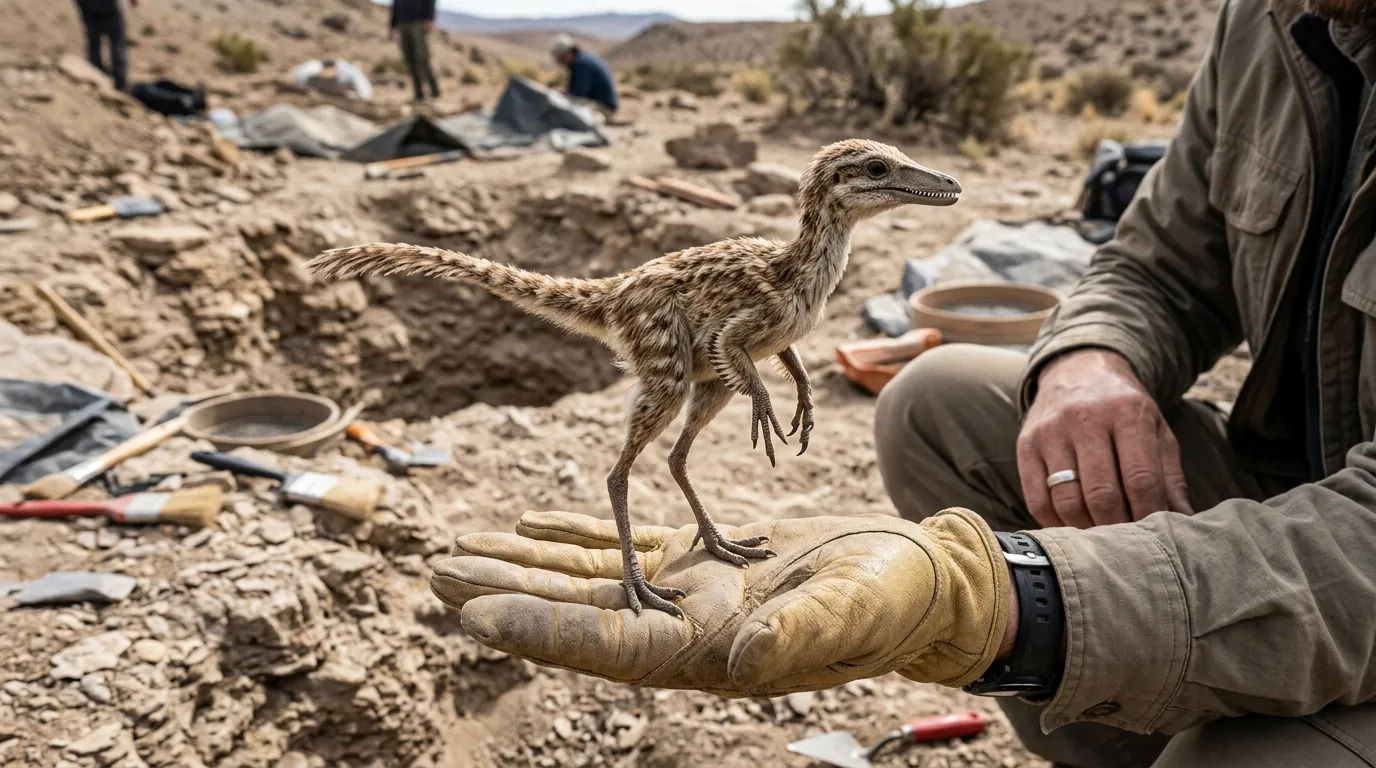
A fully grown dinosaur that weighed less than two pounds. That's what Peter Makovicky held in his hands, or at least the fossilized remains of it, after years of painstaking preparation on a skeleton discovered in northern Patagonia. The animal, named Alnashetri cerropoliciensis, lived 90 million years ago during the Late Cretaceous and belongs to one of the strangest groups of dinosaurs ever identified: the alvarezsaurs. Their discovery, published in Nature in late February 2026, doesn't just add a new species to the catalog. It rearranges the timeline of how these animals evolved and challenges a basic assumption about the relationship between body size and specialization.
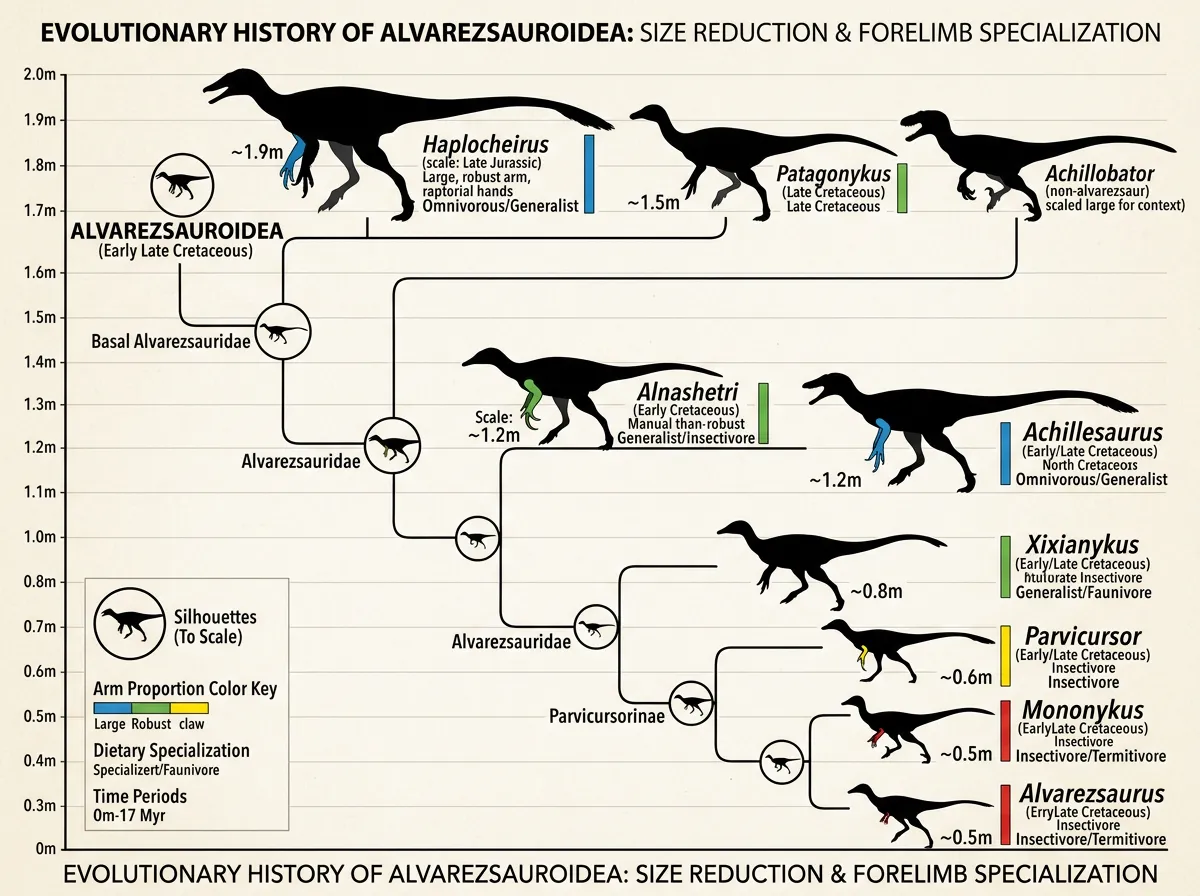
Alvarezsaurs are already weird by any standard. The best-known members of the group, species like Mononykus from Mongolia, had arms that had shrunk to stubby, muscular appendages with a single large claw, arranged in a configuration that paleontologists believe was adapted for breaking open termite mounds and ant nests. They were bird-sized insectivores that looked like they'd been assembled from spare parts: a bird's legs, a dinosaur's tail, and the arms of something that defied easy comparison.
The prevailing assumption was that this entire package evolved together. The animals got smaller, their arms got shorter, and their diet specialized, all as part of a single coordinated evolutionary transition. Alnashetri says otherwise.
A Skeleton That Shouldn't Exist in the Fossil Record
Finding a nearly complete skeleton of any dinosaur is rare. Finding a nearly complete skeleton of a dinosaur that weighed under two pounds is almost unprecedented. Small animals have fragile bones. They get eaten, stepped on, scattered by scavengers, and destroyed by geological processes that wouldn't bother a multi-ton sauropod. The fossil record is deeply biased toward large animals for exactly this reason.
Alnashetri's preservation was a product of geological luck. The skeleton was uncovered in 2014 at a site in Rio Negro Province, Argentina, a location already famous among paleontologists for its exceptionally preserved Late Cretaceous fauna. Sebastian Apesteguia, the Argentine paleontologist who co-led the research, has been excavating the site for over a decade. The rock formations there formed in an ancient floodplain environment where fine sediments could rapidly bury small carcasses before decomposition or scavenging destroyed them.
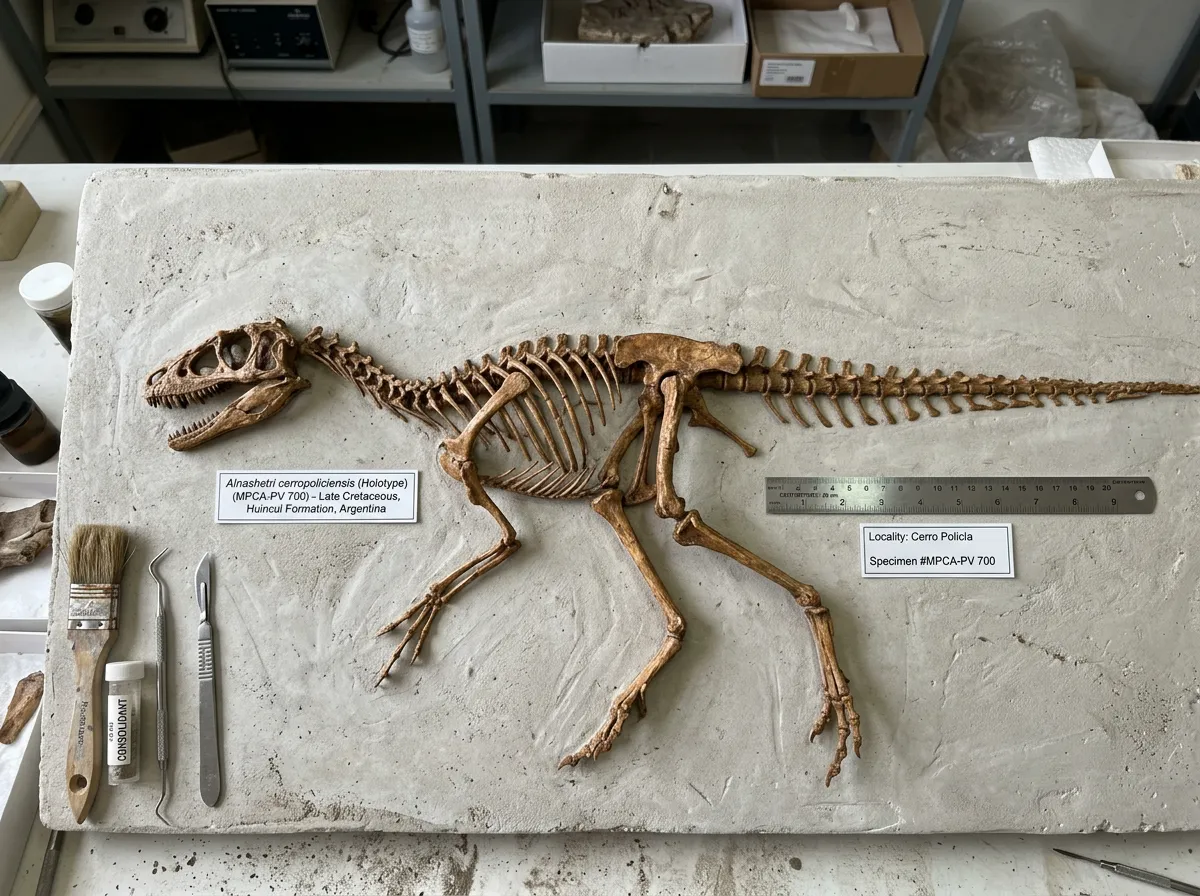
The result is a fossil that preserves nearly every bone in the body, including the arms, the skull, and the delicate bones of the feet. For a group of dinosaurs where most species are known from fragments, a few vertebrae here or a partial limb there, having a near-complete specimen is transformative. It's the difference between guessing what a puzzle picture shows from three pieces versus seeing 90% of the image.
Why Shrinking Before Specializing Matters
Here's the core finding, and why it matters beyond paleontology. Alnashetri was tiny, among the smallest dinosaurs ever found in South America. But unlike its later relatives, it had proportionally longer arms and larger teeth. Its arms hadn't yet shrunk into the stumpy, single-clawed appendages that make later alvarezsaurs so distinctive. Its teeth suggest a more generalized diet, not the specialized insectivore niche that Mononykus and its relatives would later fill.
This means the miniaturization came first. The animals became small before they became specialized. Their arms shortened and their teeth simplified later, as a consequence of being small, not as part of a single simultaneous transformation.
This sequence matters because it speaks to a fundamental question in evolutionary biology: does adaptation drive size change, or does size change enable adaptation? The traditional assumption for alvarezsaurs was the former. Researchers thought these animals evolved shorter arms to break into insect colonies, and getting smaller was part of that adaptive package. Alnashetri shows the reverse: the animals got small first, and the ecological opportunities that come with being small (accessing food sources that larger animals can't, hiding from predators, surviving on fewer calories) opened the door for later specialization.
Makovicky, who is based at the University of Minnesota Twin Cities, described the finding as evidence that "body size reduction was a precondition for the evolution of alvarezsaur specializations, not a byproduct of them." That's a subtle distinction, but it has broad implications for understanding how adaptive radiations work across the tree of life.
The Broader Pattern: Miniaturization as an Evolutionary Strategy
Alnashetri's story resonates far beyond one group of Cretaceous dinosaurs because miniaturization is one of evolution's most powerful and least understood strategies. The most famous example is the origin of birds themselves. Dinosaurs didn't become birds at full size and then shrink. They shrank over tens of millions of years along a specific lineage, and that shrinkage opened access to ecological niches (flight, arboreality, insect-gleaning from bark) that were inaccessible to larger-bodied dinosaurs.
A 2014 study published in Science by Michael Lee and colleagues tracked this process using phylogenetic analysis and found that the lineage leading to birds underwent sustained miniaturization for roughly 50 million years before flight evolved. The authors argued that being small was the prerequisite for flight, not the other way around. Alnashetri's story is a parallel case: shrinking opened the door, and specialization walked through it later.
The pattern appears in mammals as well. The earliest mammals were small, nocturnal, and generalized. Their diminutive size allowed them to occupy niches that dinosaurs dominated at larger body sizes. When the non-avian dinosaurs went extinct 66 million years ago, those small, generalized mammals diversified explosively into the ecological space that opened up. Once again, smallness came first. Specialization followed.
Makovicky and Apesteguia's work on Alnashetri provides the clearest dinosaurian example of this sequence outside the direct bird lineage. It suggests that miniaturization-before-specialization may be a general rule of adaptive radiation, not an exception limited to the ancestors of birds.
What the Fossils in Museum Drawers Revealed
The Nature paper didn't stop with Alnashetri. Makovicky and his colleagues re-examined existing alvarezsaur fossils preserved in museum collections across North America and Europe, many of which had been collected decades ago but never fully described. By incorporating these specimens into their phylogenetic analysis, the team found evidence that alvarezsaurs appeared much earlier in the fossil record than previously believed.
The conventional view placed the group's origin in the Late Cretaceous, roughly 80 to 90 million years ago, with most diversity concentrated in Asia. The revised timeline pushes their origin back significantly, with fragmentary specimens now attributed to the group dating to the Early Cretaceous, over 100 million years ago. If correct, this means alvarezsaurs had a much longer evolutionary runway than anyone realized, with the bulk of their diversification and specialization happening over a period of at least 30 to 40 million years.
This extended timeline makes the miniaturization-before-specialization pattern even more compelling. It wasn't a rapid transformation but a long, gradual process where the animals first became small and only later experimented with the extreme arm reduction and dietary specialization that defines the group's late members. Evolution, as is often the case, was patient.
The museum-drawer discoveries also illustrate a recurring theme in paleontology: some of the most important fossils aren't the ones being dug up today but the ones sitting in collections that nobody has looked at with modern analytical tools. Micro-CT scanning, advanced phylogenetic methods, and comparative databases allow researchers to extract information from century-old specimens that the original collectors couldn't have imagined.
The Patagonian Fossil Record's Ongoing Revolution
Alnashetri comes from a region of South America that has been reshaping paleontology for the past two decades. Northern Patagonia's Cretaceous formations have produced some of the most complete and scientifically significant dinosaur fossils found anywhere on Earth, including spectacular predators like Spinosaurus mirabilis and giant sauropods that rivaled anything found in North America or Asia.
What makes the Argentine sites special is a combination of geology and climate. The rock formations were deposited in river and floodplain environments that preserved animals across a wide range of body sizes. The modern climate is arid enough to expose fossils through natural erosion but not so harsh that the exposed bones disintegrate quickly. And the Argentine paleontological community, led by institutions like the Museo Argentino de Ciencias Naturales and the Fundacion de Historia Natural Felix de Azara, has invested decades in systematic fieldwork that covers enormous areas.
The result is a fossil record that's uniquely representative of Late Cretaceous ecosystems. While other regions produce spectacular individual specimens, Patagonia produces entire ecological snapshots: predators, herbivores, tiny insectivores like Alnashetri, and everything in between. Each new discovery doesn't just add a name to the list. It adds a node to the network of ecological relationships that defines how these ancient ecosystems functioned.
Why It Matters
A two-pound dinosaur from 90 million years ago might seem like a curiosity, a footnote in a fossil record dominated by creatures that shook the ground when they walked. But Alnashetri cerropoliciensis is the kind of discovery that quietly rearranges how biologists think about the mechanics of evolutionary change.
The finding that miniaturization preceded specialization in alvarezsaurs isn't just about one group of odd dinosaurs. It's about whether getting smaller is a cause or an effect of adaptive radiation, one of the central questions in evolutionary biology. If the pattern holds across other groups (and the parallel with bird origins suggests it does), then smallness isn't just a side effect of adaptation. It's the enabling condition, the first step in a sequence that opens ecological doors that larger animals can't reach.
Three questions now drive the research forward. First, how far back does the alvarezsaur lineage actually extend? The museum-drawer discoveries hint at an Early Cretaceous origin, but definitive fossils from that period remain elusive. Second, did other dinosaur lineages follow the same miniaturization-before-specialization pattern, or are alvarezsaurs and bird ancestors exceptions? Third, what ecological pressures drove the initial shrinkage? Alnashetri's generalized anatomy suggests it wasn't diet specialization. Competition with larger predators, predation avoidance, and thermal regulation in changing climates are all possibilities, but the fossil alone can't distinguish among them. The bones tell us what happened. The why, for now, is still buried.
Sources
- This 2-pound dinosaur is rewriting what scientists know about evolution - ScienceDaily
- 90-Million-Year-Old Patagonian Fossil Reveals Missing Chapter in Alvarezsauroid Evolution - Sci.News
- 90-Million-Year-Old Fossil Reveals a Fully Grown Dinosaur That Weighed Less Than 2 Pounds - Discover Magazine
- The Dainty Dinosaur That's Rewriting Evolutionary History - Nautilus