
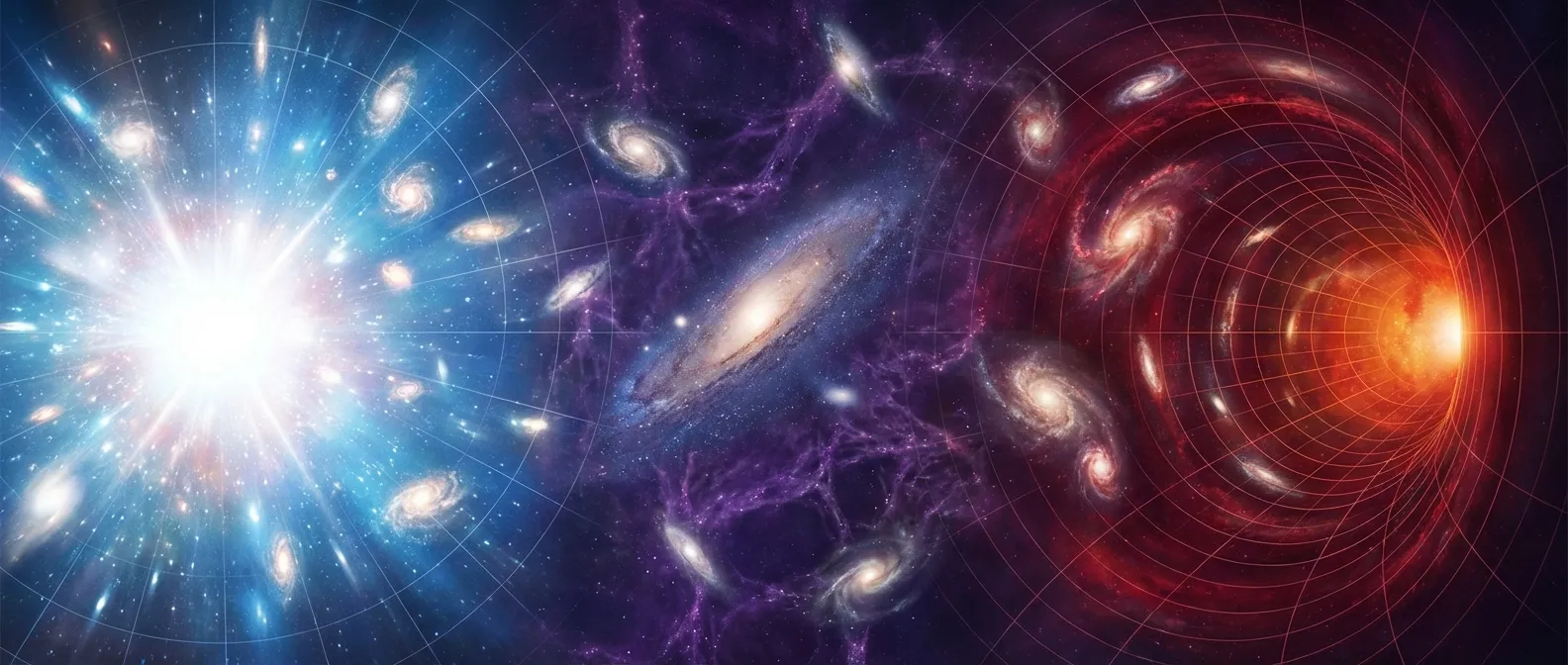
For more than two decades, cosmologists shared a quiet consensus: the universe would expand forever, thinning into a cold, dark emptiness called the Big Freeze. Dark energy, the mysterious force accelerating that expansion, seemed to guarantee it. The question wasn't whether the cosmos would end in ice, but when the last stars would flicker out.
Then, in late 2025, data from two of the world's most powerful dark energy observatories landed on the same unexpected conclusion. The acceleration is slowing. And a Cornell physicist named Henry Tye ran the numbers to their logical endpoint: the universe doesn't just stop expanding. It reverses. Everything that flew apart after the Big Bang comes back together in a cosmic collapse, a scenario physicists call the Big Crunch.
If Tye's model holds, the universe has a total lifespan of roughly 33 billion years. We're 13.8 billion years in, which means we've already passed the halfway point of cosmic history. The end isn't imminent by any human standard, but for the first time in a generation, physicists are seriously reconsidering whether the universe dies in fire rather than ice.
The Data That Changed the Conversation
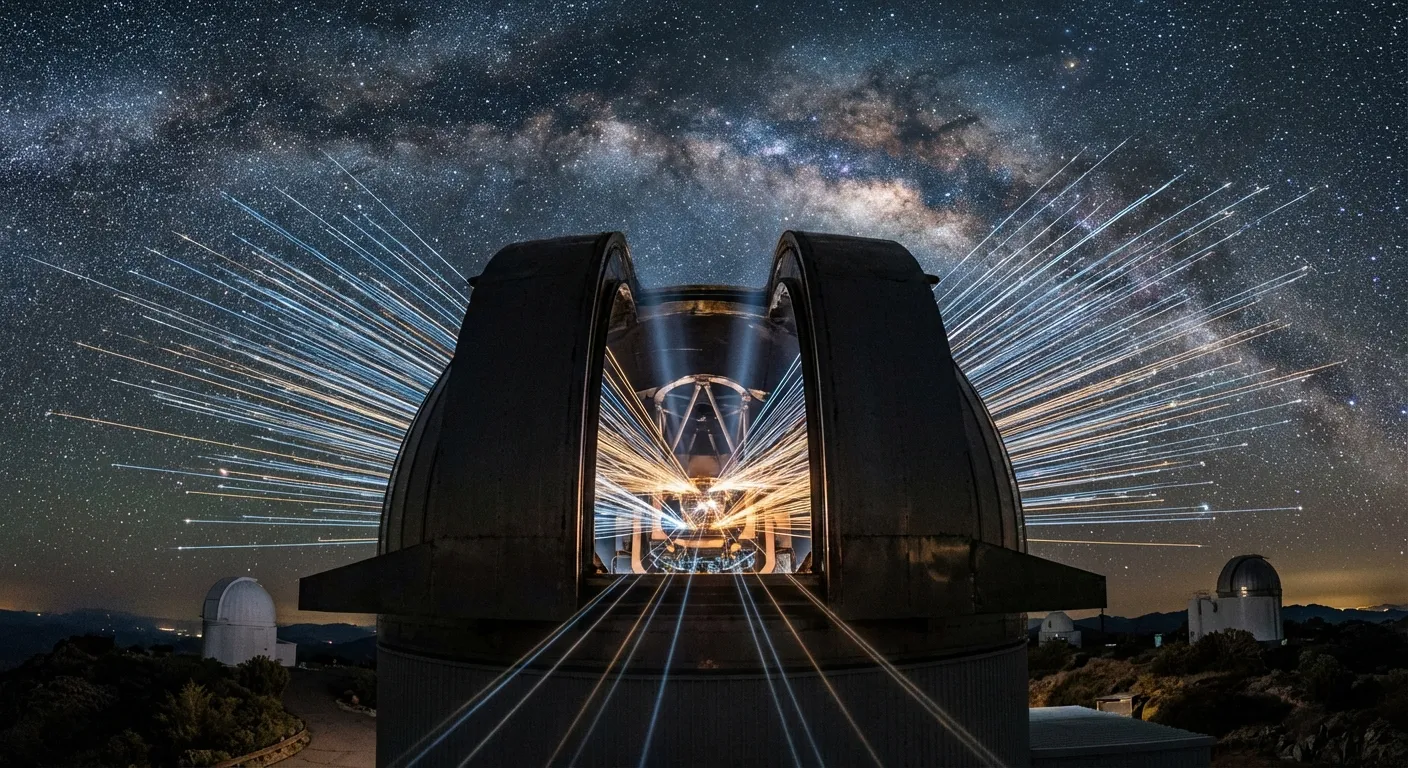
The shift began with the Dark Energy Spectroscopic Instrument (DESI), a massive camera mounted on a telescope at Arizona's Kitt Peak National Observatory. DESI maps the three-dimensional positions of millions of galaxies, measuring how their light has stretched over billions of years to track the universe's expansion rate across cosmic time.
Independently, the Dark Energy Survey (DES) in Chile conducted similar measurements from the Southern Hemisphere. When both teams published their results, the agreement was striking: dark energy's influence appears to be weakening. Not disappearing, but diminishing in a way that the standard cosmological model, which treats dark energy as a fixed constant, cannot explain.
"We didn't find that the universe is slowing down," clarified Mustapha Ishak-Boushaki, a physicist involved in interpreting the data. "We found that it is accelerating less." The distinction matters. The universe is still expanding, and still accelerating, but the rate of that acceleration appears to be declining. If that trend continues, acceleration eventually hits zero, expansion stops, and gravity takes over.
This is precisely the scenario Henry Tye explored. Working with former doctoral students Hoang Nhan Luu and Yu-Cheng Qiu at the Hong Kong University of Science and Technology, Tye published a model in the Journal of Cosmology and Astroparticle Physics proposing an ultra-low-mass hypothetical particle. Early in the universe's history, this particle mimicked Einstein's cosmological constant, the mathematical term that describes dark energy's push. But over cosmic timescales, its behavior diverged. The effective cosmological constant turned negative, meaning the force that once drove galaxies apart would eventually pull them back together.
A 33-Billion-Year Lifespan
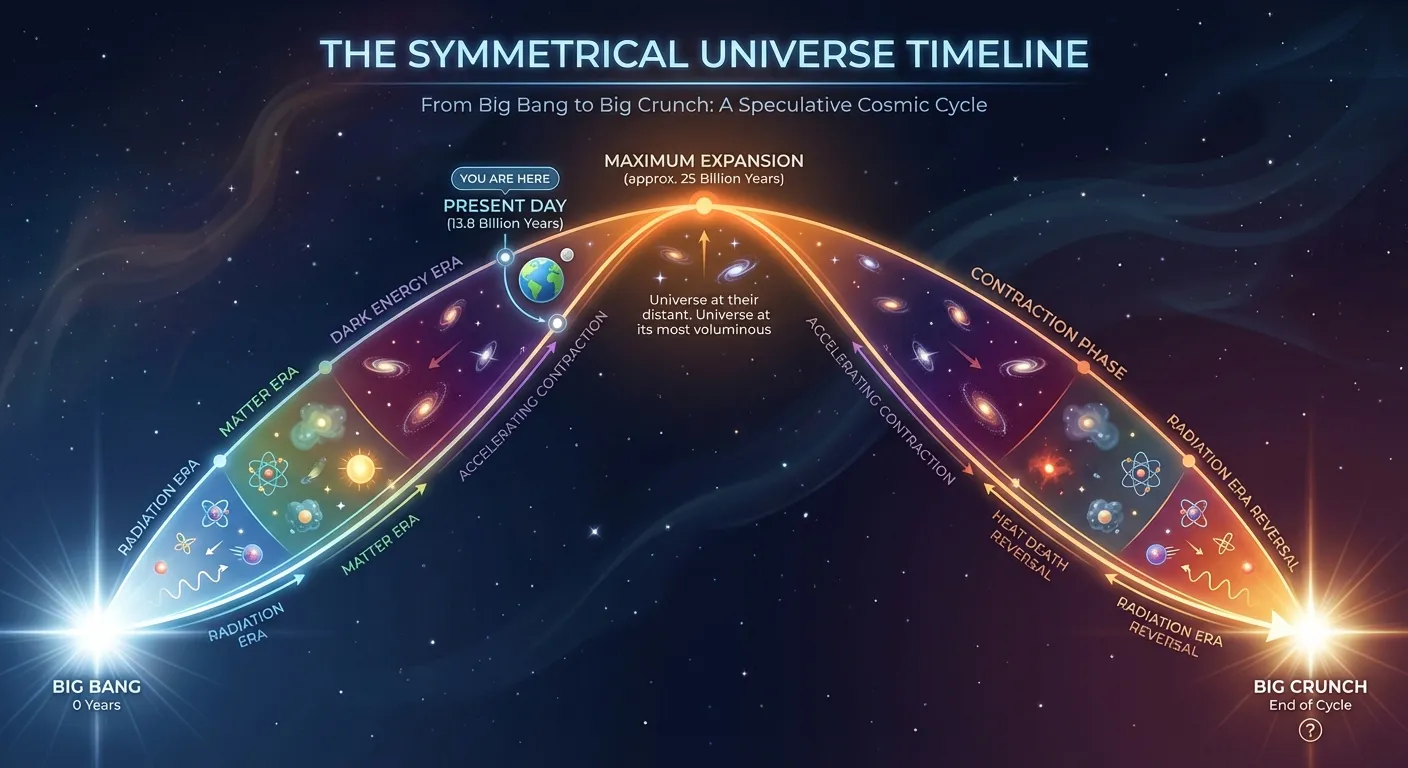
The model's timeline is specific. The universe reaches its maximum size roughly 11 billion years from now. Then contraction begins, slowly at first, then accelerating under gravity's pull. About 20 billion years from the present, everything collapses back to a singularity, a point of infinite density mirroring the one from which the Big Bang emerged.
"For the last 20 years, people believed that the cosmological constant is positive, and the universe will expand forever," Tye told Cornell Chronicle. "The new data seem to indicate that the cosmological constant is negative, and that the universe will end in a big crunch."
The total lifespan of 33.3 billion years gives the universe a kind of symmetry. The first half was dominated by expansion, the second half by contraction. We happen to exist slightly past the midpoint, in an era where expansion is still winning but the balance is already shifting.
This isn't the first time the Big Crunch has been taken seriously. Before 1998, many cosmologists assumed gravity would eventually win the tug-of-war with expansion. The discovery of dark energy that year, by two teams studying distant supernovae, seemed to settle the debate permanently. Dark energy was accelerating expansion, and if that acceleration was constant, gravity could never overcome it. The universe would expand forever, cooling toward absolute zero in what became known as the heat death.
The DESI and DES data don't overturn that discovery. They complicate it. Dark energy is real, still the dominant force in the cosmos. But if its strength is changing over time rather than remaining constant, the entire trajectory of the universe changes with it.
The Skeptics and the Stakes
Not everyone is convinced. Harvard astrophysicist Avi Loeb has suggested that the apparent weakening of dark energy could be explained by modifying our understanding of dark matter rather than dark energy itself. "The DESI anomaly could also be explained by tweaking the evolution of dark matter rather than dark energy," Loeb argued, noting that the data could support multiple interpretations.
This kind of debate is healthy and expected. DESI's initial results represent just three years of data collection. The instrument is designed to operate for at least five years, and its dataset will grow substantially. Future observations from the European Space Agency's Euclid satellite, launched in 2023 to map the geometry of the dark universe, will provide independent checks.
The challenge is that distinguishing between a constant and a slowly changing dark energy requires extraordinary precision. Small systematic errors in measuring galaxy distances, in modeling dust absorption, or in calibrating instruments could mimic the signal of weakening dark energy. Tye's model makes a specific, testable prediction: the universe's expansion rate should continue to decelerate in a measurable way. If it doesn't, the model fails.
What makes this moment unusual is that two independent surveys, using different instruments on different continents observing different patches of sky, arrived at compatible results. That convergence is what elevated the Big Crunch from a theoretical curiosity to a live scientific question. As Tye put it: "For any life, you want to know how life begins and how life ends."
What a Collapsing Universe Would Look Like
If the Big Crunch scenario plays out, the effects wouldn't be noticeable for billions of years. The initial deceleration of expansion would be imperceptible. But as contraction accelerated, the consequences would be dramatic. Galaxies that are currently racing away from each other would slow, stop, and begin falling together. The cosmic microwave background radiation, a relic of the Big Bang that has been cooling for 13.8 billion years, would begin to heat up again as the universe compressed.
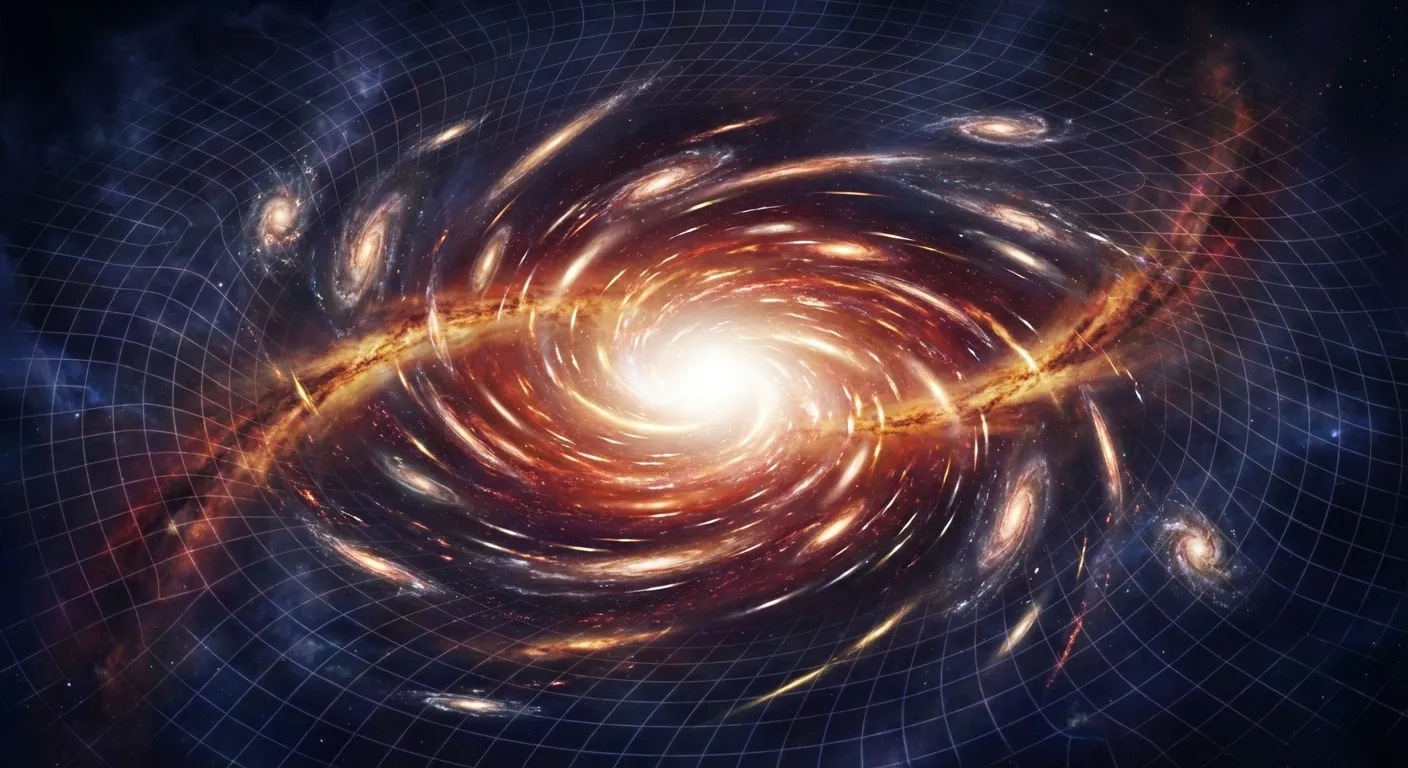
In the final stages, the scenario resembles the Big Bang in reverse. Temperatures would climb past the point where atoms can hold together. Matter would dissolve into a plasma of fundamental particles. Eventually, even those particles would be crushed into the singularity, a state where the known laws of physics break down.
Some theorists have speculated about what happens at that singularity. One possibility is that the collapse triggers a new Big Bang, creating a new universe in an endless cycle of expansion and contraction. This "cyclic universe" model, championed by physicists like Paul Steinhardt of Princeton, gained new theoretical ground alongside the Big Crunch's revival. If the universe bounces rather than simply ends, the implications for cosmology extend beyond one universe's lifetime into a potentially infinite sequence of cosmic births and deaths. The idea that our universe cannot be simulated takes on additional weight if what we observe is only one iteration in an infinite chain.
Connecting Dark Energy to Deeper Physics
The weakening of dark energy, if confirmed, would be one of the most consequential discoveries in modern physics. The cosmological constant was introduced by Einstein in 1917 to keep his equations from predicting an expanding or contracting universe. He later called it his "greatest blunder" when Edwin Hubble proved the universe was indeed expanding. But when dark energy was discovered in 1998, the cosmological constant was resurrected as the simplest explanation for the observed acceleration.
A constant dark energy fits neatly into the current standard model of cosmology, called Lambda-CDM. If dark energy varies over time, that model needs revision. Tye's ultra-low-mass particle proposal is one possible replacement, but others exist, including modifications to general relativity, extra dimensions from string theory, and scalar field models called quintessence. Each makes different predictions about how the universe will evolve.
What's remarkable is that the question of the universe's fate, which seemed settled, connects directly to some of the deepest unsolved problems in physics: the nature of dark energy, the validity of string theory, the reconciliation of quantum mechanics and gravity, and the nature of black holes and their role in cosmic evolution. Answering how the universe ends may require answering what the universe fundamentally is.
The Bigger Picture
For most of recorded history, humans assumed the cosmos was eternal and unchanging. The discovery that the universe had a beginning, in the Big Bang, was one of the 20th century's great intellectual revolutions. The possibility that it also has an end completes that story in a way that is both unsettling and deeply satisfying.
The Big Crunch remains a hypothesis, not a prediction. The data that revived it are preliminary, the interpretations contested, and the theoretical models speculative. But the fact that independent observations from two hemispheres point in the same direction gives it a credibility that purely theoretical scenarios rarely achieve. Over the next decade, as DESI completes its survey and Euclid contributes its own measurements, the question of whether the universe ends in ice or fire will move from speculation to testable science.
If the Big Crunch is real, it doesn't change anything about human life on practical timescales. Twenty billion years is incomprehensibly distant. But it changes the story we tell about where we are in cosmic history, from residents of a universe with an infinite future to inhabitants of one that is, in the deepest sense, already past its prime.
Sources
- Physicist: After 33 billion years, universe 'will end in a big crunch' - Cornell Chronicle
- Universe may end in a "big crunch," new dark energy data suggests - ScienceDaily
- The Big Crunch Theory Is Revived as Recent Data Shows Our Expanding Universe Slowing Down - Discover Magazine
- Dark energy could be getting weaker, suggesting the universe will end in a 'Big Crunch' - Space.com