
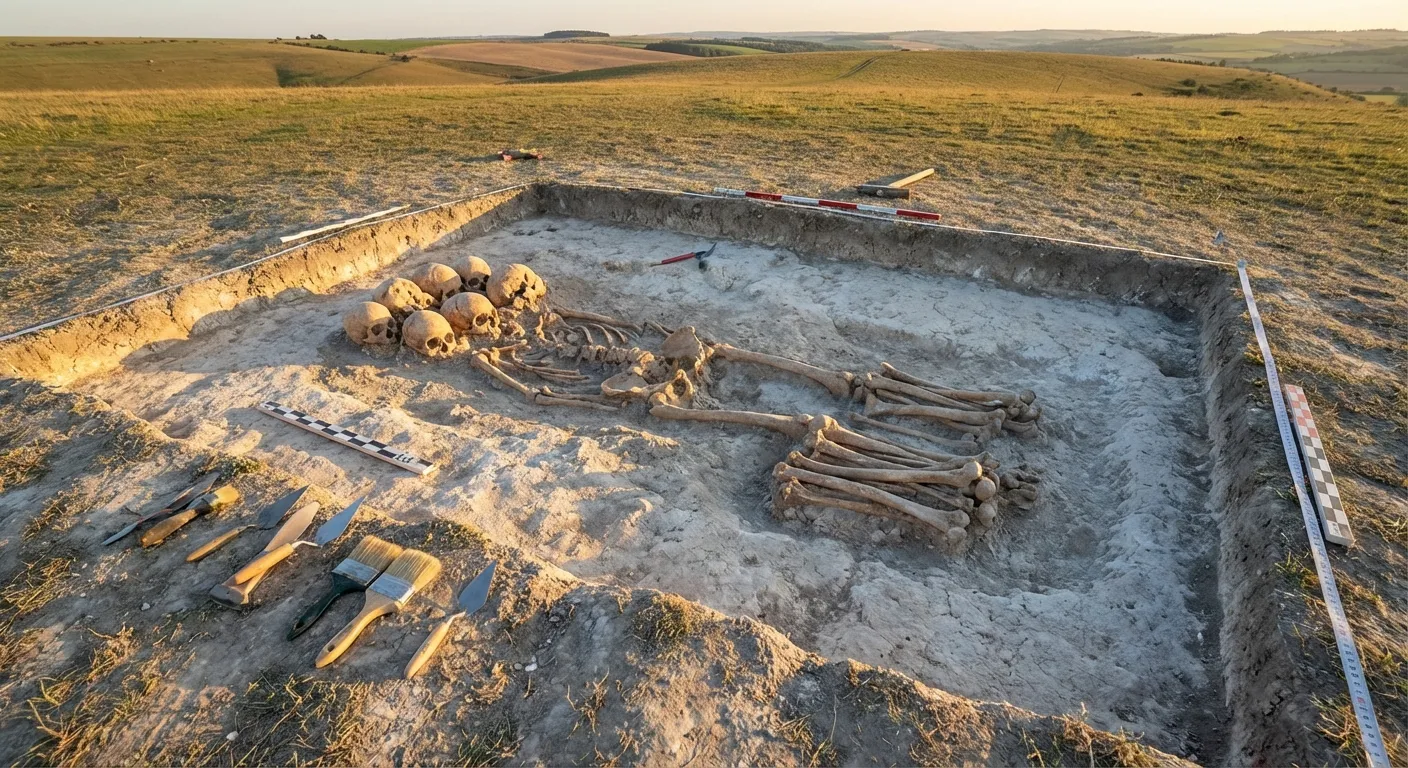
In the summer of 2025, a group of archaeology students at the University of Cambridge went to Wandlebury Country Park for a training dig. The site sits about three miles south of Cambridge, in the rolling chalk hills of southern Cambridgeshire. It was supposed to be educational. Students would learn excavation techniques, practice recording methods, and get their hands dirty in English soil that had been farmed and fought over for millennia.
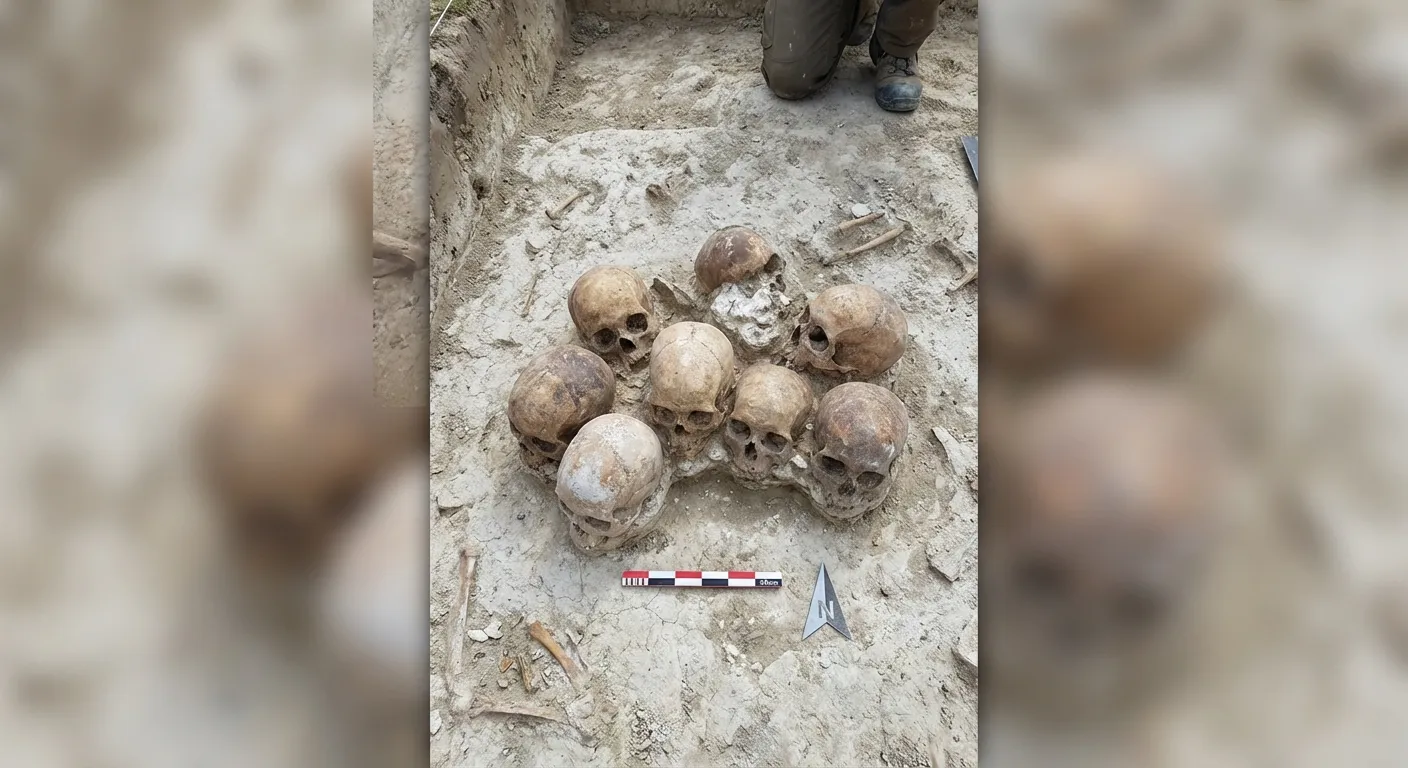
What they found was a shallow pit, roughly four meters long and one meter wide, containing the remains of ten people. The pit held four complete skeletons, a cluster of skulls without accompanying bodies, and a stack of leg bones arranged as if someone had gathered them and placed them deliberately. The individuals were all young men. Some appeared to have been flung into the ground without ceremony. Others showed signs of having been bound before death. One skeleton had been decapitated.
Among the ten was a man who stood approximately six feet five inches tall, a towering figure in an era when the average male height was about five feet six inches. This man had a hole in the back left side of his skull, roughly three centimeters in diameter, with clear signs of healing around the edges. Someone had drilled into his living skull, and he had survived the procedure. The students had uncovered not just a mass grave but a collection of stories, each more unsettling than the last.
A Frontier Zone Between Two Worlds
To understand what the Wandlebury pit means, you need to understand where Cambridge stood in the ninth century. During the 800s, England was not a unified country but a patchwork of competing kingdoms. The Vikings, Scandinavian raiders who had begun attacking English shores in 793 with the famous raid on Lindisfarne, had by the mid-ninth century shifted from raiding to conquering. In 865, the Great Heathen Army landed in East Anglia and began systematically dismantling the Anglo-Saxon kingdoms.
By the 870s, the Vikings controlled most of eastern and northern England, a region that became known as the Danelaw. The border between Viking-held territory and the surviving Anglo-Saxon kingdoms ran roughly through the English Midlands, and Cambridge sat squarely on this frontier. The area was a contested zone where Saxon and Viking forces clashed repeatedly, where allegiances shifted, and where violence was a constant backdrop to daily life.
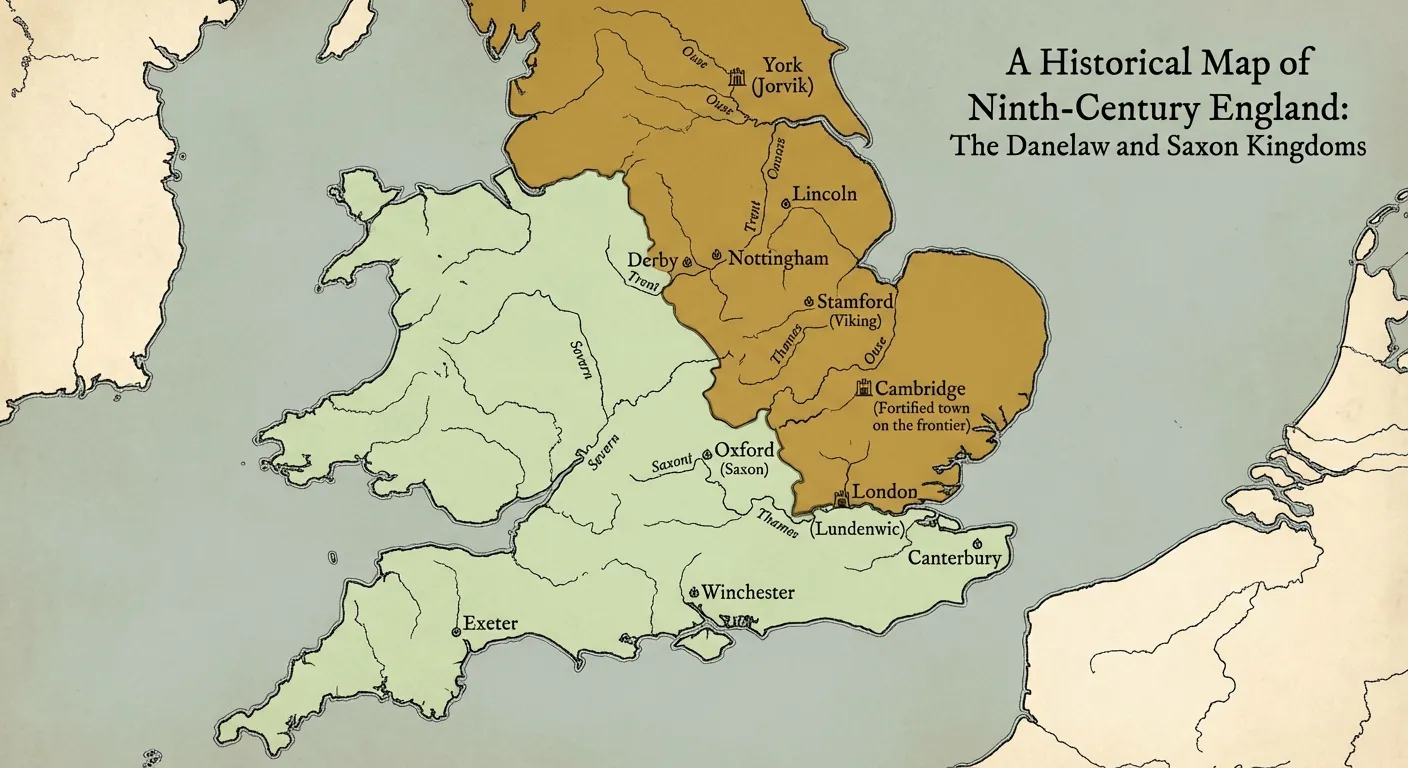
Carbon dating of one skeleton from the pit places it between 772 and 891 CE, fitting precisely within this turbulent period. The remains could belong to Vikings, Saxons, or some mix of both. They could be casualties of battle, victims of execution, or something else entirely. The pit raises questions about identity and violence that future DNA analysis and isotopic testing may eventually answer.
The location at Wandlebury adds another layer. The site has been occupied since the Iron Age, when a massive hillfort was constructed there. By the Viking Age, the hillfort was no longer in active military use, but its prominence in the landscape would have made it a meaningful place, a location associated with power and visibility. Burying, or discarding, bodies at such a site may have carried symbolic weight.
Skulls Without Bodies, Bodies Without Heads
The most immediately striking feature of the Wandlebury pit is its mix of complete and dismembered remains. Four individuals were buried more or less intact, though in positions suggesting they were tossed into the pit rather than carefully laid out. The remaining six are represented by scattered body parts: skulls grouped together, long bones stacked, some elements missing entirely.
Dr. Trish Biers, curator of the Duckworth Collections at the University of Cambridge, noted that this combination is highly unusual. Mass graves from the period tend to contain either complete burials (suggesting people killed and buried together) or uniformly dismembered remains (suggesting execution and display). The Wandlebury pit contains both, which suggests a more complex sequence of events.
One possibility is that some of the disarticulated remains were displayed before burial. In both Viking and Anglo-Saxon cultures, the bodies of defeated enemies were sometimes exhibited publicly: heads mounted on stakes, limbs displayed at crossroads. These trophies might have been collected later and buried together with freshly killed individuals. The pit may represent not a single event but a gathering of remains from different moments of violence.
At least one individual shows clear evidence of decapitation. The skull was separated from the body by a sharp instrument, consistent with execution by sword or axe. This method of killing was common in both cultures and could represent either judicial punishment or battlefield execution of captured enemies.
The Giant Who Survived Brain Surgery
The most remarkable individual in the pit is the tall man with the trepanned skull. Trepanation, the practice of drilling or scraping a hole through the skull of a living person, is one of the oldest known surgical procedures. Evidence of trepanation dates back over 7,000 years, with examples from Neolithic France, ancient Peru, and classical Greece.
The Wandlebury trepanation is notable for several reasons. The hole, an oval opening roughly three centimeters across on the back left side of the skull, shows clear evidence of healing. New bone growth around the margins indicates the man survived the procedure by weeks or months at minimum. This was not a fatal wound. It was surgery that worked.
Dr. Biers suggested a possible medical explanation for both the man's extraordinary height and the surgery. A tumor affecting the pituitary gland can cause an excess of growth hormones, producing unusual stature. Such a condition would also increase intracranial pressure, causing severe headaches. The trepanation may have been an attempt to relieve that pressure, a surprisingly logical medical intervention for the ninth century.
This interpretation, if correct, reveals something important about medical knowledge in Viking Age Britain. Whoever performed the surgery understood that pressure inside the skull could cause symptoms, that relieving that pressure could help, and had the technical skill to drill through bone without killing the patient. They also had some method of managing infection, since the wound healed. This level of medical sophistication challenges the popular image of the early medieval period as a time of unrelenting ignorance.
The connection to ancient medical practices is instructive. Many conditions that seem bizarre or impossible to us were recognized and treated in ways that, while different from modern medicine, reflected genuine empirical observation. The trepanned skull at Wandlebury joins a growing body of evidence that pre-modern medical practitioners were more capable than stereotypes suggest.
What the Bones Can Still Tell Us
The excavation is far from complete in terms of what it can reveal. The physical recovery of the remains was the first step. The next phase involves laboratory analysis that could answer many of the questions the pit raises.
Ancient DNA extraction may determine the biological relationships between the individuals. Were they related? Were they from the same community, or were some locals and others outsiders? DNA can also indicate geographic ancestry, potentially distinguishing between individuals of Scandinavian origin (Vikings) and those of Anglo-Saxon descent.
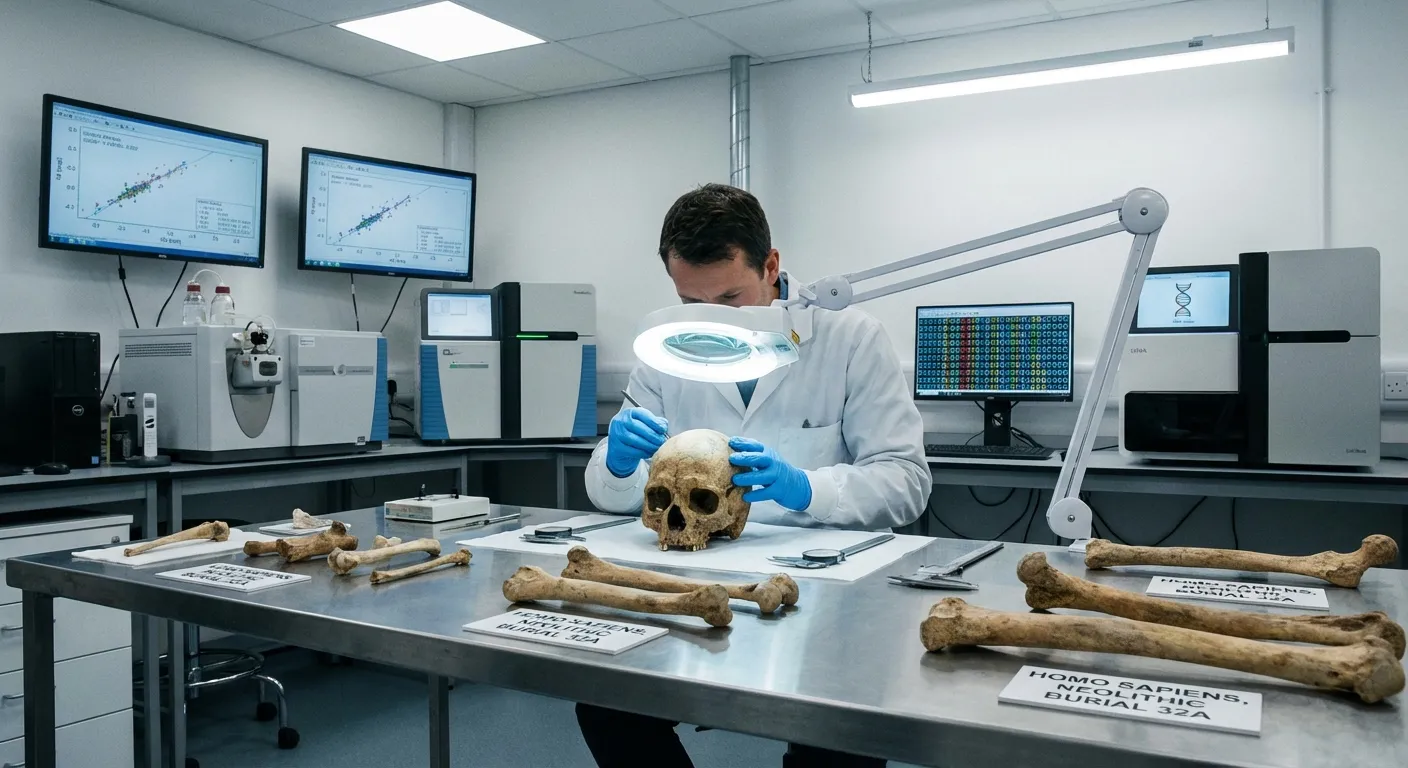
Isotopic analysis of teeth and bones provides different but complementary information. The ratio of oxygen and strontium isotopes in tooth enamel reflects the geology and climate of the place where a person grew up, since enamel forms in childhood and doesn't change afterward. If some individuals grew up in Scandinavia and others in England, isotopic signatures will differ markedly.
Carbon and nitrogen isotopes from bone collagen reveal dietary information. People who ate primarily marine protein (common among coastal Scandinavians) show different isotopic signatures from those who ate terrestrial protein (more typical of inland Anglo-Saxon farming communities). Diet can serve as a proxy for cultural identity when genetic analysis is ambiguous.
The results of these analyses, expected to emerge over the coming months, could transform our understanding of the pit. Were the victims and perpetrators from the same culture or different ones? Was this a Viking execution of Saxon prisoners, a Saxon reprisal against Viking captives, or something that doesn't fit neatly into either narrative? The bones carry answers that the dig alone cannot provide.
Echoes Across the Landscape
The Wandlebury pit is not the only Viking Age mass burial found in England, and comparisons with other sites help contextualize the discovery. The most famous parallel is the Ridgeway Hill mass grave in Dorset, discovered in 2009. That pit contained the headless remains of 54 young men, their skulls piled separately from their bodies. DNA and isotopic analysis identified them as Scandinavians, probably Vikings captured and executed by Anglo-Saxons.
Another relevant site is the Repton charnel deposit in Derbyshire, associated with the Great Heathen Army's winter camp of 873-874 CE. The Repton burials include both elaborate Viking warrior graves and a mass deposit of disarticulated bones from at least 264 individuals, mostly men of fighting age. The Repton evidence suggests large-scale violence associated with the Viking campaign, though the exact circumstances remain debated.
The Wandlebury pit fits into this pattern of frontier violence while also standing apart. Its mix of complete and dismembered burials, the presence of the trepanned giant, and its location at a site with deep historical associations make it a distinctive addition to the archaeological record. Each new discovery complicates the narrative, which is exactly what good archaeology should do. History told only through chronicles and sagas privileges certain voices. The bones speak for those the writers ignored.
The find also connects to broader questions about how we reconstruct ancient identities from physical remains. Like the evidence from Troy, the Wandlebury pit demonstrates that archaeological discoveries can bring stories told by later authors into sharper focus, providing physical evidence for periods that often feel more legendary than real.
The Deeper Question
What happened at Wandlebury around the ninth century may never be fully reconstructed. We may learn who these people were but not precisely why they died. The pit preserves a moment of violence but not the context that made that violence meaningful to the people who committed it.
This incompleteness is itself instructive. We tend to think of the past in neat categories: Vikings versus Saxons, invaders versus defenders, the Danelaw versus Wessex. But people living through these events experienced something messier. Identities were fluid. A Viking settler in East Anglia might ally with Saxon neighbors against a common threat. A Saxon lord might employ Norse mercenaries. The frontier wasn't a clean line but a zone of mixing, tension, and occasional eruptions of savage violence.
The ten young men in the Wandlebury pit lived and died in that zone. Some may have been warriors, others perhaps captives or criminals. The tall man with the hole in his skull survived a dangerous surgery, walked around for weeks or months afterward, and then ended up in a mass grave. His story is both extraordinary, because few people survived trepanation, and ordinary, because the ninth century produced countless anonymous dead.
What the students at Cambridge found in the summer of 2025 was not just a collection of bones. It was a reminder that the ground beneath our feet holds stories we haven't imagined, stories that complicate convenient narratives and resist tidy conclusions. Ten skulls in a chalk pit three miles from one of the world's great universities. A thousand years of silence, now broken by trowels and brushes in the hands of people learning to listen.
Sources
- University of Cambridge: Cambridge students help unearth possible Viking-era 'execution pit' on training dig
- Live Science: Viking Age mass grave holds mysterious mix of dismembered human remains
- University of Cambridge Department of Archaeology: Wandlebury training dig burial
- Ancient Origins: Viking Age Mass Grave in UK Reveals "Giant" with Skull Surgery