
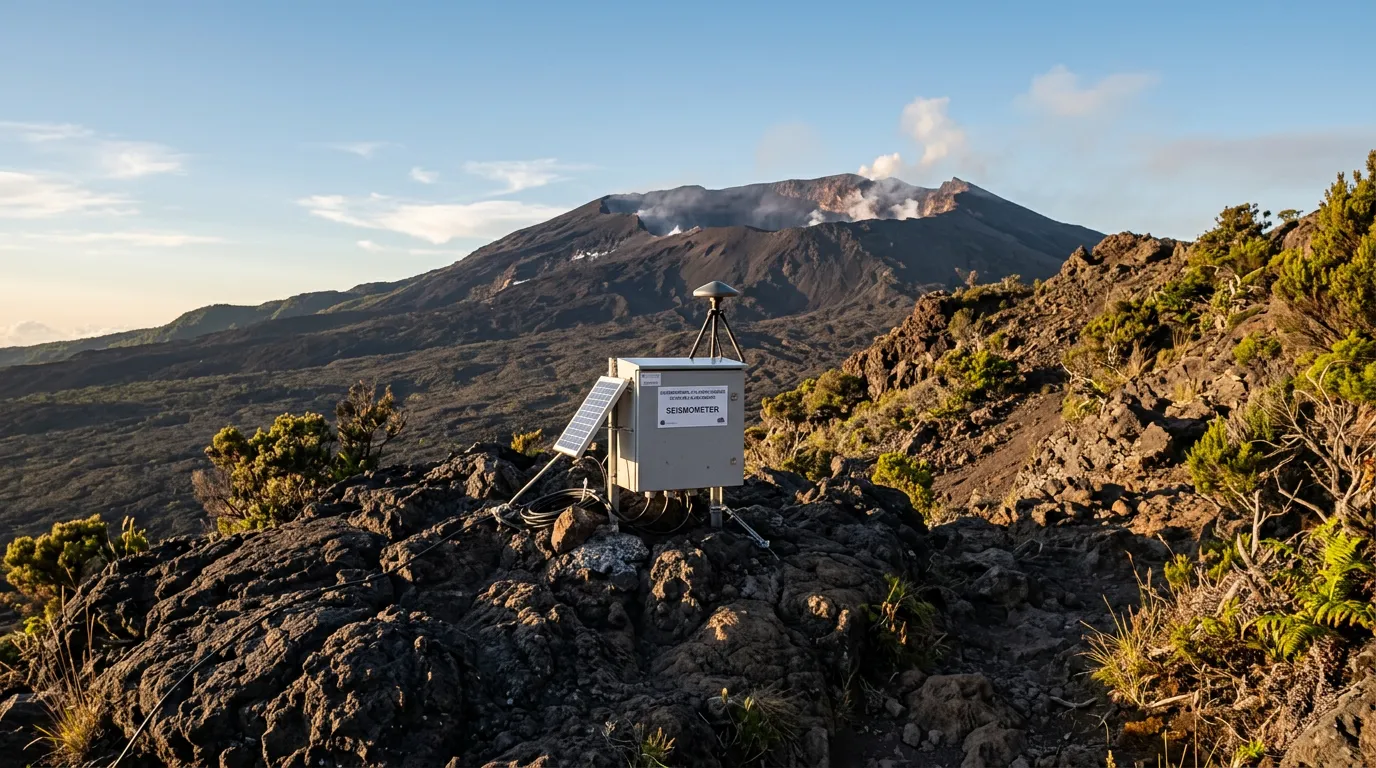
Somewhere on La Réunion, a small French island in the Indian Ocean east of Madagascar, a single seismometer sits on volcanic rock about eight kilometers from the summit of Piton de la Fournaise. It does not look like the kind of instrument that could change how the world prepares for volcanic eruptions. It has no moving parts visible to the eye. It records vibrations so faint that they measure in nanometers per second cubed, quantities so small they make a whisper seem like a thunderclap. And yet, over a span of more than ten years, this one instrument predicted 92% of the eruptions at one of Earth's most active volcanoes, sometimes eight and a half hours before lava broke the surface.
The method behind that performance is called "Jerk." Published in Nature Communications by a team led by Dr. Francois Beauducel of the Institut de Physique du Globe de Paris (IPGP) and Dr. Philippe Jousset of the GFZ Helmholtz Centre for Geosciences in Potsdam, the study describes a detection technique so minimal in its requirements that it could be deployed at volcanoes with almost no existing monitoring infrastructure. In a field where forecasting has long depended on dense sensor networks, statistical models, and a fair amount of guesswork, that simplicity is itself a kind of breakthrough.
What the Researchers Found
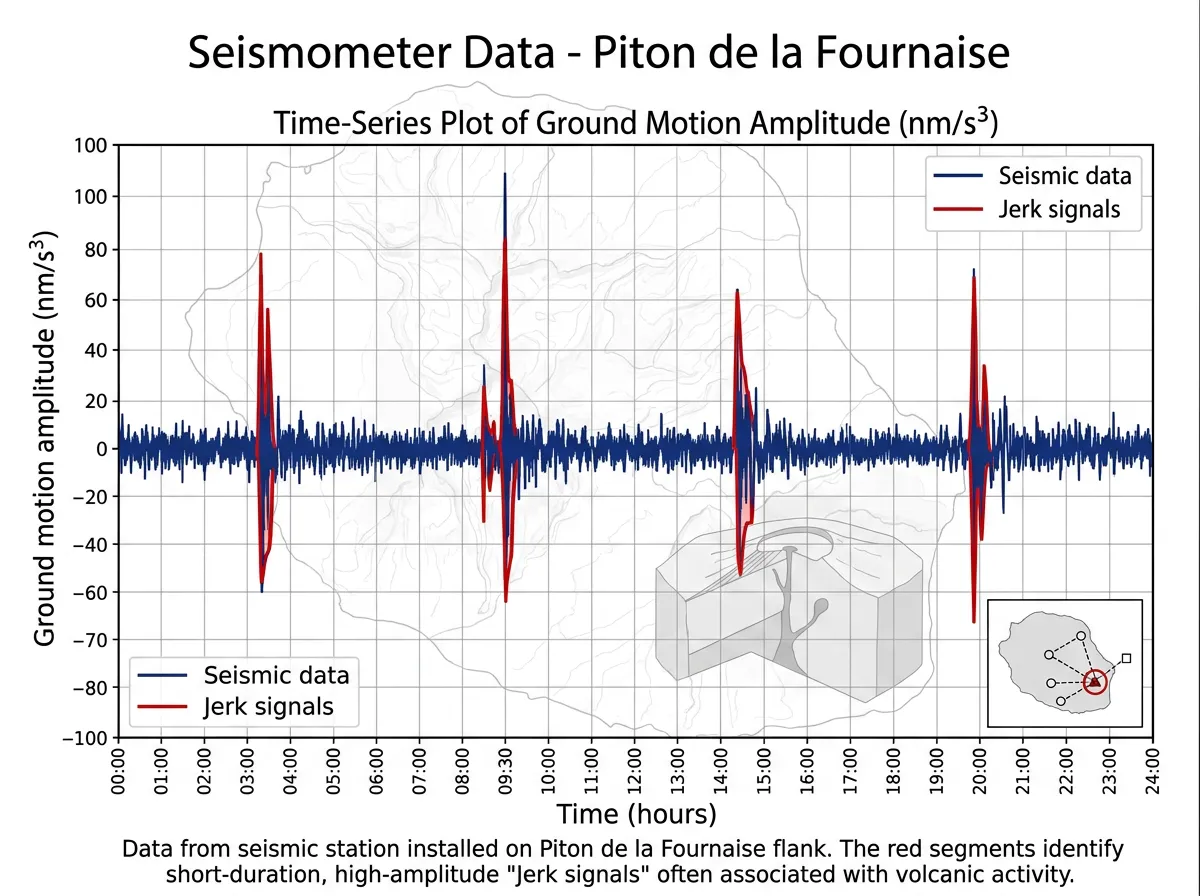
The core discovery is that volcanoes produce extremely subtle ground movements in the hours before an eruption, and those movements can be captured by a single broadband seismometer if you know what to look for. The signals, which the team calls "Jerk" signals, appear as very low frequency transients in horizontal ground motion. They reflect both acceleration and tilt in the ground surface, and their amplitudes are extraordinarily small, on the order of nanometers per second cubed. To put that in context, a nanometer is one billionth of a meter. The ground shifts the researchers are detecting are smaller than the width of a single atom.
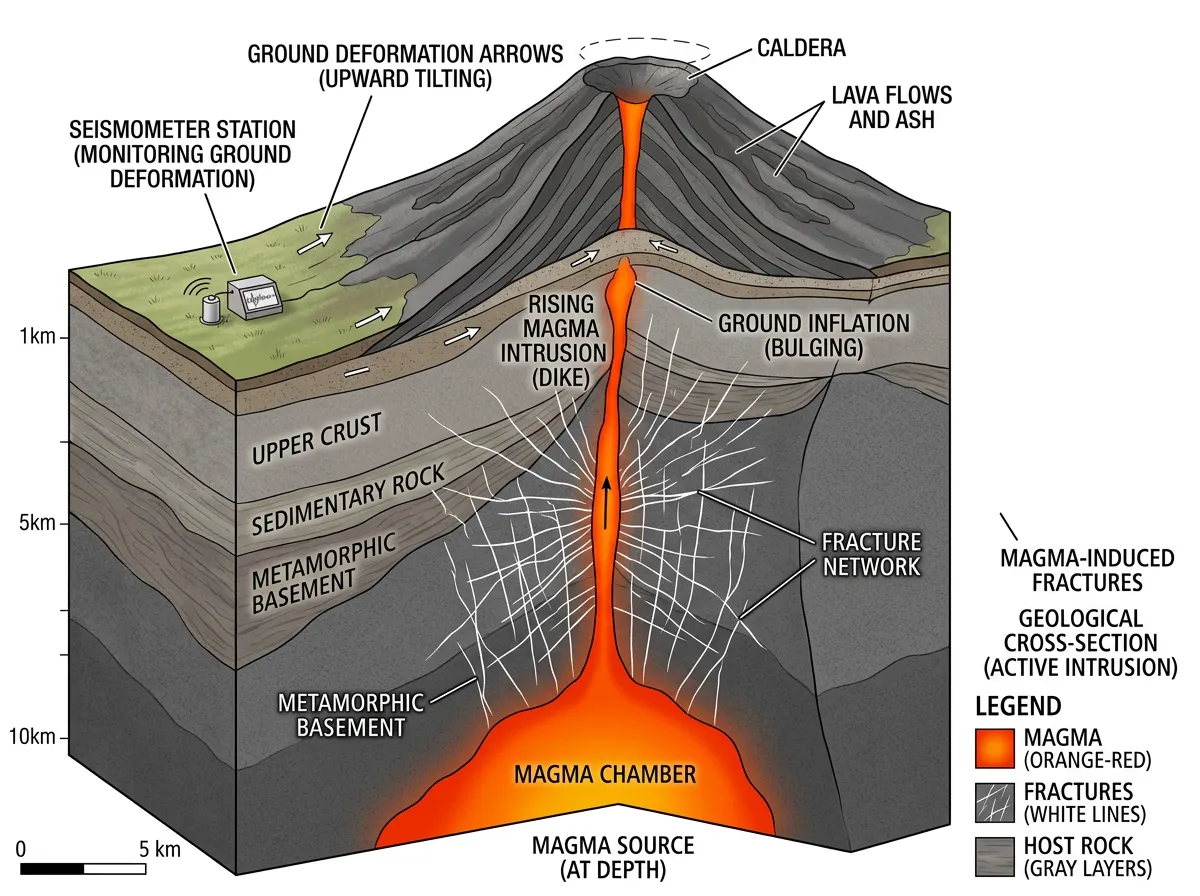
These signals emerge when magma intrudes into the crust beneath a volcano, pushing through rock and opening fractures as it rises. The physical mechanism is dynamic rock fracturing: as pressurized molten rock forces its way upward, it cracks the surrounding material in a pattern that produces tiny, impulsive shifts in the ground surface. Those shifts are too small for conventional seismic analysis to catch, but they show up clearly when the seismometer data is processed through the Jerk detection algorithm.
The name itself comes from physics. In classical mechanics, "jerk" is the third derivative of position with respect to time, the rate of change of acceleration. Velocity tells you how fast something is moving. Acceleration tells you how fast the velocity is changing. Jerk tells you how fast the acceleration is changing. It is a measure of sudden transitions, and that is exactly what these pre-eruption signals represent: abrupt, tiny shifts in the ground's acceleration as magma forces new pathways through rock.
How They Tested It
The study is not a lab experiment or a proof of concept. It is a decade of real-world, real-time, fully automated monitoring. The Jerk detection system was installed in April 2014 at the Piton de la Fournaise volcanological observatory (OVPF-IPGP) on La Réunion island. The system runs as an automated component of WebObs, the observatory's monitoring platform, and pulls data from a single broadband seismological station that belongs to the global Geoscope network. That station, located at Riviere de l'Est, sits about eight kilometers from the volcano's summit.
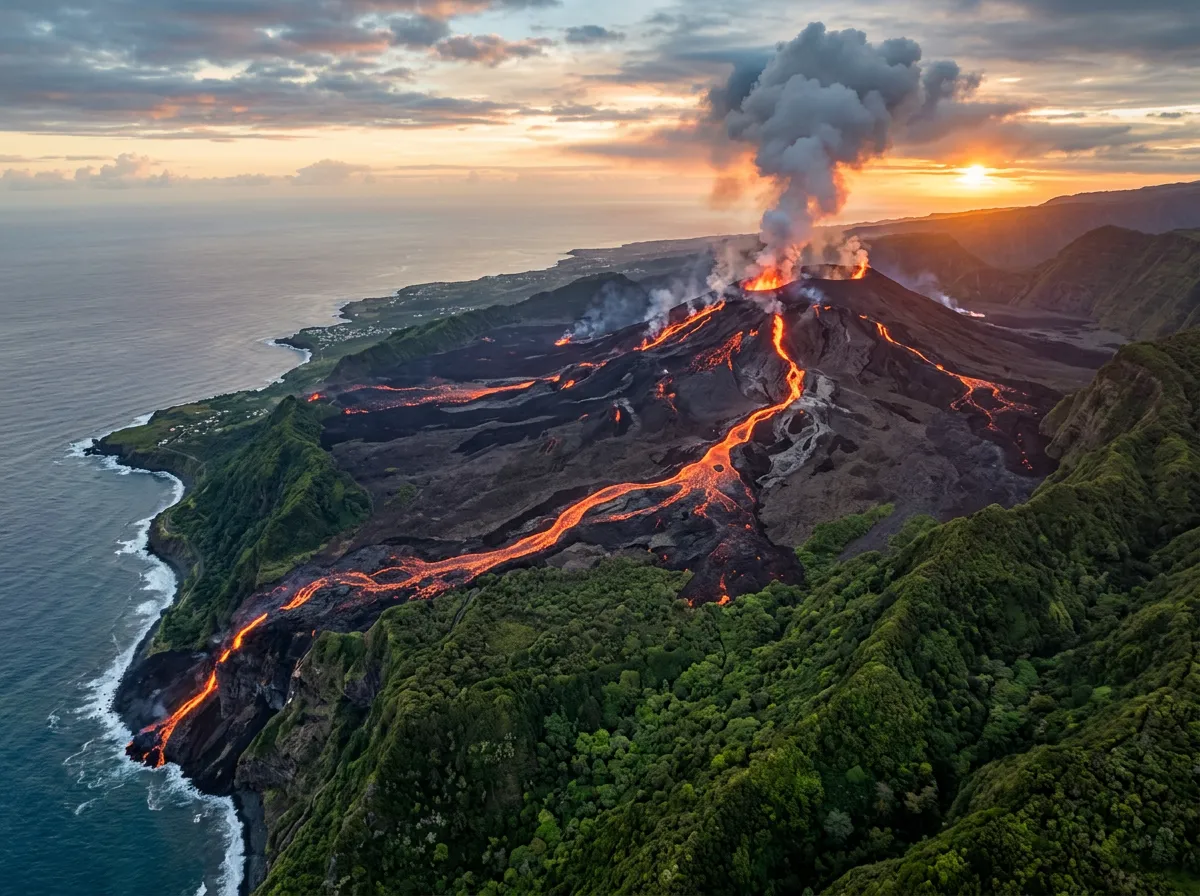
Between 2014 and 2023, Piton de la Fournaise erupted 24 times. The Jerk system detected precursor signals before 22 of those eruptions, a 92% success rate. Warning times ranged from a few minutes to eight and a half hours. The first successful real-time alert came on June 20, 2014, one hour and two minutes before the eruption began. Over the following years, the system continued to trigger alerts automatically, without human intervention or manual tuning.
"The great originality of this work lies in the fact that the Jerk method was tested and validated in real time in an automatic and unsupervised manner for more than 10 years, and not in post-processing," said Dr. Jousset. That distinction matters enormously. Many detection methods perform well when researchers go back and analyze data after an eruption, knowing when it occurred and what to look for. The Jerk system did not have that advantage. It ran continuously, processing data as it arrived, and made its calls before the eruptions happened.
The researchers also validated the method retroactively against 24 eruptions that occurred between 1998 and 2010, before the system was installed. When they applied the Jerk algorithm to archived seismometer data from those earlier events, the signals were there. The pre-eruption ground movements had been recorded all along. Nobody had known to look for them.
The False Alarm Question
Any early warning system has to contend with false positives. An alert that triggers too often without corresponding eruptions erodes trust and wastes resources. The Jerk system produced false alarms in about 14% of cases, which sounds like a significant failure rate until you examine what those false alarms actually detected.
Every false positive corresponded to a real magma intrusion or an aborted eruption. The magma moved upward, fractured rock, and produced genuine Jerk signals, but it stopped before reaching the surface. Complementary observational data from other instruments, including seismicity measurements, ground deformation sensors, and volcanic gas analyzers, confirmed that something real was happening underground during each false alarm. "In addition to the effectiveness of the Jerk alert for eruptions, the tool proves to be a perfect and unequivocal detector of magmatic intrusions," Dr. Jousset noted.
This reframes the false alarm problem entirely. The Jerk system was not crying wolf. It was detecting genuine subterranean activity that happened not to result in surface eruptions. For volcano observatories, that information is still extremely valuable. Knowing that magma is on the move, even when it stalls, helps volcanologists track the plumbing system beneath a volcano and assess how it changes over time. A tool that never misses an intrusion and occasionally overestimates the outcome is far more useful than one that stays quiet until lava is already flowing.
What Came Before: A History of Guesswork and Gradual Progress
For most of human history, predicting volcanic eruptions was impossible. People living near volcanoes relied on folklore, animal behavior, and the occasional felt earthquake as their only indicators. Modern volcano monitoring began in earnest after the catastrophic 1980 eruption of Mount St. Helens in Washington state, which killed 57 people despite weeks of visible warning signs. That disaster demonstrated both the potential and the limitations of monitoring: scientists had enough data to know something was coming, but not enough precision to say exactly when or how bad it would be.
Since then, eruption forecasting has evolved into a multi-instrument discipline. Modern volcano observatories use networks of seismometers to track earthquake swarms, GPS receivers and satellite radar to measure ground deformation, gas spectrometers to analyze volcanic emissions, and thermal cameras to detect heat anomalies. All of this data feeds into probabilistic models that attempt to estimate eruption likelihood over various time windows. The approach is fundamentally statistical. It looks for patterns across many data streams and assigns probabilities, much the way weather forecasting combines measurements from dozens of instruments to predict storms.
The problem is that this approach requires dense instrumentation. A well-monitored volcano like Piton de la Fournaise or Mount Etna may have dozens of sensors feeding continuous data to an observatory. But most of the world's approximately 1,500 potentially active volcanoes have minimal monitoring or none at all. Many of the most dangerous volcanoes, those near densely populated areas in Indonesia, the Philippines, Central America, and East Africa, lack the funding and infrastructure for comprehensive sensor networks. For those volcanoes, the Jerk method's single-seismometer requirement is not just convenient. It is potentially transformative.
The study of Earth's deep structures has revealed how much activity occurs far beneath the surface that we cannot observe directly. Volcanic plumbing systems operate in that same hidden domain, with magma chambers and conduits threading through rock at depths of several kilometers. The Jerk method offers a way to listen to what those systems are doing without building an entire observatory around them.
The Physics of Listening to Rock Break
Understanding why the Jerk method works requires thinking about what happens when pressurized magma encounters solid rock. Magma does not flow smoothly upward through open channels. It forces its way through existing fractures and creates new ones, a process called hydraulic fracturing (the same physics, though at very different scales, behind the controversial oil and gas extraction technique). Each fracture event releases energy in the form of seismic waves, and the pattern of those waves carries information about the geometry of the intrusion, how deep it is, how fast it is moving, and in which direction.
Conventional seismic monitoring focuses on earthquake-frequency waves, vibrations in the 1 to 20 hertz range that correspond to discrete rock-breaking events. The Jerk method targets something different: very low frequency signals below the range of typical seismic analysis. These signals represent not individual fractures but the cumulative, gradual tilting and shifting of the ground surface as an entire magma body rearranges the stress field around it. The distinction is like the difference between hearing individual raindrops on a roof and feeling the roof sag under the accumulated weight of water. Both tell you it is raining, but the second tells you something about scale and urgency.
The seismometer at Riviere de l'Est is a broadband instrument, meaning it records ground motion across a wide range of frequencies. The Jerk detection algorithm filters the data to isolate the very low frequency band, applies corrections for Earth tides (the slight rhythmic deformation of the solid Earth caused by the gravitational pull of the Moon and Sun), and then scans for impulsive signals that exceed a defined threshold. When it finds one, it triggers an automated alert. The entire process requires no human judgment and no secondary data sources. One instrument, one algorithm, one output.
This kind of signal extraction from a single sensor has parallels in other fields. The ancient rocks of Earth's Hadean era preserved information about conditions billions of years ago in mineral structures that nobody knew how to read until the right analytical tools were developed. The Jerk signals were similarly present in seismometer data for years before anyone recognized their significance. The data was there. The question was always whether someone could figure out how to interpret it.
What Changes Now
The immediate next step is testing the Jerk method at a second volcano. The POS4dyke project, a collaboration between GFZ Potsdam and Italy's Istituto Nazionale di Geofisica e Vulcanologia (INGV), will deploy a network of broadband seismometers on Mount Etna beginning in 2026. Etna is a useful test case because it is geologically and structurally very different from Piton de la Fournaise. Where Piton de la Fournaise is a basaltic shield volcano on an oceanic island, Etna is a large stratovolcano on the European continental plate. If the Jerk method works at both, it will suggest that the pre-eruption signals are a general feature of magmatic intrusions, not a quirk of one volcano's particular geology.
The lava tunnels beneath the Moon and Mars formed through the same basic volcanic processes that build terrestrial volcanoes, a reminder that the physics governing magma behavior is universal. If Jerk signals reflect fundamental mechanics of how pressurized fluid fractures rock, the method should work anywhere those mechanics operate. That is the hypothesis the Etna deployment is designed to test.
Beyond Etna, the implications for global volcanic monitoring are significant. The United Nations estimates that roughly 800 million people live within 100 kilometers of an active volcano. Many of those volcanoes have little or no instrumentation. A forecasting tool that requires a single broadband seismometer and a computer running one algorithm could be deployed at any of them for a fraction of the cost of a conventional monitoring network. It would not replace comprehensive observatories at heavily studied volcanoes, but it could provide a baseline early warning capability at hundreds of sites that currently have nothing.
There is also a supporting technology on the horizon. The SAFAtor project, running in parallel with POS4dyke, is exploring the use of fiber-optic cables for earthquake and volcanic eruption early warning. Distributed acoustic sensing, which uses existing telecommunications fiber as a continuous string of seismometers, could potentially detect Jerk-type signals along entire volcanic flanks rather than at a single point. If that works, it would combine the Jerk method's signal processing insight with a sensor network that is essentially already installed in many regions.
Where This Leads
The Jerk method does not solve the eruption prediction problem. No single technique can. Volcanoes are complex systems with plumbing networks that vary from one mountain to the next, and the factors that determine whether a magma intrusion becomes an eruption or stalls underground are still not fully understood. What the Jerk method provides is a new layer of information, one that is remarkably simple to collect and remarkably effective at its specific task: detecting that magma is moving.
The study's strongest claim is also its most constrained. At Piton de la Fournaise, the Jerk system detected 92% of eruptions over a decade with minimal false alarms and no human intervention. Whether that performance transfers to other volcanoes, with different magma compositions, different structural configurations, and different noise environments, is the central open question. The Etna deployment will begin to answer it.
What is already clear is that the signals exist. For at least a quarter century, broadband seismometers around the world have been recording data that contains information about magma intrusions, information that no one was extracting. The Jerk method is, at its core, a new way of reading data that was always there. That is often how detection breakthroughs work: not by building a better telescope, but by recognizing that the light you needed was hitting the lens all along. The instruments were listening. Now, for the first time, we know what they were hearing.
Sources
- Jerk, a promising tool for early warning of volcanic eruptions - Nature Communications
- "Jerk", a promising new method for early warning of volcanic eruptions - GFZ Helmholtz Centre for Geosciences
- Scientists just discovered a tiny signal that volcanoes send before they erupt - ScienceDaily
- "Jerk", a promising new method for early warning of volcanic eruptions - Institut de Physique du Globe de Paris