
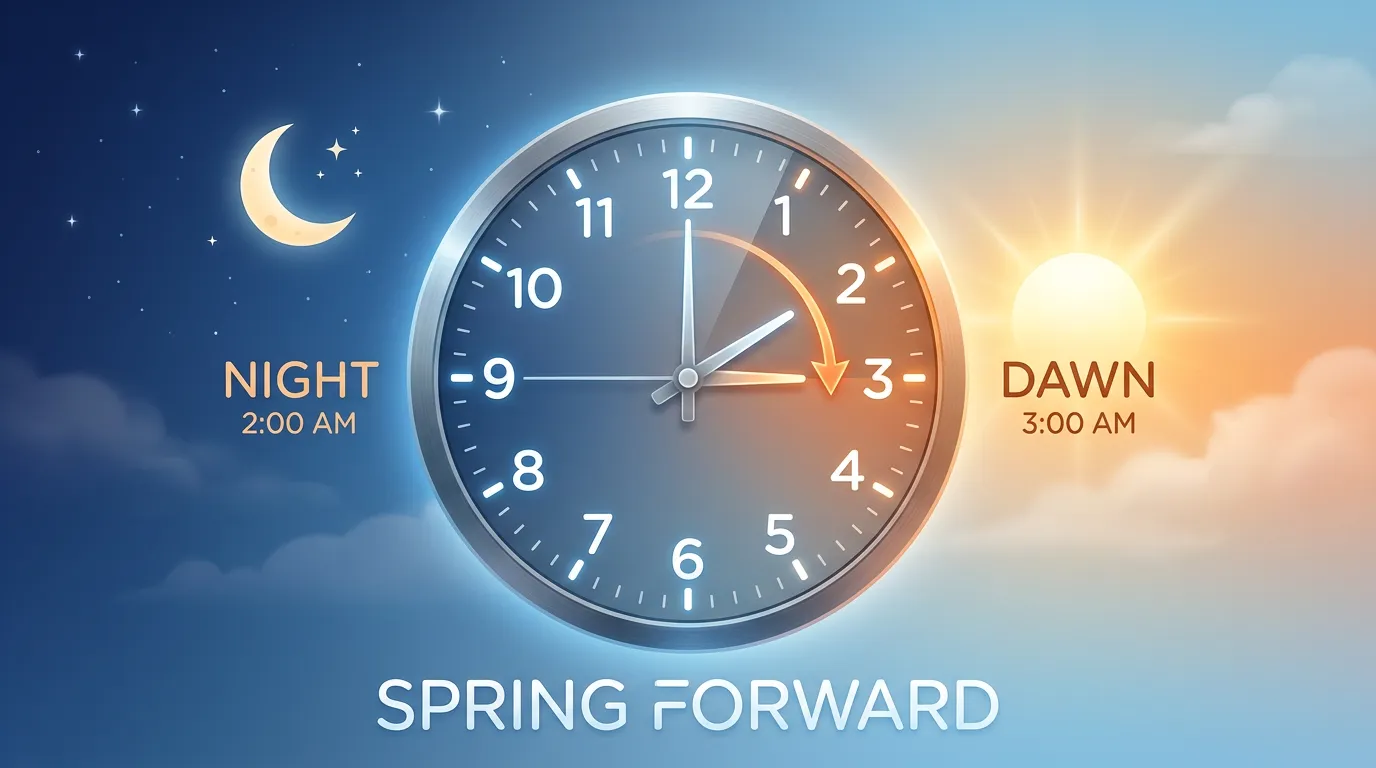
Daylight saving time starts today, Sunday, March 8, 2026, at 2:00 a.m. local time. At that moment, clocks "spring forward" one hour to 3:00 a.m., which means most Americans lose an hour of sleep. If you woke up this morning feeling groggy and wondering where an hour went, this is why.
The change means sunrise and sunset will both occur about one hour later than they did yesterday. Starting today, you'll have more light in the evening and less in the morning. Daylight saving time will remain in effect until Sunday, November 1, 2026, when clocks "fall back" one hour at 2:00 a.m.
Most smartphones, computers, and smart devices update automatically. If you have analog clocks, a non-smart watch, or an older microwave or oven clock, you'll need to manually set them forward one hour.
Who Observes Daylight Saving Time (and Who Doesn't)
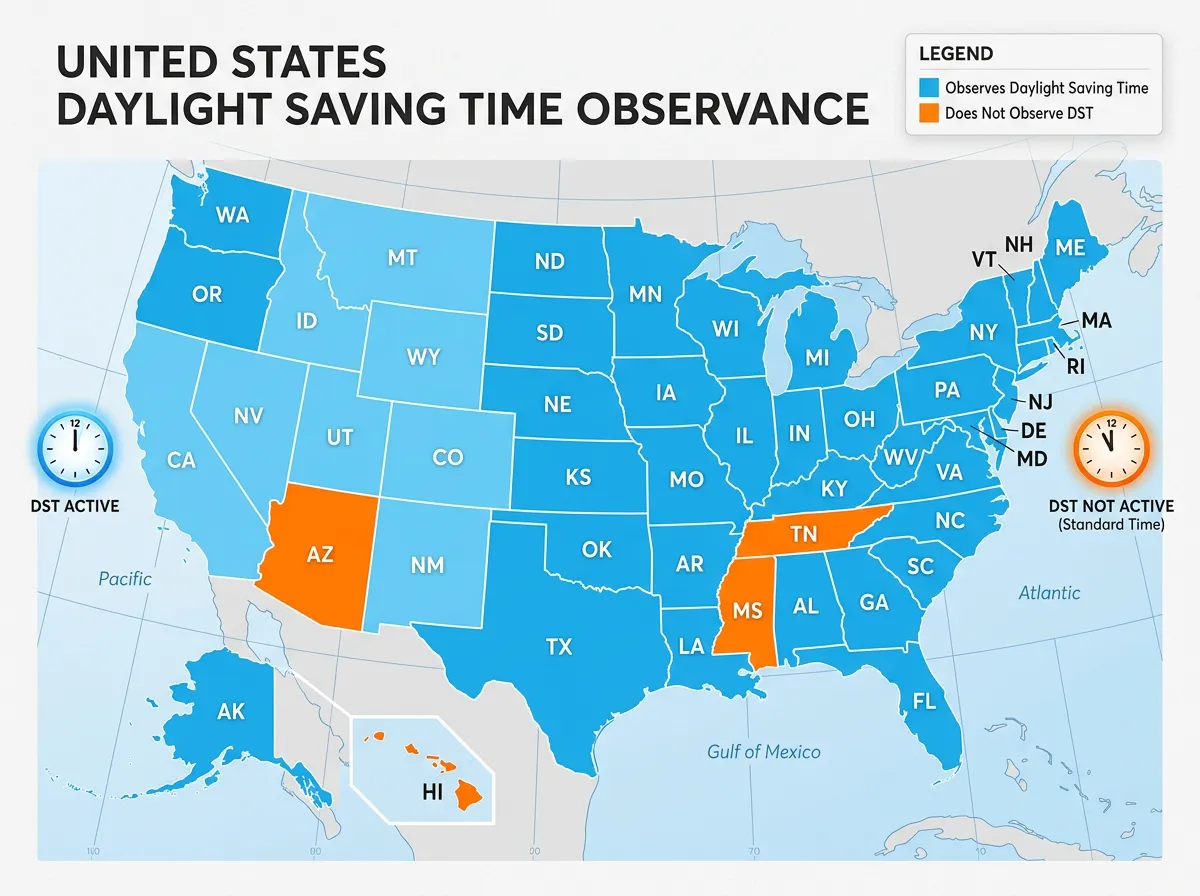
Not everyone in the United States changes their clocks. Arizona (except the Navajo Nation) and Hawaii do not observe daylight saving time and stay on standard time year-round. The U.S. territories of American Samoa, Guam, Puerto Rico, the U.S. Virgin Islands, and the Northern Mariana Islands also don't participate.
For everyone else in the U.S., the time change is governed by the Uniform Time Act of 1966, which standardized the start and end dates. Since 2007, daylight saving time has run from the second Sunday in March through the first Sunday in November, giving the U.S. about eight months of daylight saving time and four months of standard time each year.
Globally, about 70 countries observe some form of daylight saving time, though the specific dates vary. The European Union springs forward on the last Sunday in March, three weeks after the U.S. This year, British Columbia, Canada, is making a notable change: Sunday's clock adjustment will be its last, as the province permanently adopts daylight saving time, supported by more than 90% of British Columbians in public surveys, according to NPR.
Why Do We Still Change the Clocks?
The short answer: World War I. Germany first adopted daylight saving time in 1916 to conserve coal, and the United States followed in 1918 for similar wartime energy-saving reasons. The practice was repealed after the war, reinstated during World War II, and then left to individual states until the Uniform Time Act standardized it in 1966.
The energy-saving argument has weakened considerably since then. A 2008 Department of Energy study found that extending daylight saving time saved about 0.03% of total U.S. electricity consumption, a rounding error in the national energy picture. Modern air conditioning, which wasn't widespread when DST was first adopted, means that longer evening daylight actually increases cooling costs in warmer states, partially or fully offsetting any lighting savings.
Despite the thin energy rationale, daylight saving time persists because it benefits certain industries. Retail businesses, outdoor recreation companies, and the golf industry all benefit from an extra hour of evening light. The barbecue industry has historically been one of the strongest lobbying forces in favor of DST, according to reporting by Michael Downing in his book "Spring Forward: The Annual Madness of Daylight Saving Time."
The push to make daylight saving time permanent has gained significant momentum. The Sunshine Protection Act, which would make DST permanent across the U.S., passed the Senate unanimously in 2022 but stalled in the House. It has been reintroduced multiple times since, with bipartisan support, but hasn't reached the President's desk. Sleep scientists and the American Academy of Sleep Medicine actually prefer permanent standard time, arguing that it better aligns with the body's natural circadian rhythm. The debate is far from settled, but the status quo, changing clocks twice a year, satisfies almost nobody.
The Health Effects of "Springing Forward" Are Real
Losing an hour of sleep sounds minor, but research consistently shows measurable health effects in the days following the spring time change. The American Heart Association points to studies showing an uptick in heart attacks on the Monday after clocks spring forward, along with a temporary increase in strokes for two days afterward.
Fatal car crashes also increase in the first few days after the spring change. Researchers attribute the spike to sleep deprivation, noting that even one hour of lost sleep can impair reaction times at levels comparable to having a blood-alcohol content of 0.05%, according to sleep researcher Dr. Charles Czeisler of Harvard Medical School. The Monday after daylight saving begins is consistently one of the most dangerous days of the year for drowsy driving.
The effects aren't limited to acute health events. Many people experience disrupted sleep patterns for several days to several weeks after the time change. Darker mornings make it harder to wake up, while lighter evenings can delay the natural release of melatonin, the hormone that signals your body it's time to sleep. Children and older adults tend to be the most sensitive to the shift. This year's time change also arrives just days after a JAMA study revealed that nearly a quarter of American teens already sleep five hours or less, making the lost hour especially impactful for an already sleep-deprived population.
How to Adjust to the Time Change
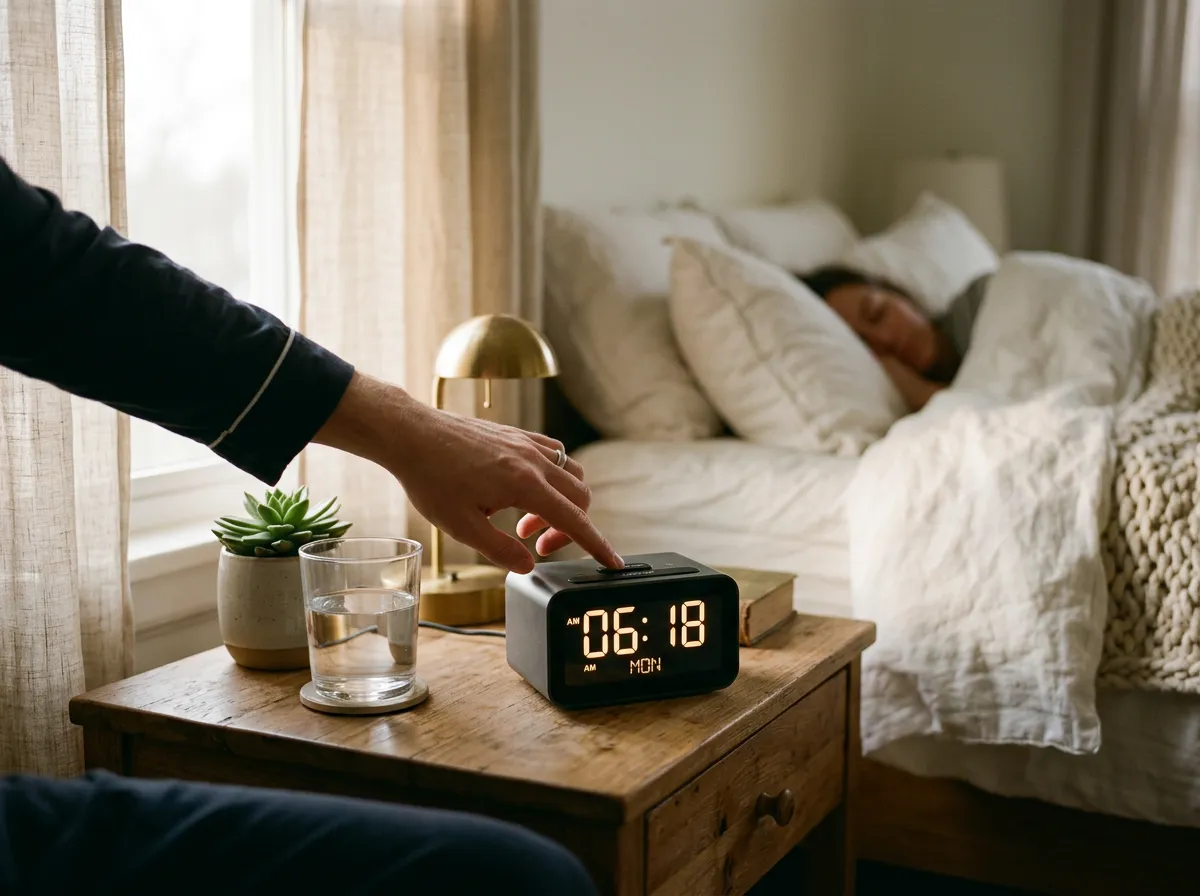
Sleep experts recommend several strategies to minimize the disruption from springing forward. Dr. Raj Dasgupta, a pulmonary and sleep medicine specialist, told CNN that the most important thing is helping your body adjust gradually rather than absorbing the full one-hour shift in a single night.
Get morning light exposure. Sunlight is the most powerful signal for resetting your internal clock. Spending 15 to 30 minutes in natural light shortly after waking helps suppress melatonin production and tells your brain it's time to be alert. This is especially important on Monday morning, when the combination of lost sleep and darker mornings makes the adjustment hardest.
Stick to your regular schedule. Go to bed and wake up at your normal times today and tomorrow, even if you feel tired. Sleeping in to "make up" the lost hour actually delays your circadian adjustment. Your body will adapt faster if you maintain consistent timing for sleep, meals, and exercise.
Avoid caffeine after noon. While a morning coffee won't hurt, afternoon and evening caffeine can interfere with your ability to fall asleep at the right time during the adjustment period. The same goes for alcohol, which may make you feel sleepy initially but disrupts sleep quality later in the night.
Be careful on Monday morning. The combination of lost sleep and darker morning conditions makes Monday after the spring time change one of the most dangerous days of the year for drowsy driving. If possible, give yourself extra time for your commute, and be especially alert at intersections and in school zones.
Check your smoke detector batteries. Fire safety organizations have long used the time change as a reminder to test smoke and carbon monoxide detectors. Even if your detectors are hardwired, the batteries that serve as backup power should be replaced at least once a year.
Key Takeaways
Daylight saving time started today, March 8, 2026, at 2:00 a.m. You've already lost an hour if you're reading this on Sunday morning. Most devices update automatically, but check any analog clocks. The time change is associated with real health effects, including increased heart attack and car crash risk in the following days, so take the adjustment seriously. Get morning sunlight, stick to your schedule, and be especially careful driving on Monday. Arizona, Hawaii, and U.S. territories don't observe DST. British Columbia just made this time change its last, permanently adopting daylight saving time. Clocks fall back on November 1, 2026.