
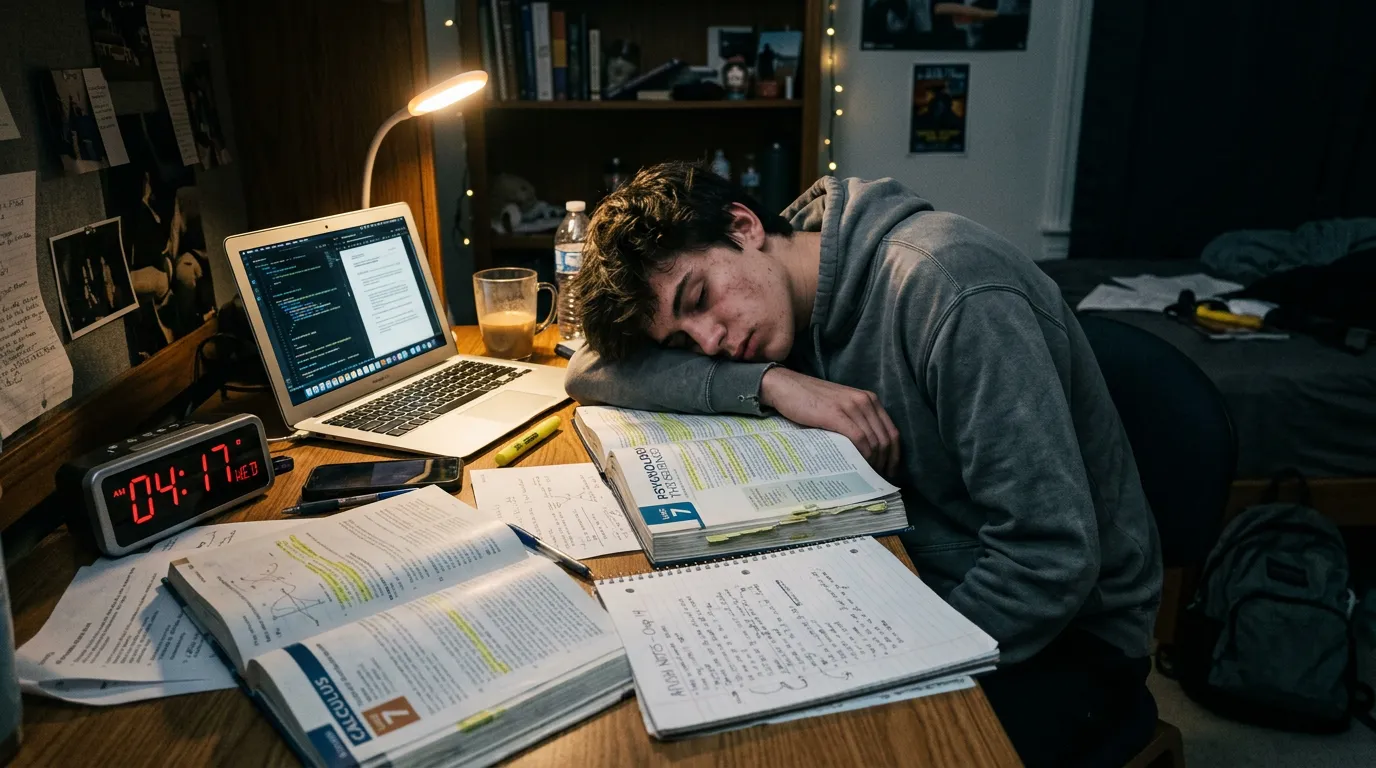
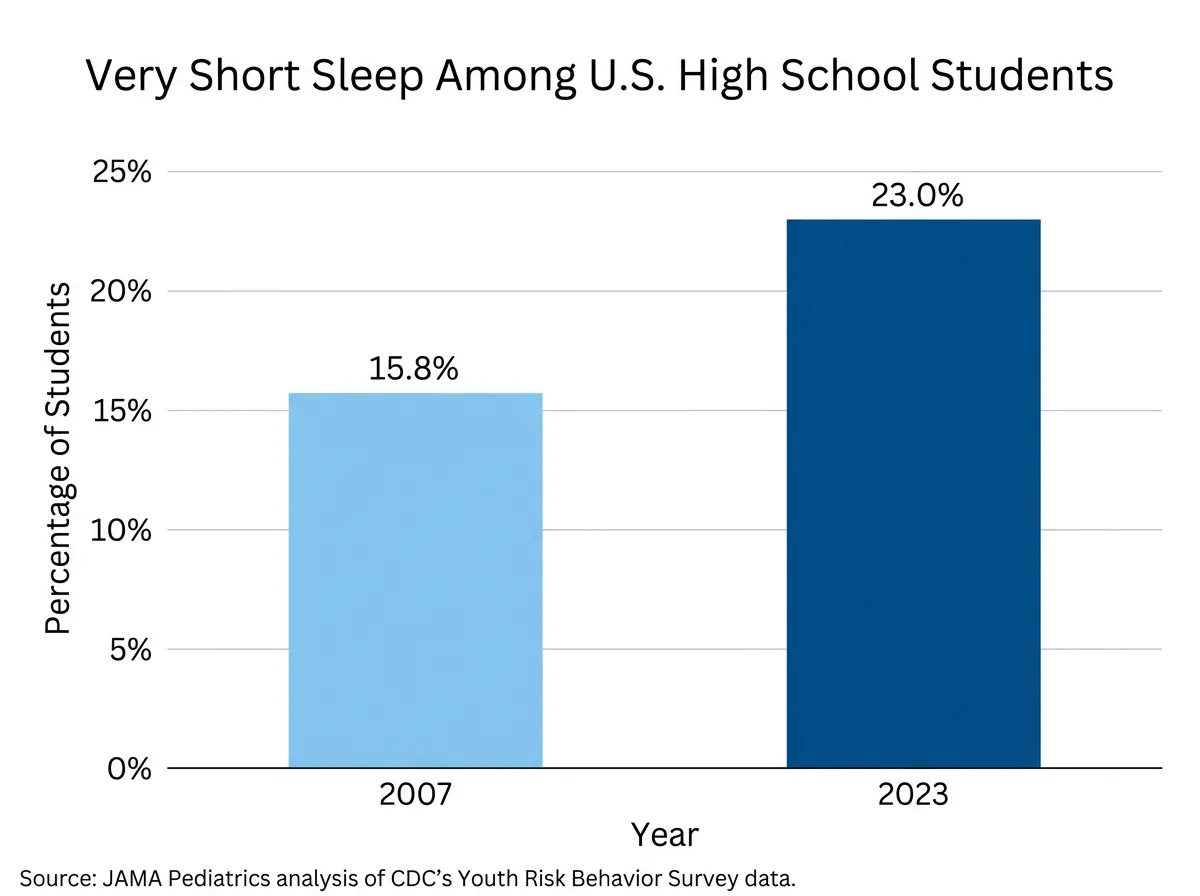
Nearly one in four American teenagers now sleeps five hours or less per night, and the problem is getting worse, not better. That's the headline finding from a study published this week in JAMA, the Journal of the American Medical Association, which analyzed data from nearly 121,000 high school students over 16 years. The share of teens getting insufficient sleep (less than eight hours) rose from 68.9% in 2007 to 76.8% in 2023, and the most alarming trend was the surge in very short sleep, five hours or less, which jumped from 15.8% to 23%.
If your first reaction is to blame the phone on your teen's nightstand, the data suggests something more complicated. The study found that insufficient sleep increased across virtually all demographic groups and behavioral categories, including among teens who reported low screen time. That doesn't mean screens are harmless, but it does mean that taking away the phone won't fix the problem on its own.
What the JAMA Study Actually Found
The researchers, led by a team from Columbia University's Mailman School of Public Health, analyzed data from the Youth Risk Behavior Survey, a biennial CDC survey that tracks health behaviors among U.S. high school students. The dataset covered 120,950 students from 2007 to 2023, making it one of the largest studies on adolescent sleep ever conducted.
The core findings were striking in their breadth. Three out of four American high school students reported sleeping less than the recommended eight hours per night. But the overall increase in insufficient sleep was driven primarily by teens moving from "somewhat short" sleep (six to seven hours) into "very short" sleep (five hours or less). That shift, from 15.8% to 23% of all high school students, means millions of additional teenagers are now operating on dangerously little rest every school night.
The increase in very short sleep was consistent across most demographic groups, including race, gender, and grade level. However, Black students showed a steeper increase in insufficient sleep compared to white students, a finding consistent with broader health disparity research showing that structural factors like neighborhood noise, overcrowded housing, and family work schedules disproportionately affect sleep in communities of color. The demographic breadth of the findings is part of what makes this study so significant: this isn't a problem affecting one group of teens. It's affecting nearly all of them.
Why Screens Aren't the Whole Story
The most counterintuitive finding was that insufficient sleep increased as much or more among students without behavioral risk factors, including those with low screen time, as among those with high screen time. As NPR's Short Wave reported, "regardless of mental health symptoms, substance use, how many hours a day they're watching TV or they're on social media," researchers saw widespread increases in insufficient sleep across the population.
This doesn't mean screens don't affect sleep. Blue light from phones and tablets suppresses melatonin production, and the stimulating content on social media and streaming platforms can delay bedtime. These effects are well-documented in smaller studies. But the JAMA findings suggest that screens alone can't explain a population-level decline in teen sleep that spans every demographic group.
So what else is going on? The researchers pointed to structural and environmental factors that affect all teenagers, not just those with specific behavioral risks. Early school start times remain a major contributor. According to the CDC, most U.S. middle and high schools start before 8:30 a.m., with some starting as early as 7:00 a.m. The American Academy of Pediatrics has recommended an 8:30 a.m. or later start time since 2014, but most school districts have not adopted the recommendation, citing transportation logistics and after-school activity schedules.
Academic pressure has also intensified over the study period. The percentage of high school students taking Advanced Placement exams has roughly doubled since 2007, and college admissions competitiveness has increased, leading to more homework, more extracurricular activities, and more pressure to perform. All of those compete with sleep.
Economic factors play a role too. Among teens from lower-income families, part-time employment, longer commutes to school, and shared living spaces all reduce available sleep time in ways that have nothing to do with personal choices or screen habits. The teen sleep crisis, in other words, is at least partly a reflection of broader economic pressures on American families.
What Insufficient Sleep Does to Teenagers
The health consequences of chronic sleep deprivation in adolescents are well-established and serious. Insufficient sleep is associated with worse cognitive performance and academic achievement. Teens who sleep less than seven hours per night score lower on standardized tests, have lower GPAs, and are more likely to miss school, per the American Academy of Pediatrics.
The mental health connections are equally concerning. Sleep-deprived teens are significantly more likely to report symptoms of depression, anxiety, and suicidal ideation. A January 2026 study published in ScienceDaily found that getting more sleep was "the simplest way teens can protect their mental health," with each additional hour of sleep associated with measurably lower rates of depressive symptoms. The relationship runs both ways: poor mental health makes sleep harder, and poor sleep worsens mental health, creating a cycle that's difficult to break without intervention.
Physical health suffers too. Sleep deprivation is linked to higher rates of obesity, weakened immune function, and increased injury risk in teen athletes. The timing of the JAMA study's release, coinciding with the start of daylight saving time, which costs everyone an hour of sleep, adds an ironic emphasis to the findings: a population already getting dangerously little sleep just lost another hour.
What Parents and Schools Can Actually Do
The JAMA study's most important implication is that fixing teen sleep requires systemic changes, not just individual behavior modifications. Taking away phones at bedtime is a reasonable step, but it won't solve a problem driven by school start times, academic pressure, and economic constraints.
Push for later school start times. This is the single most evidence-backed intervention. California's 2022 law requiring high schools to start no earlier than 8:30 a.m. led to measurable increases in student sleep duration, and several other states are considering similar legislation. If your school district hasn't addressed start times, this is the most impactful advocacy target available to parents.
Create a consistent sleep environment. Regardless of screens, teens benefit from consistent sleep and wake times, a cool and dark bedroom, and a wind-down routine before bed. These habits don't solve structural problems, but they maximize sleep quality within existing constraints.
Have honest conversations about trade-offs. Many teens are sacrificing sleep to maintain a schedule packed with AP classes, sports, volunteering, and part-time work. Parents can help by acknowledging that doing everything at the cost of sleep is not a viable strategy and by supporting teens in making realistic choices about commitments. Dropping one activity to gain an hour of sleep is almost always the right call.
Advocate for systemic change. The study's lead researchers explicitly called for "system-level changes" rather than placing the burden entirely on individual families. This includes later school start times, but also policies that address economic factors affecting teen sleep, such as limits on work hours for minors and transportation access for students who live far from school.
What to Remember
The teen sleep crisis is real, it's getting worse, and blaming screens alone misses the larger picture. Nearly a quarter of American high school students now sleep five hours or less per night, driven by a combination of early school start times, academic pressure, economic factors, and technology. The solution isn't one thing; it's a combination of individual sleep habits, parental support, and systemic changes to how schools schedule their days. If you're a parent of a teen who seems perpetually exhausted, the JAMA data validates what you've been observing. Your kid probably isn't choosing to be sleep-deprived. The system they're operating in makes sleep nearly impossible to prioritize, and changing that system is the most effective thing we can do.
Sources
- Teen Sleep Is Getting Worse. It's More Than Just Screentime. - NPR Short Wave
- Insufficient Sleep Among US Adolescents Across Behavioral Risk Groups - JAMA
- Teenagers Are Getting Far Less Sleep Now Than They Did in Late 2000s - Medical Xpress
- The Simplest Way Teens Can Protect Their Mental Health - ScienceDaily