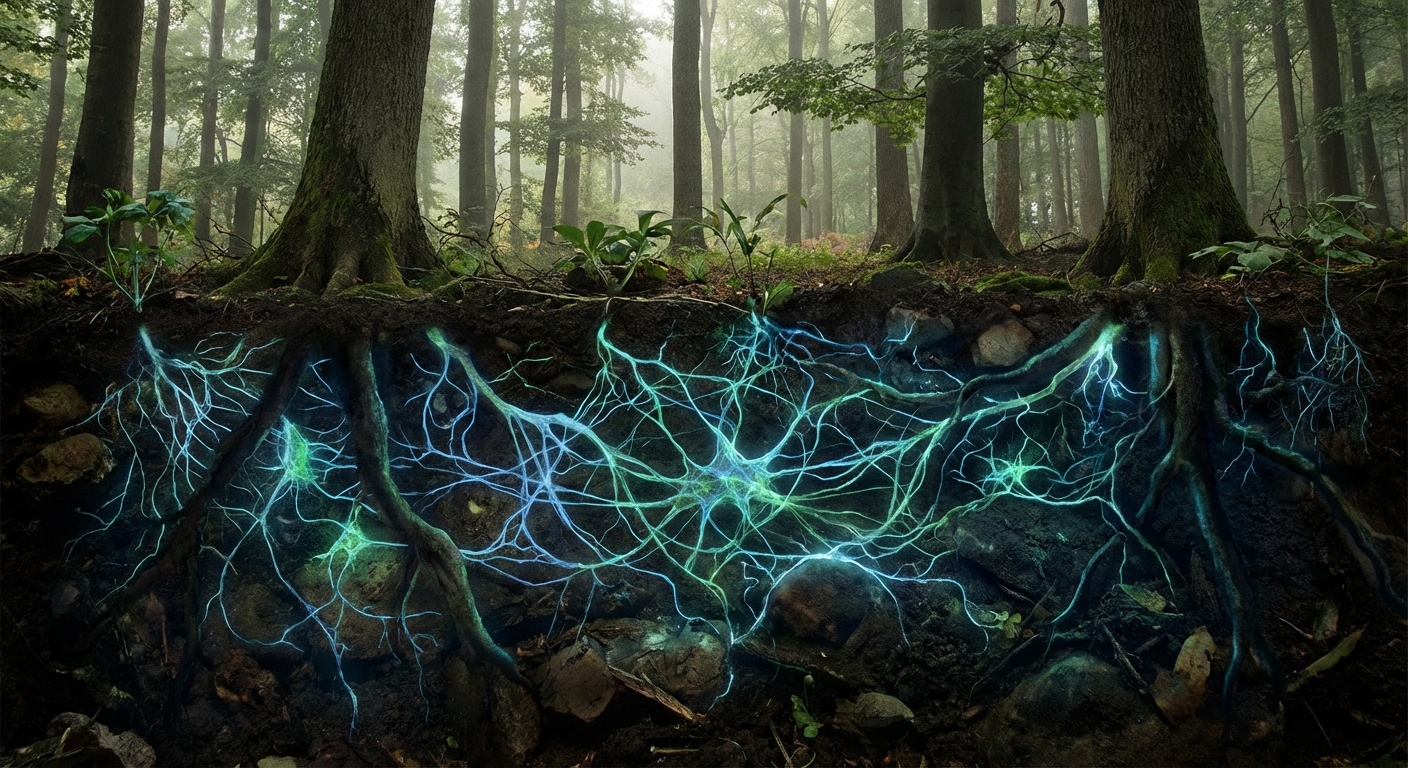
Beneath every forest floor lies a communication network so vast and intricate that scientists have nicknamed it the “Wood Wide Web.” This network is built from fungi, specifically from threadlike structures called hyphae that connect the roots of different trees into a single, interconnected system. Through this network, trees share resources, send chemical signals, and may even recognize their own offspring. The discovery has fundamentally changed how ecologists understand forests, revealing them not as collections of competing individuals but as something closer to superorganisms, with the fungal network serving as a kind of circulatory and nervous system.
The science behind this phenomenon, called mycorrhizal networking, has accumulated over decades of careful research. But it reached broader awareness through the work of forest ecologist Suzanne Simard, whose experiments in Canadian forests demonstrated that trees actively share carbon through fungal connections. Her research showed that large “mother trees” can transfer resources to smaller seedlings in the understory, particularly their own genetic relatives. The forest, it turns out, takes care of its young.
Understanding how this system works requires looking at one of nature’s oldest and most successful partnerships: the symbiosis between plants and fungi that has shaped terrestrial ecosystems for over 400 million years.
The Ancient Partnership
When plants first colonized land roughly 470 million years ago, they faced a problem. Terrestrial soils were nothing like the nutrient-rich waters where their ancestors evolved. Extracting minerals from rock and soil required capabilities that early plants lacked. Fungi, which had colonized land earlier, had already solved this problem. They could break down rock, decompose organic matter, and access nutrients locked in soil particles.
The partnership that emerged was mutually beneficial. Plants could photosynthesize, capturing carbon from the atmosphere and converting it into sugars. Fungi could mine the soil for phosphorus, nitrogen, and other nutrients essential for plant growth. The deal they struck was straightforward: plants would share their sugars with fungi, and fungi would share their mined nutrients with plants. This exchange happens at the interface between plant roots and fungal hyphae, in structures that look like tiny branching trees inside root cells.
Today, roughly 90% of land plants form mycorrhizal associations. The relationship is so fundamental that many plants cannot survive without their fungal partners. Orchids, for example, rely on fungi not just for nutrients but for germination itself. Their tiny seeds contain almost no stored energy; they depend entirely on fungi to feed them until they can photosynthesize on their own.
The fungal partners in these relationships are themselves remarkably diverse. The most common type, arbuscular mycorrhizal fungi, form relationships with grasses, crops, and most tropical trees. Ectomycorrhizal fungi, which form sheaths around root tips rather than penetrating cells, partner with most temperate forest trees including oaks, pines, and birches. It’s this latter type that forms the most extensive communication networks.

The Network Takes Shape
Individual mycorrhizal fungi don’t just connect one tree to one fungus. A single fungal individual can connect to multiple trees simultaneously, and a single tree can host dozens of different fungal species. The result is a network where most trees in a forest are connected to most other trees through one or more fungal pathways.
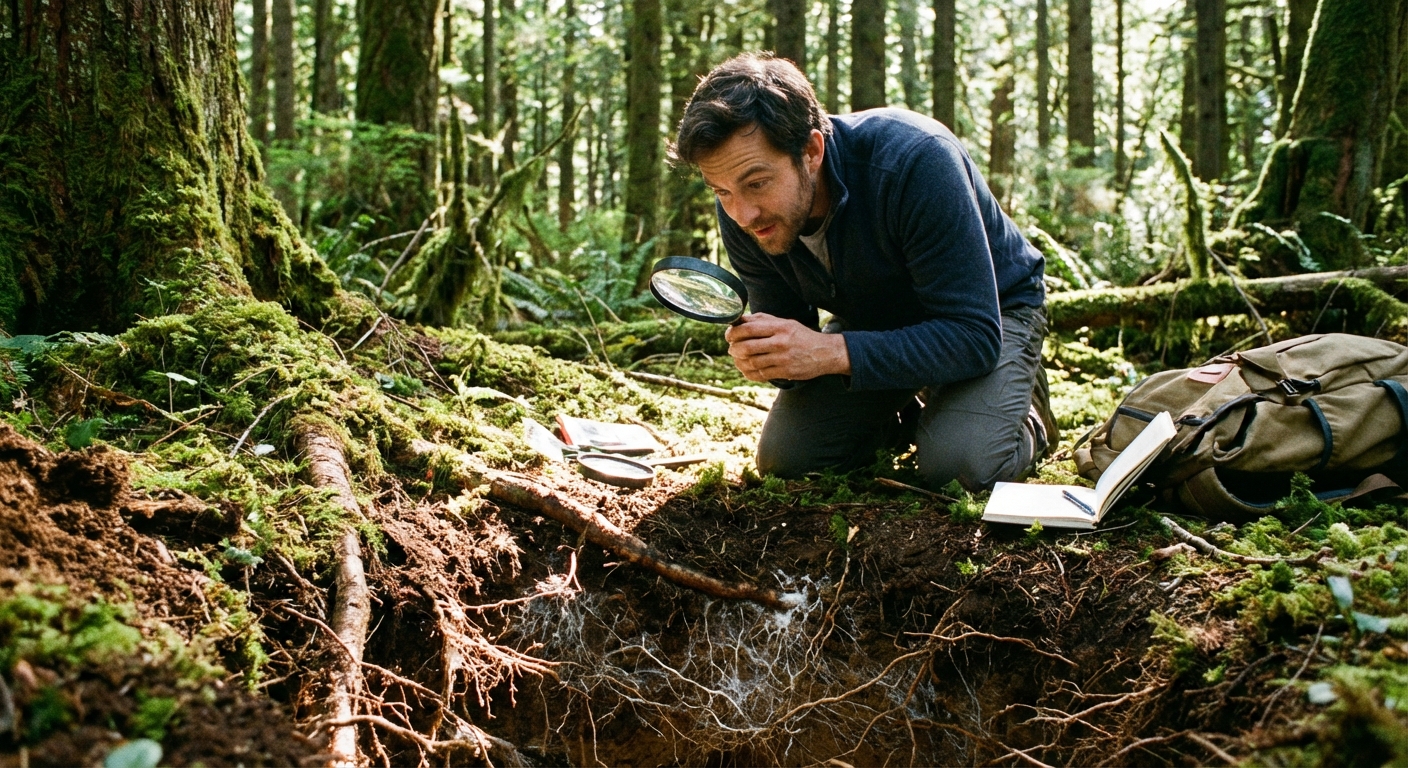
Mapping these networks is technically challenging. Researchers use a combination of molecular techniques to identify which fungi connect which trees, isotope tracing to track the flow of resources, and careful excavation to physically follow hyphal connections. What they’ve found is structure. The networks aren’t random webs; they’re organized, with certain trees serving as highly connected hubs.
Suzanne Simard’s research identified “mother trees,” large, old trees that serve as the central nodes of their local networks. These hub trees are connected to hundreds of other trees and appear to play a disproportionate role in resource distribution. When Simard’s team tracked radioactive carbon through a forest, they found that mother trees transferred carbon to seedlings in the understory, particularly when those seedlings were shaded and struggling. The transfer was especially pronounced when the seedlings were the mother tree’s own offspring.
This preferential treatment of kin raised eyebrows. Kin recognition typically requires genetic mechanisms for distinguishing self from other, and the idea that trees could recognize their relatives seemed almost mystical. But subsequent research has confirmed the finding using careful controls. Trees can distinguish their own seedlings from unrelated seedlings and allocate resources accordingly. The mechanism appears to involve chemical signals in root exudates that indicate genetic relatedness.
What Flows Through the Network
The most well-documented resource sharing involves carbon. Trees that are photosynthesizing vigorously can transfer sugars to trees that are struggling, whether due to shade, damage, or seasonal dormancy. This transfer can be substantial. Studies have measured transfers equivalent to several percent of a seedling’s annual carbon budget coming from established trees through fungal networks.
Nitrogen and phosphorus also move through the network, though the dynamics are more complex. These nutrients are often limiting in forest ecosystems, and their distribution through fungal networks may help explain why some seedlings survive and others don’t. Access to a well-connected fungal network can be the difference between thriving and dying for a young tree trying to establish itself in the competitive understory.
But the network carries more than nutrients. Trees appear to use it to send warning signals. When insects attack a tree, the tree produces defensive chemicals and also releases compounds into its root system. Neighboring trees connected through the fungal network show increased defensive chemistry within hours of the attack, before any airborne signals could have reached them. The network, it seems, can transmit alarm signals.
The mechanism isn’t fully understood. One possibility is that defensive compounds themselves travel through the fungal network. Another is that trees release specific signaling molecules that trigger defensive responses in neighbors without transferring the defensive compounds directly. Either way, the practical effect is that attacks on one tree can prime the defenses of connected trees, reducing the success of spreading infestations.

The Implications for Forest Management
These discoveries have significant implications for how we manage forests. Traditional forestry often treats trees as isolated individuals, maximizing timber yield by removing competitors and harvesting mature trees. But if forests function as interconnected systems, with mother trees supporting younger generations through fungal networks, this approach may undermine forest health and resilience.
Simard has argued for retention forestry practices that preserve hub trees during logging operations. Removing all the large trees in an area doesn’t just remove timber; it removes the nodes that support seedling establishment and nutrient distribution. The stumps of cut trees quickly lose their fungal connections, and the network fragments. Regeneration in clear-cut areas takes longer and is less successful than in areas where large trees are retained.
Climate change adds urgency to these considerations. Forests under stress from drought, heat, and new pest pressures may depend more heavily on network-mediated resource sharing. Trees that can access support from neighbors through fungal connections may survive conditions that would kill isolated individuals. Preserving and enhancing these networks may be crucial for forest survival in a changing climate.
Some researchers are exploring ways to actively manage fungal networks. Inoculating seedlings with beneficial fungi before planting can improve establishment success. Maintaining forest continuity, rather than fragmenting it with clear-cuts, preserves the fungal networks that support regeneration. These practices are still being developed, but they represent a shift toward managing forests as systems rather than as collections of individual trees.
What We Don’t Yet Know
The field of mycorrhizal network research is young, and significant uncertainties remain. Critics have pointed out that laboratory demonstrations of resource transfer don’t necessarily reflect what happens in natural forests, where the quantities transferred might be too small to matter ecologically. The extent to which network-mediated sharing actually affects tree survival and forest composition is still debated.
The nature of the relationship between trees and their fungal partners is also more complex than a simple mutualism. Fungi have their own interests, and they don’t necessarily align with those of any particular tree. Some researchers argue that the fungal network is less like a cooperative internet and more like a marketplace, with fungi acting as brokers who profit from the exchanges they facilitate. The “altruistic forest” narrative may be anthropomorphizing relationships that are actually driven by fungal self-interest.
There are also questions about how generalizable the findings are. Most detailed research has focused on temperate forests dominated by ectomycorrhizal trees. Tropical forests, which contain most of the world’s tree species and are dominated by arbuscular mycorrhizal associations, may work differently. The extent to which the Wood Wide Web metaphor applies across forest types remains to be determined.
The Bigger Picture
The discovery of fungal communication networks forces us to reconsider what a forest is. The traditional view saw forests as battlegrounds where individual trees compete for light, water, and nutrients. Winners grow tall; losers die in the shade. This competition undoubtedly happens, but it’s not the whole story. Cooperation, resource sharing, and communication also shape forest dynamics. The forest is both battlefield and community.
This shift in understanding echoes broader changes in how biologists think about nature. The 20th century emphasis on competition and individual selection is giving way to greater appreciation for cooperation, symbiosis, and systems-level properties. Forests, coral reefs, and even human bodies are increasingly understood as ecosystems where multiple species cooperate in ways that benefit all participants.
There’s also something humbling about these discoveries. Trees have been communicating through fungal networks for hundreds of millions of years. We’ve only begun to understand this system in the past few decades, and we’re still working out the basic rules. The natural world contains communication systems, social structures, and cooperative arrangements that dwarf our own in age and complexity.
The next time you walk through a forest, consider what’s happening beneath your feet. Every step crosses dozens of fungal threads connecting trees in an ongoing exchange of resources and information. The stillness of the forest is deceiving; underground, a vast conversation is taking place. We’ve only just started listening.