At forty degrees below zero, Fahrenheit and Celsius meet at the same point, and at that temperature, exposed human flesh freezes in minutes. Yet as you read this during a January cold snap, animals across the Northern Hemisphere are not merely surviving such conditions but thriving in them, hunting, feeding, and even reproducing in environments that would kill an unprepared human in hours. The strategies these creatures employ represent millions of years of evolutionary problem-solving, and understanding them reveals just how creative natural selection can be when survival is at stake.
Winter presents animals with a fundamental thermodynamic challenge. Warm-blooded creatures must maintain core body temperatures around 37 to 40 degrees Celsius regardless of external conditions. When the outside temperature drops to negative 40, the temperature gradient between body and environment becomes enormous, creating constant heat loss that must be replaced through metabolism. Cold-blooded animals face a different problem: their body temperature tracks the environment, and below certain thresholds, the chemistry of life simply stops working. Both groups have evolved remarkable solutions to these challenges.
The Physics of Staying Warm
Before examining specific adaptations, it helps to understand the physics of heat loss that winter animals must contend with. Heat escapes a warm body through four mechanisms: conduction, convection, radiation, and evaporation. Each presents distinct challenges, and successful winter animals have evolved countermeasures against all of them.
Conduction transfers heat through direct contact with colder materials. An animal standing on frozen ground or lying in snow loses heat rapidly to the substrate. Convection occurs when cold air or water flows across the body surface, carrying heat away. Wind dramatically increases convective heat loss, which is why wind chill matters so much. Radiation involves the emission of infrared energy, which happens constantly from any warm surface. Evaporation removes heat through the phase change of water, whether from breath or from wet fur or skin.
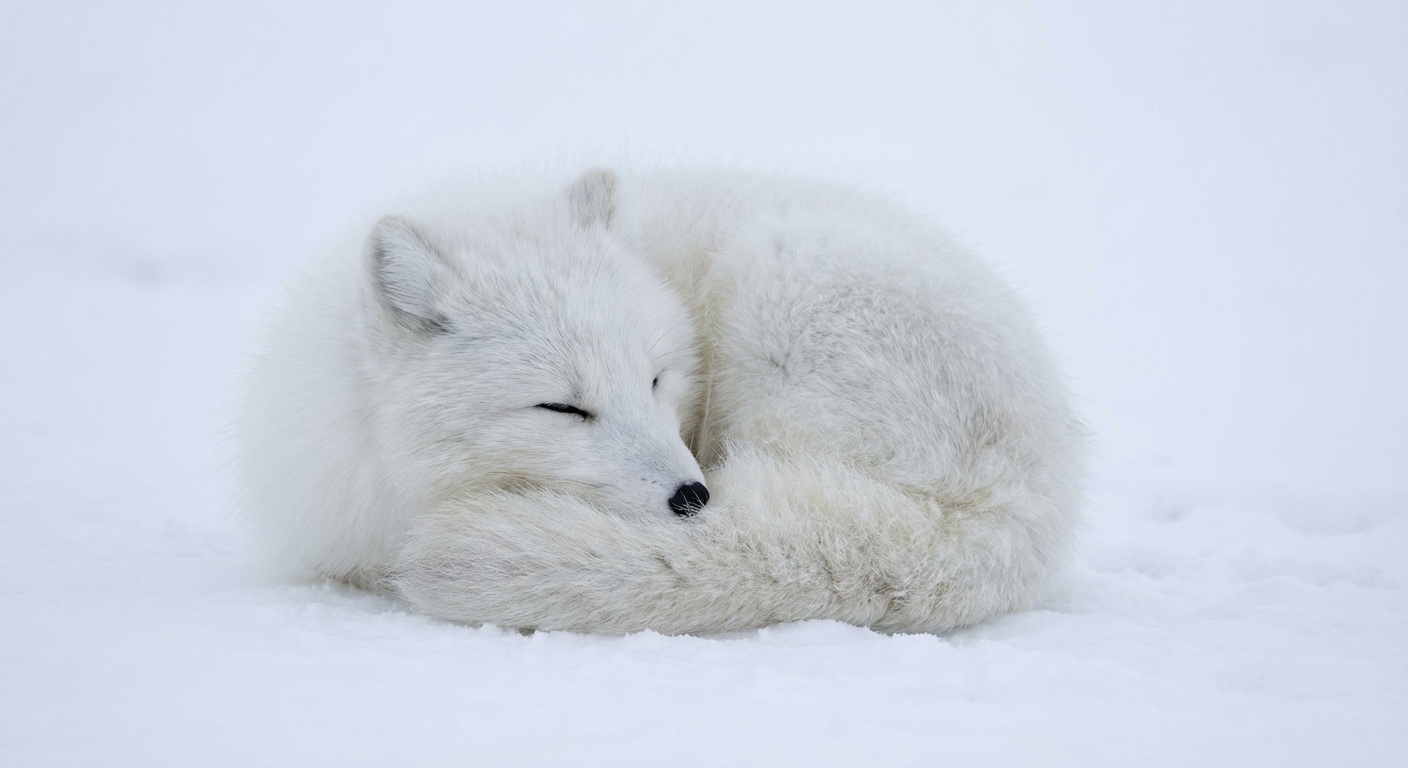
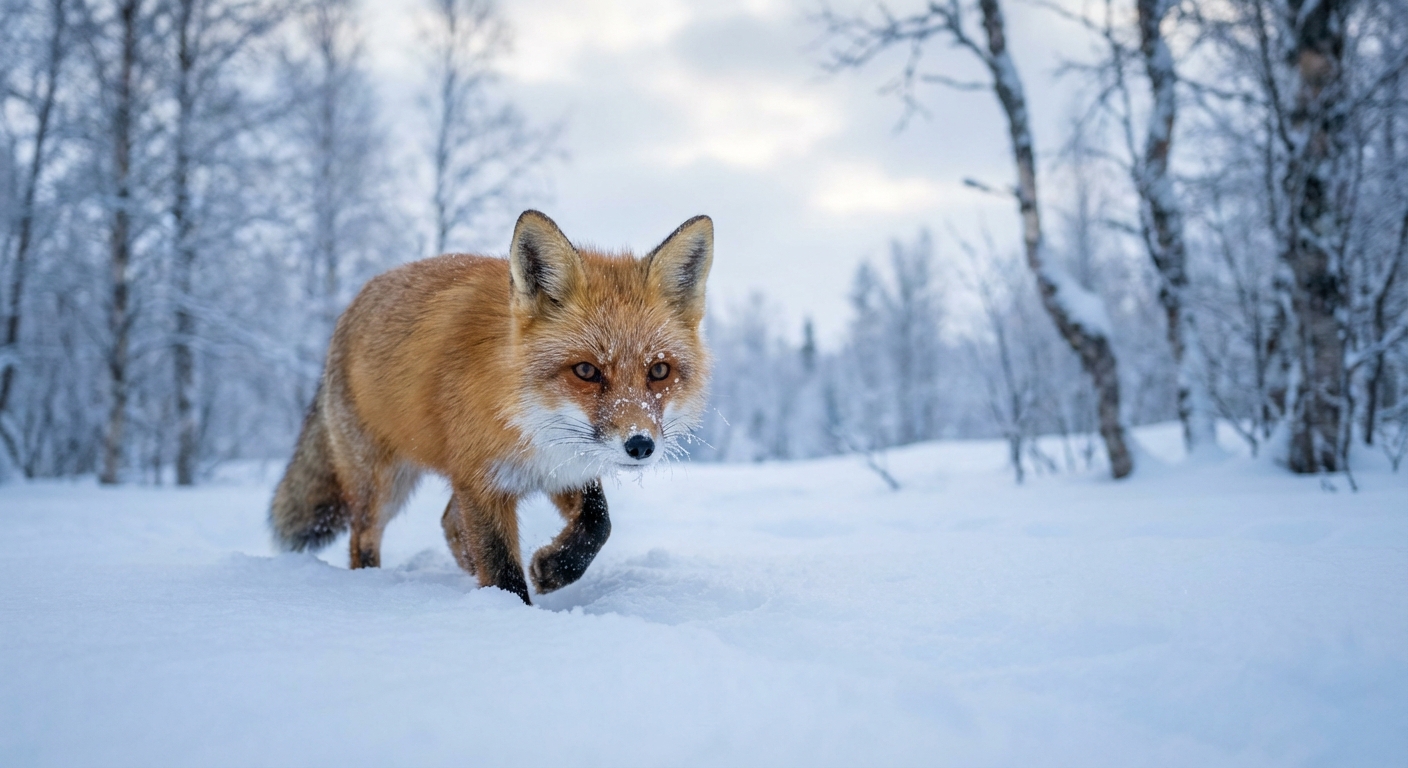
The most obvious winter adaptation is insulation: thick fur or feathers that trap air close to the body. Air is an excellent insulator because it conducts heat poorly, and a layer of still air between skin and environment dramatically reduces heat loss. Arctic foxes have fur so dense that they can comfortably rest on ice at minus 40 degrees. Their fur contains both long guard hairs that shed snow and water and a dense undercoat that traps insulating air. The fur is so effective that the foxes begin to show signs of heat stress at only minus 10 degrees, a temperature most humans would find dangerously cold.
Birds rely on feathers, which are even more effective insulators per unit weight than mammalian fur. A chickadee weighing less than half an ounce can survive nights when temperatures drop below minus 30 degrees, thanks to feathers that can fluff to trap more air when conditions demand. But insulation alone does not explain how these tiny birds make it through winter nights without eating for 12 to 16 hours while their metabolic furnaces burn continuously.
Metabolic Miracles
The internal fires that keep warm-blooded animals warm require constant fuel. A chickadee at rest in cold weather burns calories at roughly 20 times the rate of a human per unit of body weight. To sustain this metabolic inferno, small winter birds must eat almost constantly during the short daylight hours, consuming the equivalent of their body weight in seeds every day or two. This is why backyard bird feeders become lifelines during severe cold, providing concentrated calories that wild food sources cannot match.
Larger animals have an easier time metabolically because of the surface area to volume relationship. As an animal gets bigger, its volume (which produces heat) increases faster than its surface area (which loses heat). This is why elephants struggle to cool down in hot climates while shrews freeze quickly when exposed. Winter favors large body size, which is one reason why Arctic and Antarctic animals tend to be larger than their temperate relatives, a pattern called Bergmann’s Rule.
Some animals take a more radical approach to the metabolic challenge: they simply turn down the furnace. Hibernation involves reducing body temperature, heart rate, and breathing to fractions of normal levels, allowing an animal to survive for months on stored fat. A hibernating woodchuck drops its body temperature from around 37 degrees Celsius to just above freezing, its heart rate from 80 beats per minute to four or five, and its breathing to perhaps once every few minutes. In this state, it uses only about one percent of the energy it would need while active.
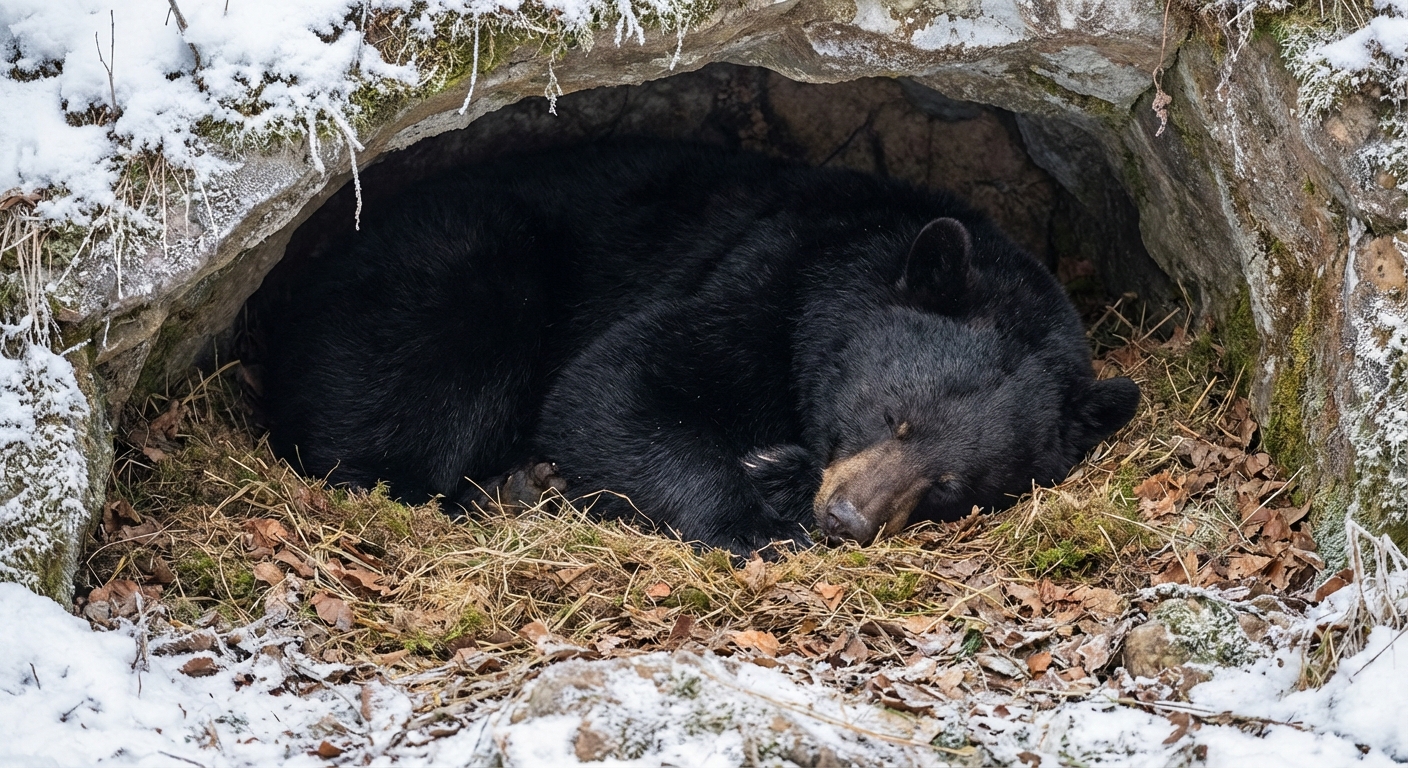
Bears present a curious case. They are often described as hibernators, but their winter dormancy differs significantly from true hibernation. A bear’s body temperature drops only a few degrees during winter sleep, and the animal can wake quickly if disturbed. What makes bear dormancy remarkable is that they do not eat, drink, urinate, or defecate for up to seven months, living entirely off stored fat while pregnant females even give birth and nurse cubs. Understanding how bears maintain muscle mass and bone density during such extended inactivity has attracted medical researchers hoping to help bedridden human patients.
Antifreeze and Other Chemical Tricks
For cold-blooded animals, the challenge is not maintaining warmth but surviving cold. When tissue freezes, ice crystals form inside and between cells, mechanically destroying cellular structures and disrupting the chemistry of life. Most organisms die if any significant portion of their body freezes solid. Yet some creatures have evolved the ability to survive freezing, and their mechanisms border on the miraculous.
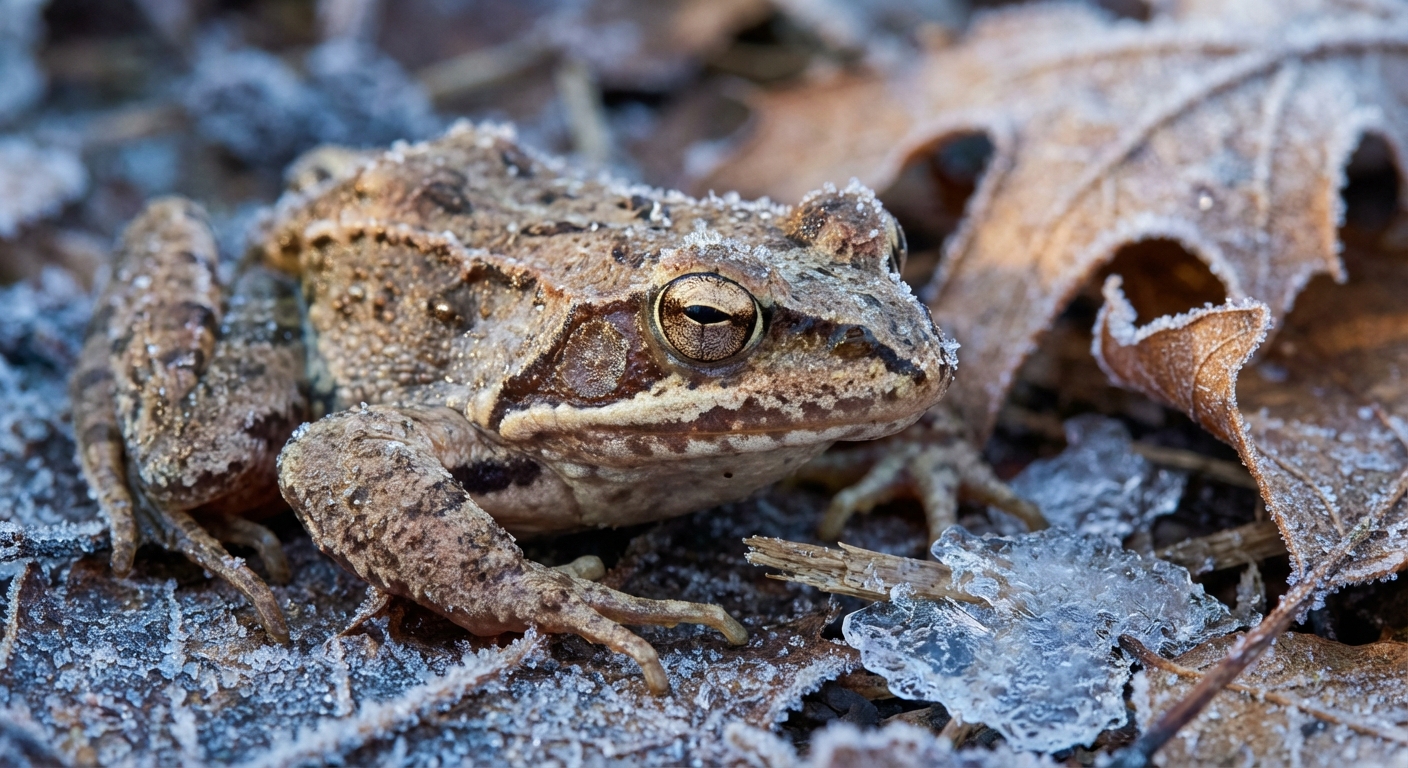
The wood frog of North America can survive having up to 65 percent of its body water freeze solid. When temperatures drop, these frogs begin converting liver glycogen into glucose, flooding their cells with a natural antifreeze that prevents ice from forming inside cells even as ice fills the spaces between them. The frog’s heart stops, its breathing ceases, and to any external observation, the animal is dead. Yet when spring arrives and temperatures rise, the ice melts, the heart restarts, and the frog hops away apparently unharmed.
Fish in polar waters face a different problem. The ocean around Antarctica drops to minus 1.8 degrees Celsius, below the freezing point of fish blood. If ice crystals form in a fish’s bloodstream, they grow rapidly and prove fatal. Antarctic icefish have evolved antifreeze proteins that bind to tiny ice crystals and prevent them from growing large enough to cause damage. These proteins are so effective that some species have lost their hemoglobin entirely, their blood running clear because the cold water holds enough dissolved oxygen that red blood cells became unnecessary. The deep ocean holds its own mysteries, but polar seas reveal life pushed to its physical limits.
Insects use similar strategies. The woolly bear caterpillar, famous for its supposed ability to predict winter severity, survives by producing glycerol that prevents its tissues from freezing solid. The caterpillar can endure temperatures down to minus 90 degrees Fahrenheit in laboratory conditions, making it one of the most cold-tolerant animals known. It freezes, thaws, and refreezes repeatedly during Alaskan winters without apparent harm.
Behavioral Brilliance
Not all winter survival strategies involve physiological adaptations. Many animals simply behave their way through winter, adjusting what they do rather than what they are. These behavioral adaptations can be as sophisticated as any metabolic trick.
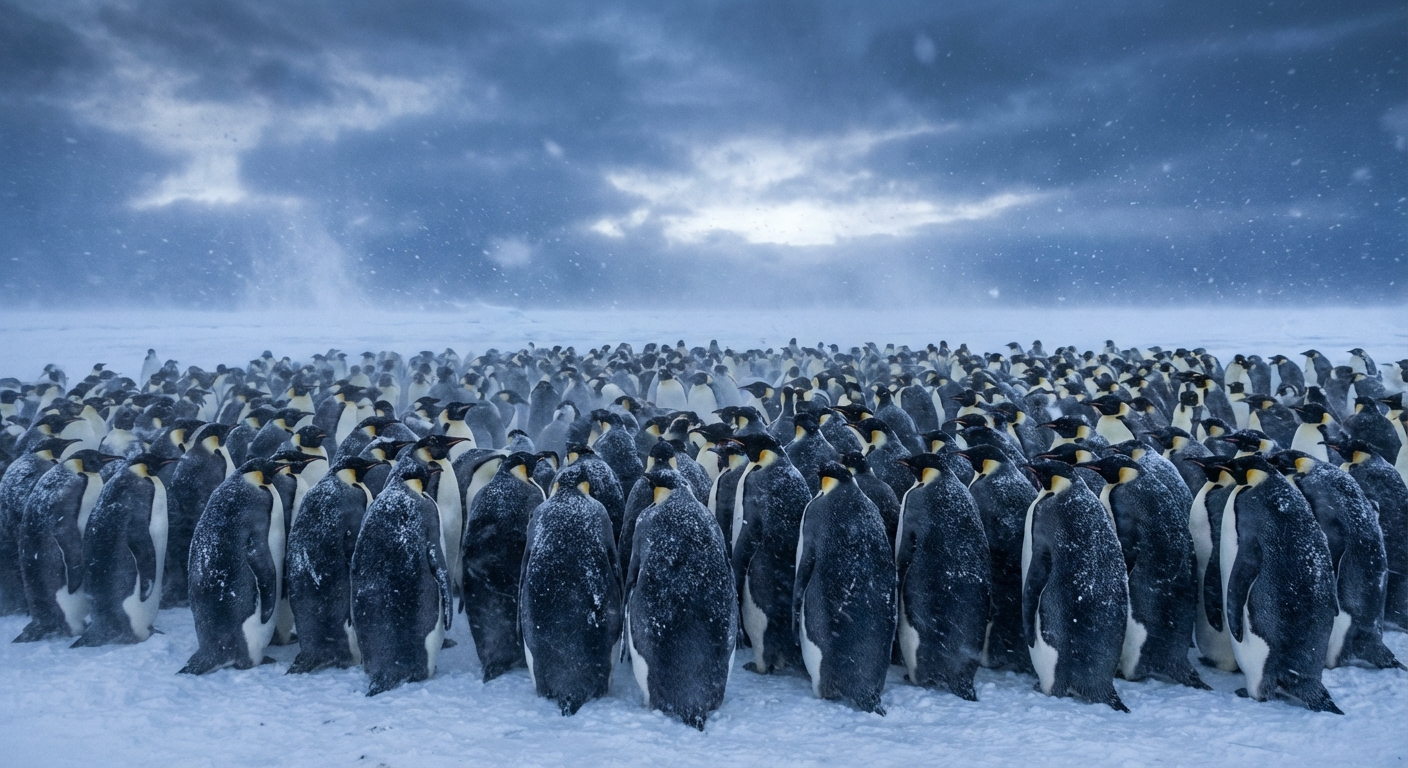
Emperor penguins in Antarctica face the harshest conditions any bird endures. Males incubate eggs during the Antarctic winter, when temperatures drop below minus 40 degrees and winds exceed 100 miles per hour. A solitary penguin would quickly freeze, but emperors survive through cooperative huddling. Thousands of birds pack together so tightly that the temperature at the center of a huddle can exceed 35 degrees Celsius even as the outside temperature plunges. The birds rotate continuously, those on the cold windward edge moving to the warm interior while others take their turn on the perimeter. This creates a living, circulating system of heat conservation that no individual could achieve alone.
Smaller birds employ different social strategies. On cold nights, hundreds of starlings may roost together in tree cavities, sharing body heat. Pygmy nuthatches in western North America pack up to 100 individuals into a single tree hole during severe cold. Even species that are typically solitary may huddle during extreme weather, setting aside territorial instincts when survival demands cooperation.
Food caching represents another behavioral solution. Clark’s nutcrackers, crow relatives living in western mountain forests, cache up to 100,000 pine seeds each fall, burying them in thousands of locations across miles of territory. The birds then recover these caches throughout winter and spring, relying on spatial memory so precise that they can locate seeds buried under several feet of snow. Studies have shown that nutcrackers remember the specific locations of thousands of individual caches, a cognitive feat that exceeds what most animals can achieve. Their hippocampus, the brain region responsible for spatial memory, is proportionally larger than in related species that do not cache food.
Migration: The Ultimate Escape
Some animals solve winter by avoiding it entirely. Migration represents the ultimate behavioral adaptation to seasonal cold, trading the challenges of winter survival for the challenges of long-distance travel. The Arctic tern holds the record for the longest annual migration, flying from Arctic breeding grounds to Antarctic feeding areas and back, a round trip of roughly 44,000 miles. These birds experience two summers per year and see more daylight than any other creature on Earth.
But migration carries its own costs. The journey expends enormous energy and exposes animals to predators, storms, and habitat loss along the way. Bar-tailed godwits migrate from Alaska to New Zealand in a single eight-day flight covering 7,000 miles without stopping to eat, drink, or rest, the longest nonstop flight of any bird. Before departure, they nearly double their body weight with fat while their digestive organs shrink to reduce weight and drag. The flight requires such precise navigation that scientists long wondered how the birds could possibly manage it without getting lost over the featureless Pacific.
Monarch butterflies present perhaps the most mysterious migration. Each fall, butterflies born in the northern United States and Canada fly up to 3,000 miles to specific mountains in central Mexico, where they spend the winter clustered by the millions in oyamel fir forests. No individual butterfly makes the round trip; those that fly south in fall are several generations removed from those that flew north the previous spring. Yet they find the same trees their ancestors used, employing a combination of sun compass, magnetic sense, and perhaps inherited knowledge that scientists still do not fully understand.
The Bigger Picture
The strategies that animals employ to survive winter reveal something profound about the power of natural selection. Given enough time and enough selective pressure, life finds ways to persist in conditions that seem impossible. From antifreeze proteins to communal huddling to continent-spanning migrations, each adaptation represents a solution to problems that the environment posed and survival demanded.
These adaptations also remind us of our own biological limitations. Humans originated in tropical Africa and spread across the globe only by carrying our environment with us in the form of clothing, shelter, and fire. Without technology, we would be restricted to a narrow band of the planet’s surface. The animals that thrive in winter environments possess capabilities we lack and can only study with admiration.
As climate change alters winter conditions around the world, many of these adaptations face new tests. Animals timed to hibernate may wake to find spring has not arrived. Migrants may find their food sources displaced or their routes disrupted. Species that evolved to endure extreme cold may struggle as conditions become warmer but less predictable. Understanding how life adapts to changing conditions becomes more urgent as the conditions themselves change faster than evolution can follow.
Walking through a winter forest, it is easy to think that nature has gone dormant, that life pauses until spring returns. But beneath the snow, inside tree cavities, under the ice, and in the bodies of creatures that move through the cold with apparent ease, the business of survival continues. Every animal you see in winter is a survivor, heir to millions of years of ancestors who made it through conditions like these and worse. Their strategies, written in genes and expressed in behavior, represent nature’s accumulated wisdom about living on a planet where cold comes every year. That wisdom deserves our attention, our respect, and, increasingly, our protection.