
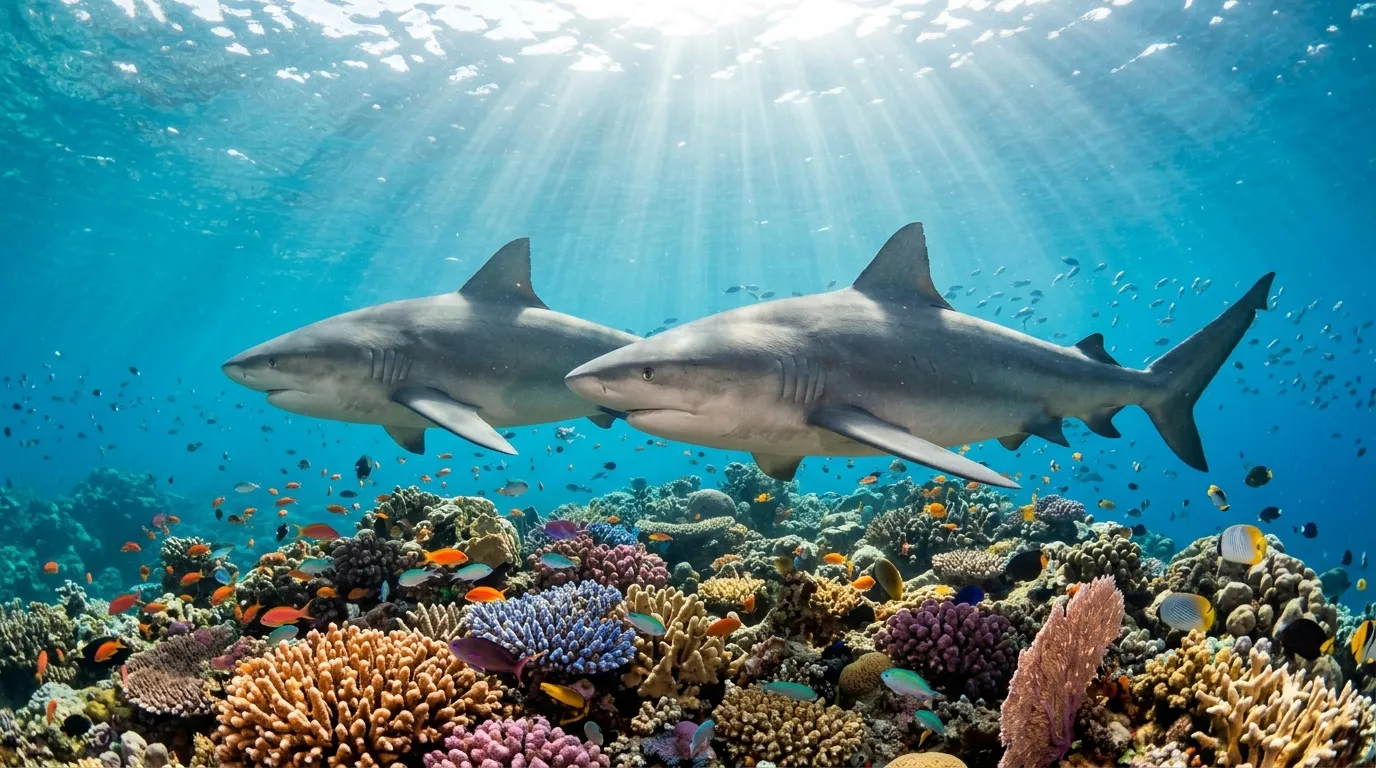
If someone told you that one of the most feared predators in the ocean has a best friend, you'd probably assume they were talking about dolphins. Dolphins get all the credit for marine social intelligence, with their pods, their cooperative hunting, their apparent capacity for play. Sharks, by contrast, occupy a different cultural slot entirely: solitary, instinct-driven, governed by hunger rather than companionship. The image of the lone shark, cruising empty water in search of its next meal, is so deeply embedded in how we think about these animals that it barely registers as an assumption anymore. It just feels like a fact.
It isn't. A study published this week in the journal Animal Behaviour, based on six years of fieldwork at the Shark Reef Marine Reserve in Fiji, has revealed that bull sharks, one of the species most commonly associated with aggressive behavior, form genuine social bonds. They choose specific companions. They swim in coordinated patterns with those companions. They even follow each other around the reef in what researchers describe as "lead-follow" behavior, a hallmark of active social engagement seen in species we typically consider far more cognitively sophisticated.
"Contrary to commonly held perceptions of sharks, our study shows they have relatively rich and complex social lives," said Professor Darren Croft from the University of Exeter's Centre for Research in Animal Behaviour, one of the study's lead authors. The finding doesn't just add a charming footnote to shark biology. It challenges a fundamental assumption about what kinds of brains are capable of social complexity.
Six Years, 184 Sharks, One Reef
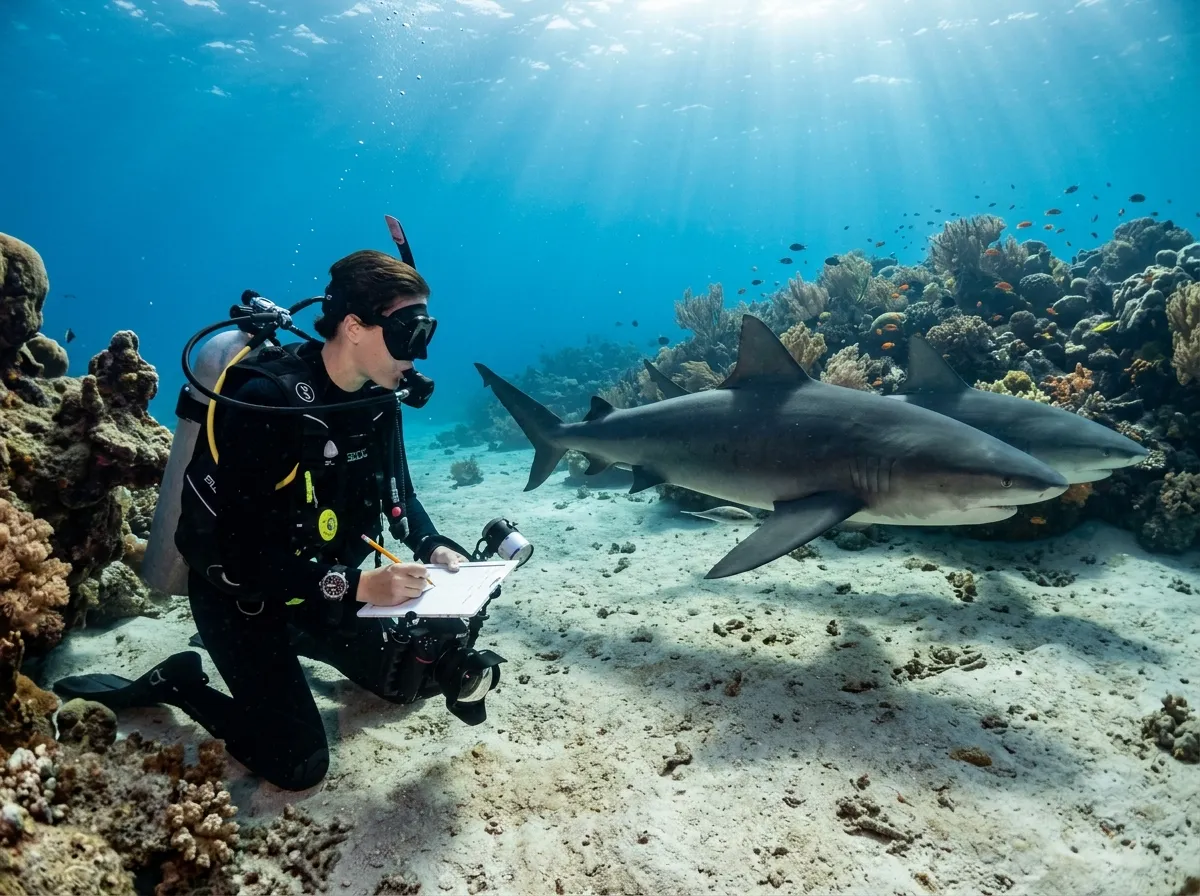
The study's strength lies in its scale. Researchers from the University of Exeter, Lancaster University, and the Fiji Shark Lab spent six years observing 184 individual bull sharks at a single site in the Shark Reef Marine Reserve, one of Fiji's most well-established marine protected areas. Each shark was identified through unique markings and tracked across hundreds of encounters, building a dataset large enough to distinguish between random co-occurrence (two sharks happening to be in the same place) and genuine social preference (two sharks repeatedly choosing to be near each other).
The distinction matters enormously. Marine animals aggregate for many non-social reasons: shared food sources, favorable currents, refuge from predators. Proving that animals are actually choosing each other's company requires ruling out all of those alternatives. The Fiji team did this by analyzing two levels of social behavior. The first was association, defined as two sharks staying within one body length of each other. The second was interaction, specifically "lead-follow" behavior (one shark swimming and the other actively tracking behind) and parallel swimming (two sharks moving in synchronized formation). Both interaction types require active coordination that random proximity cannot explain.
What they found was striking. Bull sharks didn't just aggregate. They formed stable social preferences that persisted across years. Certain pairs appeared together far more often than chance would predict, and the same individuals showed up in each other's social networks repeatedly. The sharks, in a very real sense, had friends.
The Social Architecture of a Shark Community
The study's most nuanced findings involve how social behavior varies with age and sex. Adult sharks in their reproductive prime were the most socially connected, forming the densest networks of preferred associates. These adults tended to bond with sharks of similar size, suggesting that body size is a social sorting mechanism, much as it does in many terrestrial species.
Sex played an equally important role. Female bull sharks strongly preferred the company of other females. Males also preferred associating with females, but since the females would rather be with each other, male-female bonds were less common than the males might have preferred. This pattern mirrors dynamics observed in bottlenose dolphins, where female alliances form the stable core of social groups and males orbit the periphery.
The oldest sharks in the study, those past reproductive age, were the least social. The researchers suggest this isn't cognitive decline but rather a shift in survival strategy. "These older individuals have many years of experience honing their skill sets, hunting and mating," the paper notes. Sociality may simply be less integral to their survival than it is for a shark in its prime that still benefits from the information-sharing and predator-dilution advantages that group living provides.
This age-graded pattern is itself significant. In behavioral ecology, the expectation is that if sociality is purely driven by external factors like food availability, all age classes should respond similarly. The fact that different age groups show different social strategies suggests the sharks are making something resembling decisions about their social lives, adjusting their behavior based on internal state and life stage rather than simply reacting to environmental conditions.
Why This Changes How We Think About Shark Brains
Here's where the Fiji study bumps against a much larger question in comparative cognition: what kind of brain does social complexity require?
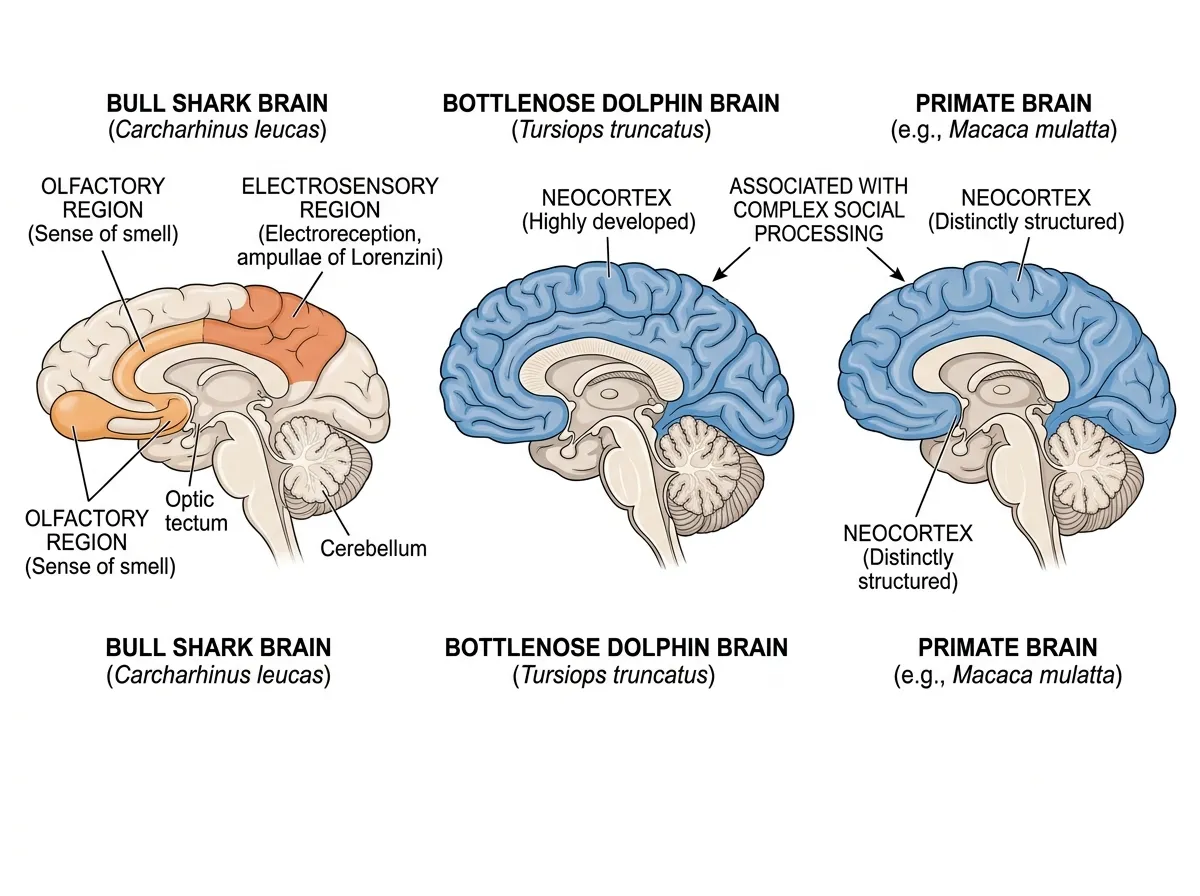
The dominant framework for understanding animal social intelligence is the "social brain hypothesis," which proposes that the cognitive demands of navigating complex social relationships drove the evolution of large brains in primates, dolphins, and other highly social mammals. The logic is intuitive. Keeping track of who your allies are, who your rivals are, who owes you a favor, and who double-crossed you last week requires a lot of neural real estate. Primates have big neocortices. Dolphins have big neocortices. Elephants have big neocortices. The correlation between social complexity and brain size, at least in mammals, is well established.
Sharks don't fit this model at all. Their brains are small relative to body size, they lack a neocortex entirely, and their neural architecture is organized around sensory processing, particularly electroreception and olfaction, rather than the associative cortex regions that handle social computation in mammals. By every metric the social brain hypothesis would predict, sharks shouldn't be capable of the kind of selective, stable, age-differentiated social behavior the Fiji study documents.
And yet they are. This suggests one of two things. Either social complexity doesn't require the neural hardware we thought it did, or sharks are solving the same social problems through completely different neural mechanisms, the way birds evolved flight independently from bats using a fundamentally different wing structure. Both possibilities are fascinating. The first would mean we've been overestimating the cognitive bar for sociality, which has implications for how we think about social behavior in reptiles, fish, and invertebrates. The second would mean that evolution has invented social intelligence multiple times independently, converging on similar behavioral outputs through radically different biological machinery.
Dr. Culum Brown, a fish cognition researcher at Macquarie University who was not involved in the Fiji study, has argued for years that we systematically underestimate fish and shark intelligence because we project mammalian cognitive frameworks onto animals with very different evolutionary histories. "We keep being surprised that sharks can do things we assumed required a mammalian brain," he told Discover Wildlife. "At some point, we need to update the assumption rather than just being surprised again."
The Conservation Stakes
The discovery that bull sharks maintain structured social networks carries direct implications for how we protect them. Current marine conservation frameworks tend to treat sharks as individuals distributed across a habitat. Protected areas are designed around geographic range, migration corridors, and breeding grounds. Social structure rarely enters the equation.
But if sharks form stable social groups with preferred companions, then disrupting those groups, through fishing, habitat destruction, or forced displacement, may carry costs beyond the loss of individual animals. In species with documented social bonds, from elephants to wolves to dolphins, the removal of key social individuals can destabilize entire group dynamics, reducing reproductive success, increasing stress, and altering behavior patterns in survivors.
The Fiji Shark Lab is already working with Fiji's Ministry of Fisheries to incorporate the study's findings into conservation planning for the Shark Reef Marine Reserve. The broader question is whether other shark species show similar patterns. Bull sharks are among the most studied sharks due to their coastal habitat and tolerance of human proximity. Open-ocean species like blue sharks and makos are far harder to observe, and their social lives, if they have them, remain almost entirely unknown.
The world's oceans have lost an estimated 71% of their shark and ray populations since 1970, according to a 2021 analysis in Nature. If even a fraction of those species maintain the kind of social structures found in Fiji, then we've been losing not just individual animals but entire networks of relationships that took years to form and cannot simply reassemble when populations recover.
Where This Leads
The bull shark friendship study is a single data point, but it lands in a scientific moment primed for its implications. Over the past decade, researchers have documented tool use in fish, culture in whales, episodic memory in cuttlefish, and play in octopuses. Each finding chips away at the idea that complex cognition is a mammalian monopoly. The Fiji study adds social selectivity to that list, and in a particularly striking way, because bull sharks are among the last animals most people would associate with the word "friendship."
The deeper lesson may be about the limits of human intuition as a guide to animal minds. We expect social behavior from animals that look social to us: animals with expressive faces, vocalizations we can hear, and group structures we can see from shore. Sharks fail every one of those tests. They're silent, expressionless, and appear to move through the ocean alone. It took six years of systematic underwater observation to reveal what was there all along: sharks choosing companions, swimming in formation, building relationships that outlast any single encounter.
Professor Croft framed it simply in the University of Exeter's press release: "We need to stop thinking of sharks as mindless eating machines." The evidence, six years and 184 sharks' worth, suggests he's right. Somewhere off a reef in Fiji, two bull sharks are swimming side by side right now, not because they have to, but because they want to. That sentence would have been unscientific a week ago. As of this week, it's just what the data shows.
Sources
- Bull Sharks Have 'Friends' - University of Exeter News, March 2026
- Scientists Just Discovered Bull Sharks Have Friends - ScienceDaily, March 17, 2026
- Bull Sharks Form Social Relationships with Specific 'Friends,' Research Reveals - Phys.org, March 2026
- Researchers Studied 184 Bull Sharks in Fiji - Discover Wildlife, March 2026
- Sharks, It Turns Out, Have Friends - The Spokesman-Review, March 16, 2026