
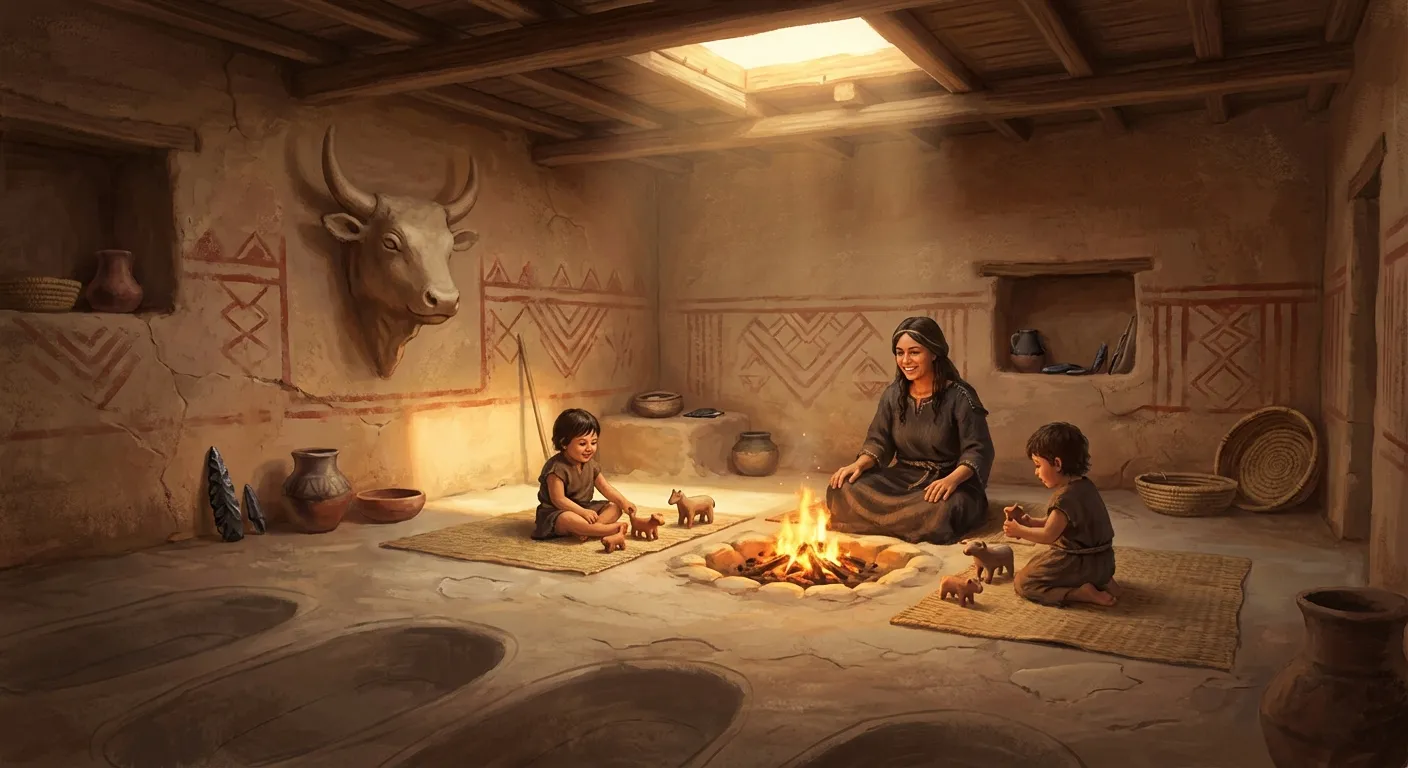
In 1961, British archaeologist James Mellaart began excavating a massive mound in the Konya Plain of central Turkey and found something that baffled his colleagues. The settlement, called Catalhoyuk, had no streets, no public squares, no obvious hierarchy. People entered their homes through holes in the roof. And scattered throughout the site were clay figurines of women, seated on thrones flanked by leopards, holding their bellies in postures of authority and fertility.
Mellaart proposed that Catalhoyuk was organized around women, possibly even governed by a goddess cult. The archaeological establishment pushed back hard. Later excavations led by Ian Hodder of Stanford, beginning in 1993, suggested a more egalitarian reading. The figurines might be toys or ritual objects, not evidence of female power. The debate simmered for decades, constrained by the limits of what artifacts alone could reveal about social organization.
Then, in 2025, a team of geneticists settled the argument with something Mellaart never had access to: DNA. By extracting and analyzing ancient genomes from 131 individuals buried beneath the floors of Catalhoyuk's houses, researchers demonstrated that this 9,000-year-old community was organized around female kinship lines. Mothers, daughters, and maternal relatives formed the core of each household. It is the oldest genetically confirmed female-centered social structure in any food-producing society on Earth.
Buried Beneath the Floors
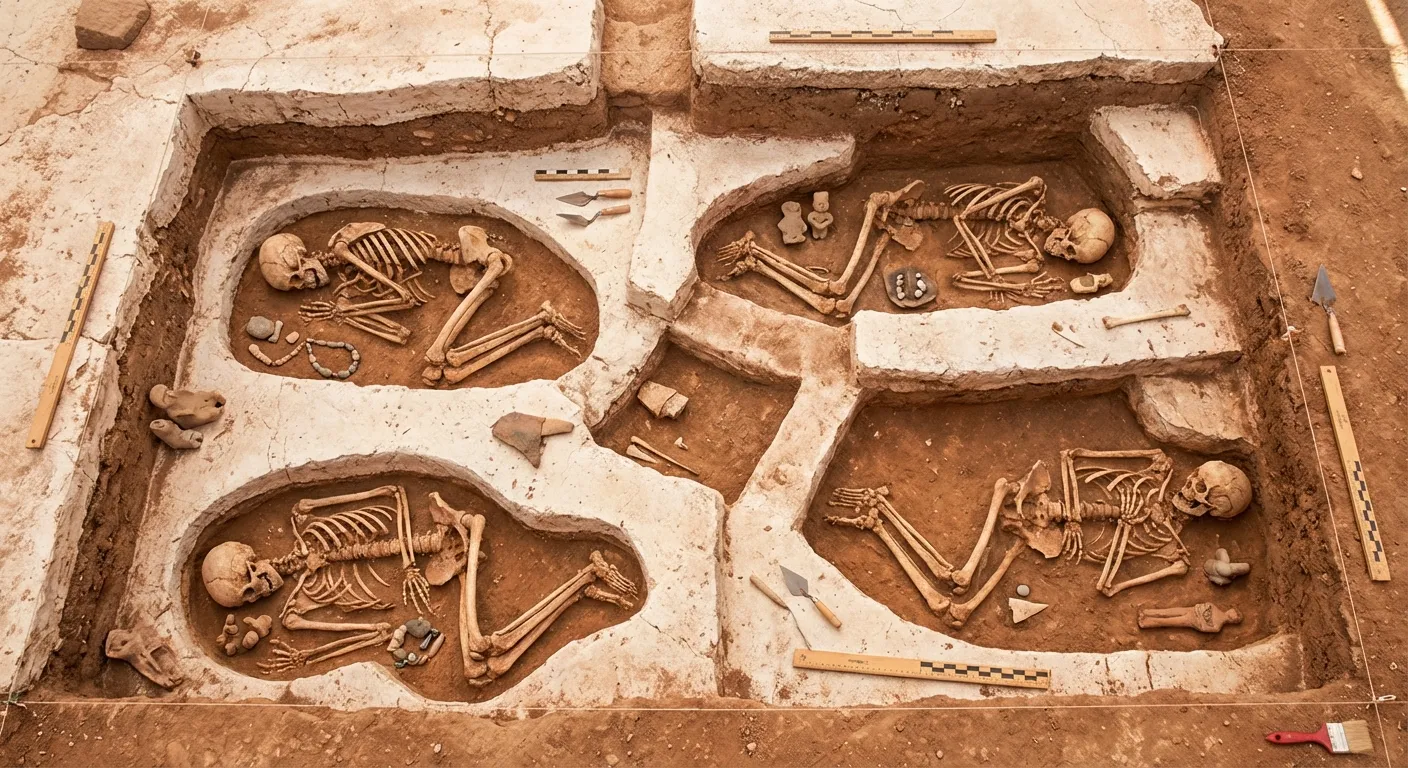
To understand what the genetic evidence revealed, you need to understand Catalhoyuk's most striking practice. The residents buried their dead under the floors of their own homes. Not in cemeteries, not in designated ritual spaces, but directly beneath the platforms where families slept, cooked, and lived their daily lives.
This practice persisted for over a thousand years, from roughly 7100 to 5950 BCE. Over generations, a single house might contain dozens of burials, layered on top of each other, each plastered over so the living surface was restored. The dead were literally the foundation of the household.
Archaeologists had long speculated about what governed who was buried where. Were all house members biologically related? Were some houses for elites and others for commoners? The question mattered because burial location might reveal the invisible social rules that organized the community.
The genetic study, led by Eren Yuncu and Mehmet Somel of Turkey's Middle East Technical University along with Eva Rosenstock of the University of Bonn, answered these questions definitively. In the earlier phases of the settlement, people buried in the same building were frequently close genetic relatives, and the kinship connections ran overwhelmingly through maternal lines. First-degree relatives (mothers and children, sisters) were buried together beneath the same house. More distant maternal relatives were interred in nearby buildings, creating neighborhood clusters connected by female descent.
"With Catalhoyuk, we now have the oldest genetically-inferred social organisation pattern in food-producing societies," Somel told reporters. "Which turns out to be female-centered."
More Than Kinship: The Evidence of Grave Goods
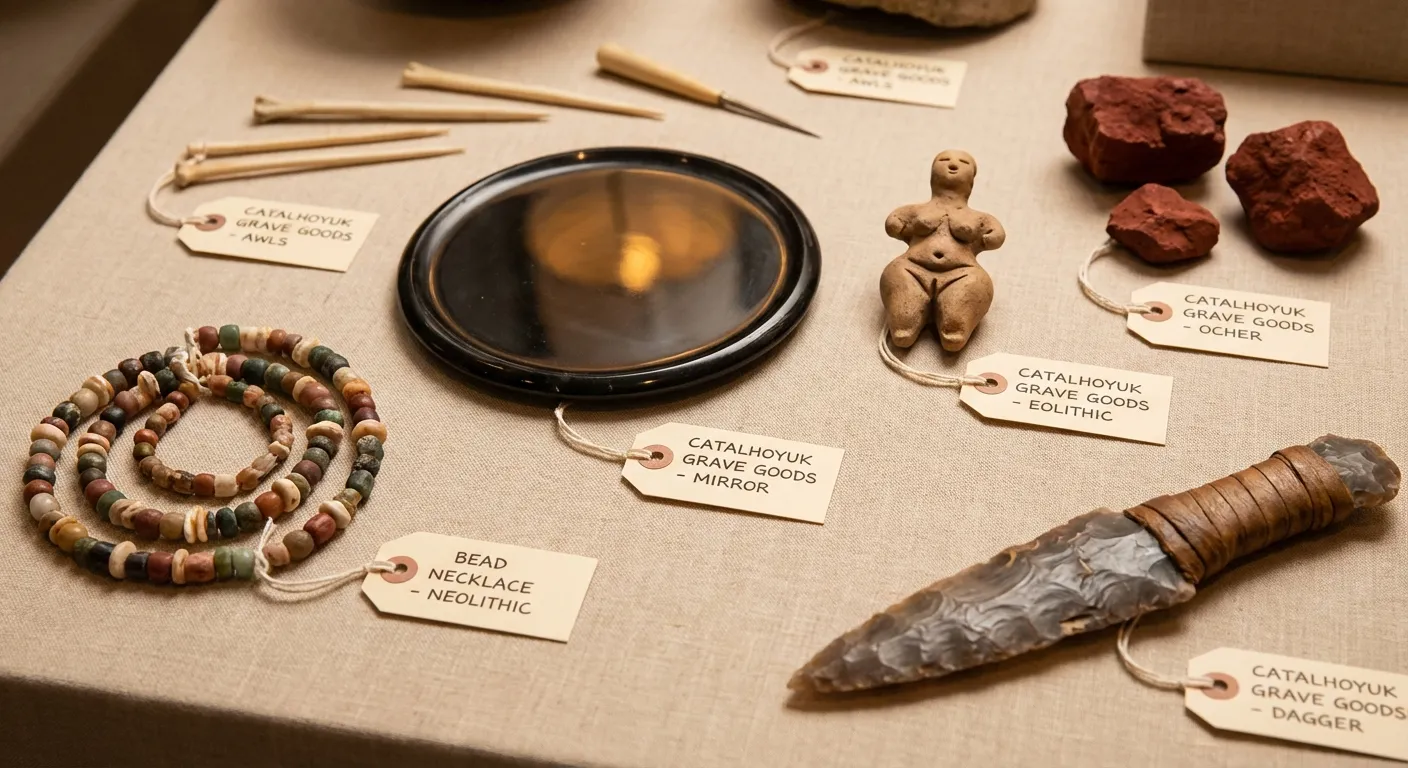
The DNA evidence didn't stand alone. The archaeological record reinforced the genetic findings in a way that strengthened both. Female burials at Catalhoyuk consistently received more grave goods than male burials. Women and girls were interred with obsidian mirrors, bone tools, beads, and pigments at rates up to five times higher than their male counterparts.
This disparity in burial treatment is significant because grave goods in Neolithic archaeology are widely interpreted as markers of social value. The people who mattered most to a community, those whose loss was most keenly felt, tended to receive the most elaborate send-offs. At Catalhoyuk, that pattern pointed squarely at women.
The combination of genetic matrilineality and preferential female burial treatment paints a picture of a society where women occupied a central, possibly privileged, position. This doesn't necessarily mean Catalhoyuk was a matriarchy in the political sense, where women held formal power over men. But it does mean that social identity, household membership, and community standing were transmitted through mothers rather than fathers. Scholars use the more precise term "matrilineal" to describe this arrangement: descent and inheritance tracked through the female line.
The distinction matters because matrilineal societies aren't automatically matriarchal. In many documented matrilineal cultures, including the Minangkabau of Sumatra and the Khasi of northeast India, property and clan membership pass through women while men still hold political authority. What the Catalhoyuk evidence shows is that female lineage was the organizing principle of daily life: who you lived with, where you were buried, and how your community remembered you.
A Society That Changed Over Time
One of the study's most revealing findings was that Catalhoyuk's social structure wasn't static. The genetic patterns shifted across the settlement's roughly 1,200-year occupation of the East Mound.
In the earliest phases, households were tightly bound by biological kinship. The people buried under the same floor were genuine relatives, connected through maternal lines that could be traced across generations. Households were biological families in the most literal sense.
But in later phases, something changed. Individuals buried in the same building were often genetically unrelated, despite sharing similar diets (as revealed by isotope analysis of their bones). This suggests that the concept of "household" evolved from a biological family unit to something more like an adoptive or chosen family, bound by shared practices and identity rather than shared DNA.
Critically, even as biological kinship loosened its grip on household composition, the preference for female lineage persisted. When genetic relatives were found together in later-period houses, the connections still ran through mothers. The cultural template was matrilineal even when the biology became more flexible.
This kind of social evolution, from biological kinship to cultural kinship while maintaining female-centered organization, has parallels in ethnographic studies of more recent societies. The Maya civilization organized complex kinship systems that blended biological descent with political alliance. What makes Catalhoyuk remarkable is the genetic resolution: we can actually watch these social transformations happen across centuries in a single community.
The Petrous Bone Breakthrough
None of this would have been possible without a technical revolution in ancient DNA extraction. Traditional methods relied on teeth and long bones, which often yielded degraded or contaminated DNA, especially in warm climates like central Turkey where preservation is poor.
The breakthrough came from targeting the petrous bone, a small, extraordinarily dense bone deep within the inner ear. Eva Rosenstock described it as "the densest bone in the human body," and its density is precisely what makes it valuable: DNA survives better in compact bone tissue. By drilling into petrous bones from Catalhoyuk skeletons that had been stored in museums for decades, the team extracted enough genetic material to reconstruct 131 ancient genomes spanning the settlement's entire occupation.
This technical capability transforms what archaeology can accomplish. Previous studies of Catalhoyuk relied on artifacts, architecture, and isotope chemistry, all of which provide indirect evidence of social structure. Ancient DNA offers direct evidence of biological relationships, cutting through interpretive ambiguity. When Somel says the society was female-centered, he isn't interpreting figurines or extrapolating from burial positions. He's reading the genetic signatures that connect individuals across households and across generations.
The approach has already been applied to other Neolithic sites, but Catalhoyuk's sample size of 131 individuals is unusually large, giving the statistical power needed to distinguish genuine patterns from random variation. Similar studies at other archaeological sites are beginning to reveal how social structures varied across the ancient world.
When Did Patrilineality Take Over?
Perhaps the most provocative implication of the Catalhoyuk study is what it suggests about the origins of patrilineal societies, the model that dominated most of recorded history and remains widespread today.
If the earliest genetically documented farming community was organized around mothers, then patrilineality isn't the natural or default state of human social organization. It's an innovation, something that emerged and spread under specific historical conditions. The research team noted that male kinship and paternal lineage appear to have become "more culturally significant in Europe as the Neolithic period advanced," suggesting a gradual shift that may have accelerated with the spread of pastoralism, warfare, and property accumulation.
This timeline raises uncomfortable questions about causation. Did the shift to patrilineality coincide with increasing violence and inequality? Did the accumulation of heritable wealth (livestock, land) create incentives to track paternal lineage? Archaeological evidence from later Neolithic and Bronze Age sites across Europe shows increasing signs of social stratification, warfare, and male-dominated burial practices, a pattern that the Viking Age burial record also illustrates.
The Catalhoyuk data doesn't answer these questions directly, but it establishes a critical baseline. Before the rise of patrilineal empires, before the codification of patriarchal law, before the great civilizations that fill most history textbooks, there were communities like Catalhoyuk where women were the axis around which society turned. Understanding that this was once normal, not exceptional, reframes how we think about the trajectory of human social organization.
Why It Matters
James Mellaart died in 2012, a decade before the technology existed to prove him right. His original interpretation of Catalhoyuk as a female-centered community was dismissed, softened, or ignored by a generation of archaeologists who viewed it as romanticism or projection. The genetic evidence published in Science in 2025 vindicated his core insight while adding nuance he could never have imagined.
The study matters beyond Catalhoyuk because it demonstrates what ancient DNA can reveal about invisible social structures. Architecture, art, and artifacts tell us what people made. Genetics tells us how they lived together, who they considered family, and what principles organized their communities. As petrous bone extraction techniques improve and sample sizes grow, similar studies will illuminate social patterns across the ancient world, from the first cities of Mesopotamia to the migration-era communities of Europe.
For now, Catalhoyuk stands as proof that the deep past was more varied than our assumptions allowed. Nine thousand years ago, in a settlement with no streets and no apparent rulers, people buried their mothers beneath their floors and organized their lives around the women who came before them. It wasn't universal, it wasn't permanent, and it wasn't a paradise. But it was real, and it lasted for a thousand years.
Sources
- Female lineages and changing kinship patterns in Neolithic Catalhoyuk - Science (2025)
- DNA reveals female-centered society in 9,000-year-old Neolithic city of Catalhoyuk - Archaeology Magazine
- DNA analysis suggests matriarchal society in Neolithic settlement at Catalhoyuk - Phys.org
- Top 10 Discoveries of 2025: A Feminine Touch - Archaeology Magazine, January/February 2026