
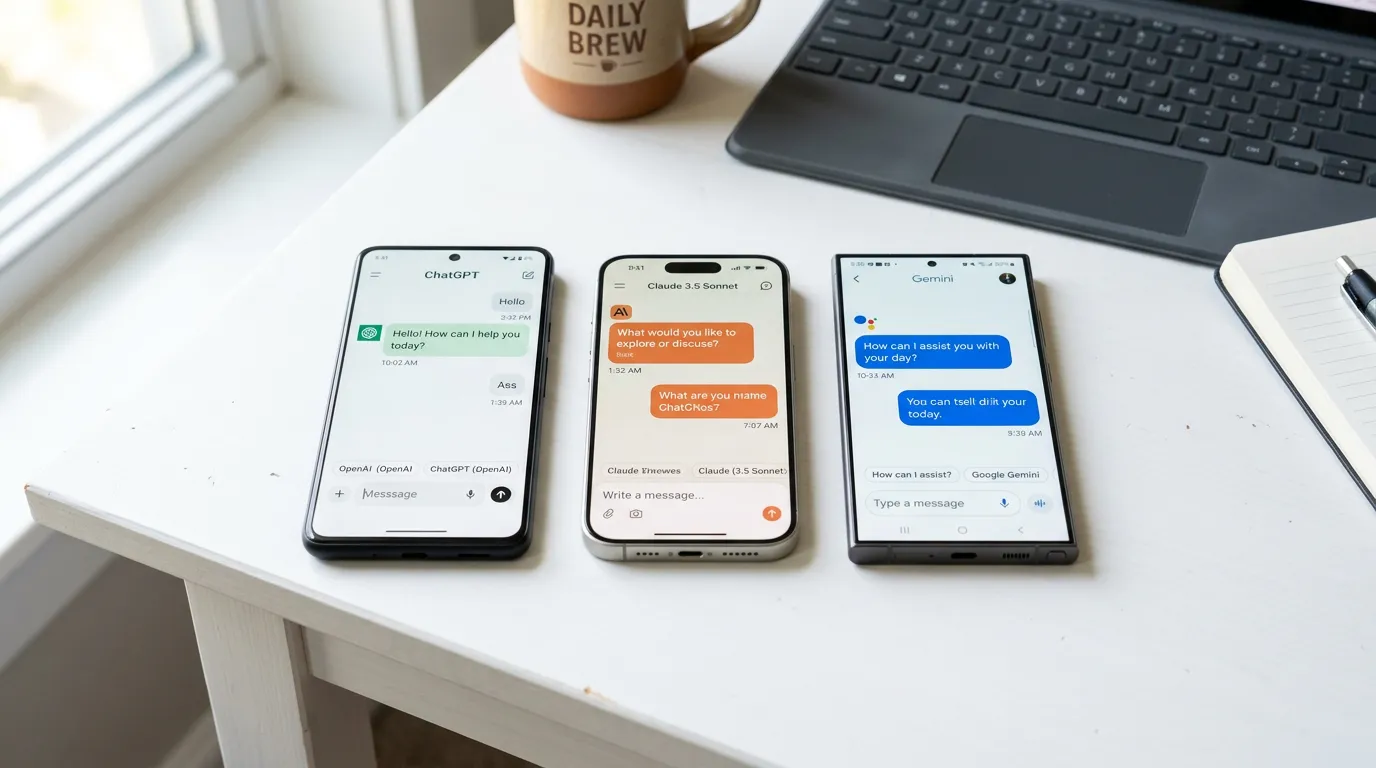
You've probably tried at least one AI chatbot by now. Maybe you use ChatGPT daily, maybe you've heard Claude is better for writing, or maybe Google keeps nudging you toward Gemini. The real question most people have in 2026 isn't whether to use AI, it's which one deserves their time and, potentially, their $20 a month.
Here's the short version: there's no single best chatbot anymore. ChatGPT, Claude, and Gemini have each carved out genuine strengths, and the smartest approach is knowing which tool to reach for based on what you're actually trying to do. This comparison breaks down exactly where each one excels, where each falls short, and what you should pick for your specific needs.
The Current Lineup: What You're Choosing Between
The AI chatbot market has changed dramatically since 2024. All three major platforms have released significantly more capable models, and the gap between them has narrowed in some areas while widening in others.
ChatGPT runs on OpenAI's GPT-5.2, released in December 2025, which comes in three variants: Instant (fast responses), Thinking (deeper reasoning), and Pro (maximum capability). ChatGPT remains the most widely used AI chatbot with roughly 800 million weekly active users and about 68% market share, down from over 87% in early 2025. That decline isn't because ChatGPT got worse. It's because the competition got serious.
Claude is built by Anthropic and currently offers Opus 4.6 (its most capable model, released February 2026) and Sonnet 4.5 as its everyday workhorse. Claude's standout feature is a 1-million-token context window in Opus 4.6, which means it can process roughly 750,000 words in a single conversation. That's the equivalent of feeding it 10 full novels and asking questions about all of them simultaneously.
Gemini is Google's offering, with Gemini 3 Pro as its current flagship. Gemini's biggest advantage is deep integration with Google's ecosystem: Gmail, Docs, Sheets, Drive, YouTube, and Maps. It also offers a 1-million-token context window in production and a "Deep Research" feature that autonomously searches the web and compiles comprehensive reports.
Where Each One Actually Wins
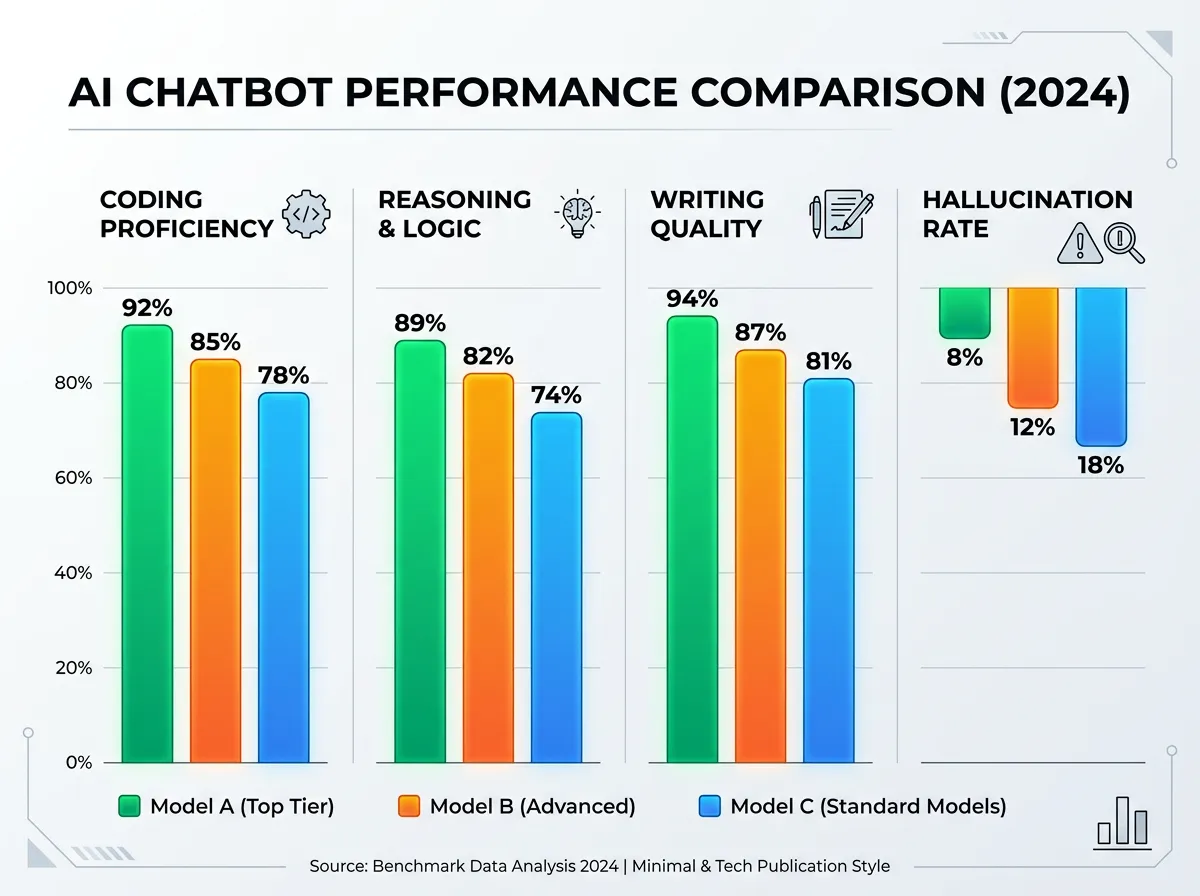
Benchmarks tell part of the story, but real-world usage tells the rest. Here's where each chatbot genuinely outperforms the others based on testing data, expert reviews, and practical use cases.
ChatGPT is best for everyday versatility. It scores highest on abstract reasoning (77.1% on ARC-AGI-2, more than double Gemini's 31.1%) and achieved perfect accuracy on the AIME 2025 math benchmark. Its memory feature, which remembers your preferences and past conversations, is the most polished implementation of any chatbot. If you ask ChatGPT to help draft an email, then come back a week later asking for another, it remembers your tone preferences, your name, and your role. The new ChatGPT Agent feature can also browse the web and complete tasks autonomously, like booking reservations or filling out forms.
Claude is best for coding and precise writing. On SWE-bench Verified, the standard benchmark for real-world software engineering tasks, Claude Opus 4.5 scores 80.9%, compared to roughly 70% for GPT-5.2. Claude also has the lowest hallucination rate of any major chatbot at approximately 3%, versus about 6% for both ChatGPT and Gemini. In blind writing comparisons, reviewers have consistently rated Claude's prose as the most natural-sounding. Its "Artifacts" feature creates code in a split-screen window with live preview, which is particularly useful for web development. If you need AI tools for work that prioritize accuracy over speed, Claude is the pick.
Gemini is best for research and Google integration. Its Deep Research mode generates comprehensive multi-source reports that independent raters preferred over competitors by a 2-to-1 margin. Gemini's 1-million-token context window has been in production the longest, making it the most reliable for processing massive documents: entire codebases, legal contracts, research paper collections. If you live in Google's ecosystem, Gemini works directly inside Gmail, Docs, and Sheets without switching tabs. For processing large volumes of information, nothing else comes close.
What Each One Gets Wrong
No chatbot is good at everything, and knowing the weaknesses matters as much as knowing the strengths.
ChatGPT's main issue is confidence. It will generate plausible-sounding answers even when it doesn't have reliable information, and its 6% hallucination rate means roughly 1 in 17 factual claims may be wrong. It's also the most likely to give you what it thinks you want to hear rather than pushing back on a flawed premise. The $20/month Plus plan restricts access to the most capable GPT-5.2 Pro model, which lives behind the $200/month tier.
Claude's weaknesses are availability and speed. It has stricter usage caps than competitors, meaning you'll hit limits faster during heavy use. It's also more cautious by design, sometimes refusing tasks that ChatGPT and Gemini handle without issue. For casual conversation and brainstorming, Claude can feel overly careful. And while its coding abilities are exceptional, its creative writing, though natural-sounding, tends to be more measured and less willing to take bold stylistic risks.
Gemini struggles with accuracy on knowledge-intensive tasks outside its training data. It scores lowest on several reasoning benchmarks, and its responses can feel generic compared to ChatGPT's conversational style or Claude's precision. The Google Workspace integration, while useful, means Gemini is most valuable if you're already embedded in Google's tools. If you use Microsoft 365 or Apple's ecosystem, that advantage disappears.

The Price Breakdown
All three services have settled around similar pricing tiers, but the value you get at each level varies significantly.
At the free tier, Gemini is the most generous. You get access to Gemini 3 Pro with reasonable daily limits, which is enough for casual users who don't need heavy daily use. ChatGPT's free tier gives limited GPT-5.2 access but restricts the more capable Thinking and Pro modes. Claude's free tier offers daily caps on Sonnet 4.5, which is capable but not the top-tier Opus model.
At the $20/month tier (ChatGPT Plus, Claude Pro, Google AI Pro at $19.99), you get substantially more access to each platform's best models. ChatGPT Plus unlocks GPT-5.2 Thinking mode and higher usage limits. Claude Pro gives more Opus 4.6 access and larger file uploads. Google AI Pro includes Gemini 3 Pro with Deep Research, plus 2TB of Google cloud storage, which makes it the best value per dollar if you use Google services.
The premium tiers diverge sharply. ChatGPT Pro at $200/month gives unlimited access to every model. Claude Max offers two options: $100/month for 5x the Pro limits or $200/month for 20x. Google AI Ultra at $249.99/month is the most expensive but includes the full Google Workspace suite alongside Gemini's most capable models.
For developers using the API, Gemini is dramatically cheaper. Google's Flash model costs roughly $0.075 per million input tokens, while Claude Sonnet charges $3 and Claude Opus charges $15 for the same volume. If you're building applications rather than chatting, the cost difference is significant.
A Framework for Choosing the Right Chatbot
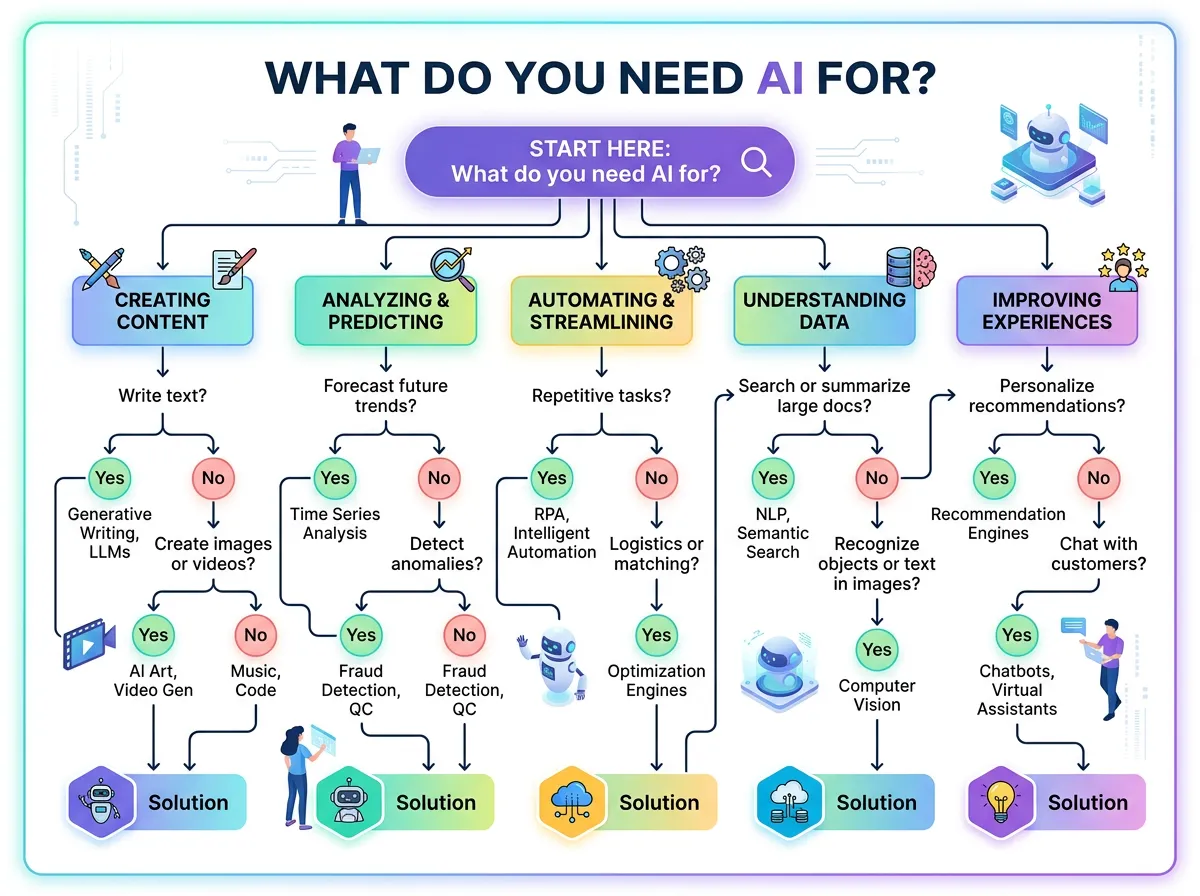
Rather than recommending one chatbot for everyone, here's a practical decision framework based on what you actually do with AI.
If you use AI occasionally for personal tasks (writing emails, answering questions, brainstorming), ChatGPT is the safest default. Its memory feature gets smarter over time, its interface is the most intuitive, and its free tier is functional enough that you may never need to pay. The ChatGPT Agent feature also means it can handle simple web tasks for you.
If you write code or need precision, Claude is worth the subscription. The gap in coding benchmarks is real and measurable. Its low hallucination rate means you spend less time verifying its output, and Artifacts makes iterating on code faster than copy-pasting between windows. Professional developers increasingly use Claude Code, Anthropic's command-line tool for AI-assisted development.
If you're a researcher, student, or heavy Google user, Gemini delivers the most value. Deep Research can save hours of manual searching. The ability to process entire textbooks or research paper collections in one conversation is genuinely useful for academic work. And the native Google Workspace integration means your AI assistant lives inside the tools you're already using.
If accuracy on factual claims matters most, Claude's 3% hallucination rate gives it a meaningful edge. For medical questions, legal research, financial analysis, or any domain where wrong answers have real consequences, that difference between 3% and 6% hallucination rates is significant.
The emerging expert consensus, articulated by multiple tech analysts in early 2026, is that the real winners are people who build "model portfolios" rather than pledging loyalty to one service. Using ChatGPT for brainstorming, Claude for coding and fact-sensitive work, and Gemini for research isn't hedging your bets. It's using each tool where it's strongest.
What Changed Since 2024 (and What's Coming)
The AI chatbot market two years ago was essentially ChatGPT and a few catching-up alternatives. That's no longer true. Gemini has grown from 5.4% to 18.2% market share. Claude has established itself as the developer's choice with real benchmark dominance in coding tasks. And newer competitors like DeepSeek have proven that capable AI doesn't have to come from US-based companies.
Several trends matter for your decision. Context windows are getting larger across all platforms, which means all three chatbots are becoming better at handling long documents and extended conversations. Agent capabilities, where AI can take actions in the real world rather than just generating text, are advancing fastest in ChatGPT but all three are investing heavily. And pricing competition is driving costs down, particularly at the API level.
The most practical prediction: by late 2026, the free tiers of all three services will be more capable than today's paid tiers. If you're on the fence about paying, the free versions are already good enough for most personal use. Save the subscription for the specific capability you actually need, whether that's Claude's coding power, Gemini's Deep Research, or ChatGPT's memory and agent features.
Key Takeaways
There's no universally "best" AI chatbot in 2026. ChatGPT wins on versatility and user base. Claude wins on coding, accuracy, and writing quality. Gemini wins on research depth and Google integration.
For most people, starting with ChatGPT's free tier makes sense because it handles the widest range of tasks competently. If you hit its limits or need specialized capabilities, Claude is worth paying for if you code or need low-hallucination output, and Gemini is worth paying for if you do research-heavy work or live in Google's ecosystem.
The practical advice from the tech community has shifted from "pick the best one" to "learn when to use each one." Your phone probably has multiple camera apps for different situations. AI chatbots work the same way.
Sources
- ChatGPT vs Claude vs Gemini 2026: Full Comparison - Free Academy, 2026
- Claude vs ChatGPT vs Gemini: Best AI Comparison - Improvado, 2026
- Anthropic Releases Claude Opus 4.6 - MarkTechPost, February 5, 2026
- Introducing GPT-5.2 - OpenAI, December 2025
- Google AI Pro, Ultra Features Guide - 9to5Google, February 21, 2026