
Show someone a photograph of the person they love, and something happens in their brain that looks, on a functional MRI scan, almost indistinguishable from a cocaine hit. The same reward circuits light up. The same neurotransmitter surges. The same regions associated with craving, motivation, and euphoria activate in near-perfect overlap. This is not a metaphor. Biological anthropologist Helen Fisher, who spent decades scanning the brains of people in various stages of romantic love at Rutgers University, concluded that romantic love is not primarily an emotion. It is a drive, one of the most powerful motivational systems the human brain has ever evolved, older than the circuits for fear and possibly older than those for anger.
What makes this finding so striking is its universality. In a landmark cross-cultural survey, anthropologists William Jankowiak and Edward Fischer examined 166 societies across every inhabited continent and found clear evidence of romantic love in 147 of them. In the remaining nineteen, researchers had simply never asked the question. No culture studied produced negative evidence. Romantic love appears to be as fundamental to human biology as hunger or thirst, wired into the architecture of the brain long before any culture invented Valentine's Day.
The Three Phases
Fisher's model, refined over three decades of research, divides romantic love into three overlapping neurochemical phases, each governed by a distinct cocktail of hormones and neurotransmitters. The first is lust, driven primarily by testosterone and estrogen. This is the most ancient layer, shared with nearly every vertebrate species, and its function is straightforward: get you interested in potential mates. It is general, not specific. Lust does not care who.
The second phase, attraction, is where the experience sharpens into what most people recognize as "falling in love." This is the obsessive stage: the inability to stop thinking about one particular person, the racing heart, the sleepless nights, the loss of appetite. The chemistry behind it involves a surge of dopamine and norepinephrine paired with a measurable drop in serotonin. That serotonin dip is significant. Researcher Donatella Marazziti at the University of Pisa found in 1999 that serotonin levels in the blood of people who reported being intensely in love were comparable to those measured in patients with obsessive-compulsive disorder. The comparison is not casual. The intrusive, repetitive thoughts about a loved one share a neurochemical signature with clinical obsession.
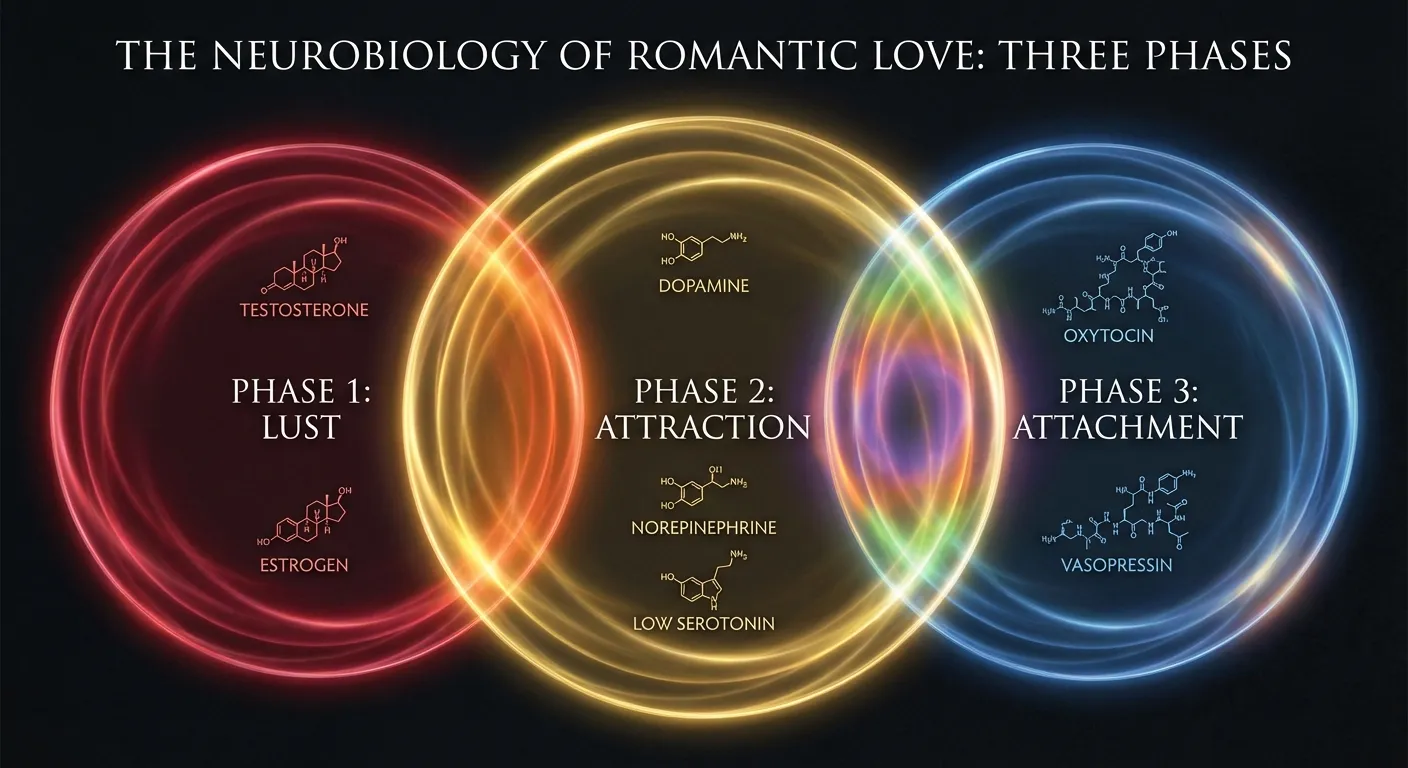
The third phase is attachment, the longer-term bonding that allows couples to stay together through child-rearing and beyond. Here the dominant players are oxytocin and vasopressin, neuropeptides associated with trust, social recognition, and pair bonding. Oxytocin is released during physical touch, sex, and even prolonged eye contact. Vasopressin, studied extensively in prairie voles by Thomas Insel at the National Institute of Mental Health, appears to play a critical role in the protective, territorial behaviors that characterize long-term pair bonds.
These three systems are not sequential. They can operate simultaneously, and their interactions produce the complex, sometimes contradictory experience of romantic relationships. You can feel deep attachment to a long-term partner while experiencing intense attraction to someone new, a neurochemical conflict that Fisher argues is hardwired rather than a moral failing.
Your Brain on Love
The most detailed picture of what love does to the brain comes from fMRI studies, and the results consistently point to the same structures. When people in the early stages of romantic love view photographs of their beloved, the ventral tegmental area (VTA) activates powerfully. The VTA is a small cluster of cells in the brainstem that produces dopamine and projects it to the caudate nucleus and other reward-processing regions. This is the same circuit that responds to food when you are hungry, water when you are thirsty, and drugs when you are addicted.
A 2010 meta-analysis led by Stephanie Ortigue (later Cacioppo) at Syracuse University synthesized the fMRI literature and found that falling in love engages 12 distinct brain areas working in concert, releasing dopamine, oxytocin, adrenaline, and vasopressin in a coordinated neurochemical cascade. The process is fast. The neural response to seeing a loved one's face begins in as little as a fifth of a second, faster than conscious thought.
What does not activate is equally revealing. The amygdala, which processes fear and negative social judgments, shows reduced activity during early romantic love. So does the frontal cortex, the seat of critical reasoning and judgment. This deactivation pattern explains why new love produces a measurable decline in the ability to assess a partner's faults. It is not that love is blind by choice. The brain's critical evaluation circuits are being actively suppressed by the reward system. You are, in a real neurological sense, incapable of fully objective judgment about someone you have just fallen in love with.
The Addiction Parallel
The overlap between love and addiction is not a loose analogy. It is a specific, documented neurobiological convergence. Fisher and her colleagues, including neuroscientist Lucy Brown at the Albert Einstein College of Medicine, published a series of studies showing that the brain regions activated by romantic love, particularly the VTA and caudate nucleus, are the same regions implicated in behavioral and substance addictions. The dopamine-driven reward pathway that makes cocaine feel euphoric is the same pathway that makes seeing your beloved feel euphoric.
The parallel extends to withdrawal. People who have recently been rejected in love show activation patterns that mirror those seen in studies of drug craving. Fisher scanned the brains of people who had been dumped and found heightened activity in the VTA (still producing dopamine, still craving the reward), in the nucleus accumbens (associated with addiction and risk-taking), and in the insular cortex and anterior cingulate (regions associated with physical pain). The metaphor of heartbreak turns out to be grounded in neurobiology: the brain processes social rejection through the same pain circuits it uses for physical injury.
Naomi Eisenberger's research at UCLA provided some of the most striking evidence for this connection. Using an experimental paradigm called Cyberball, in which participants were excluded from a virtual ball-tossing game while inside an fMRI scanner, Eisenberger showed that social rejection activated the dorsal anterior cingulate cortex (dACC) and anterior insula, the same regions that process physical pain. In a follow-up study, her team found that participants who took acetaminophen (Tylenol) daily for three weeks reported fewer hurt feelings and showed reduced neural activity in pain-processing regions after social exclusion compared to a placebo group. Heartache, it turns out, responds to painkillers.
When the Textbook Gets It Wrong
For decades, the story of pair bonding seemed settled. Oxytocin was the "love hormone," vasopressin was the "monogamy molecule," and prairie voles were the proof. Unlike their promiscuous cousins the montane voles, prairie voles form lifelong pair bonds, and early pharmacological studies showed that blocking oxytocin receptors in prairie voles prevented pair bonding entirely. The narrative was clean: oxytocin equals attachment, no oxytocin means no bonding.
Then in January 2023, a study published in Neuron upended the textbook. Researchers at UC San Francisco used CRISPR to create prairie voles that completely lacked functional oxytocin receptors from birth. The prediction was straightforward: these voles should be unable to form pair bonds. They formed pair bonds anyway. The mutant voles bonded with partners, raised pups, and behaved in ways indistinguishable from normal voles. Females even nursed their young, though they produced less milk.
The finding does not mean oxytocin is irrelevant to bonding. It suggests something more nuanced: the brain's bonding systems are redundant. When one pathway is absent from birth, others compensate. Oxytocin appears to enhance pair bonding rather than being strictly required for it. The pharmacological studies, which blocked receptors in adult voles whose brains had developed normally, produced different results than genetic knockouts in which the brain developed without oxytocin signaling from the start. The lesson is that love, neurochemically speaking, is not a single lock with a single key. It is a system with multiple fail-safes, as though evolution considered pair bonding too important to leave to a single molecular pathway.
A Biological Universal
The universality of romantic love across cultures is one of the strongest pieces of evidence that it is biological rather than culturally constructed. Jankowiak and Fischer's survey of 166 societies was published in 1992, and in the decades since, no anthropological study has identified a culture in which romantic love is absent. The experience manifests differently. Courtship rituals vary wildly. Arranged marriages exist alongside love marriages. But the underlying neurochemistry, the dopamine surge, the obsessive thinking, the attachment drive, appears constant.
This should not be surprising from an evolutionary perspective. Romantic love serves a clear adaptive function: it focuses mating effort on a single individual long enough to conceive and raise offspring through the vulnerable early years. Fisher argues that the three-phase system (lust, attraction, attachment) evolved sequentially, with lust being the oldest and attachment the most recent, allowing humans to pursue a flexible reproductive strategy that balances seeking new partners with maintaining stable pair bonds.

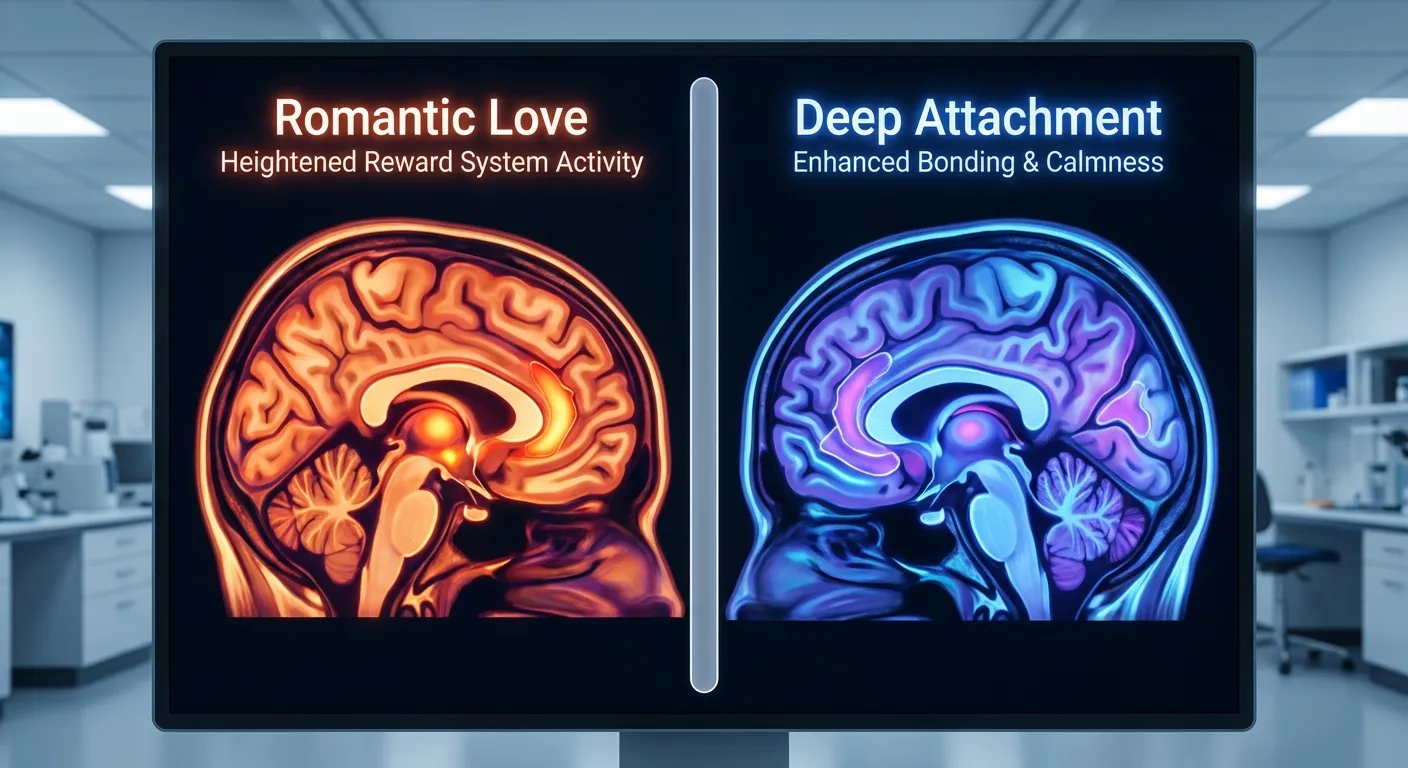
What is genuinely novel in recent research is the discovery that long-term love is not simply a pale echo of early passion. A 2011 fMRI study led by Bianca Acevedo and Arthur Aron at Stony Brook University scanned 17 people who reported being intensely in love with their spouses after an average of 21.4 years of marriage. When these long-term lovers viewed photos of their partners, the VTA activated with the same intensity seen in studies of people who had just fallen in love. The dopamine-rich reward system was still firing, still responding to the partner as a source of deep reward. The key difference was that long-term love also activated regions associated with calm and pain suppression, regions that early-stage love does not engage. Long-term love, the data suggest, retains the dopamine-driven intensity of new love while adding a neurochemical layer of comfort and security that new relationships lack.
Why It Matters Beyond the Lab
Understanding the chemistry of love is more than an intellectual exercise. It reframes several practical questions about relationships and mental health. If romantic love operates through the same circuits as addiction, then the difficulty of getting over a breakup is not weakness. It is withdrawal, and it has a predictable neurochemical timeline. Fisher's research suggests that the acute phase of romantic rejection typically lasts between six and eighteen months, which corresponds roughly to the time required for the dopamine reward system to recalibrate after losing its primary source of stimulation.
The clinical implications extend further. Conditions involving disrupted social bonding, from certain attachment disorders to the social withdrawal seen in some forms of depression, may involve dysfunction in the same oxytocin, vasopressin, and dopamine systems that govern romantic love. The 2023 prairie vole study, by revealing the redundancy of these systems, suggests that therapeutic approaches targeting a single "love molecule" are likely to be insufficient. The biology is more complex, more resilient, and more intertwined with other neural systems than the popular narrative of "oxytocin sprays" and "love drugs" would suggest.
Perhaps the deepest insight from the neuroscience of love is how it reframes the relationship between reason and emotion. The deactivation of the frontal cortex during early love, the suppression of critical judgment, the hijacking of reward circuits, these are not bugs. They are features of a system that evolved to ensure reproductive bonding by temporarily overriding the very cognitive faculties that might talk you out of it. Love is not irrational in the sense of being random or meaningless. It is irrational by design, a calculated neurochemical override that has been calibrated by millions of years of natural selection to serve a purpose so fundamental that the brain quite literally deletes competing priorities to make room for it.
The poets were not wrong when they described love as a kind of madness. The neuroscientists have simply identified the mechanism.
Sources
- Neural Correlates of Long-Term Intense Romantic Love (Acevedo et al., 2012)
- Oxytocin Receptor Is Not Required for Social Attachment in Prairie Voles (Neuron, 2023)
- Acetaminophen Reduces Social Pain (DeWall, Eisenberger et al., 2010)
- Love and the Brain (Harvard Medical School)
- Neuroimaging of Love: fMRI Meta-Analysis Evidence (Ortigue et al., 2010)