
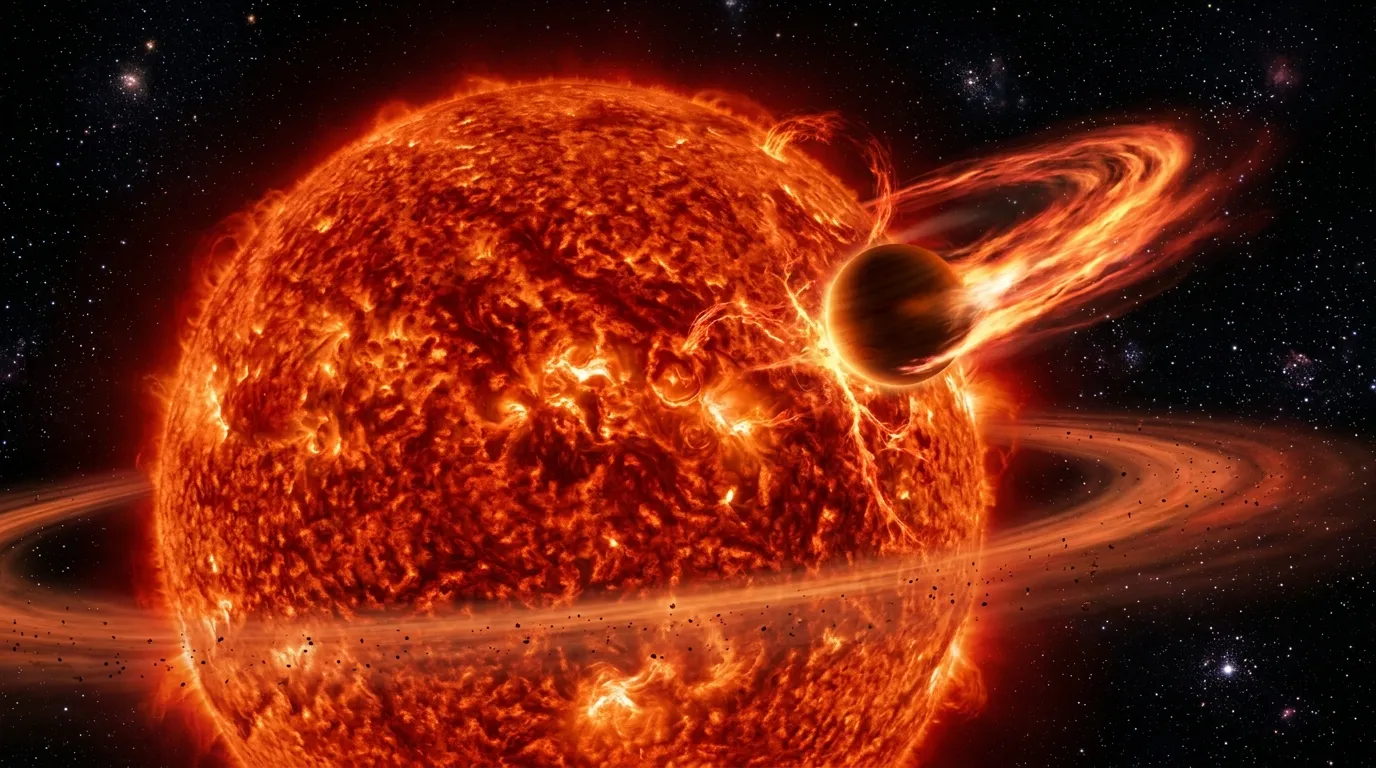
Every star has a death sentence written into its core. When the hydrogen fuel runs out, the star cools, swells, and balloons outward into a red giant, sometimes expanding to hundreds of times its original radius. For decades, astronomers have predicted that this expansion should be catastrophic for any planets orbiting too close. The math was clear: tidal forces would drag those worlds inward until they were torn apart or consumed entirely. But predictions are not the same as proof, and direct evidence of this planetary destruction has been remarkably difficult to pin down.
A new study, led by Dr. Edward Bryant at University College London's Mullard Space Science Laboratory and the University of Warwick, has finally delivered that proof at population scale. By analyzing NASA's Transiting Exoplanet Survey Satellite (TESS) data for nearly half a million aging stars, Bryant and his collaborators found a stark and unmistakable pattern: the more evolved a star becomes, the fewer close-orbiting giant planets survive around it. The planets aren't migrating outward to safety. They're being destroyed.
The findings, published in Monthly Notices of the Royal Astronomical Society, constitute the largest systematic survey ever conducted of planets around post-main-sequence stars. And the implications reach all the way to our own Solar System, where the Sun will undergo the same transformation in roughly five billion years.
What the TESS Data Actually Shows
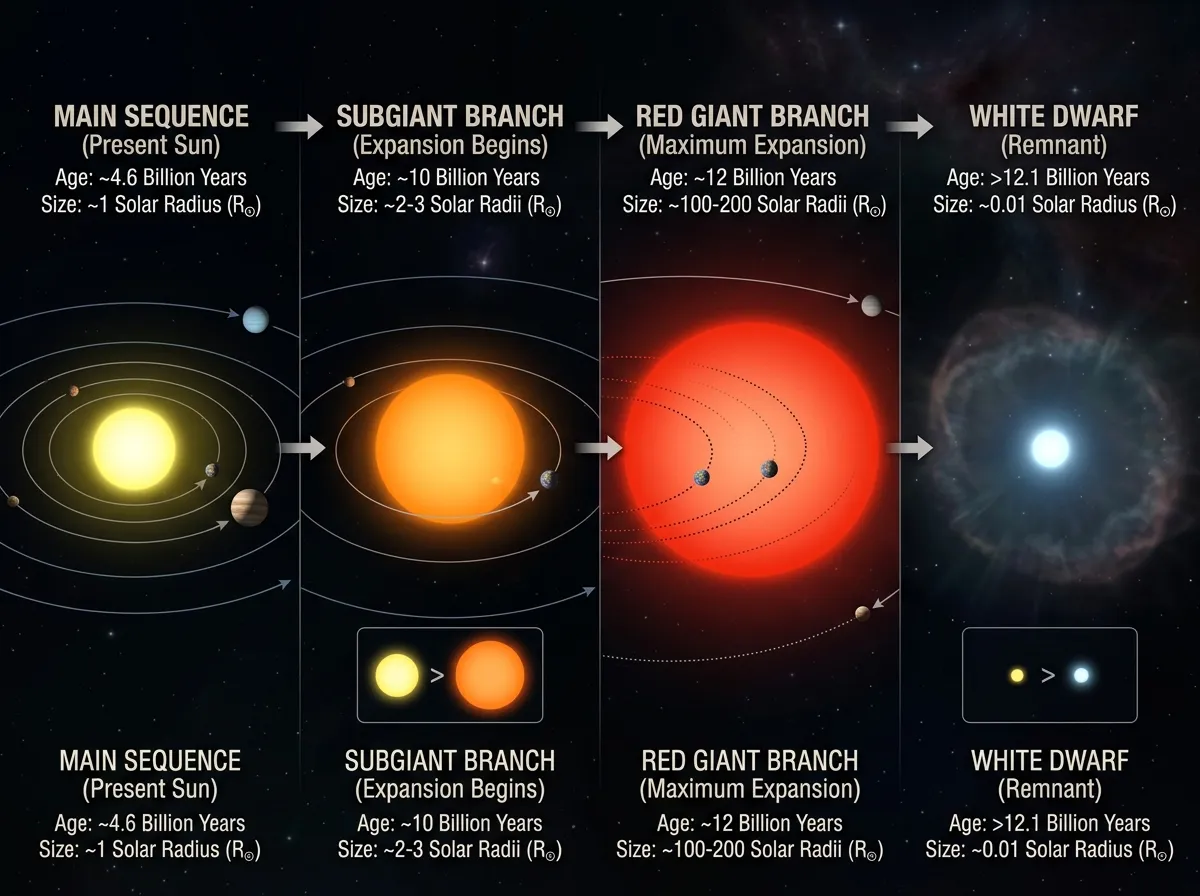
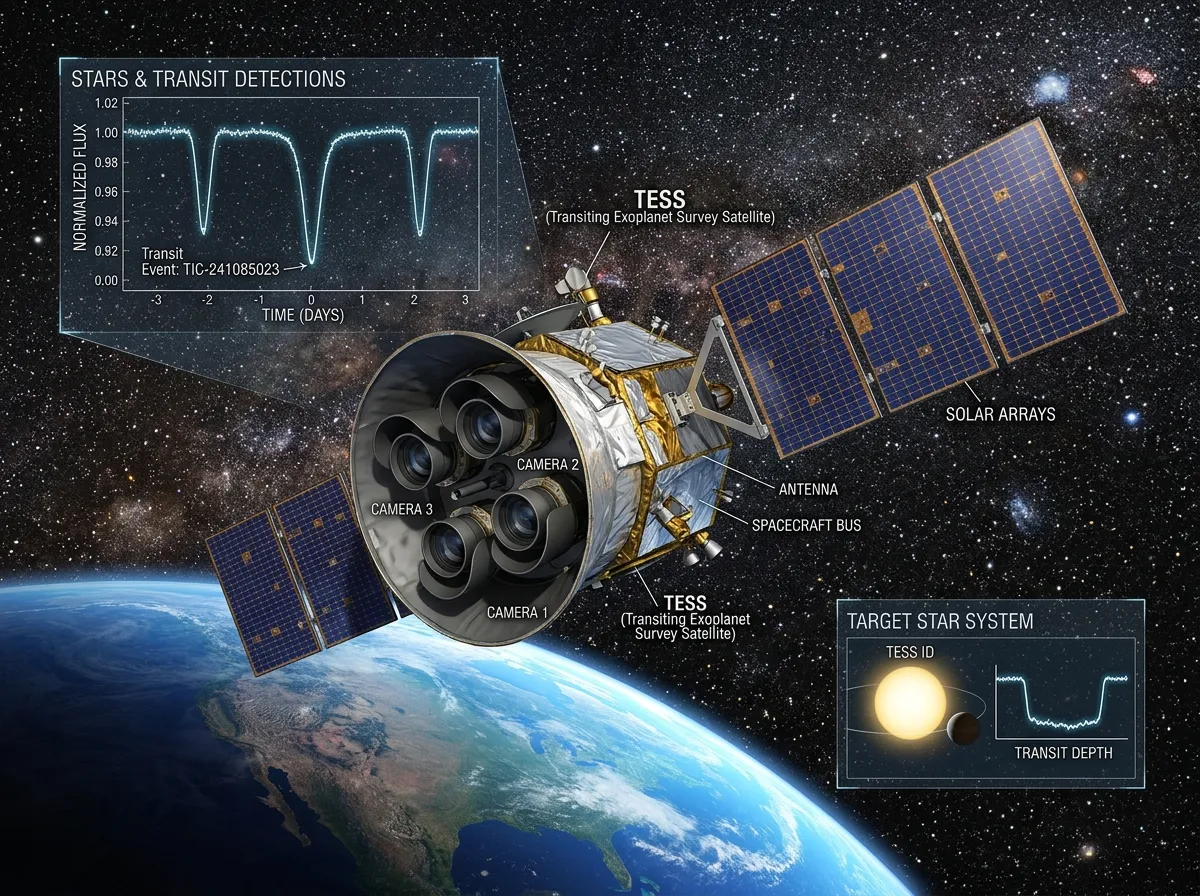
The research team didn't observe individual planets being consumed. Instead, they took a statistical approach, one that required enormous numbers to work. Using TESS data, they surveyed stars that have already left the main sequence, the stable hydrogen-burning phase where our Sun currently resides, and entered the later stages of stellar evolution. They searched for the telltale brightness dips that occur when a planet transits across the face of its host star, focusing specifically on giant planets with orbital periods of 12 days or less. These are the worlds most vulnerable to tidal destruction.
The numbers were staggering in their initial scope and ruthless in their filtering. The team started with roughly 15,000 candidate signals from nearly 500,000 stars. After eliminating false positives from binary star systems, instrumental artifacts, and other noise sources, they were left with 130 confirmed planets and planetary candidates. Of those, 33 were entirely new discoveries, 48 were confirmations of previously known planets, and 49 verified earlier candidates that had not yet been confirmed.
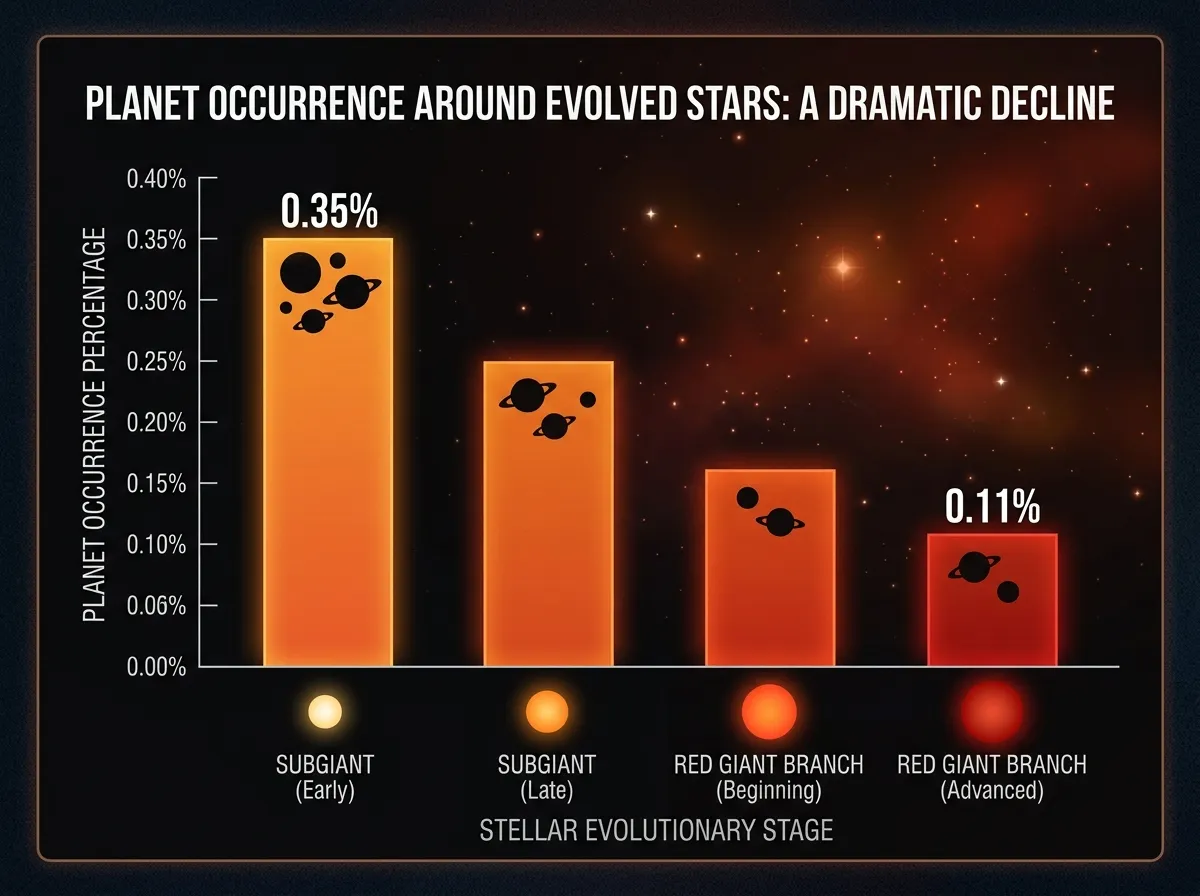
The critical finding emerged when they sorted these detections by the evolutionary stage of the host star. Among the "youngest" post-main-sequence stars, those that had only recently begun expanding, 0.35% hosted close-in giant planets. Among the more evolved red giants, that number dropped to 0.11%. The decline was not gradual or ambiguous. It was a clear, statistically significant decrease that tracked precisely with how far each star had progressed in its expansion.
"This is strong evidence that as stars evolve off their main sequence, they can quickly cause planets to spiral into them and be destroyed," Bryant explained. He noted that the team was "surprised by just how efficient these stars seem to be at engulfing their close planets."
The Tidal Tug of War
The mechanism behind this planetary destruction is not a simple matter of a star expanding and physically swallowing a planet, though that can happen too. The primary driver is tidal interaction, the same fundamental gravitational effect that causes ocean tides on Earth, operating on a far more violent scale.
When a massive planet orbits close to an aging, expanding star, the gravitational pull between them creates tidal bulges on both objects. On the star, this bulge doesn't align perfectly with the line connecting the two bodies because the star's rotation and the planet's orbit aren't synchronized. The resulting offset creates a torque that transfers angular momentum from the planet's orbit to the star's rotation. The planet loses orbital energy. Its orbit shrinks. It spirals inward.
This process is self-reinforcing. As the planet moves closer, the tidal forces grow stronger, which accelerates the orbital decay, which brings the planet even closer. Eventually, one of two things happens: the planet crosses the Roche limit, the distance at which tidal forces exceed the planet's own gravity, and is literally torn apart into a ring of debris, or it plunges directly into the star's outer atmosphere and is consumed.
The physics mirrors what happens between Earth and the Moon, but in reverse. Earth's tidal interaction with the Moon is slowly pushing the Moon outward, about 3.8 centimeters per year, because the Moon orbits outside the synchronous orbit distance. For close-in exoplanets around expanding stars, the geometry works the other way. The planet orbits inside the critical distance, and tidal friction drags it inward instead of pushing it outward. There is no escape trajectory. The spiral is a one-way trip.
How We Got Here: A History of Theoretical Predictions
The idea that expanding stars might destroy their inner planets is not new. Theoretical models of tidal orbital decay have existed since the 1960s, when astronomers first began to seriously model the long-term gravitational interactions between stars and close companions. Early calculations by Zahn and others established the basic framework: convective stellar envelopes, the kind found in red giants, are extremely effective at dissipating tidal energy, which accelerates the inward migration of nearby objects.
What made the theoretical picture frustrating for decades was the difficulty of testing it observationally. Before the era of exoplanet surveys, astronomers had exactly one stellar system to study in detail: our own. And the Sun hasn't yet begun its red giant phase, so there was nothing to observe directly. The discovery of hot Jupiters in the mid-1990s, gas giants orbiting their host stars in just a few days, opened up new possibilities. Here were planets that should be vulnerable to exactly the kind of tidal destruction the models predicted. But those early detections were almost entirely around main-sequence stars that hadn't yet begun to expand.
Isolated cases of "missing" planets around evolved stars had been reported before Bryant's study, but the sample sizes were always too small to draw firm conclusions. A few researchers pointed to the relative scarcity of hot Jupiters around subgiant stars as suggestive evidence, but alternative explanations, such as different planetary formation conditions around different stellar types, could not be ruled out. What the field needed was exactly what Bryant and his team delivered: a survey large enough to see the statistical signature of planetary destruction across an entire population of evolving stars.
What This Means for Earth and the Inner Solar System
The implications of this research extend beyond academic interest in distant star systems. Our own Sun will exhaust its core hydrogen supply in approximately five billion years and begin its transition to a red giant. Current models suggest it will expand to roughly 250 times its present radius, large enough to engulf Mercury and Venus entirely and reach close to Earth's current orbital distance.
Dr. Vincent Van Eylen, a co-author on the study based at UCL's Mullard Space Science Laboratory, addressed the question directly. "Earth is certainly safer than the giant planets close to their parent stars. But life on Earth probably would not survive," he said. The reasoning is straightforward: even if Earth avoids being physically consumed, the Sun's luminosity during the red giant phase will increase by a factor of several thousand. The oceans will boil off. The atmosphere will be stripped away. The surface will be sterilized long before the expanding star reaches Earth's orbit.
Mars, sitting farther out at 1.5 astronomical units, may survive the expansion itself, but it too will be baked beyond any possibility of habitability. The outer planets, Jupiter, Saturn, Uranus, and Neptune, should survive intact, though their environments will be radically altered as the Sun's mass loss changes their orbital dynamics. Jupiter's frozen moons, particularly Europa and Ganymede with their subsurface oceans, might briefly become more habitable as the increased stellar luminosity melts their icy surfaces, a strange irony in the death of a star system.
This is not speculation. Bryant's data confirms that the theoretical models predicting planetary destruction during stellar evolution are correct. The question for our Solar System is not whether the inner planets will be affected, but precisely how far the destruction will reach, and that depends on details of the Sun's mass loss rate and rotational evolution that remain areas of active research. What the TESS survey has done is remove doubt about the fundamental process: expanding stars really do consume their close-in planets, efficiently and relentlessly.
The Surprising Efficiency of Stellar Consumption
One of the study's most striking results is how quickly and completely the destruction appears to occur. The drop from 0.35% to 0.11% in planet occurrence rates between early and late-stage evolved stars suggests that the tidal inspiral process, once it begins in earnest, finishes relatively rapidly on astronomical timescales. Planets don't linger in slowly decaying orbits for billions of years. Once their host star begins expanding significantly, the tidal dissipation ramps up so aggressively that the planets are consumed within a cosmically brief window.
This efficiency has implications for a puzzle that has long bothered exoplanet scientists: the "hot Jupiter problem." Hot Jupiters, gas giants orbiting within a few stellar radii of their host stars, are found around roughly 1% of Sun-like main-sequence stars. Theorists have argued for years about how they got there, whether they migrated inward through the protoplanetary disk early in the system's life or were scattered into close orbits by gravitational interactions with other planets. Bryant's results add a new dimension to this discussion. If tidal destruction is this efficient around evolved stars, then the current population of hot Jupiters around main-sequence stars is a snapshot of planets that will eventually be consumed. The population we observe today is, in a sense, the survivors that haven't yet met their end.
This also raises questions about what happens to the debris. When a giant planet is tidally disrupted or accreted by its host star, the material doesn't simply vanish. It should produce detectable chemical signatures in the star's atmosphere, a process called "pollution." Some researchers have found evidence of anomalous metal enrichment in evolved stars that could be explained by planetary ingestion, though separating this signal from the star's own internal mixing processes remains challenging. Future spectroscopic surveys may be able to identify the chemical fingerprints of devoured worlds, essentially reading a star's menu from its atmospheric composition.
Why It Matters
The discovery that dying stars systematically consume their close-in planets connects to a much larger question in astronomy: what is the ultimate fate of planetary systems? For most of the history of exoplanet science, the focus has been on formation and detection, finding new worlds and understanding how they came to exist. This study belongs to a growing body of work that examines the other end of the story, how planetary systems die.
The picture that emerges is not a gentle fading but an active, violent dismantling. Stars don't simply grow old and dim while their planets continue orbiting peacefully. They transform into engines of destruction that reshape and ultimately erase the inner architecture of their systems. The outer planets may survive, scattered into wider orbits by the star's mass loss, but the close-in worlds, the ones most easily detected by transit surveys, are doomed.
This has practical consequences for how we interpret exoplanet demographics. Every survey of planets around evolved stars is measuring a depleted population, a remnant sample from which the most vulnerable members have already been removed. Understanding the rate and completeness of this removal is essential for reconstructing the original population of close-in planets, which in turn informs theories about how planetary systems form and evolve. Bryant's study provides the most precise measurement yet of this depletion rate.
There are also connections to our ambitions as a spacefaring species. If humanity, or its descendants, still exists in billions of years when the Sun begins its red giant phase, the TESS data confirms what they will face: an expanding star that will systematically erase the inner Solar System. Any long-term survival strategy for a technological civilization would need to account for this eventual transformation. The timeframe is impossibly long by human standards, but the physics is now observationally confirmed.
What remains unknown is equally compelling. How do the destroyed planets affect the subsequent evolution of their host stars? Do the chemical signatures of consumed worlds persist long enough to be detected in white dwarfs, the stellar remnants left after the red giant phase ends? And perhaps most tantalizing: could the brief warming of icy outer moons during the red giant phase create temporary habitable environments, short-lived oases of liquid water in what were previously frozen wastelands? These questions sit at the intersection of stellar physics, planetary science, and astrobiology, fields that are increasingly converging as we learn that the fates of stars and planets are inseparable, bound together from birth to destruction.
Sources
- Bryant, E.M. & Van Eylen, V. (2025). "Determining the impact of post-main-sequence stellar evolution on the transiting giant planet population." Monthly Notices of the Royal Astronomical Society, 544(1): 1186-1214. DOI: 10.1093/mnras/staf1771
- ScienceDaily: Dying stars are devouring their giant planets
- ScienceAlert: Giant Stars Are Eating Planets, and We Finally Know Why
- EarthSky: Stars destroy their planets as they evolve into red giants