
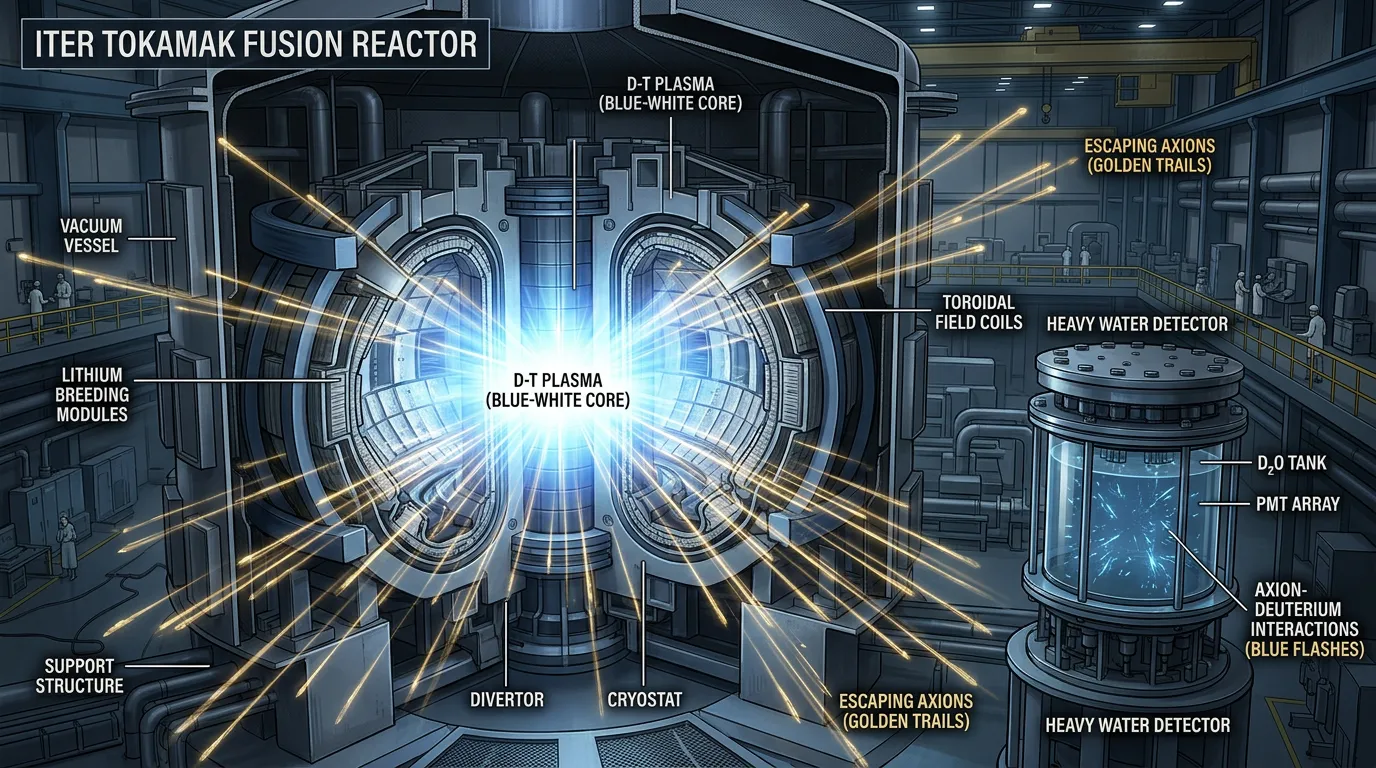
Physicists have spent billions of dollars building underground laboratories to find dark matter. They've hollowed out mountains, filled caverns with liquid xenon, and waited years for a single particle to bump into a detector shielded from cosmic rays by a kilometer of rock. So far, those experiments have produced exquisitely sensitive instruments and zero confirmed detections. The irony is that the answer might come as an accidental byproduct of a machine being built for an entirely different purpose: a fusion reactor.
A new theoretical study published in the Journal of High Energy Physics lays out a method for producing axions, hypothetical low-mass particles linked to the dark sector, inside a working fusion reactor. The study, led by Dr. Raghavan Rangarajan of the University of Cincinnati and a team of international collaborators, focuses specifically on the ITER reactor under construction in southern France. Their calculations show that the intense neutron flux generated by deuterium-tritium fusion, when it strikes the lithium walls lining the reactor vessel, could forge particles connected to dark matter at rates high enough to detect with relatively simple equipment placed nearby.
If the physics holds up, this approach would bypass the need for purpose-built underground labs entirely. A detector made of heavy water, positioned outside the reactor walls, could catch the signal. The elegance is in the economy: ITER is already being built, the neutrons are already part of the design, and the detection method doesn't require exotic materials or billion-dollar instruments.
The Problem Dark Matter Has Always Posed
Dark matter accounts for roughly 27% of the total mass-energy content of the universe. We know this because galaxies rotate faster than they should given their visible mass, because gravitational lensing bends light around clusters in ways that demand unseen material, and because the cosmic microwave background radiation carries an imprint of dark matter's gravitational influence on the early universe. The evidence is overwhelming. What we don't know is what dark matter actually is.
For decades, the leading candidates were WIMPs (Weakly Interacting Massive Particles), heavy particles that interact with ordinary matter only through gravity and the weak nuclear force. Massive experiments like LUX-ZEPLIN in South Dakota and XENON1T in Italy were built to catch WIMPs colliding with atomic nuclei deep underground. These detectors achieved extraordinary sensitivity, able to register the energy of a single atom recoiling from an impact. But they found nothing. As each generation of detectors pushed sensitivity limits further without a detection, the WIMP hypothesis began losing ground.
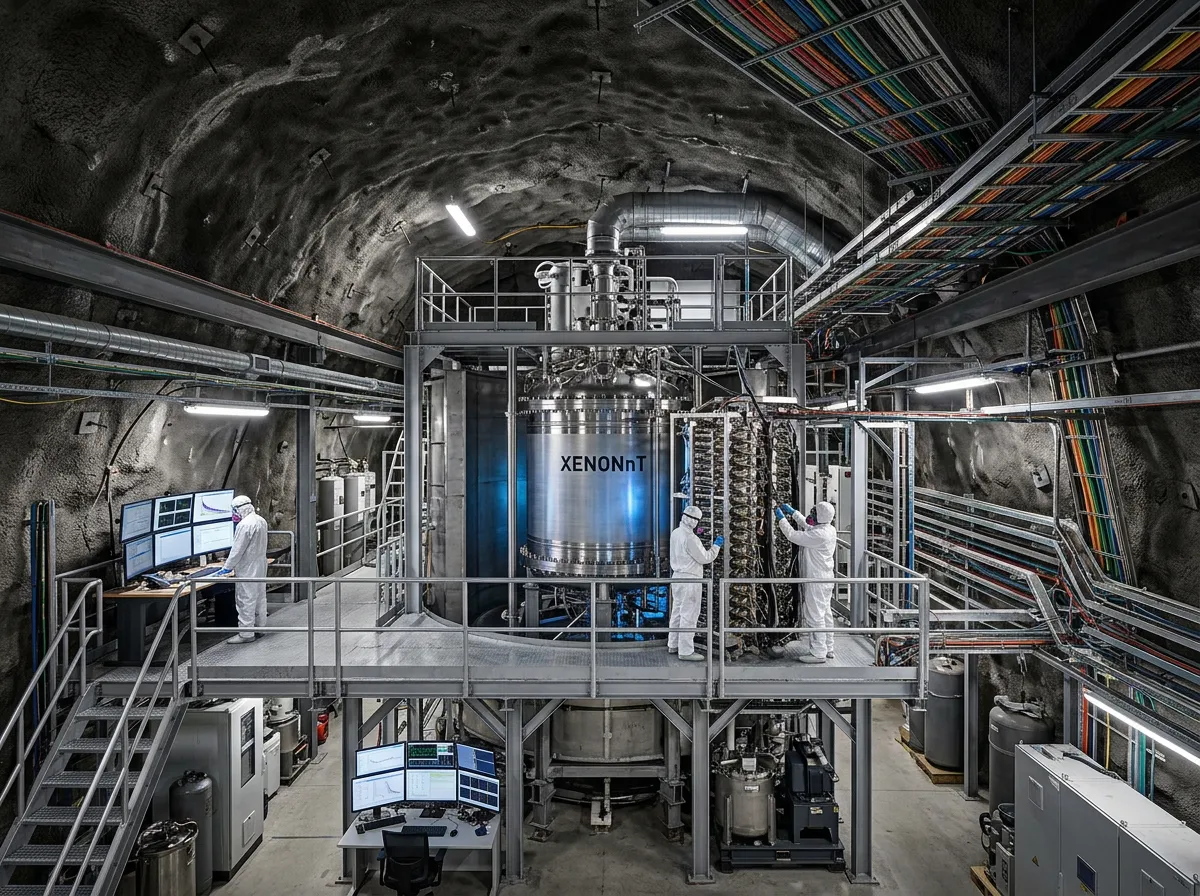
This doesn't mean dark matter is any less real. It means physicists may have been looking for the wrong particle. The failure to find WIMPs has shifted attention toward lighter, more weakly coupled candidates, and none has gained more theoretical momentum than the axion.
The axion was not originally proposed to explain dark matter at all. In 1977, Roberto Peccei and Helen Quinn introduced it to solve a problem in quantum chromodynamics, the theory governing the strong nuclear force. That problem, called the strong CP problem, concerns why certain symmetry violations predicted by theory don't show up in experiments with neutrons. Peccei and Quinn proposed a new symmetry whose breaking would naturally suppress the missing violations. Shortly afterward, Frank Wilczek and Steven Weinberg independently realized that this mechanism would produce a new particle: the axion. Wilczek named it after a brand of laundry detergent because, he said, it "cleaned up" the problem.
How a Fusion Reactor Could Produce Axions
The ITER reactor, short for International Thermonuclear Experimental Reactor, is a collaborative project involving 35 nations. Its goal is to demonstrate that nuclear fusion can produce net energy, generating more power than it consumes. The reactor will fuse deuterium and tritium (heavy isotopes of hydrogen) at temperatures exceeding 150 million degrees Celsius, contained within a magnetic field inside a doughnut-shaped vacuum chamber called a tokamak.
Fusion of deuterium and tritium releases enormous energy, mostly in the form of 14.1 MeV neutrons. These high-energy neutrons carry about 80% of the reaction's energy output. In ITER's design, the neutrons slam into a lithium blanket lining the reactor walls. The lithium absorbs the neutrons and, in doing so, breeds tritium fuel for the reactor while capturing the neutrons' kinetic energy as heat.
Dr. Rangarajan's team recognized that these neutron-lithium interactions create exactly the conditions where axion-like particles could be produced. When a high-energy neutron strikes a lithium nucleus, the interaction involves the strong nuclear force at energies where axion production becomes theoretically possible. The sheer volume of neutrons matters here. ITER will produce approximately 10^20 neutrons per second during full operation. Even if the probability of axion production in any single interaction is vanishingly small, the cumulative flux could push the total number of escaping axion-like particles into a detectable range.
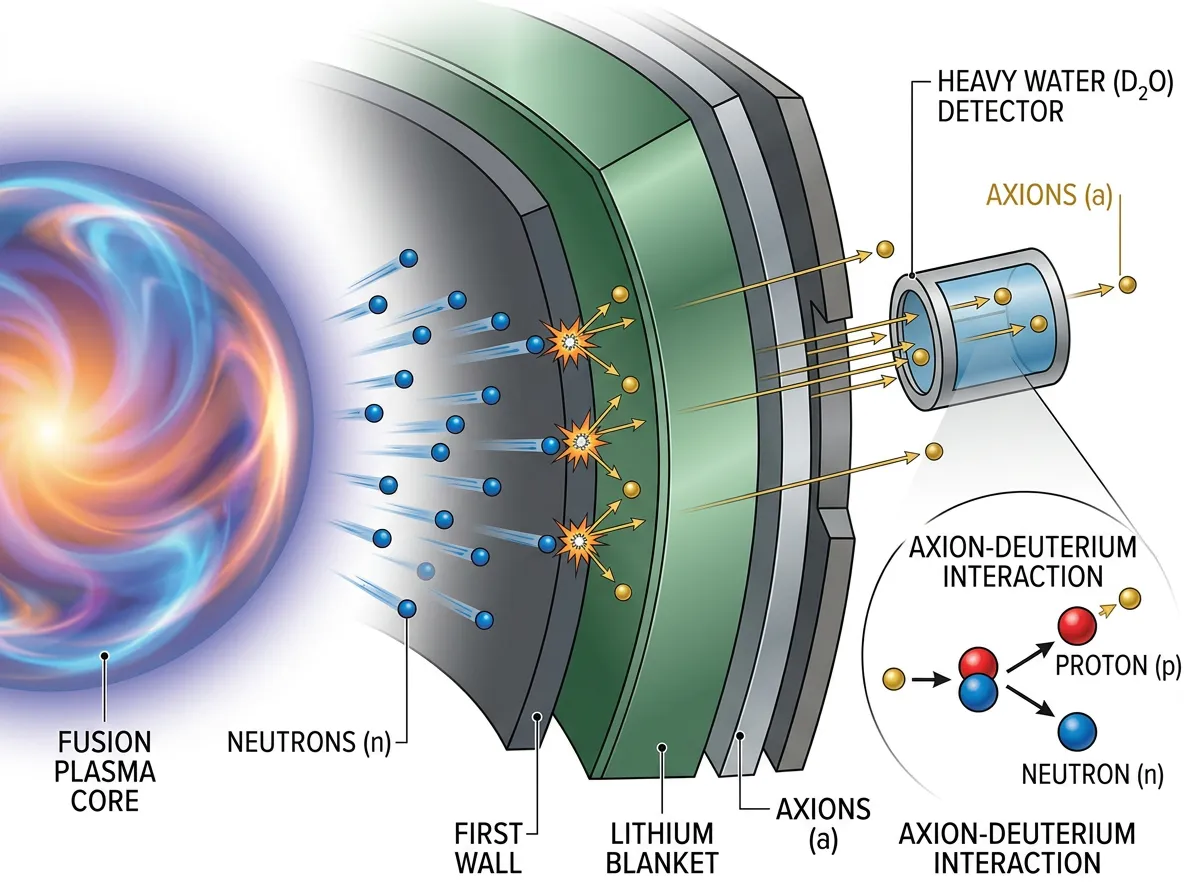
"The theoretical flux of axion-like particles may reach detectable levels outside the reactor walls," the team wrote. Because axions interact so weakly with ordinary matter, they would pass through the reactor structure largely undisturbed, much like neutrinos pass through solid rock. This weakness, which makes axions so difficult to find in traditional experiments, becomes an advantage here: the reactor itself doesn't absorb them.
A Simple Detector for a Hard Problem
The proposed detection method is strikingly straightforward compared to existing dark matter experiments. The team suggests placing a tank of heavy water (deuterium oxide, D2O) near the reactor. Heavy water contains deuterium, hydrogen with one proton and one neutron in its nucleus. When an axion-like particle interacts with a deuterium nucleus, it can split that nucleus apart, releasing a free proton and a free neutron. This reaction, called photodisintegration by analogy with gamma-ray-induced breakup, produces a distinctive signature: a coincidence detection of a proton and a neutron arriving at nearly the same time from the same location.
This signature is relatively clean. Background events that mimic it are rare, especially if the detector is properly shielded from the reactor's own neutron output. The team's calculations suggest that even a modestly sized heavy water detector, on the order of a few cubic meters, could register a statistically meaningful signal over the course of a reactor operating cycle.
The contrast with conventional dark matter searches is sharp. Underground xenon detectors cost hundreds of millions of dollars, require years of construction, and operate in custom-built underground facilities. The Greenwald limit research in fusion plasma already shows how fusion physics is yielding unexpected dividends for other fields. A heavy water tank next to a reactor that already exists for another purpose would cost a fraction of that investment. Even accounting for the shielding and calibration equipment needed, the economics are compelling.
Why Axions Fit the Dark Matter Profile
Axions are appealing dark matter candidates for several reasons beyond their origin in the strong CP problem. First, they are predicted to be extremely light, with masses potentially billions of times smaller than an electron. This lightness means they would have been produced abundantly in the early universe, filling space as a cold, slow-moving gas that clumps under gravity exactly the way dark matter observations require.
Second, axions interact with ordinary matter almost not at all, which explains why decades of experiments designed for heavier, more interactive particles missed them. Third, the mathematics constraining axion properties comes from well-tested physics. The Peccei-Quinn mechanism that predicts them is grounded in the same quantum chromodynamics that accurately describes nuclear behavior in particle accelerators. The axion is not a speculative add-on; it falls naturally out of known physics.
Several experiments are already searching for cosmic axions. ADMX (Axion Dark Matter Experiment) at the University of Washington uses a powerful magnet and a resonant microwave cavity to convert ambient axions into detectable photons. CERN's IAXO (International Axion Observatory) aims to detect axions streaming from the Sun. What Rangarajan's proposal adds is a third production channel: instead of looking for axions that already exist in nature, create them in a controlled environment where you know when, where, and how many to expect.
This controlled production is what makes the fusion reactor approach distinctive. In cosmic axion searches, you don't know the flux, the energy spectrum, or the precise coupling strength in advance. You set up a detector and hope the parameters fall within your instrument's sensitivity window. With reactor-produced axions, the production rate can be calculated from known neutron fluxes and nuclear cross-sections. If the signal doesn't appear at the predicted level, you've constrained the axion's properties. If it does appear, you've detected a dark sector particle under laboratory conditions for the first time.
An Unplanned Experiment 50 Years in the Making
There is a pleasing historical arc to this proposal. The axion was dreamed up in the late 1970s to solve a narrow problem in particle physics. Fusion reactors were first theorized in the same era, born from the realization that the process powering the Sun could be replicated on Earth. For nearly half a century, these two threads of physics developed independently. Axion theorists never thought about fusion reactors, and fusion engineers never thought about dark matter. Rangarajan's insight was recognizing that the reactor conditions ITER will produce, purely to generate energy, happen to overlap with the conditions needed to test a 50-year-old particle physics hypothesis.
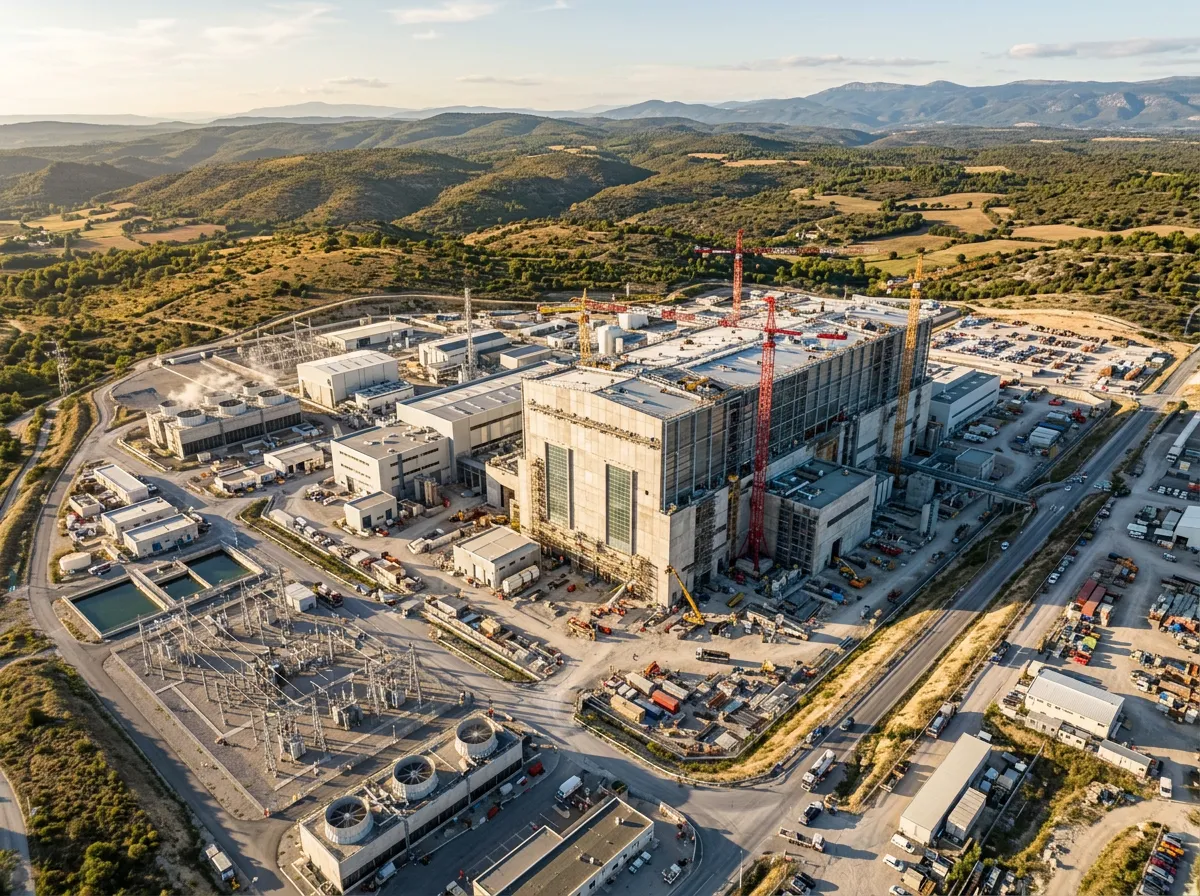
ITER aims for first plasma in the late 2020s or early 2030s, with full deuterium-tritium operations following later in the decade. The timeline means that axion detection could piggyback on a facility that governments have already committed approximately $22 billion to build. No additional reactor is needed. No new underground cavern must be excavated. The marginal cost of adding a heavy water detector to an existing facility is negligible compared to the price of any dedicated dark matter experiment.
This is not the first time a large physics facility has produced unexpected science outside its original mission. The Large Hadron Collider at CERN was built to find the Higgs boson, which it did in 2012, but its data have since constrained theories of supersymmetry, measured rare particle decays, and tested quantum chromodynamics at energies never before achieved. The discovery of early black holes by the James Webb Space Telescope came from a telescope designed primarily to study star formation. Big physics instruments tend to generate discoveries their designers never anticipated.
The key caveat is that Rangarajan's work is theoretical. No axion has been detected in any setting, and the production cross-sections used in the calculations carry significant uncertainties. The coupling constants that determine how strongly axions interact with nucleons are constrained by existing experiments but not precisely known. If the real coupling is at the weaker end of the allowed range, the signal in a heavy water detector could be too faint to distinguish from background noise even with years of data collection.
What This Means
The proposal to detect dark matter particles inside a fusion reactor reframes a question that has consumed billions of dollars and decades of experimental effort. Instead of building ever-larger, ever-more-sensitive detectors in purpose-built underground facilities, physicists could get their answer from a machine that already exists for a completely different purpose.
The approach carries real uncertainties. Axions may not exist. Their coupling to nuclear matter may be weaker than current bounds allow for detection at ITER. The reactor itself may produce backgrounds that obscure the signal. But the cost of testing the idea is so low relative to existing dark matter programs that the risk-reward calculus is hard to argue with.
What is genuinely new here is the collision of two fields that had no reason to talk to each other. Fusion physics and particle physics inhabit different departments, attend different conferences, and compete for different funding streams. Rangarajan's contribution was seeing across that divide and recognizing that a device engineered to produce clean energy also produces, as a side effect, the exact conditions for probing one of the universe's oldest and most stubborn mysteries. Whether ITER ultimately detects axions or rules them out at certain coupling strengths, the attempt itself signals a shift in how physicists think about the dark sector of the universe. Sometimes the most productive experiments are the ones nobody planned.
Sources
- Rangarajan, R. et al., "Axion-like particle production in fusion reactors," Journal of High Energy Physics, 2026
- Peccei, R. D. and Quinn, H. R., "CP Conservation in the Presence of Pseudoparticles," Physical Review Letters, Vol. 38, 1977
- Wilczek, F., "Problem of Strong P and T Invariance in the Presence of Instantons," Physical Review Letters, Vol. 40, 1978
- ITER Organization, "What Is ITER?" iter.org, accessed February 2026