
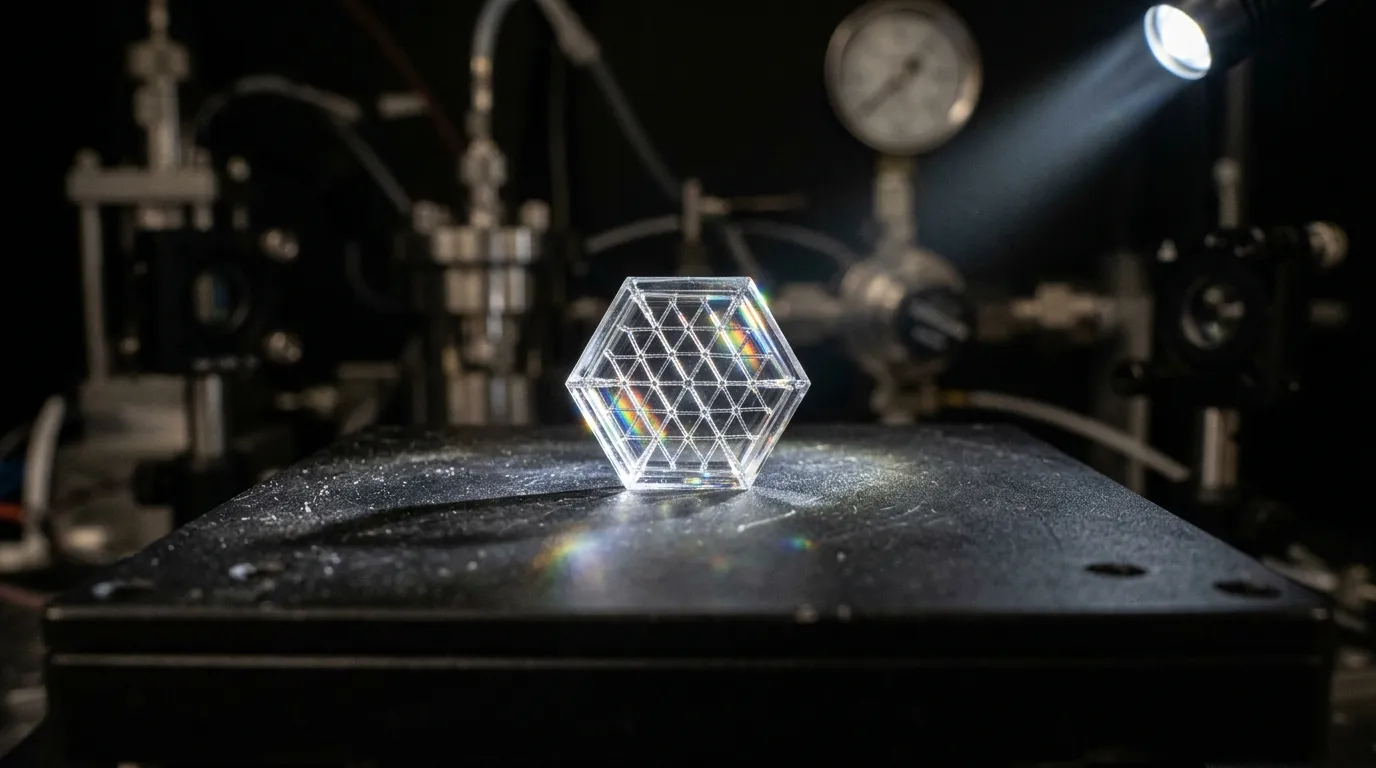
Diamond has held the title of hardest natural material for as long as humans have known what hardness means. It is the reference point, the standard everything else gets compared to. So when a team of Chinese researchers announced in Nature this month that they had created a material harder than diamond, the obvious question was: harder than diamond made of what, exactly?
The answer is carbon. The same element, in a different arrangement. The material is called lonsdaleite, or hexagonal diamond, and it has been the white whale of materials science for more than half a century. Theorists predicted in the 1960s that if you could arrange carbon atoms in a hexagonal lattice instead of the cubic lattice found in regular diamond, the resulting material would be significantly harder. The problem was that nobody could actually make the stuff in large enough quantities to test. Every attempt produced fragments too small or too impure to measure reliably.
That changed with a paper published in *Nature* on March 4, 2026. A team led by researchers at Yanshan University in China synthesized a pure, millimeter-sized piece of hexagonal diamond using extreme pressure (20 gigapascals) and temperatures between 1,300 and 1,900 degrees Celsius. They then measured its hardness at 114 gigapascals, slightly above the roughly 110 GPa typically recorded for natural cubic diamond. After fifty years of ambiguity, the verdict is in: hexagonal diamond is real, it is harder than regular diamond, and it can be made in a laboratory.
A Crystal Born from Cosmic Violence
The story of lonsdaleite begins not in a lab but in a crater. In 1891, a massive iron meteorite slammed into the Arizona desert, leaving behind a hole nearly a mile wide and 570 feet deep. Scientists named it the Canyon Diablo meteorite, and over the following decades, they discovered that fragments from the impact contained microscopic crystals of an unusual carbon material.
In 1967, researchers identified these crystals as a new allotrope of carbon, a form in which the atoms are arranged differently from both graphite and diamond. They named it lonsdaleite, after Dame Kathleen Lonsdale, the Irish-born crystallographer who pioneered X-ray diffraction techniques and, in 1929, became the first person to prove the structure of benzene. Lonsdale was also the first woman elected as a Fellow of the Royal Society, and naming a material harder than diamond after her carries a fitting symbolism.
The formation mechanism was violent and elegant. When the meteorite struck, the immense heat and pressure of the impact transformed graphite, a soft mineral where carbon atoms are arranged in loose, flat sheets, into diamond. But instead of rearranging into diamond's standard cubic lattice, the carbon atoms locked into a hexagonal pattern, preserving a structural echo of the graphite they came from. The resulting crystals were vanishingly small, mixed in with ordinary diamond, and for decades existed only as a scientific curiosity that hinted at something harder waiting to be made.

Cubic vs. Hexagonal: Why Shape Matters for Hardness
To understand why hexagonal diamond is harder than the regular kind, you need to know what hardness actually measures. At the atomic level, hardness is a material's resistance to permanent deformation when force is applied. It depends on how tightly the atoms are bonded and how those bonds are arranged in three-dimensional space.
In cubic diamond, every carbon atom forms four bonds with its neighbors in a tetrahedral pattern, the same geometry in every direction. This is why diamond is so uniformly hard: there are no weak planes, no directions where the structure gives way more easily than others. It is an extraordinarily rigid arrangement, and for most of the history of materials science, it was considered the theoretical maximum for hardness in a naturally occurring material.
Hexagonal diamond changes the geometry. The atoms still form four bonds each, but the layers stack differently. Instead of the ABCABC repeating pattern of cubic diamond, where each layer is offset from the ones above and below it, hexagonal diamond uses an ABAB pattern, where alternating layers sit directly above one another. This subtle difference creates shorter and stronger bonds between certain layers, a structural feature that theoretical physicists predicted would make the material harder, particularly along the axis perpendicular to those layers.
The theoretical predictions were bold. Some calculations suggested hexagonal diamond could be more than 50% harder than cubic diamond. The actual measurement, 114 GPa versus roughly 110 GPa for natural diamond, shows the real-world advantage is smaller than the models predicted but still meaningful. The discrepancy likely comes from the fact that theoretical models assume perfect crystal structure, while real materials always contain tiny imperfections that reduce measured hardness. As synthesis techniques improve and larger, more perfect crystals become available, the measured gap between hexagonal and cubic diamond may widen.
How They Finally Made It
The challenge with hexagonal diamond has always been synthesis. Nature makes the stuff in meteorite impacts, where conditions are extreme and transient: pressures in the hundreds of gigapascals, temperatures in the thousands of degrees, all lasting for fractions of a second. Those conditions are nearly impossible to replicate in a laboratory, and previous attempts to create lonsdaleite produced results that were controversial at best.
Several research groups over the decades claimed to have synthesized hexagonal diamond, but their samples were typically nanocrystalline, meaning they consisted of tiny grains rather than a single continuous crystal. At that scale, it is difficult to confirm whether you have actually made hexagonal diamond or just created a disordered mess of carbon that happens to produce similar X-ray diffraction patterns. A 2014 study published in Physical Review Letters went so far as to argue that lonsdaleite might not exist at all as a distinct phase, suggesting that previous "hexagonal diamond" samples were simply faulted cubic diamond: ordinary diamond riddled with structural defects that mimicked hexagonal signatures.
The Yanshan University team took a different approach. Instead of starting with random graphite powder, they used highly oriented graphite, a form in which the graphite layers are already aligned in a consistent direction. They then subjected this material to 20 GPa of pressure, about 200,000 times atmospheric pressure, and temperatures between 1,300 and 1,900 degrees Celsius in a multi-anvil press. The alignment of the starting material appears to have been the key innovation. Because the graphite layers were already oriented, the transformation to diamond preserved the hexagonal stacking sequence rather than randomizing into the cubic form.
The result was a pure, millimeter-sized crystal, large enough to analyze with standard characterization techniques. X-ray diffraction confirmed the hexagonal lattice. Electron microscopy showed a clean, single-phase structure without the cubic diamond contamination that plagued earlier samples. And Vickers hardness testing measured 114 plus or minus 6.4 GPa along the axial direction and 106 plus or minus 5.7 GPa along the radial direction, confirming that hexagonal diamond is measurably harder than natural cubic diamond.

Fifty Years of Near-Misses
The history of attempts to make hexagonal diamond reads like a scientific detective story with an unreliable narrator. In 1967, the same year lonsdaleite was identified in the Canyon Diablo meteorite, researchers reported synthesizing it in the lab by compressing graphite using both static presses and explosive shockwaves. But the samples were fragmentary, mixed with cubic diamond, and too small for definitive characterization.
Throughout the 1970s and 1980s, various groups reported hexagonal diamond synthesis using different techniques: shock compression, chemical vapor deposition, and laser ablation. Each time, the results were ambiguous. The crystals were nanometer-scale, the X-ray signatures were noisy, and other researchers struggled to reproduce the results. A pattern emerged: every few years, a new paper would claim success, and within a year or two, the claim would be challenged by skeptics who could not replicate the findings.
The most damaging blow came in that 2014 Physical Review Letters study, which used advanced electron diffraction to argue that supposed hexagonal diamond samples were actually faulted cubic diamond. The paper suggested that the distinct hexagonal diffraction peaks could be explained by specific stacking faults in cubic diamond, essentially arguing that what everyone thought was a new material was just old material with defects. The debate split the materials science community. Some researchers continued to pursue hexagonal diamond synthesis, while others concluded the whole concept was a measurement artifact and moved on.
The 2026 Nature paper settles the argument decisively. By producing a millimeter-scale, single-phase crystal with unambiguous X-ray diffraction and direct hardness measurements, the Yanshan team provided the evidence that fifty years of smaller, noisier experiments could not. "This is the definitive proof," said Paul McMillan, a professor of chemistry at University College London who was not involved in the study, in comments to *Nature* News. "The debate about whether hexagonal diamond exists as a distinct phase is over."
What a Harder Diamond Actually Means
The practical applications of a material slightly harder than diamond might seem obvious: better drill bits, sharper cutting tools, more durable industrial abrasives. Diamond is already used extensively in these applications, and a material that edges it out on the hardness scale would be a straightforward upgrade. But the significance of hexagonal diamond extends well beyond incremental improvements in industrial tooling.
The most interesting applications lie in areas where diamond's properties are almost but not quite sufficient. In high-pressure physics experiments, diamond anvil cells are used to study materials under extreme conditions, compressing samples between two gem-quality diamonds to pressures exceeding 300 GPa. At those extremes, even diamond deforms. A material that is measurably harder could extend the pressure range of these experiments, opening windows into the behavior of matter under conditions found in planetary cores and neutron star crusts.
There are also implications for electronics. Diamond is an excellent semiconductor material, with a wide bandgap, high thermal conductivity, and exceptional electron mobility. But growing large, defect-free diamond crystals for electronics is expensive and technically challenging. Hexagonal diamond, with its different crystal symmetry, may have electronic properties that differ in useful ways. Some theoretical work suggests it could have a wider bandgap than cubic diamond, which would make it valuable for high-power, high-frequency electronic devices, the kind of components that 5G base stations and electric vehicle inverters demand in growing quantities.
Perhaps the most speculative but intriguing possibility is in quantum computing. Diamond containing nitrogen-vacancy defects is already one of the leading platforms for room-temperature quantum bits. The hexagonal crystal structure would create a different defect landscape, potentially hosting new types of quantum states with longer coherence times. This is years away from any practical application, but it illustrates how a seemingly small change in crystal geometry can open entirely new research directions.

The Deeper Question
The lonsdaleite breakthrough is satisfying as a resolution to a fifty-year scientific argument, but it also raises a question that goes beyond materials science: what else have we been too hasty to dismiss?
The 2014 paper that nearly killed interest in hexagonal diamond was not poorly done. It used sophisticated techniques and made a legitimate scientific argument. The problem was that the evidence available at the time, nanocrystalline samples with ambiguous diffraction patterns, was genuinely insufficient to settle the question. Scientists drew the most conservative conclusion from the data they had, and for a decade, that conclusion suppressed research in a promising direction.
This pattern repeats across science. Quasicrystals, materials with ordered structures that don't repeat periodically, were dismissed as "twinned crystals" for years after Dan Shechtman first observed them in 1982. Shechtman's own lab director reportedly told him to "go read the textbook" and asked him to leave the research group. Shechtman won the Nobel Prize in Chemistry in 2011. The parallels to hexagonal diamond are worth noting, particularly given how novel material states are often initially dismissed as measurement errors before better experiments vindicate the original observation.
Carbon, the element at the center of this story, continues to surprise us. Graphene, a single layer of carbon atoms arranged in a honeycomb lattice, was thought to be thermodynamically unstable until Andre Geim and Konstantin Novoselov isolated it in 2004 using adhesive tape. Carbon nanotubes were predicted decades before they were reliably synthesized. And now hexagonal diamond, predicted in the 1960s, debated for fifty years, and nearly written off entirely, turns out to be exactly what the theorists said it would be: real, distinct, and harder than the hardest natural material we knew.
The takeaway is less dramatic than "science was wrong" and more interesting: nature is patient, and the right experiment, at the right scale, with the right starting material, sometimes takes half a century to arrive. The team at Yanshan University didn't have better computers or fancier equipment than their predecessors. They had better graphite, aligned in the right direction, and the persistence to keep working on a problem that much of the field had abandoned. Sometimes that is all it takes to find something at the very edge of what we thought possible.
Sources
- Fresh claim of making elusive 'hexagonal' diamond is the strongest yet - Nature News, March 2026
- In physics first, Chinese scientists create rare 'hexagonal diamond' that's harder than natural diamond - Live Science, March 2026
- Scientists create a hexagonal diamond that could be even harder than the real thing - Phys.org, March 2026
- Sixty Years After Its Discovery in a Meteorite, Scientists Make Hexagonal Diamond in Bulk - SciChi / Science Blog, March 2026
- Diamonds Are Even More Forever as Scientists Create Special Harder Variety - Newsweek, March 2026