
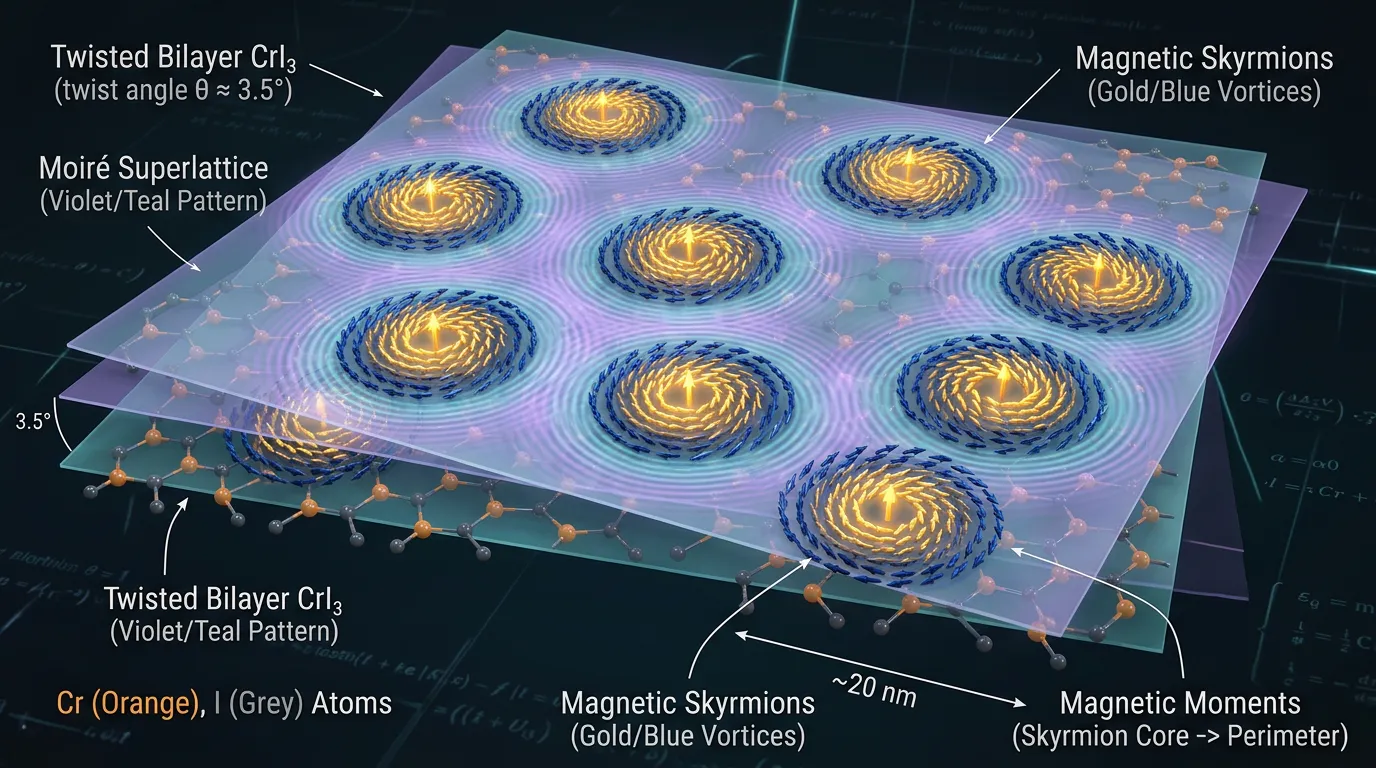
The entire future of data storage might hinge on rotating a crystal by a fraction of a degree. That sounds absurd, but a team at the University of Stuttgart has just demonstrated it. By taking four atomic layers of chromium iodide and twisting two stacked bilayers relative to each other, the researchers produced a magnetic state that has never been observed before: one that hosts skyrmions, nanoscale magnetic vortices so stable and so small that they could one day store information at densities that make current hard drives look primitive. A single skyrmion is smaller than a virus. It is topologically protected, meaning that the laws of mathematics prevent it from being easily erased. And until this experiment, nobody had generated or directly observed one in a twisted two-dimensional magnetic material.
The findings, published in Nature Nanotechnology, connect two of the most active frontiers in condensed matter physics: the study of magnetic skyrmions as next-generation information carriers and the field of moiré engineering, where stacking and twisting atom-thin sheets produces emergent properties that neither layer possesses alone. The result is a proof of concept that bridges these two worlds and opens a path toward magnetic storage technologies that operate at scales conventional approaches cannot reach.
What Skyrmions Are and Why They Matter
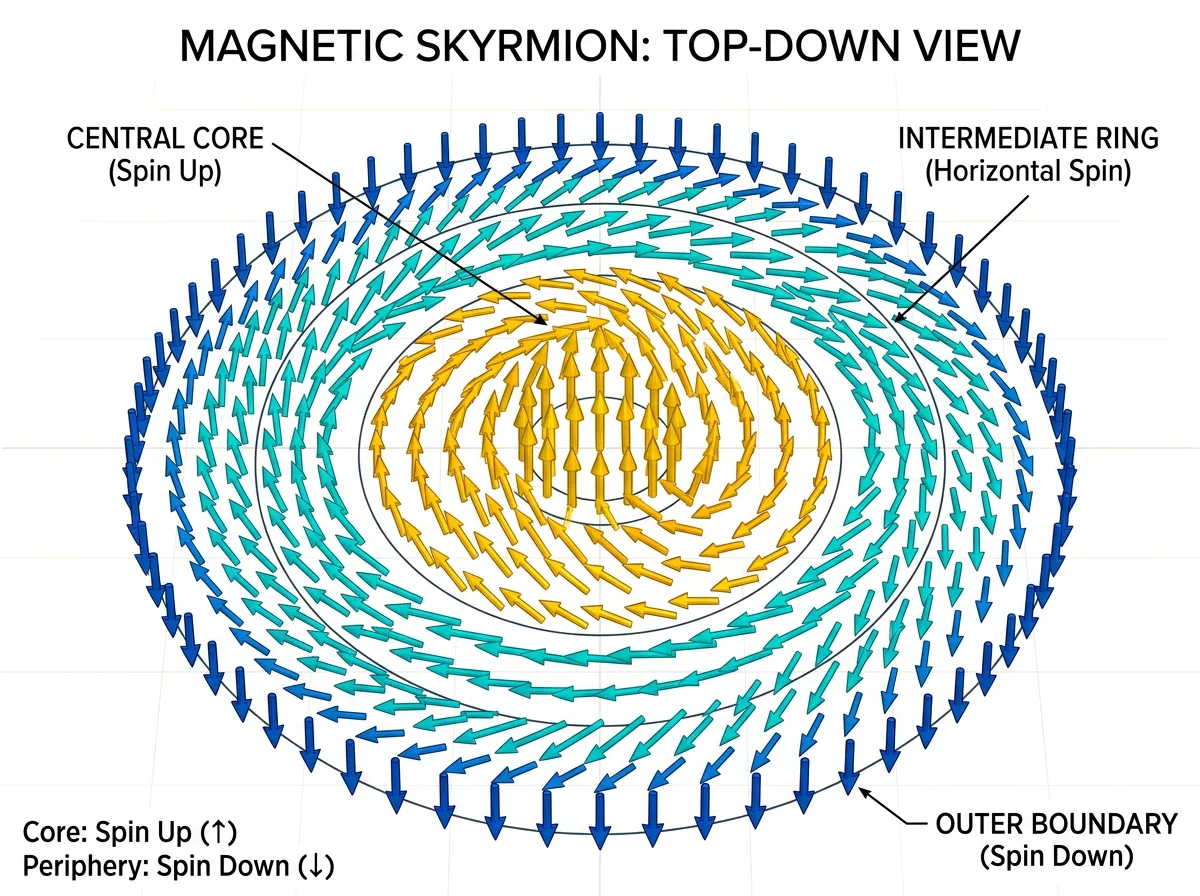
A skyrmion is a magnetic structure with a particular topological property. In an ordinary magnet, the magnetic moments (think of them as tiny compass needles at each atom) all point in roughly the same direction. In a skyrmion, those moments wrap into a swirling vortex pattern, spiraling smoothly from pointing up at the center to pointing down at the perimeter. The key feature is that this arrangement is topologically protected. In the same way that you cannot smoothly deform a coffee mug into a sphere without tearing it (the mug's handle changes the topology), you cannot smoothly unwind a skyrmion back into a uniform magnetic state without overcoming a significant energy barrier. This makes skyrmions exceptionally stable against thermal fluctuations and other environmental disturbances.
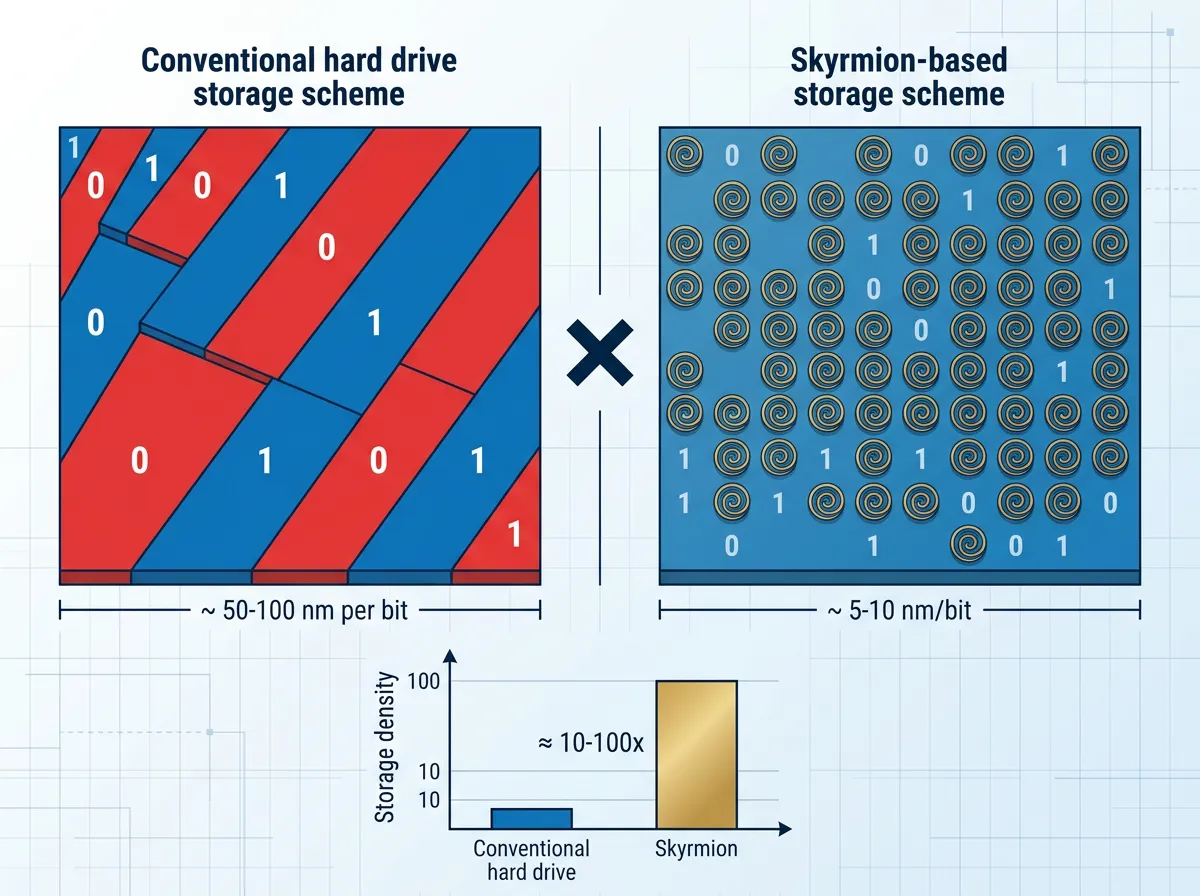
That stability has made skyrmions attractive as potential carriers of digital information. A conventional hard drive stores data using magnetic domains, regions where all the magnetic moments point in one direction or the other. These domains are currently about 50 to 100 nanometers across, and shrinking them further runs into fundamental physical limits where thermal energy starts flipping the magnetization randomly. Skyrmions sidestep this problem. Because their stability comes from topology rather than from the size of the magnetic region, they can be far smaller than conventional domains while remaining robust. Proposals for skyrmion-based memory devices suggest storage densities orders of magnitude greater than anything achievable with today's technology.
The challenge has always been creating and controlling skyrmions reliably, especially in materials thin enough to integrate into practical devices. Most skyrmion research has focused on bulk materials or thick films, where the structures were first discovered. Moving to two-dimensional materials, the atom-thin sheets that have transformed electronics research since the isolation of graphene in 2004, has been an obvious goal but a difficult one.
The Moiré Engineering Revolution
The technique the Stuttgart team used belongs to a broader research program called moiré engineering, and understanding it requires a brief detour into one of the most surprising discoveries in recent physics.
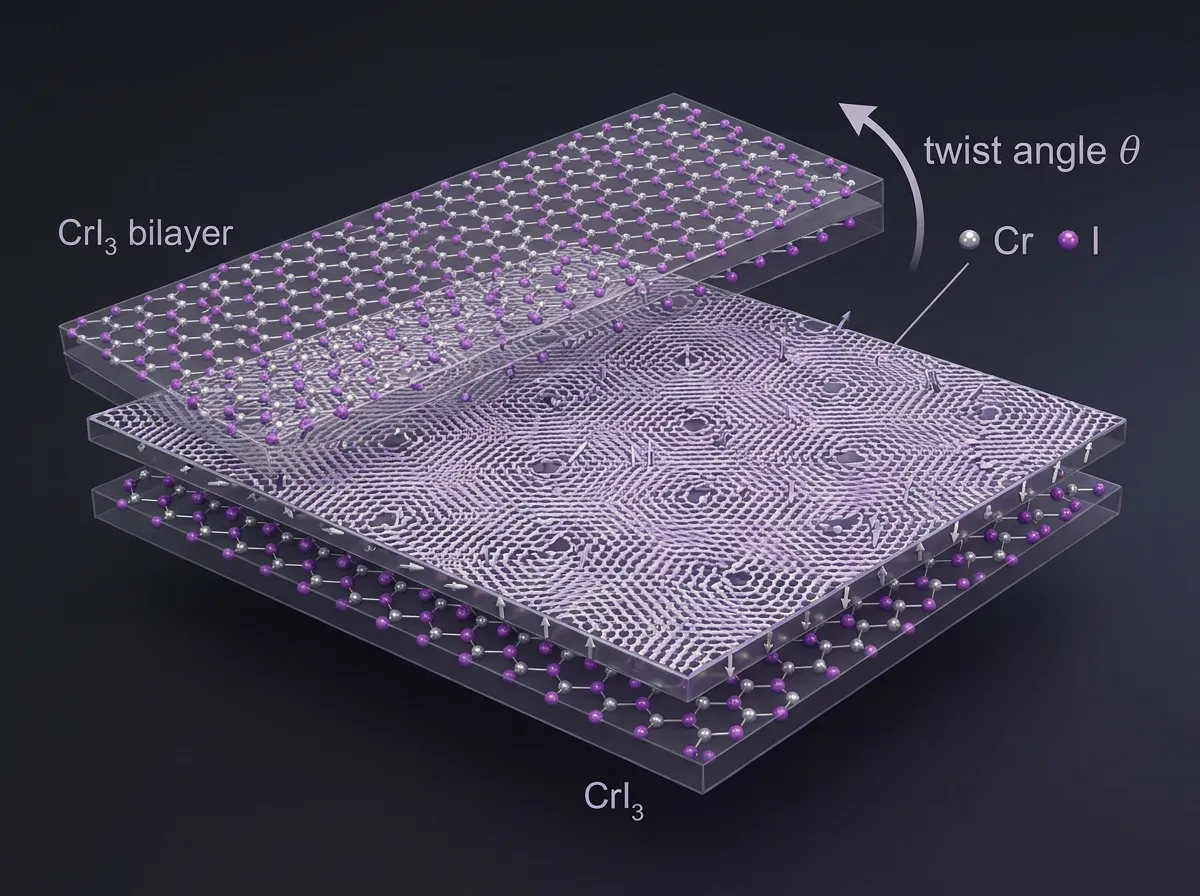
In 2018, physicist Pablo Jarillo-Herrero and his team at MIT showed that rotating two layers of graphene by exactly 1.1 degrees relative to each other (the "magic angle") transformed the material from a normal conductor into a superconductor. The physics community was stunned. Graphene by itself does not superconduct. Neither does a stack of two aligned graphene sheets. But twist them by just the right amount, and a completely new electronic state emerges. The phenomenon arises from the moiré pattern, the large-scale interference pattern created when two periodic structures overlap at a slight angle. You can see moiré patterns in everyday life when two window screens overlap, creating those wavy visual patterns. At the atomic scale, the moiré pattern creates a superlattice, a new periodic structure much larger than the original atomic lattice, that fundamentally alters how electrons behave.
Since that 2018 discovery, researchers have applied the twist technique to dozens of different layered materials, finding new electronic, optical, and magnetic properties in each case. The field has grown so rapidly that it now has its own name, "twistronics," and its own set of conferences. But most of the work has focused on electronic properties, things like superconductivity, correlated insulating states, and novel quantum phases. The Stuttgart experiment extends the approach to magnetism in a direct and dramatic way, producing not just a modified magnetic state but an entirely new one that hosts topological structures.
What the Stuttgart Team Did
The researchers started with chromium iodide (CrI3), one of only a handful of materials that remain magnetic even when thinned to a few atomic layers. CrI3 has been studied extensively since 2017, when it was first shown to maintain magnetic order at the two-dimensional limit. In its natural state, bilayer CrI3 is an antiferromagnet: the magnetic moments in adjacent layers point in opposite directions, canceling each other out.
The Stuttgart group took two bilayers of CrI3 and stacked them on top of each other with a slight rotational offset. This twist created a moiré superlattice in the magnetic material, and within that superlattice, the competition between different magnetic interactions produced a configuration that does not exist in the untwisted material. The resulting state is neither a simple ferromagnet (all moments aligned) nor a simple antiferromagnet (moments alternating). Instead, it is a new magnetic phase whose internal structure is complex enough to host skyrmions.
The team then confirmed the presence of skyrmions directly, not through indirect electrical measurements or theoretical inference, but through real-space imaging. This is where the experiment becomes technically remarkable. The magnetic signals from four atomic layers of material are extraordinarily faint. Conventional magnetic imaging tools, which work well for bulk materials, do not have the sensitivity to detect them. The researchers turned to a scanning probe microscope built around a nitrogen-vacancy (NV) center, a single atomic defect in diamond that acts as a quantum sensor for magnetic fields. By scanning this sensor across the surface of their twisted CrI3 sample, they mapped the magnetic texture at the nanoscale and identified individual skyrmions within the moiré superlattice.
Why the Measurement Was So Hard
It is worth pausing on the detection method because it illustrates both the difficulty of working with 2D magnetic materials and the ingenuity required to study them.
A nitrogen-vacancy center is a point defect in a diamond crystal where a nitrogen atom replaces one carbon atom next to a missing carbon atom (a vacancy). This defect traps electrons in a quantum state that is exquisitely sensitive to nearby magnetic fields. When you bring an NV center close to a magnetic surface, the local field shifts the energy levels of the trapped electrons, and you can measure that shift optically by shining a laser on the defect and monitoring the fluorescence it emits. The technique, called NV center scanning probe microscopy, can detect magnetic fields from individual atomic layers, something that no other imaging method currently achieves with comparable spatial resolution.
The Stuttgart group mounted a single NV center on the tip of a scanning probe and rastered it across their twisted CrI3 sample at a height of only tens of nanometers. The resulting magnetic field maps revealed the skyrmion textures within the moiré superlattice. This is the first time anyone has directly imaged skyrmions in a twisted 2D magnet, and the achievement depended equally on the materials science (fabricating the twisted structure) and on the quantum sensing technology used to observe it. Without NV center microscopy, the skyrmions would have been invisible, and the discovery might not have been made. This connection between quantum-scale sensing techniques and materials discovery is becoming increasingly important as researchers push further into the atomic-scale regime.
The Moiré Magnetism Toolkit
The broader significance of the Stuttgart result is that it adds magnetism to the moiré engineering toolkit in a concrete, experimentally verified way. Before this work, moiré physics had produced remarkable results in electronic and optical properties, but its application to magnetism was largely theoretical. Researchers had predicted that twisting magnetic layers should produce new magnetic phases, but experimental confirmation had been elusive because the signals are so weak and the materials so difficult to fabricate.
Now that the technique has been demonstrated, the design space is large. CrI3 is just one member of a family of layered magnetic materials that includes chromium tribromide (CrBr3), iron triselenide (Fe3GeTe2), and several others. Each has different magnetic properties, different preferred spin orientations, and different response to twist angles. By varying the material, the twist angle, the number of layers, and external parameters like temperature and applied magnetic field, researchers can potentially tune the type, size, and density of the skyrmions that form. This tunability is exactly what would be needed for practical device applications, where you want precise control over the magnetic structures that encode information.
The robustness of the observed magnetic properties also matters. The Stuttgart team reported that the skyrmion-hosting state was stable against environmental perturbations, meaning that moderate changes in temperature and external conditions did not destroy the skyrmions. For any data storage application, stability against thermal noise is a basic requirement. The fact that these skyrmions are topologically protected and experimentally robust is an encouraging sign for future device development, though the gap between a laboratory demonstration and a working storage technology remains substantial.
Original Analysis: What Twist Angle Magnetism Means for the Information Storage Problem
The most interesting implication of this work sits at the intersection of two trends that have been developing independently. On one side, the data storage industry is running into physical limits. The superparamagnetic limit, where thermal fluctuations begin to randomize the magnetization of individual storage bits, constrains how small conventional magnetic domains can be. Current hard drive technology addresses this through techniques like heat-assisted magnetic recording (HAMR) and shingled magnetic recording (SMR), but these are incremental solutions that buy years, not decades. The industry needs a fundamentally different approach to magnetic storage if density is to keep improving at anything like the historical rate.
On the other side, moiré engineering has been producing new physical states at a remarkable pace since 2018, but the connection between these exotic laboratory phenomena and practical technology has remained tenuous. Twisted bilayer graphene's superconductivity, for instance, occurs at temperatures below 1.7 Kelvin, far too cold for any conceivable consumer device. The perception in much of the physics community has been that moiré physics produces fascinating science but not yet useful technology.
The Stuttgart skyrmion result sits in a different position than most moiré discoveries. Skyrmions are already recognized as candidates for information storage, and the materials science community has been working on skyrmion-based devices for over a decade. What has been missing is a way to create and control skyrmions in materials thin enough and tunable enough for integration into modern fabrication processes. Two-dimensional materials are inherently compatible with the thin-film deposition and lithographic patterning techniques that the semiconductor industry uses. A skyrmion-based storage element built from twisted 2D magnets would, in principle, fit into existing manufacturing workflows in a way that bulk skyrmion materials cannot. The twist angle itself becomes a design parameter, a knob that engineers can turn to control the properties of the storage medium at the point of fabrication.
This does not mean that skyrmion hard drives are imminent. The gap between imaging a few skyrmions in a cryogenic microscope and manufacturing terabytes of reliable storage is enormous. The materials need to work at room temperature. The skyrmions need to be written and read electrically, not with a diamond-tipped quantum sensor. And the fabrication of precisely twisted 2D heterostructures needs to scale from hand-assembled laboratory samples to wafer-scale manufacturing. Each of these problems is solvable in principle, but each requires years of engineering development. What the Stuttgart result does is establish the starting point: the physics works. Skyrmions form in twisted 2D magnets, they are stable, and they can be observed. The engineering can now begin with confidence that there is something real to engineer toward.
This follows a pattern visible in other areas where advanced computing concepts meet materials science: a laboratory proof of concept establishes feasibility, and then a separate, longer effort translates that feasibility into technology. The question for the field is whether the moiré magnetism approach offers enough advantages over competing skyrmion platforms (bulk materials, thin film multilayers, synthetic antiferromagnets) to justify the investment in scaling up twisted 2D fabrication.
Where This Leads
The Stuttgart team's achievement opens several concrete research directions. The most immediate is surveying other layered magnetic materials using the same twist technique to determine which combinations of material and twist angle produce skyrmions with the most favorable properties for storage applications: room-temperature stability, small size, and electrical readability. Beyond CrI3, materials like CrBr3 and Fe3GeTe2 are obvious candidates, and the recently developed autonomous exploration techniques in materials science could accelerate the search through this large parameter space.
A second direction is improving the fabrication precision. The moiré pattern, and therefore the magnetic properties, depend sensitively on the twist angle. Small deviations produce different states. This sensitivity is both a feature (it means fine control is possible) and a challenge (it means manufacturing tolerances are tight). Developing reliable methods for controlling twist angles to within fractions of a degree across large areas is a prerequisite for any technology based on these materials.
The quantum sensing technique used to image the skyrmions will also continue to develop. NV center microscopy is still a relatively young technology, and improvements in sensitivity and scanning speed will make it easier to study the magnetic properties of twisted 2D materials in detail. As the imaging improves, researchers will be able to track how skyrmions form, move, and interact under different conditions, building the understanding needed to design functional devices.
What the Stuttgart experiment has added to the field is a demonstrated connection between two of the most active research areas in condensed matter physics. Moiré engineering now has a confirmed magnetic dimension, and skyrmion physics now has a 2D materials platform. Whether this specific combination leads to commercial technology or serves primarily as a stepping stone toward something better, the scientific advance is clear: twist a few atomic layers by the right amount, and entirely new magnetic structures appear. The physics of two-dimensional materials continues to surprise.
Sources
- Blower, M. et al., "Magnetic skyrmions in twisted CrI3 bilayers," Nature Nanotechnology (2025). DOI: 10.1038/s41565-025-02103-y
- University of Stuttgart, press release on the discovery of skyrmions in twisted 2D magnetic materials, February 2025
- Jarillo-Herrero, P. et al., "Unconventional superconductivity in magic-angle graphene superlattices," Nature 556, 43-50 (2018), the original magic-angle twisted bilayer graphene paper
- Fert, A., Reyren, N. & Cros, V., "Magnetic skyrmions: advances in physics and potential applications," Nature Reviews Materials 2, 17031 (2017), a comprehensive review of skyrmion physics and proposed applications