
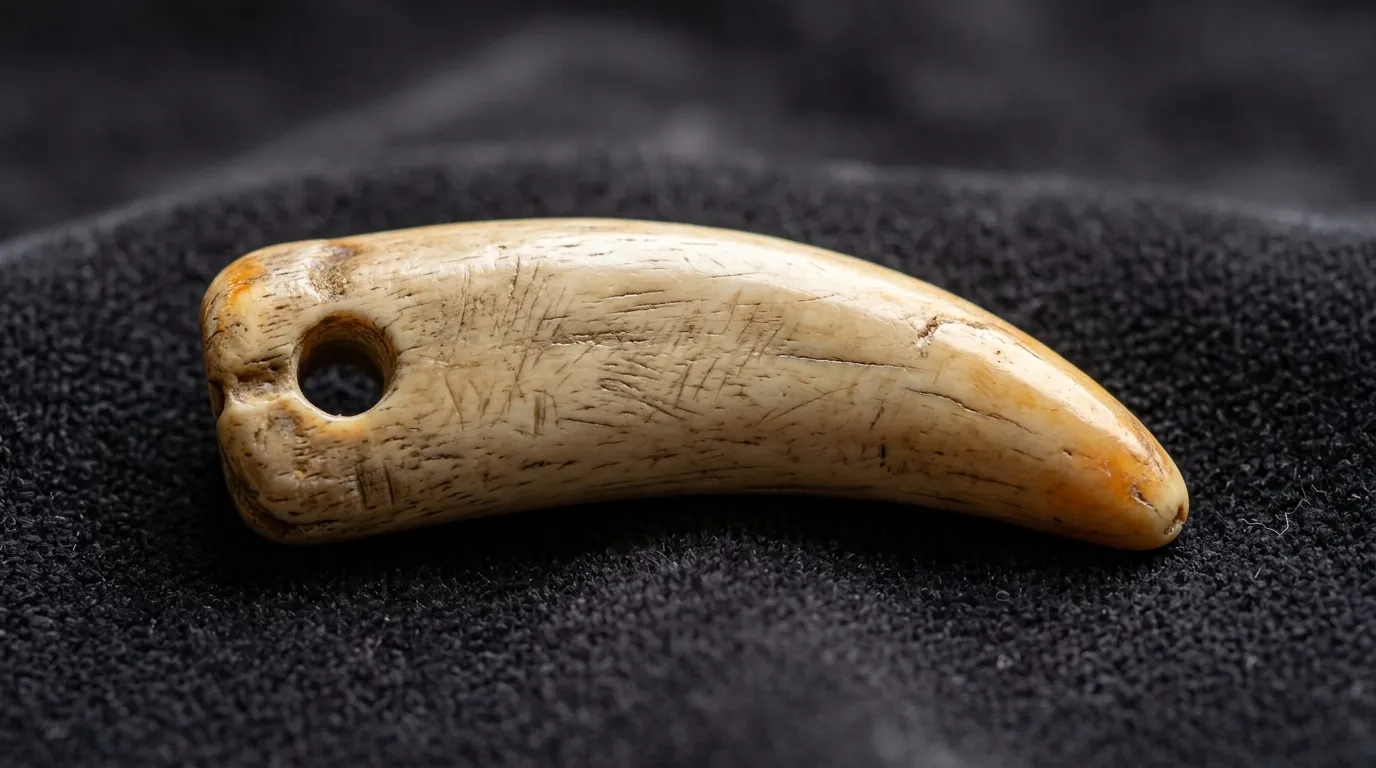
In 1867, a Victorian gentleman-archaeologist named William Pengelly was methodically digging through the sediment of a limestone cave in Devon, England, when he pulled from the dirt a small, worn tooth with a neatly drilled hole through its root. He bagged it, labeled it, and moved on. The tooth was identified, cautiously and without much excitement, as probably belonging to a badger or a wolf. It went into a drawer at the Natural History Museum in London and stayed there, essentially unexamined, for 158 years.
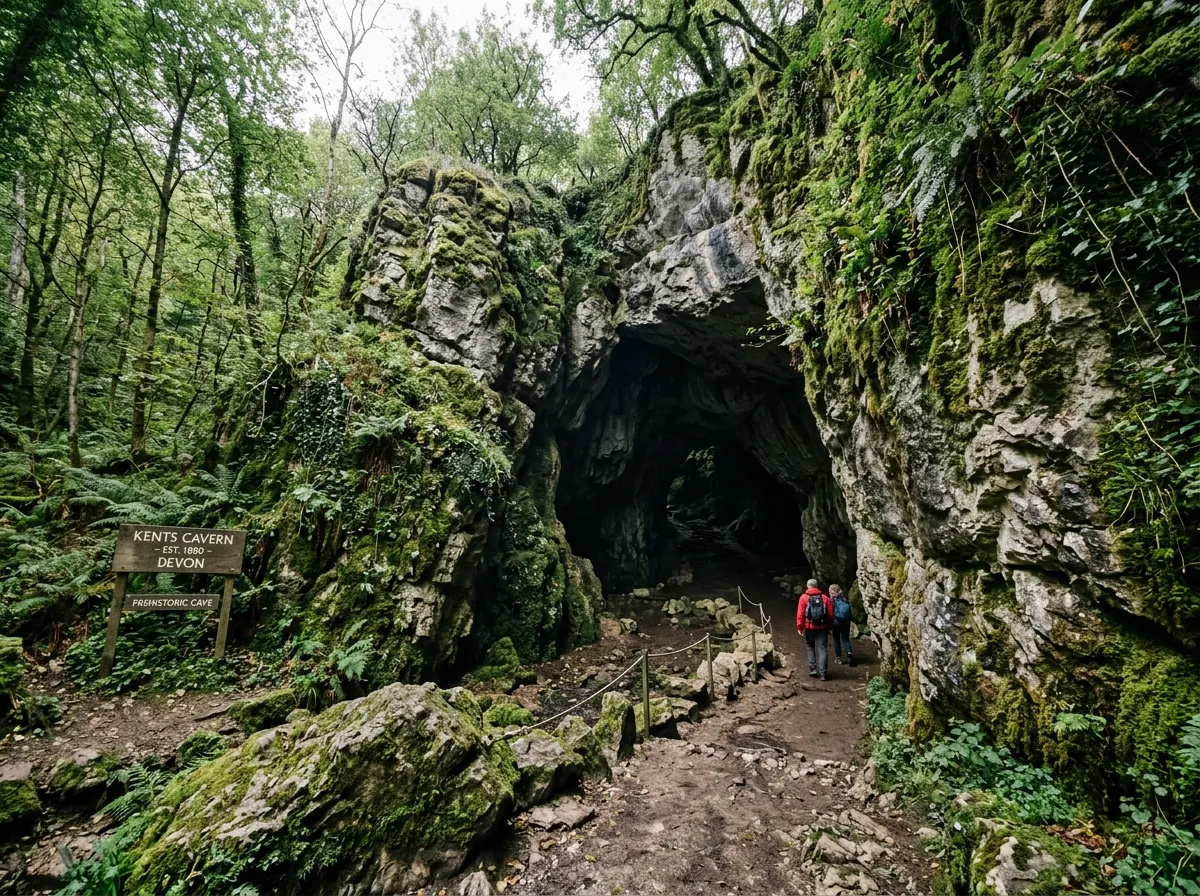
Last week, a team led by researchers from UCL and the Natural History Museum published a paper in Quaternary Science Reviews showing that Pengelly's tooth is not from a badger or a wolf. It is the canine of a male grey seal, about 12 years old at the time of its death, killed somewhere on the Atlantic coast roughly 15,000 years ago. The tooth was then carefully worked into a pendant, suspended from a cord, and carried at least 100 kilometers inland to Kents Cavern, the cave on the English Riviera where Pengelly later found it.
The identification sounds small. It is not. The pendant is the first of its kind ever found in Britain, only the fourth from anywhere in Ice Age Europe, and direct physical evidence that humans in post-glacial Britain were either traveling long distances on foot across a landscape most archaeologists had treated as sparsely populated, or exchanging objects through networks we did not previously know existed.
What Pengelly Actually Found
Kents Cavern, which sits inside the modern town of Torquay, is one of the most important archaeological sites in Britain. Pengelly, a self-taught geologist, excavated it systematically between 1865 and 1880, developing in the process some of the earliest rigorous stratigraphic methods in the field. His excavations produced tens of thousands of artifacts, most of them stone tools from the Middle and Upper Palaeolithic, along with bones of cave lions, woolly rhinos, and reindeer.
The seal tooth came out of a layer dated to the Late Upper Palaeolithic, roughly 15,000 years ago, a period known in continental Europe as the Magdalenian. Pengelly's age estimates were rough by modern standards, and he did not have the comparative anatomy knowledge to identify marine mammal teeth. Grey seals are not large animals, and their canines are a similar size and shape to those of several terrestrial carnivores. The misidentification was reasonable for 1867.
What it was not was checked. The tooth sat in storage, accession number 34218, as British prehistoric archaeology moved on to more spectacular finds elsewhere and then to radiocarbon dating, isotope analysis, and the suite of scientific methods that would eventually make possible the kind of reanalysis the current team has performed.
How the Identification Was Made
The new analysis used a combination of techniques. Rob Dinnis, the UCL archaeologist who led the study, first noticed that the tooth's morphology did not match any terrestrial British carnivore. He consulted marine mammal specialists and ran comparative measurements, and the match to Halichoerus grypus, the grey seal, was unambiguous.
The next step was dating. Radiocarbon dating on the tooth itself confirmed the Late Upper Palaeolithic age of roughly 15,000 years, consistent with the stratigraphic layer Pengelly had recorded in his 1867 field notes. Isotope analysis of the tooth's enamel provided information about the seal's diet during its life, and through that, a narrow geographic constraint on where the animal had lived and died. The results point to the Atlantic coast, probably somewhere on what is now the western British or northern French shoreline.
Finally, the team examined the pendant's surface under high-magnification microscopy. They documented evidence of systematic working: the root of the tooth had been scraped and ground to reduce its thickness, a hole had been drilled through the remaining root using a pointed flint tool rotated repeatedly from both sides, and the pendant showed clear polish consistent with long wear against skin or clothing. This was a finished object, used for an extended period, not a hastily made trinket.
Why 100 Kilometers Matters
During the Ice Age, the British coastline was dramatically different from today. With so much water locked in continental ice sheets, sea levels were roughly 80 to 100 meters lower than current levels, which meant that what is now the English Channel was a dry plain and Britain was physically connected to continental Europe. The nearest coastline to Kents Cavern, at the time the seal was killed, was still more than 100 kilometers away, either to the southwest along what would become the Channel or further north along the Atlantic.
For a pendant made from a coastal animal to end up in a cave 100 kilometers inland, something had to move. Either the person wearing the pendant walked that distance carrying the object on their body, or the object passed between people through a chain of exchanges that eventually brought it to the cave.
Both possibilities are interesting. Seasonal migration by Magdalenian foragers between coastal and inland sites is consistent with the archaeological record in other parts of Europe, where similar movements are suggested by the distribution of marine shells and fish bones at inland sites. Long-distance trade networks are also well-documented in Magdalenian Europe, where specific kinds of flint from known quarry sources have been found hundreds of kilometers from their origin.
What makes the Kents Cavern pendant significant is that Britain has, until now, had very little evidence of either pattern. Most of what we know about Magdalenian Britain comes from fragmentary stone tools, and the prevailing view has been of a small, mobile population that moved across the land but left few objects suggesting complex social networks. The pendant changes that picture.
The Magdalenian World
The Magdalenian culture is the last major phase of the European Upper Palaeolithic, dating roughly from 17,000 to 12,000 years ago. It is the period that produced the famous cave art of Lascaux and Altamira. It is the period when Europe's surviving hunter-gatherers were pushing back northward after the worst of the Last Glacial Maximum, gradually recolonizing territory that had been abandoned for millennia under the ice sheets.
Magdalenian material culture is striking for its sophistication. Stone tools are worked with a precision that matches anything produced by later prehistoric cultures. Bone and antler objects, including delicately engraved spear throwers and needles for sewing tailored clothing, survive in dozens of European sites. Symbolic objects, including worked teeth, shell beads, and small figurines, are common across Iberia, France, Germany, and the Low Countries.
Britain's position in this world has always been uncertain. The island was recolonized later than continental Europe after the Last Glacial Maximum, and the Magdalenian presence there has been understood as thinner and more fragile than what we see across the Channel. The small number of worked symbolic objects found in Britain has been a particular puzzle. Where continental sites have yielded beads and pendants by the dozens, Kents Cavern, Creswell Crags, and other British Upper Palaeolithic sites have produced almost none.
The seal tooth pendant, read against that background, is not just one more artifact. It is direct evidence that the people who lived in post-glacial Britain were participating, even if at the edge, in the same symbolic and social world that produced the Lascaux paintings and the Dordogne bead traditions. Similar threads of cross-species and cross-continental identification have shown up in biological evidence too, where independent lineages converge on the same solutions. In the Kents Cavern case, it is cultural convergence, not biological, but the lesson is similar: connections between populations are denser than our patchy evidence suggests.
What Pendants Actually Meant
It would be easy, and wrong, to treat a Palaeolithic pendant as a "piece of jewelry" in the modern sense. The evidence from better-documented Magdalenian sites suggests that personal ornaments carried specific social meaning: group identity, status within a community, membership in a trade network, perhaps kinship ties. Pendants made from the teeth or claws of predators often appear to have served as trophies or protective amulets. Pendants made from marine shells, in regions far from any sea, likely served as markers of long-distance connection or prestige.
A grey seal tooth, carried from the coast to a cave 100 kilometers inland, fits comfortably into that second category. It was not a common object. The individual who wore it would have been marked, visibly, as someone with a connection to the coast, either by personal travel or through membership in a network that reached that far. The object is small, but what it communicates is structural: this cave, this population, was not isolated.

The other three comparable Magdalenian worked-tooth ornaments from Europe come from sites in France and Germany. That Britain has now produced a fourth, geographically at the far western edge of the Magdalenian world, suggests that British Upper Palaeolithic populations were more integrated into continental symbolic traditions than the sparse artifact record alone would indicate. The absence of more pendants in Britain may reflect poor preservation conditions and sampling biases as much as genuine scarcity.
The Museum Drawer Problem
There is one final lesson in this story, and it has nothing to do with seals. The pendant was found in 1867. It was correctly identified in 2026. It spent 158 years in a museum drawer, correctly cataloged, correctly stored, and effectively invisible to science.
Natural history and archaeology collections around the world contain millions of objects in this state. Specimens collected in the 19th and 20th centuries, labeled with best-guess identifications by the standards of their time, waiting for someone with fresh eyes, new tools, and a reason to look again. The Natural History Museum's collection alone contains an estimated 80 million specimens, the vast majority of which have never been examined using modern techniques.
Every few years, one of those specimens is re-identified and rewrites a small piece of history. A Chinese dinosaur fossil languishing in an American museum turns out to be a new species. A pressed plant specimen from the 1890s turns out to be the only evidence of an extinct flora. A misidentified tooth turns out to be a pendant that connects a British cave to the continental Magdalenian world.
This is not a reason to stop collecting. It is a reason to fund the slow, patient work of reanalyzing what is already collected. The pace of new discoveries from existing collections is astonishing when anyone takes the time to look. The Kents Cavern seal tooth is a reminder that some of the most important archaeological finds of the next fifty years are already in drawers, already cataloged, already waiting.
The Deeper Question
What makes this study land is the reframing it forces on a familiar period. Ice Age Britain has long been imagined as sparse, marginal, half-populated by small bands passing briefly through a landscape being reclaimed from the ice. A single correctly identified pendant makes that picture harder to hold. If one inland cave produces a worked seal tooth that traveled 100 kilometers, how many others are hiding similar evidence in their undersampled deposits? How many more pendants sit, unidentified, in drawers in London, Paris, and Berlin?
The Magdalenian world, it turns out, may have been more connected at its edges than we realized. The people who lived in Kents Cavern 15,000 years ago wore objects that tied them to a coast they may never have seen, through networks of movement or exchange we have only begun to map. The tooth is small. The world it hints at is large. And the next discovery, almost certainly, is already waiting in a box that someone has not yet thought to open.
Sources
- Natural History Museum, "Seal tooth pendant reveals ancient human culture and long-distance trading"
- UCL News, "Prehistoric seal tooth pendant reveals ancient culture in Devon"
- Archaeology Magazine, "Study Reviews Seal Tooth Pendant from Kent's Cavern"
- Phys.org, "Seal tooth pendant reveals ancient human culture and long-distance trading"
- Arkeonews, "15000-Year-Old Seal Tooth Pendant Discovered in England Reveals Ancient Trade Networks and Creativity"