
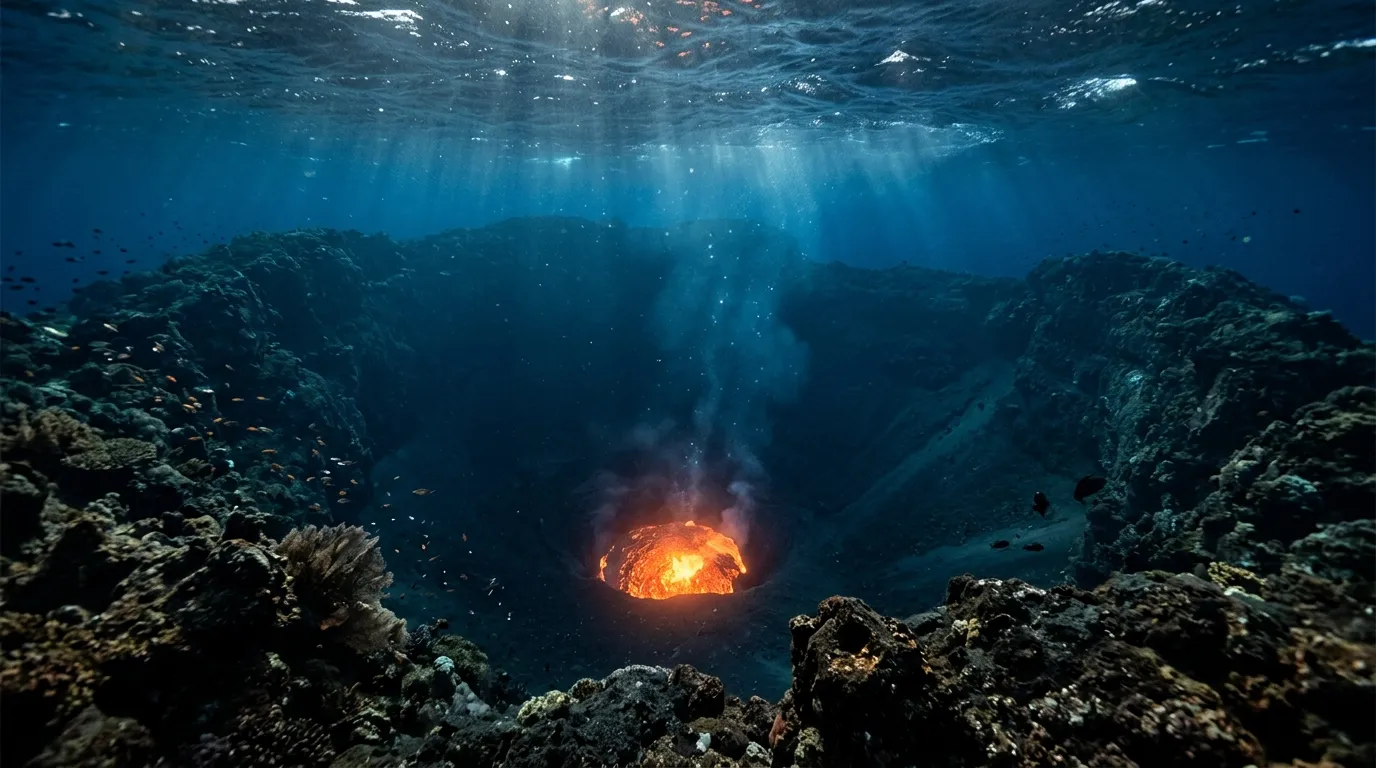
Somewhere between the southern tip of Kyushu and the volcanic Ryukyu Islands, the Pacific Ocean conceals a scar in the Earth's crust roughly 20 kilometers across. From the surface, the water looks like any other stretch of the East China Sea, calm enough to sail over without a second thought. But beneath that water, geophysicists have just confirmed, a magma reservoir is slowly refilling. The same reservoir that produced the most powerful volcanic eruption of the past 10,000 years is rebuilding.
A team led by Kobe University geophysicist Nobukazu Seama, working in collaboration with the Japan Agency for Marine-Earth Science and Technology (JAMSTEC), published their findings in Communications Earth & Environment in March 2026. Using underwater seismic imaging, they mapped a magma-rich zone sitting at remarkably shallow depths beneath the Kikai caldera, and they confirmed something that changes how volcanologists think about supervolcanic systems: the magma down there isn't leftover. It's new.
The Holocene's Biggest Blast
To understand what's refilling, you need to understand what emptied. Approximately 7,300 years ago, the Kikai caldera erupted with a violence rated at 7 on the Volcanic Explosivity Index, placing it alongside the most catastrophic eruptions in recorded geological history: Santorini, Tambora, the eruption that formed Crater Lake in Oregon. But Kikai was arguably worse than any of them in terms of raw output.
The eruption ejected between 133 and 183 cubic kilometers of magma (measured in dense rock equivalent), with total bulk volume reaching as high as 457 cubic kilometers. For a sense of scale, that's enough material to bury New York's Central Park under 12 kilometers of volcanic debris. The resulting pyroclastic flows, superheated avalanches of gas, ash, and rock that can travel at hundreds of kilometers per hour, raced across the ocean surface and reached the coast of southern Kyushu, more than 100 kilometers away.
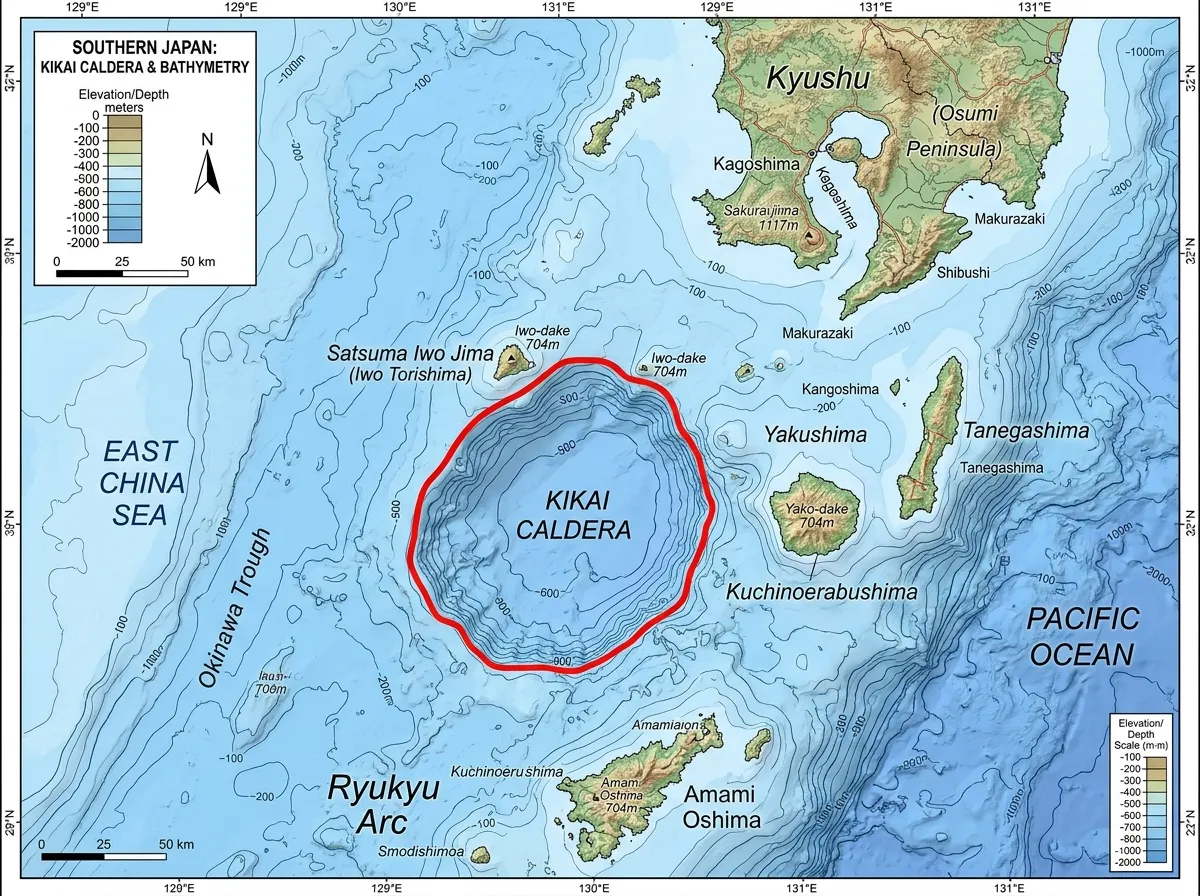
The tephra, volcanic ash and fragments launched into the atmosphere, spread across more than two million square kilometers, blanketing most of the Japanese archipelago and reaching as far as the southern Korean Peninsula. This material, known as the Akahoya tephra, remains one of the most important geological marker layers in East Asian stratigraphy. Whenever a geologist in Japan needs to date a sediment layer from the mid-Holocene, the Akahoya ash is often the reference point.
The human cost was severe. The eruption devastated the Jomon civilization of southern Kyushu, a sophisticated hunter-gatherer culture that had developed some of the world's earliest pottery traditions. Archaeological evidence shows population collapse in the immediate blast zone and significant cultural disruption across a wider area, though recent research suggests the impact wasn't quite as total as earlier studies proposed. The Nishinozono pottery tradition, which predated the eruption, appears to have survived in some form, suggesting that at least some communities recovered or that refugees carried their cultural knowledge northward.
How Scientists Peer Inside a Submarine Volcano
Studying a volcano that sits mostly underwater presents obvious challenges. You can't walk up to it with instruments the way you might approach Mount St. Helens or Etna. Seama's team used a technique analogous to medical imaging, but scaled up to planetary proportions.
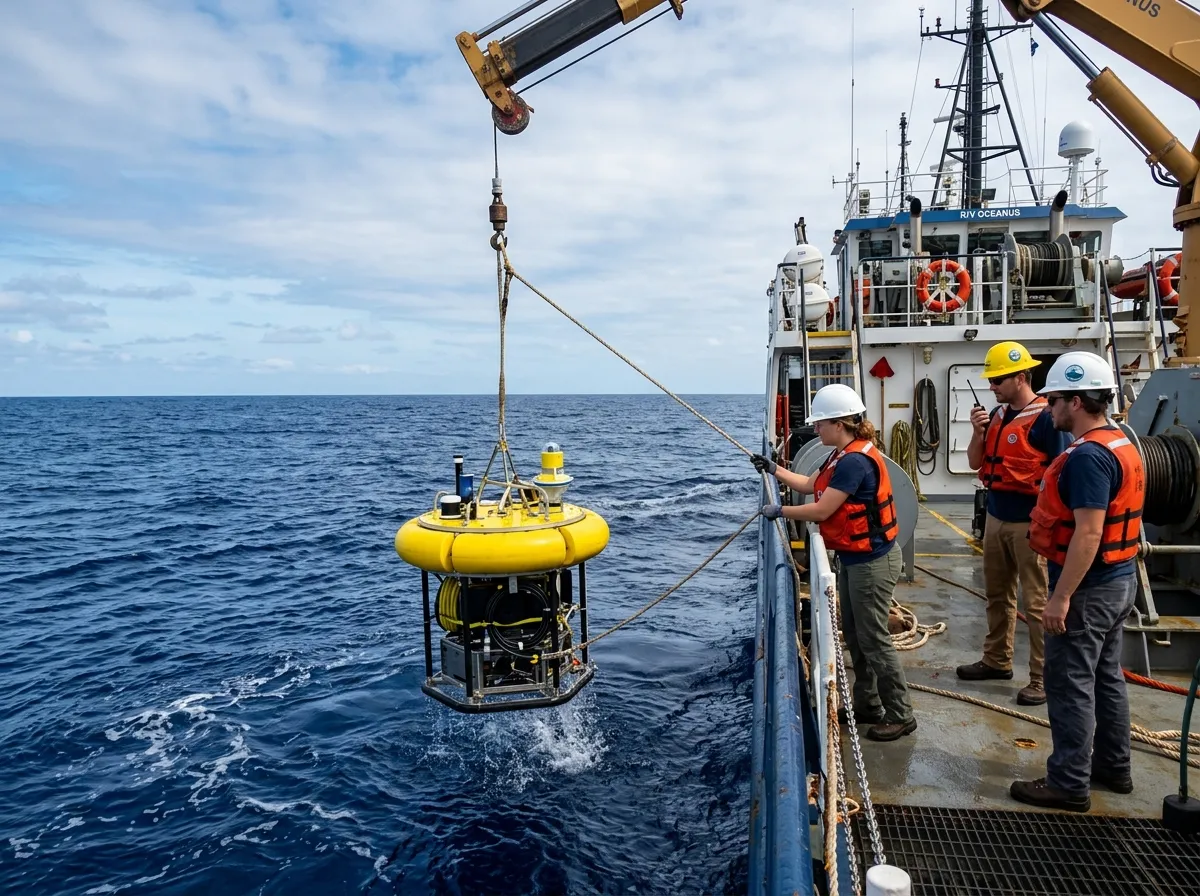
They deployed airgun arrays, devices that release compressed air to create controlled seismic pulses, essentially shouting into the Earth's crust with a precisely calibrated acoustic source. Networks of ocean bottom seismometers, placed on the seafloor around and within the caldera, then recorded how those pulses traveled through the rock below. Just as an ultrasound reveals soft tissue by tracking how sound waves bounce and bend, seismic waves change speed and direction when they encounter different materials. Molten rock slows them down. Solid rock speeds them up.
What the team found was a low-velocity anomaly directly beneath the caldera, a zone where seismic waves slowed significantly, indicating the presence of partially molten rock. The position of this anomaly, Seama noted, "strongly suggests it corresponds to the same reservoir involved in the massive eruption 7,300 years ago." In other words, the plumbing system that once fed the Holocene's largest eruption is still there, still connected, and now gradually filling with fresh material.
What the New Magma Means
The critical finding isn't simply that magma exists beneath the caldera. Residual melt from a VEI-7 eruption might reasonably persist for thousands of years. What makes this discovery significant is the chemical evidence that the magma currently in the reservoir is compositionally different from the material ejected 7,300 years ago.
Over the past 3,900 years, a lava dome has been growing at the center of the caldera. When researchers analyzed samples from this dome, they found that its chemical signature didn't match the Akahoya eruption products. The implication is straightforward but important: the reservoir isn't holding stale leftovers. It's receiving new injections of magma from deeper in the Earth's mantle, material that has a different composition because it represents a fresh supply, not a remnant of the old one.
This distinction matters enormously for hazard assessment. A reservoir containing only residual melt from an ancient eruption would be cooling, solidifying, and becoming less dangerous over time. A reservoir receiving active injections of new magma is doing the opposite. It's recharging. The volcano isn't winding down. It's, on geological timescales, winding up.
"We must understand how such large quantities of magma can accumulate to understand how giant caldera eruptions occur," Seama said. That sentence contains a subtle but telling admission: we don't yet fully understand the accumulation process. We can see that it's happening. We can measure its rough dimensions. But the rate of refilling, the threshold at which the system becomes critically pressurized, and the triggers that might push a recharged caldera toward eruption remain open questions.
Yellowstone, Toba, and the Caldera Refill Pattern
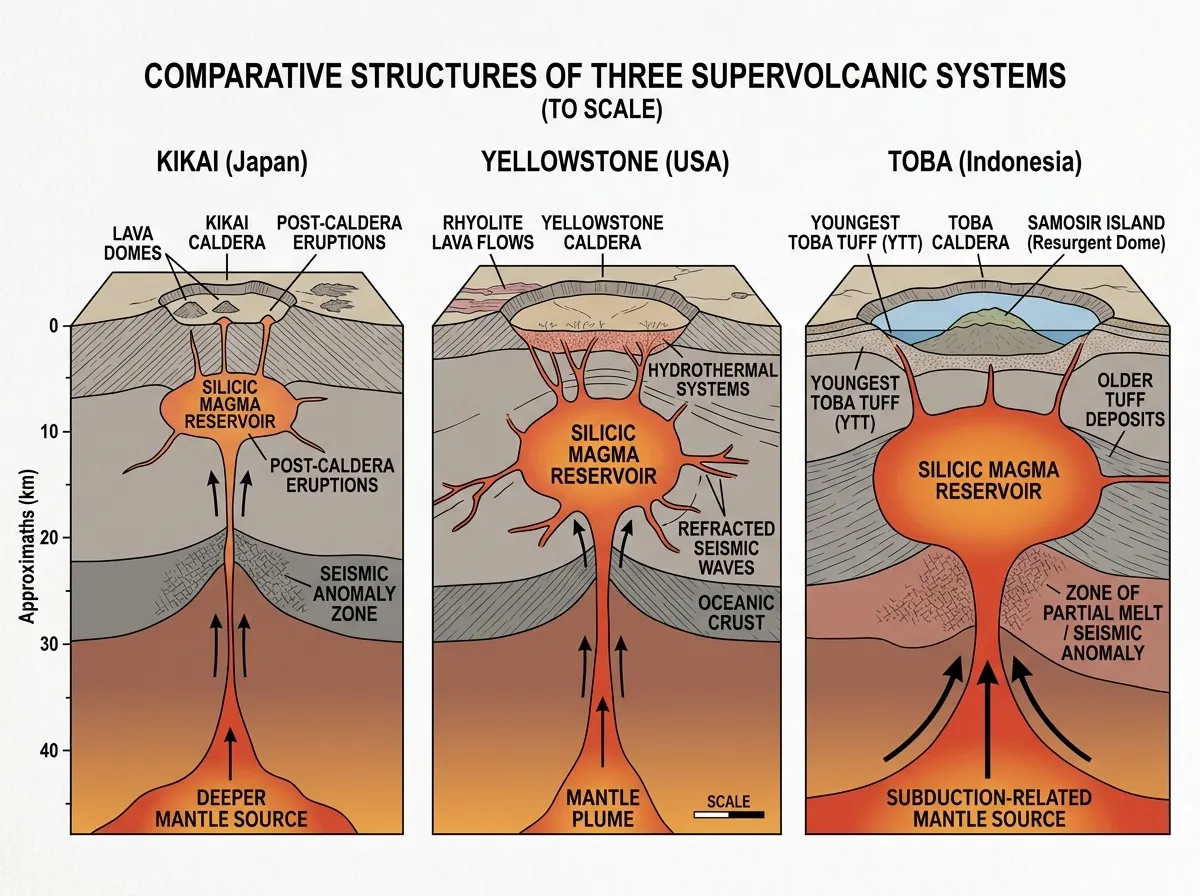
Kikai is not the only supervolcanic system showing signs of post-eruption recharge. Yellowstone's caldera, beneath the famous national park in Wyoming, sits above a magma reservoir that has been continuously monitored for decades. Toba, in Sumatra, which produced the largest eruption of the past two million years roughly 74,000 years ago, shows evidence of similar magma accumulation. What makes the Kikai study valuable beyond its specific findings is how it contributes to an emerging model of how all giant calderas behave after they erupt.
The traditional assumption was that a supervolcanic eruption essentially empties the chamber, and that the system then goes dormant for an extended period, potentially hundreds of thousands of years, before enough magma re-accumulates to pose any threat. The Kikai data challenges this timeline. If the reservoir is already receiving measurably fresh magma after just 7,300 years, with a lava dome actively growing for nearly four millennia, then the recovery period for these systems may be shorter than previously thought.
That said, "shorter" in geological terms still means extraordinarily long in human ones. The refill rate at Kikai, while measurable, is not something that should keep anyone in Kyushu awake at night. Supervolcanic eruptions operate on timescales of tens of thousands to hundreds of thousands of years. The fact that the system is recharging doesn't mean it's close to erupting. It means the process has begun, and understanding that process from its earliest stages gives scientists a chance to build monitoring frameworks that could, eventually, provide warning on the scale of centuries rather than decades.
The comparison between Kikai, Yellowstone, and Toba also reveals an important pattern about where supervolcanoes sit. All three are located above subduction zones or mantle hotspots, geological settings where the Earth's interior is actively pushing material upward. The mantle doesn't stop delivering magma just because the surface erupted. The volcanic system is more like a slow-filling bathtub than a spent firecracker. Drain it violently, and the faucet keeps running.
Where This Leads
The Kikai study arrives at a moment when volcanology is undergoing a quiet revolution in monitoring capability. Satellite-based InSAR (Interferometric Synthetic Aperture Radar) can detect surface deformation of less than a centimeter across entire calderas. Distributed fiber-optic sensing networks can turn existing undersea telecommunications cables into seismometers. Machine learning models are being trained to distinguish between the seismic signatures of tectonic activity, harmless fluid movement, and genuine magma intrusion.
What scientists still lack is a long baseline of observations for submarine calderas like Kikai. Most of our detailed volcanic monitoring infrastructure is built around land-based volcanoes: Yellowstone, the Cascades, the volcanoes of Iceland and Italy. Submarine calderas, which represent some of the most powerful volcanic systems on Earth, have received far less attention simply because they're harder to reach. Seama's team demonstrated that the imaging technology works. The question now is whether the funding and political will exist to deploy it permanently.
Japan, to its credit, takes volcanic monitoring more seriously than most nations. The country's network of seismic and geodetic stations is among the densest in the world, and JAMSTEC's fleet of research vessels has been instrumental in studying the submarine volcanic arc that stretches from Tokyo Bay to the Ryukyu Trench. But permanent, real-time monitoring of a submarine caldera at the level now applied to Yellowstone would be a first, and the Kikai findings make a compelling case that it's necessary.
The magma beneath the Kikai caldera will continue to accumulate whether anyone watches it or not. The difference between monitoring it and ignoring it is the difference between understanding a process that takes millennia and being surprised by one that takes hours. The eruption 7,300 years ago gave no warning that we know of. The next one, whenever it comes, doesn't have to catch us unprepared.
Sources
- One of Earth's most explosive supervolcanoes is recharging - ScienceDaily
- Japan's giant caldera volcano is refilling 7,300 years later - Phys.org
- Ancient supervolcano beneath Japan is refilling with magma - Earth.com
- Kikai Caldera - Wikipedia