

Somewhere in the frozen record of Greenland's ice sheet, roughly two miles below the surface and 12,800 years back in time, there is a spike. Not a spike you can see with the naked eye, but a chemical one: a sudden, dramatic increase in platinum concentration, captured in ice that formed at one of the most violent turning points in Earth's recent climate history. For more than a decade, that spike has been one of the most contested pieces of evidence in geology, fuel for a hypothesis that an asteroid or comet struck Earth at the dawn of the Younger Dryas, a mysterious cold snap that reversed thousands of years of warming and plunged the Northern Hemisphere back into near-glacial conditions.
New research, published in PLOS ONE and covered by ScienceDaily this week, has not just challenged the cosmic impact interpretation. It has largely dismantled it. The platinum spike, the study's authors argue, wasn't deposited by an object from space. It was deposited by volcanoes, likely from a sustained fissure eruption in Iceland. And it arrived roughly 45 years too late to have caused the catastrophe it was supposed to explain.
The finding does not solve the Younger Dryas itself, one of climate science's most persistent puzzles. But it removes the strongest physical evidence from a contested theory and redirects attention toward mechanisms that are both more mundane and, in their own way, more alarming.
A Chemical Anomaly in Ancient Ice
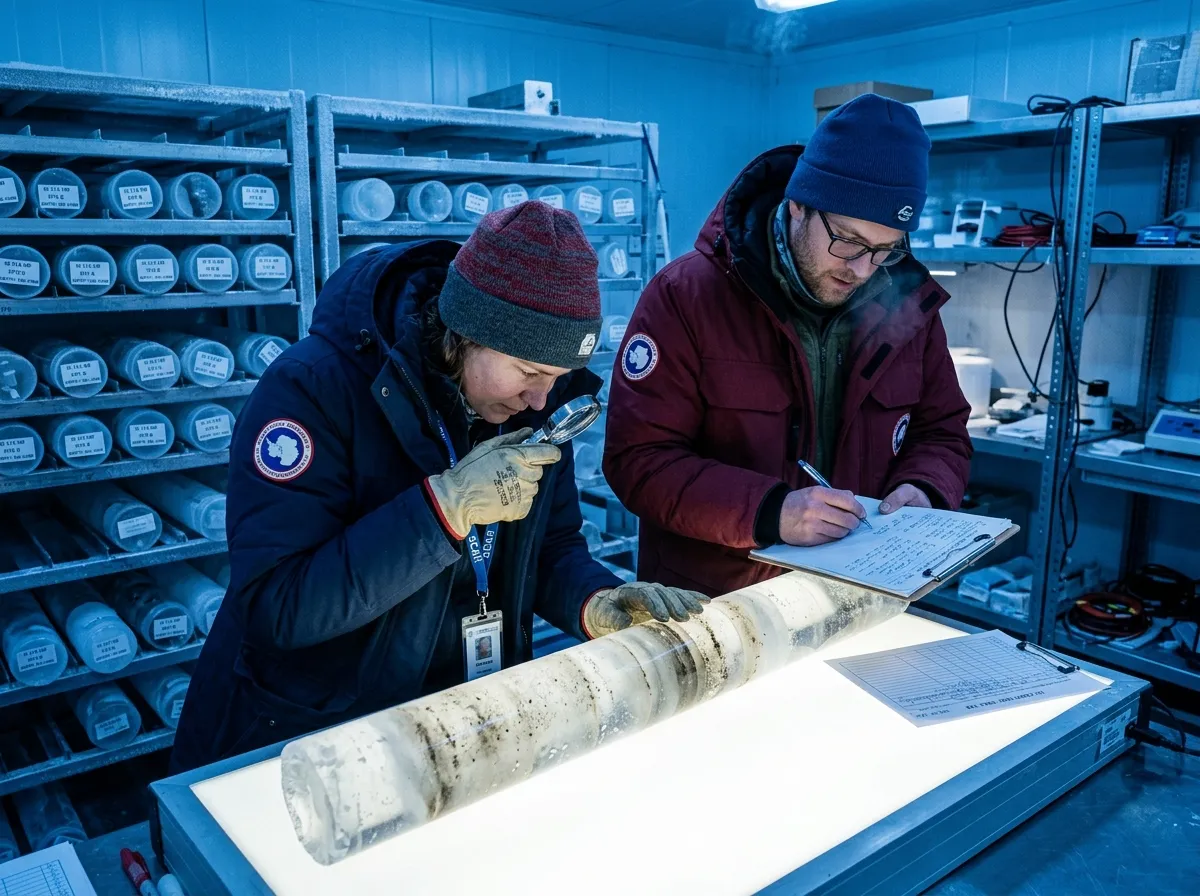
The story begins with a drill. In the early 1990s, researchers extracted a deep ice core from central Greenland known as GISP2, the Greenland Ice Sheet Project 2. Ice cores are among the most information-dense natural archives on Earth. Each annual layer of compressed snow traps tiny samples of the atmosphere: volcanic dust, sea salt, pollen, and trace metals from the moment it fell. By reading these layers, scientists can reconstruct climate conditions with remarkable precision going back hundreds of thousands of years.
In 2013, a team led by Michail Petaev of Harvard University reported something unusual in the GISP2 core. At a depth corresponding to approximately 12,800 years ago, right at the boundary between the warm Bolling-Allerod period and the frigid Younger Dryas, they found a massive spike in platinum concentration. Platinum levels jumped roughly 100-fold above background values. The spike was sharp, appeared suddenly, and persisted for about 14 years before fading back to baseline.
Petaev and his colleagues proposed the spike was evidence of a large extraterrestrial impact, possibly a comet or metallic asteroid. Platinum is rare in Earth's crust but relatively abundant in certain types of meteorites. A cosmic impact would distribute platinum-rich material into the atmosphere, where it would settle onto the ice sheet as a thin, chemically distinct layer. The logic was compelling: the same kind of chemical fingerprint, an iridium anomaly, had helped confirm the asteroid impact that killed the dinosaurs 66 million years ago.
The Cosmic Hypothesis and Its Problems
The platinum spike landed in the middle of an already heated debate. Since 2007, a group of researchers had been promoting what became known as the Younger Dryas Impact Hypothesis: the idea that a comet or asteroid (or fragments of one) struck or exploded above the Northern Hemisphere around 12,800 years ago, triggering the Younger Dryas cold period. The proposed impact was blamed for continent-wide wildfires, the extinction of large Ice Age mammals like mammoths and saber-toothed cats, and the disappearance of the Clovis people, one of North America's earliest known cultures.
The hypothesis had dramatic appeal. A single catastrophic event explaining multiple mysteries was exactly the kind of clean narrative that attracts both scientific attention and public imagination. Proponents pointed to scattered evidence: nano-diamonds in soil layers, unusual carbon spherules, a thin layer of charcoal at archaeological sites across North America and Europe. The platinum spike in the GISP2 core seemed to be the strongest piece of physical evidence, a geochemical fingerprint that matched what a cosmic impact should leave behind.
But the hypothesis also had persistent problems that grew harder to ignore. No impact crater from that period has ever been found, despite extensive searching. The physical evidence was microscopic and contested, with multiple independent labs failing to reproduce key findings. A comprehensive 2023 review in Earth-Science Reviews called the evidence "unconvincing" and noted that many of the proposed impact markers could be explained by ordinary terrestrial processes. Still, the platinum spike remained: a genuine anomaly that alternative explanations struggled to address. Until now.
Volcanoes Take the Stage
The new study, led by Charlotte E. Green and Professor James U. L. Baldini of Durham University's Department of Earth Sciences, approached the platinum spike with a specific question: could a volcanic eruption produce the same chemical signature?
The team started with the Laacher See eruption, a massive volcanic event in what is now Germany that occurred around the same time as the Younger Dryas onset. Laacher See was a plausible candidate because it was one of the largest volcanic eruptions in Europe during the late Pleistocene, powerful enough to have injected significant material into the atmosphere over a wide area. The researchers analyzed 17 pumice samples from Laacher See deposits, measuring platinum, iridium, and other trace elements to build a chemical fingerprint.
The result was definitive: Laacher See wasn't the source. Platinum levels in the pumice samples were at or below detection limits. But the investigation didn't end there. The team also re-examined the timing of the platinum spike itself, using updated ice core chronologies that have become significantly more precise since Petaev's original 2013 analysis. What they found changed the entire picture.
The platinum spike occurred approximately 45 years after the Younger Dryas cooling began. It was not contemporaneous with the onset of the cold period. Whatever deposited the platinum did not trigger the climate shift, because the shift had already happened nearly half a century earlier.
Why Timing Changes Everything
The 45-year gap is devastating for the impact hypothesis. If a comet struck Earth and caused the Younger Dryas, its chemical fingerprint should appear at or just before the onset of cooling, not decades later. The timing mismatch means the platinum spike and the Younger Dryas onset are two separate events that happened to fall in the same general geological period, close enough to be confused with each other at lower dating resolutions, but clearly distinct with modern precision.
The duration of the spike reinforces this conclusion. The elevated platinum persisted for about 14 years before returning to baseline levels. A cosmic impact, whether a single large body or a shower of fragments, is an instantaneous event. It might deposit material over days or weeks as debris settles through the atmosphere, but not over 14 years. A volcanic source, by contrast, fits perfectly. Fissure-style eruptions in Iceland, the kind that scientists are now learning to predict through ground acceleration patterns, routinely last years or even decades. The famous Eldgja eruption in the tenth century lasted roughly four years. The Laki eruption of 1783-84 lasted eight months and produced measurable atmospheric effects across the entire Northern Hemisphere. A sustained Icelandic fissure eruption would generate a platinum signal that builds gradually, persists for years, and fades, which is exactly the pattern preserved in the GISP2 core.
The Durham team proposed that the specific source was likely a chloride-rich and platinum-rich Icelandic eruption that delivered platinum to the nearby Greenland ice sheet through atmospheric transport. This mechanism would explain both the chemistry (volcanic gases can carry platinum in chloro-complexes) and the 14-year duration (consistent with known Icelandic fissure eruption timescales). It is, as Baldini's team noted, a far simpler explanation than a cosmic impact, and it fits the data better on every measurable dimension.

The Deeper Puzzle Remains
If the platinum spike wasn't caused by a cosmic impact, what actually triggered the Younger Dryas? This is the question the new research deliberately leaves open, and it is arguably more interesting than the debate it resolves.
The leading hypothesis for the Younger Dryas has always been a disruption of the Atlantic Meridional Overturning Circulation (AMOC), the massive ocean current system that carries warm water northward and regulates European and North American climate. As the ice sheets melted at the end of the last glacial period, enormous volumes of freshwater flooded into the North Atlantic, potentially from the catastrophic drainage of glacial Lake Agassiz, a body of water larger than all the modern Great Lakes combined. This freshwater influx would have diluted the salty, dense water that drives the circulation, causing it to slow or shut down entirely. Without warm water flowing north, temperatures in the Northern Hemisphere would have plummeted.
What makes this explanation both compelling and unsettling is that the AMOC is under stress today. Climate scientists have been tracking signs that the current system is weakening, potentially approaching a tipping point similar to the one that triggered the Younger Dryas. Earth's climate has a history of dramatic, self-inflicted transformations: the Great Oxidation Event roughly 2.4 billion years ago nearly destroyed the biosphere when photosynthetic organisms flooded the atmosphere with a gas (oxygen) that was toxic to most existing life. The Younger Dryas may represent a more recent example of the same principle, a climate system that can flip states with terrifying speed when the right trigger is pulled.
Intriguingly, the new research also identified a "large volcanic sulfate spike" in the ice records that aligns precisely with the onset of cooling around 12,870 years ago. Volcanic aerosols can cool the climate by reflecting sunlight back into space, and a sufficiently large eruption in the Northern Hemisphere could have provided the initial push that disrupted ocean circulation. The researchers suggest the Younger Dryas may have been triggered by volcanic forcing, with the cooling then sustained by the AMOC shutdown in a feedback loop. If true, the Younger Dryas was not caused by a single dramatic event from space but by the far more complex (and far more relevant) interaction of volcanic activity and ocean dynamics.
The Bigger Picture
The Younger Dryas platinum spike story is, at its heart, a story about how science corrects itself. The impact hypothesis was never unreasonable. Platinum spikes in geological records are legitimately associated with extraterrestrial events, and the coincidence of timing (at least as it was understood in 2013) was striking. What changed was not the evidence itself but the precision with which it could be dated. Better chronologies revealed a gap that the original measurements couldn't resolve, and that gap was enough to shift the entire interpretation from cosmic catastrophe to earthly volcanism.
For the Younger Dryas Impact Hypothesis, this is likely a fatal blow. The platinum spike was its strongest piece of physical evidence, and that evidence now points to a terrestrial volcanic origin. The broader mystery of the Younger Dryas itself, however, remains very much alive. We know that 12,800 years ago, Greenland temperatures dropped more than 15 degrees Celsius below modern levels. We know the consequences were catastrophic for ecosystems and human cultures across the Northern Hemisphere. What we still don't fully understand is the precise chain of events that set it in motion.
The answer now appears to involve fire from below rather than fire from above. And the mechanisms being investigated, volcanic forcing and ocean circulation collapse, are not safely confined to the distant past. They are processes that operate in the same climate system we inhabit today, governed by the same physics, and potentially sensitive to the same kinds of disruption. The Younger Dryas is not just a mystery about what happened 12,800 years ago. It is a warning about what a climate system is capable of when it reaches a breaking point.
Sources
- ScienceDaily: Scientists solve 12,800-year-old climate mystery hidden in Greenland ice
- PLOS ONE: A possible volcanic origin for the Greenland ice core Pt anomaly near the Bolling-Allerod/Younger Dryas boundary
- Space.com: A volcano or a meteorite? New evidence sheds light on puzzling discovery in Greenland's ice sheet
- Durham University: A volcano or a meteorite?