
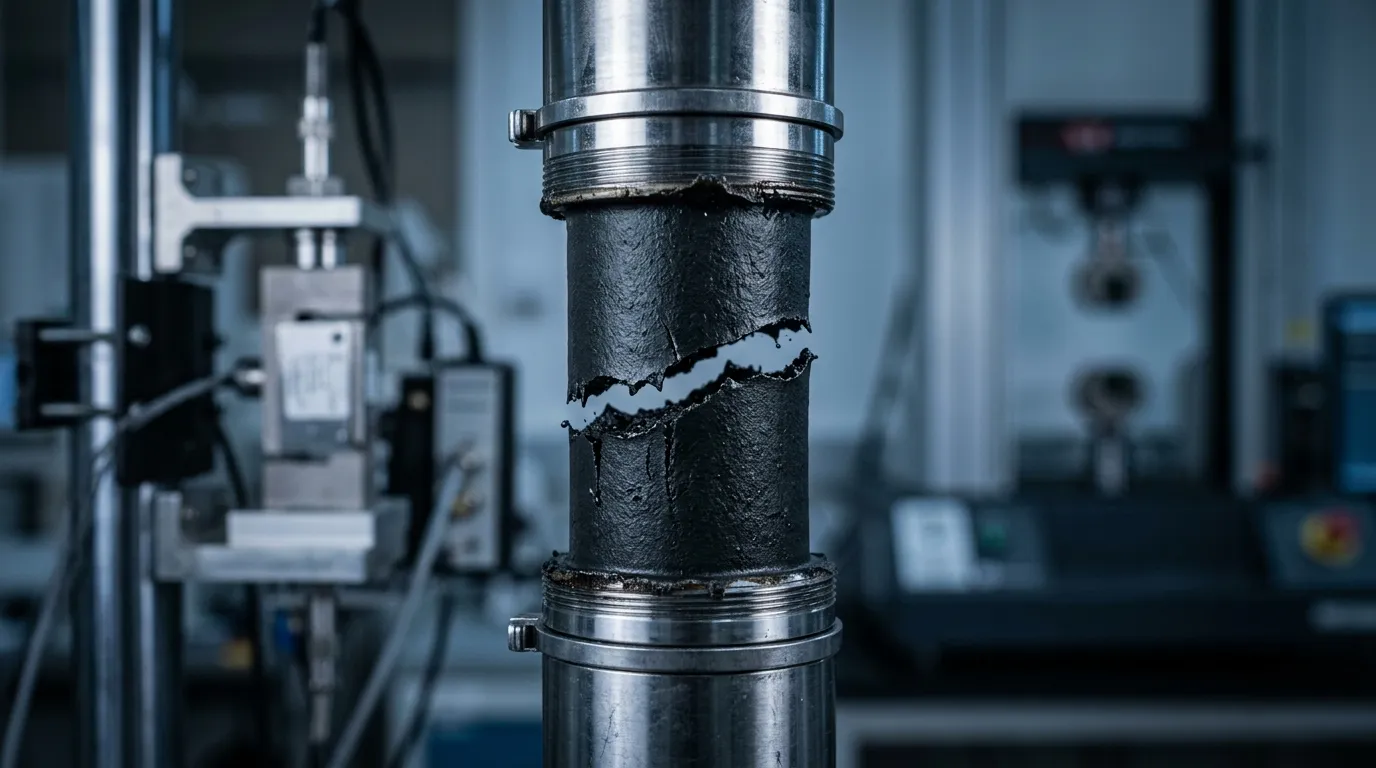
Every physics textbook that has ever tried to draw a tidy line between solids and liquids has relied on one picture: pull on a solid and it eventually cracks, pull on a liquid and it pulls into a thin thread. Honey dribbling off a spoon behaves one way. A piece of toffee yanked between two hands behaves the other. Those are supposed to be different physical regimes, governed by different equations. A team at Drexel University has just shown, with a high-speed camera and a startled laboratory, that the line is not where anyone thought it was.
In a paper published last month in Physical Review Letters, researchers Thamires A. Lima and Nicolas J. Alvarez, along with collaborators Stuart E. Smith, Kazem V. Edmond, Manesh Gopinadhan, and Emmanuel Ulysse, report something that was not supposed to be possible: a plain, simple, viscous liquid, stretched hard enough, reaches a critical stress and fractures. Not necks. Not thins. Fractures. With a snap the team could hear from across the room.
"The fracture caused a very loud snapping noise that actually startled me," Lima said in the Drexel announcement. It is a very rare admission in a press release from a rheology lab. Rheology, the study of how things flow, is a field where surprises are usually quiet.
What They Actually Did
The experiment is, in outline, almost mundane. Lima and her colleagues used a technique called extensional rheology, which is essentially a mechanical version of slowly pulling taffy. A small amount of liquid sits between two plates. The plates separate at a controlled rate. Sensors measure how much force the liquid pushes back with as it thins.
Run this on honey, or motor oil, or any ordinary liquid, and the column between the plates slowly narrows. It forms a thread. Eventually the thread pinches off under surface tension, and the two halves fall back to their respective plates. That behavior has been formalized in equations for more than a century.
The Drexel team ran it on a pair of liquids at the upper end of normal viscosity: a styrene oligomer, a short-chain cousin of the polymer used in disposable coffee cups, and a tar-like hydrocarbon blend, similar to the heavy residues left after petroleum refining. Both are unambiguously liquids. Neither is a polymer network, neither is a gel, neither is elastic in any mechanical sense. They are what physicists call Newtonian fluids, the simplest case the field deals with.
At slow stretching rates, both liquids did the expected thing. They thinned and necked. At faster stretching rates, something else happened. The column abruptly broke, leaving a clean, nearly flat fracture surface on each side. A high-speed camera running at tens of thousands of frames per second caught what an unaided eye could not: a crack propagating across the fluid in microseconds, with a snap loud enough to carry across the lab.
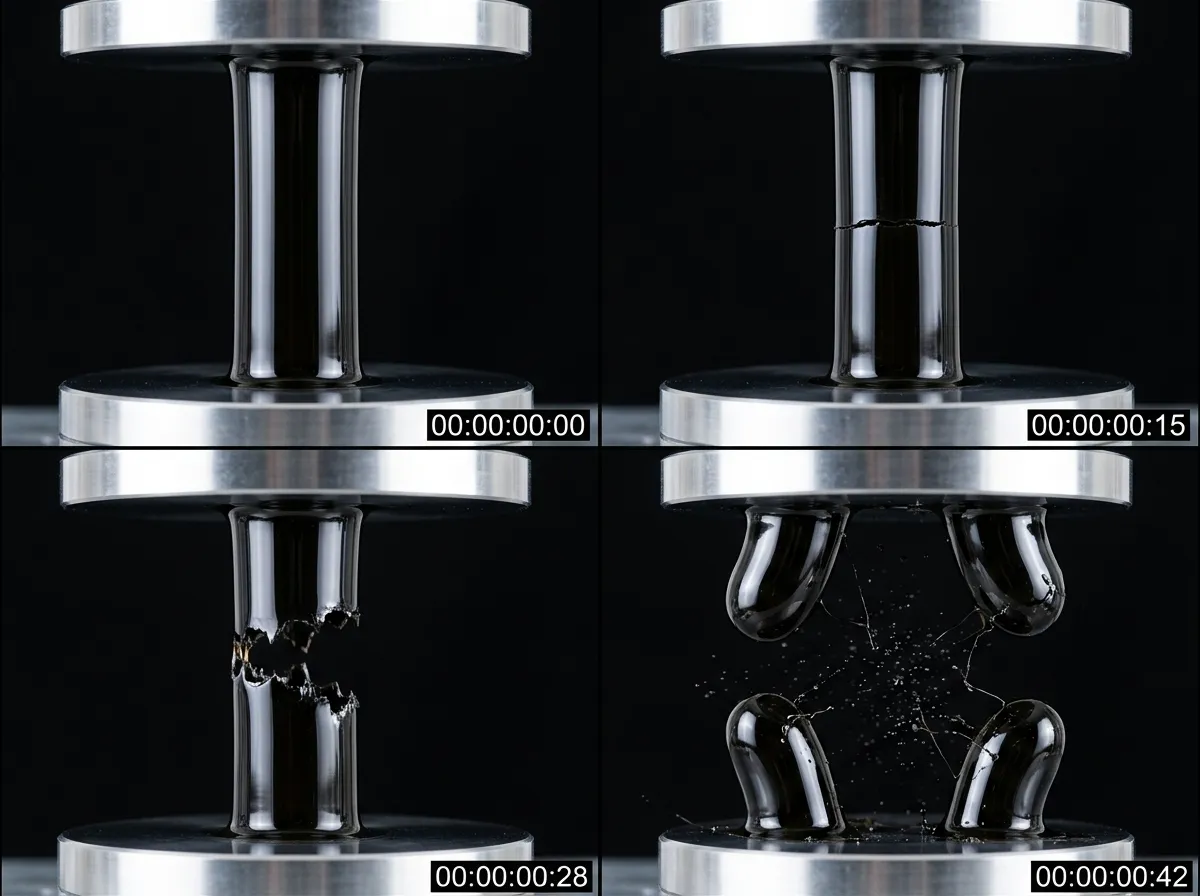
"What we observed was so unexpected that we needed to repeat the experiments a few more times to make sure it was real," Alvarez said.
The Number That Surprised Everyone
When the team finally settled down and did the physics, they found that both liquids fractured at essentially the same critical stress: about 2 megaPascals. That figure, which Drexel translates as roughly the force you would feel if a laundry bag filled with ten bricks snagged on your fingernail, has a very particular meaning. Above it, the liquid cannot flow fast enough to accommodate the stretch, and the bonds inside the fluid give out in a cascade instead.
Two details make the 2 MPa figure important. First, it is close to the critical stress at which a comparable glassy polymer would fracture. Second, it appears to depend only on viscosity. Both liquids, despite having different chemistries, fractured at the same stress when stretched at the same rate. That strongly suggests the fracture behavior is controlled by the fluid's internal friction, not by any hidden elastic structure.
That is the genuinely new piece. A rare form of "liquid fracture" has been observed before, in polymer melts and complex viscoelastic fluids, materials that behave partly like rubber. Those systems have real elastic memory. Pulling on them stores energy, and that stored energy is what eventually cracks. Simple viscous liquids are not supposed to have any of that. They are supposed to dissipate all the energy you feed them as heat and flow.
"Our findings show that if pulled apart with enough force per area, a simple liquid will reach a point of 'critical stress,' when it will actually fracture like a solid," Lima said. "This fundamentally changes our understanding of fluid dynamics."
Why This Breaks the Textbook Picture
The traditional division between solids and liquids rests on timescales. A solid responds elastically on short timescales and, under very long loads, may flow. A liquid flows on short timescales and never really holds a shape. In between are materials that do both, and rheologists have spent decades mapping them onto a single spectrum using a concept called the Deborah number, which ratios the internal relaxation time of a material to the timescale of the experiment.
The textbook assumption, and the one that every fluid-mechanics equation quietly rides on, is that a simple Newtonian liquid has essentially no relaxation time. Pull on it however fast you like, and it will still flow, because molecular rearrangement is instantaneous on any practical laboratory scale. The Drexel result says that assumption fails at high enough stress. The fluid cannot get out of its own way in time. Instead of flowing, it cracks.
This is the kind of finding that shares DNA with other moments in recent physics where a neat boundary turned out to be porous. Particle physicists are still assimilating CERN's discovery of a doubly charmed baryon, a hadron that lives in a regime most models had treated as effectively forbidden. Closer to the chemistry end of the spectrum, a 150-year-old assumption about how certain molecules bond was reversed in a Cambridge lab only weeks ago. The common thread: "simple" rarely stays simple once someone can measure at the right speed.
The Questions the Drexel Team Cannot Yet Answer
The new result raises at least four open questions, and rheologists will be arguing about them for years.
- Does every liquid do this, eventually? The team tested two liquids at the upper end of normal viscosity. Water might, in principle, fracture too, but at rates that are not currently achievable in a rheology rig. Resolving that requires either faster instruments or very cold, very thick analogues.
- Is the "critical stress" universal? The 2 MPa figure held for two chemistries. If it holds for many more, it becomes a real material constant, a property of liquids in general, the way the speed of sound is.
- What exactly is breaking? Fracture in a solid breaks chemical bonds or displaces dislocations. In a viscous liquid, there are no dislocations and no fixed bond network. Something mechanical is giving way, but the microscopic picture is not yet settled.
- Where does the energy go? A solid that fractures releases stored elastic energy as sound, heat, and new surface area. A simple liquid supposedly stores almost none. The loud snap suggests that energy has to be coming from somewhere.
"Showing that viscous effects are enough to promote solid-like fracture behavior opens a world of new questions," Lima said, in what is likely the most honest form of a scientific victory lap.
Where This Lands in the Real World
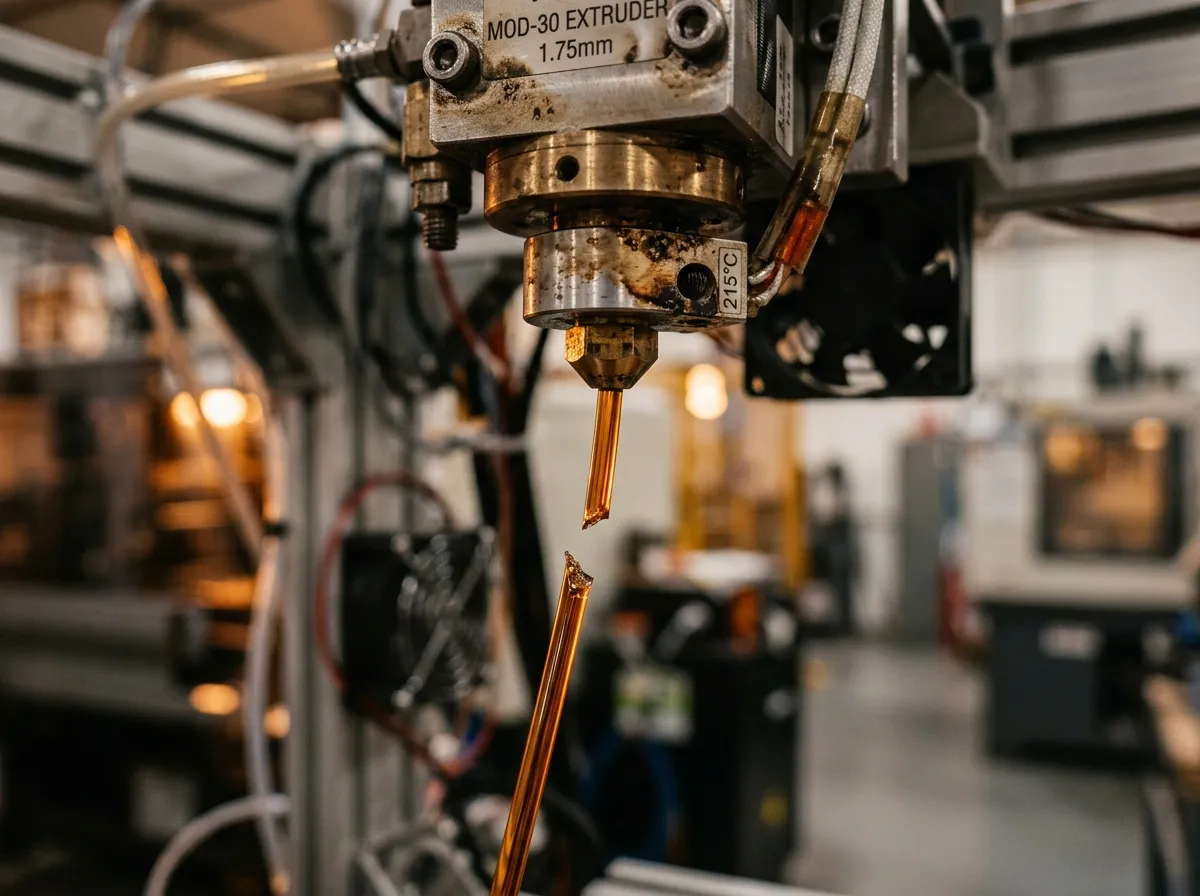
The practical implications are larger than they first look. Any process that stretches a viscous fluid quickly is potentially operating near a regime in which the fluid might fracture rather than flow. That list turns out to be long: industrial fiber spinning, inkjet printing, 3D printing with high-viscosity resins, coatings, adhesives under shear, hydraulic fracturing (the irony is unavoidable), blood flow in narrow vessels and prosthetic valves, and the behavior of liquid metals in additive manufacturing.
The Drexel paper does not turn any of those fields upside down. What it does is give engineers a new variable to worry about. When you design a nozzle or a pump or a spinneret, you plan for viscous losses and turbulence. You typically do not plan for the working fluid to shatter. If the critical stress for common industrial fluids lands in a regime their equipment regularly touches, product designers will need a new rule: do not cross that line, or be ready for the fluid to break.
There is also a quieter biomedical angle. Blood is, technically, a complex fluid, and plasma behaves as a Newtonian liquid to a first approximation. In catastrophic trauma, where vessel walls fail and very high strain rates appear briefly, fluid fracture behavior is not a concept that currently appears in clinical models. It probably should be.
What This Means
A result like this does not happen often. It is not a correction to a number or an improvement to a measurement. It is the identification of a mechanical behavior in a class of materials that was supposed, by definition, not to have it. Simple liquids flow. That is what "simple" meant. After the Drexel paper, "simple" means something more provisional: simple liquids flow, until they are pulled too hard, and then they break.
The most interesting consequence is probably philosophical. Physics spends a great deal of effort dividing the world into categories and then deriving different equations for each one. Every so often, someone demonstrates that the categories were artifacts of the tools available. The Drexel team had a high-speed camera, a rheology rig capable of very fast pulls, and the patience to ask whether the "thread" they were watching was actually threading. The fluid gave them a different answer. The rest of the discipline now has to decide what to do with it.
Sources
- Drexel researchers discover liquids have a breaking point, Drexel University News
- Scientists stretched a liquid and it snapped like a solid, ScienceDaily
- Liquids can fracture like solids, researchers discover the breaking point, Phys.org
- Drexel researchers discover liquids have a breaking point, EurekAlert
- Liquids Crack With an Audible Snap, Study Finds, Gizmodo