
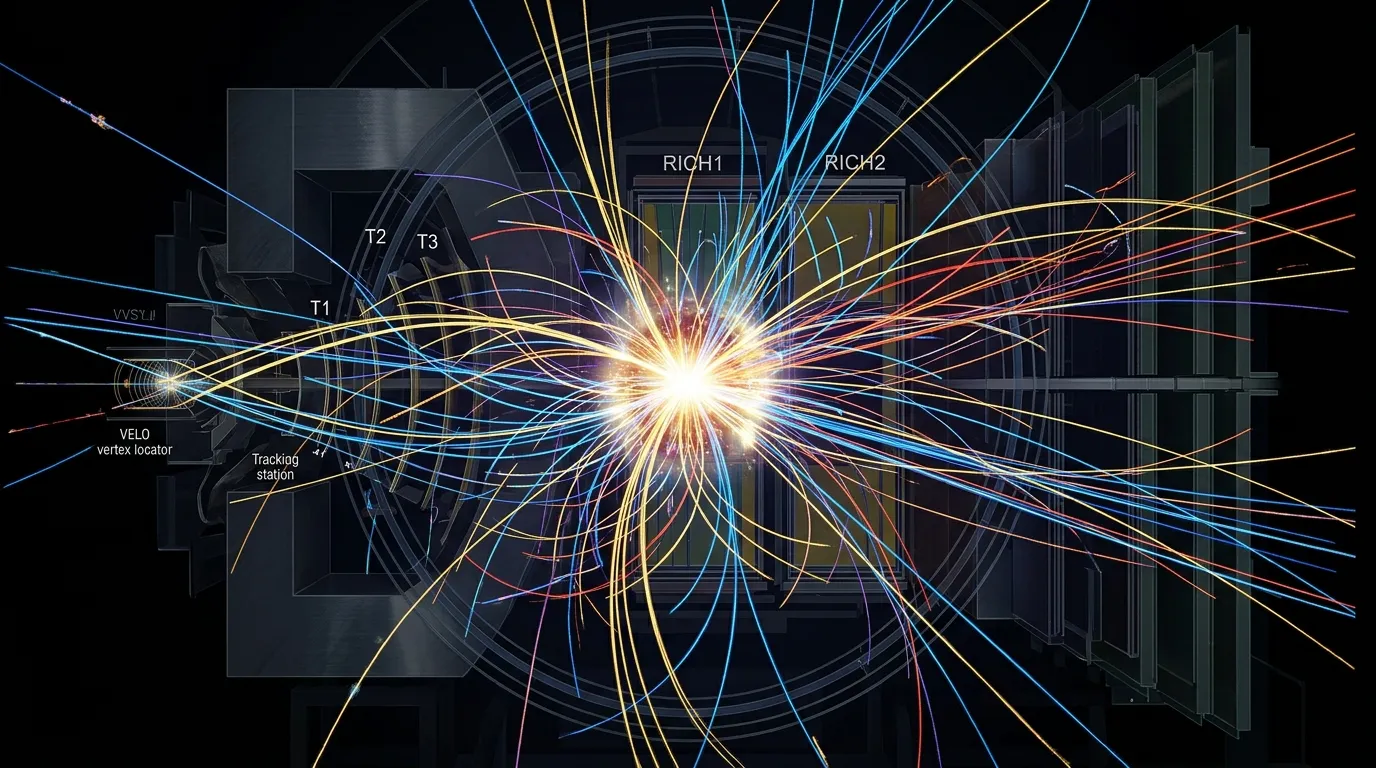
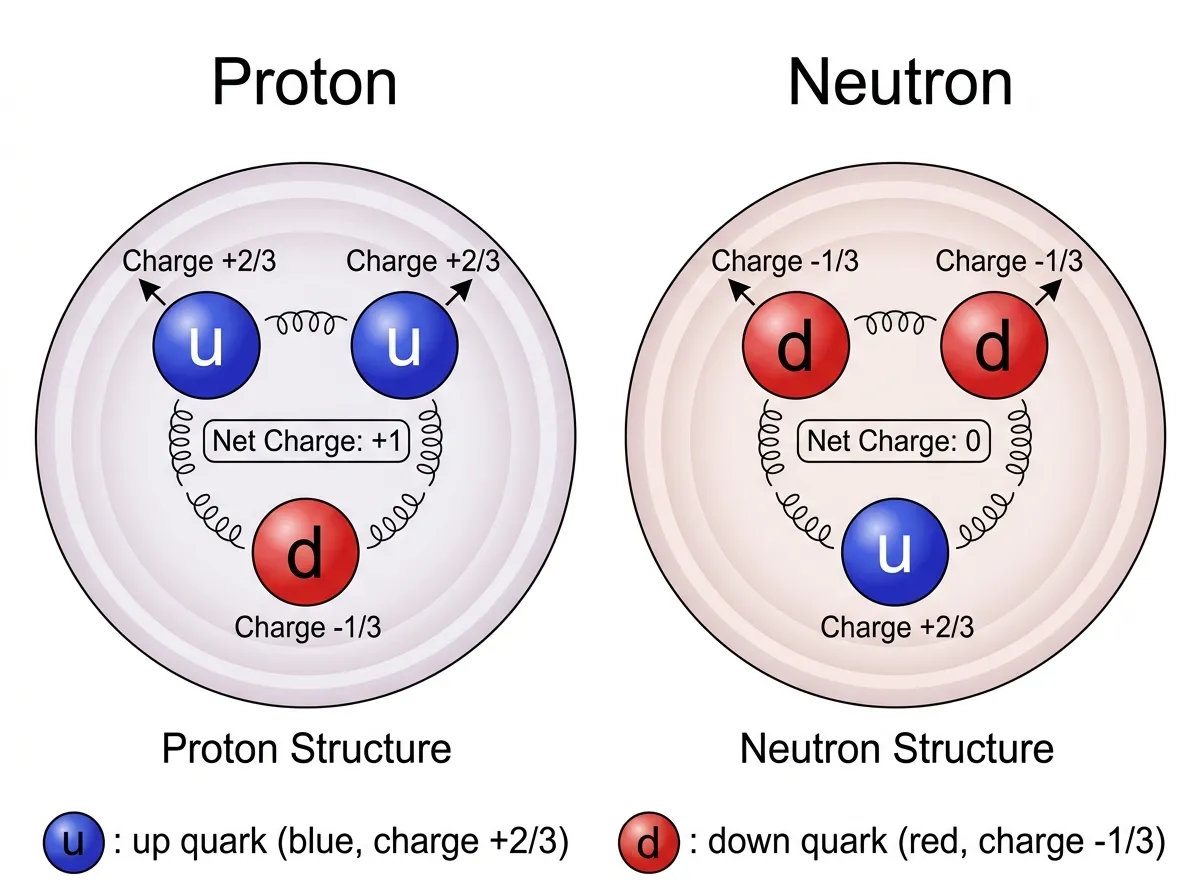
Everything you can touch, taste, or measure is built from a handful of elementary particles. Protons, the building blocks of every atomic nucleus, are made of three quarks bound together by the strong nuclear force: two "up" quarks and one "down" quark. This arrangement is so stable that protons essentially last forever. They form hydrogen atoms, fuse into helium inside stars, and eventually become every element on the periodic table.
But the universe allows other arrangements. Heavier and more exotic, these particles are held together by the same strong force but in combinations that exist for barely a trillionth of a second before decaying. On March 17, physicists at CERN announced they'd found one of these arrangements for the first time: a baryon containing two charm quarks and one down quark, designated Ξcc⁺ (pronounced "zi-cc-plus"). It is essentially a heavier cousin of the proton, roughly four times its mass, and the 80th particle discovered at the Large Hadron Collider.
The discovery resolves a scientific dispute that has lingered for more than two decades. And what it reveals about the strong force, the most powerful and least intuitive force in nature, could reshape how physicists understand the glue that holds all matter together.
A Proton, but Heavier
To understand why this particle matters, it helps to start with what a proton actually is. A proton contains two up quarks and one down quark, all bound together by gluons, the carrier particles of the strong force. The quarks are light. Most of the proton's mass comes not from the quarks themselves but from the energy of the gluon field binding them. This is one of the strangest facts in physics: you weigh what you weigh mostly because of energy, not matter.
Now swap out those two lightweight up quarks for two charm quarks. Charm quarks are roughly 500 times heavier than up quarks. The resulting particle, the Ξcc⁺, has the same three-quark structure as a proton but with a radically different internal dynamic. The two heavy charm quarks sit close together at the center, orbited by the lighter down quark, creating something that resembles an atom more than a typical baryon.
This structure gives theorists a unique laboratory. In a normal proton, all three quarks are light and move at nearly the speed of light, making calculations enormously difficult. In the Ξcc⁺, the two heavy quarks move more slowly, simplifying the mathematics. Physicists can use this system to test their models of the strong force with far greater precision than a proton alone allows.
How You Spot Something That Vanishes in a Trillionth of a Second
The Ξcc⁺ doesn't stick around long enough to be observed directly. It decays almost immediately after forming, breaking apart into lighter particles: a Λc⁺ baryon, a kaon (K⁻), and a pion (π⁺). What physicists actually detect are these decay products, and they work backward to reconstruct what must have existed, however briefly, at the point of collision.
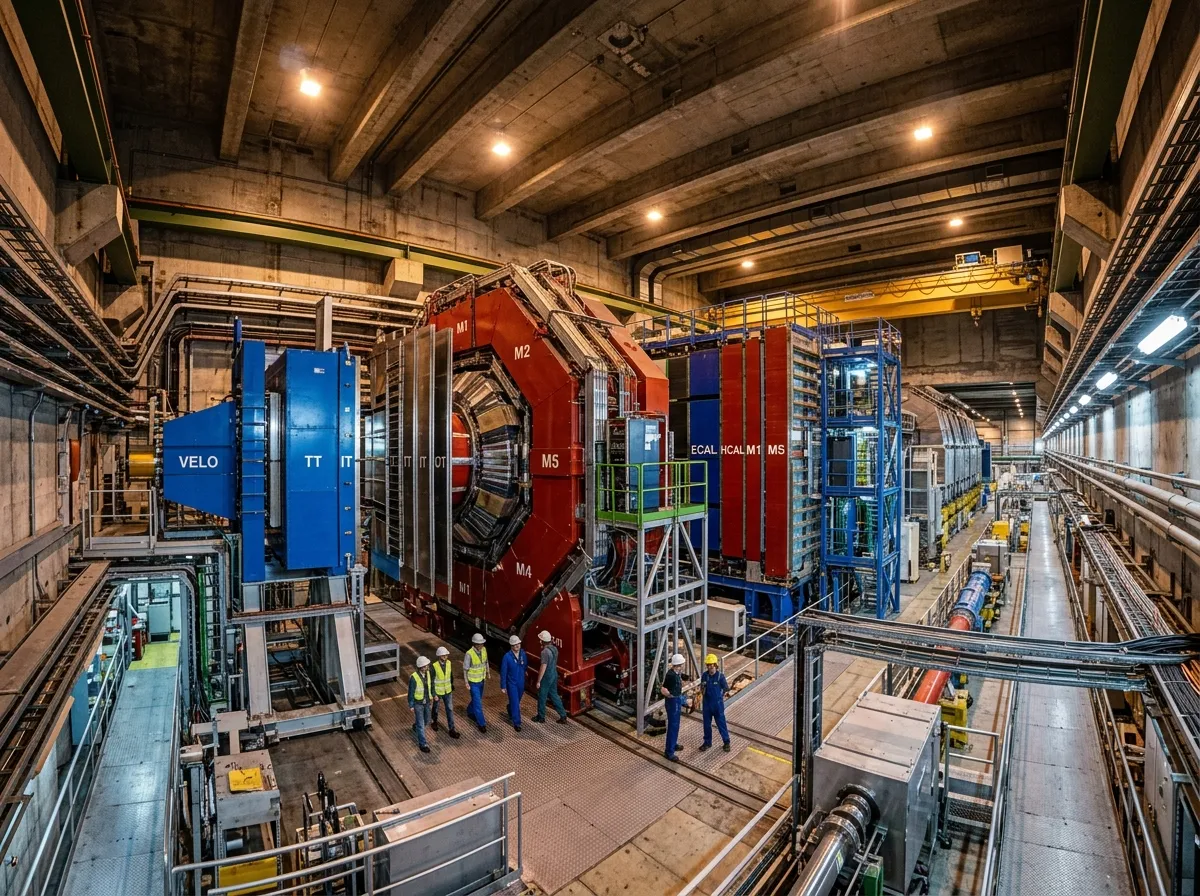
The LHCb detector, one of four major experiments around the Large Hadron Collider's 17-mile ring near Geneva, is specifically designed for this kind of forensic particle physics. Protons accelerated to over 99.9% of the speed of light smash into each other roughly 30 million times per second. Each collision produces a shower of particles. The detector tracks their trajectories, measures their momenta, and identifies their types.
In the data collected during the LHC's third run in 2024, researchers found a clear signal: approximately 915 events where the decay products lined up at a mass of 3,620 MeV/c², exactly where theory predicted the Ξcc⁺ should appear. The statistical significance was 7 sigma, meaning there's less than one chance in a trillion that the signal is a random fluctuation. In particle physics, 5 sigma is the threshold for claiming a discovery. Seven sigma leaves no room for doubt.
"This result was a major goal of the upgraded LHCb detector," said LHCb spokesperson Vincenzo Vagnoni. The detector underwent a complete overhaul between 2018 and 2023, replacing nearly every component to handle data at five times the previous rate. The Ξcc⁺ is the first new particle it has found since coming back online.
The SELEX Puzzle: Two Decades of Disagreement
The discovery carries extra weight because of a controversy that began in 2002. That year, the SELEX experiment at Fermilab in Illinois reported evidence for a very similar particle, the Ξcc⁺, but at a different mass and with a much longer lifetime than theory predicted. The claim was published in peer-reviewed journals. The data were not obviously flawed. But no other experiment could reproduce it over the following two decades.
This left physicists in an uncomfortable position. Theoretical predictions from quantum chromodynamics (QCD), the mathematical framework describing the strong force, consistently placed the Ξcc⁺ at one mass. SELEX put it at another. Without independent confirmation, the discrepancy became one of particle physics' lingering loose ends.
The new LHCb measurement resolves the puzzle definitively. The Ξcc⁺ appears at the mass that QCD calculations predicted, not at the mass SELEX reported. Its lifetime is consistent with theoretical models, roughly six times shorter than the related Ξcc⁺⁺ baryon that LHCb discovered in 2017 (which has two charm quarks and one up quark instead of a down quark). The SELEX signal, whatever it was, does not match the Ξcc⁺.
This is science working as it should. An anomalous result, questioned but never dismissed, is resolved two decades later by a more powerful experiment. There's no dramatic new physics hiding in the SELEX disagreement. But the confirmation that QCD was right all along strengthens confidence in the calculations physicists rely on to understand everything from nuclear structure to the behavior of matter inside neutron stars.
What Two Charm Quarks Reveal About Nature's Strongest Force
The strong force is, paradoxically, the least well understood of the forces that govern particle physics. It is roughly 100 times more powerful than electromagnetism and 10³⁸ times stronger than gravity. It holds quarks inside protons and neutrons, and it holds protons and neutrons inside atomic nuclei. Without it, atoms would not exist.
But it behaves in ways no other force does. Pull two quarks apart and the force between them gets stronger, not weaker. At the distances inside a proton, roughly a femtometer (10⁻¹⁵ meters), the mathematics of the strong force becomes so complex that physicists cannot solve the equations exactly. They resort to lattice QCD, a technique that approximates the calculations on massive supercomputer grids, or to effective theories that simplify the problem by focusing on specific energy ranges.
The Ξcc⁺ offers a new testing ground. Because its two charm quarks are heavy and move relatively slowly, the system is more amenable to precise calculations. Theorists can predict the particle's mass, lifetime, and decay patterns with good accuracy, and then check those predictions against experiment. Where the predictions match, confidence in QCD grows. Where they don't, new physics could be hiding.
The 2017 discovery of the Ξcc⁺⁺ (two charm quarks and one up quark) began this program. The new Ξcc⁺ extends it. Together, the two particles form a doublet, a pair related by the swap of an up quark for a down quark. Comparing their properties tests a specific prediction of QCD called isospin symmetry. Early indications suggest the measurements are consistent with theory, but more data will be needed for a definitive test.
CERN Director-General Mark Thomson noted that the discovery "highlights how experimental upgrades at CERN directly lead to new discoveries." The upgraded detector's ability to record data at five times the previous rate is what made it possible to accumulate the 915 events needed to spot the Ξcc⁺ above background noise.
From Protons to Pentaquarks: The LHC's Growing Particle Zoo
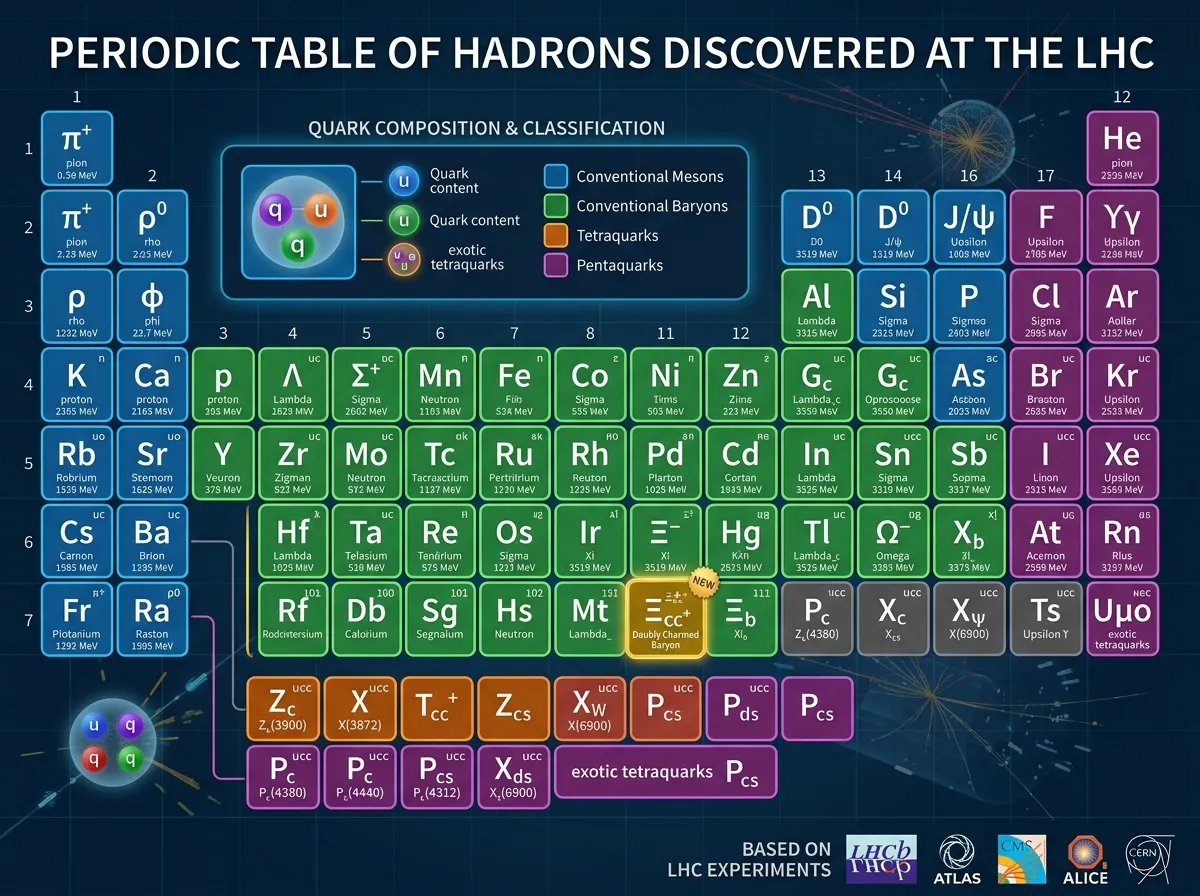
The Ξcc⁺ is the 80th particle discovered at the LHC since collisions began in 2010. That number deserves context. When the LHC was built, its primary mission was finding the Higgs boson, a single particle that completed the Standard Model of physics. The Higgs was found in 2012. Everything since has been a bonus.
Most of the 79 particles preceding the Ξcc⁺ are exotic hadrons: combinations of quarks that don't fit the simple two-quark (meson) or three-quark (baryon) categories that physicists used for decades. The LHC has found tetraquarks (four quarks), pentaquarks (five quarks), and now multiple baryons with heavy quarks that were previously only theoretical predictions.
These discoveries connect to a broader effort to understand how quantum systems produce unexpected behaviors. The Standard Model predicts all of these particles. Their discovery doesn't require new physics. But the sheer variety of ways quarks can combine is itself informative, revealing the richness of the strong force in regimes where perturbative calculations fail and only lattice simulations or direct experimental observation can provide answers.
The next targets for LHCb include baryons with beauty quarks, which are even heavier than charm quarks, and continued searches for exotic combinations like doubly heavy tetraquarks. The upgraded detector will collect data through at least 2032, and the planned High-Luminosity LHC upgrade promises ten times more collisions after that.
The Deeper Question
Particle physics in 2026 occupies a strange position. The Standard Model, completed with the Higgs boson in 2012, predicts essentially everything the LHC has found. No experiment has produced a result that contradicts it. That is a remarkable achievement, and also a source of frustration. Physicists know the Standard Model is incomplete: it doesn't account for dark matter, dark energy, or the asymmetry between matter and antimatter that allowed the universe to exist. But the LHC hasn't found the cracks yet.
Discoveries like the Ξcc⁺ are a different kind of progress. They don't overturn the theory. Instead, they test it in regimes where precision matters and where small deviations could point toward something beyond the Standard Model. The strong force, in particular, remains a frontier. Lattice QCD calculations have improved enormously in recent years, but they still struggle with certain configurations. Each new doubly heavy baryon provides another data point, another check, another opportunity for theory and experiment to disagree.
The pattern echoes what's happening across physics, from levitating time crystals built from Styrofoam and sound waves to the study of crystalline structures harder than diamond. The most exciting science often comes not from revolutionary breaks with existing theory but from pushing known physics into unfamiliar territory and watching carefully for surprises. Two charm quarks and a down quark, bound together for less than a trillionth of a second in a tunnel beneath the Swiss-French border, may not rewrite the textbooks. But they are teaching physicists to read the existing ones more carefully. And when the next breakthrough arrives, it will likely come from exactly this kind of patient, precise work at the edges of what we thought we already understood.
Sources
- LHCb Collaboration discovers new proton-like particle - CERN
- Physicists discover a 'charmed' new particle - Scientific American
- CERN Adds a New Particle to Large Hadron Collider's Subatomic Zoo - Universe Today
- Observation of the doubly charmed heavy proton Ξcc⁺ - LHCb Outreach