
For every action, there is an equal and opposite reaction. Newton's Third Law is so fundamental that most of us absorbed it before we could define the word "fundamental." It holds when you push off a wall, when a rocket expels exhaust, when two billiard balls collide. It has held, without exception, for more than three centuries.
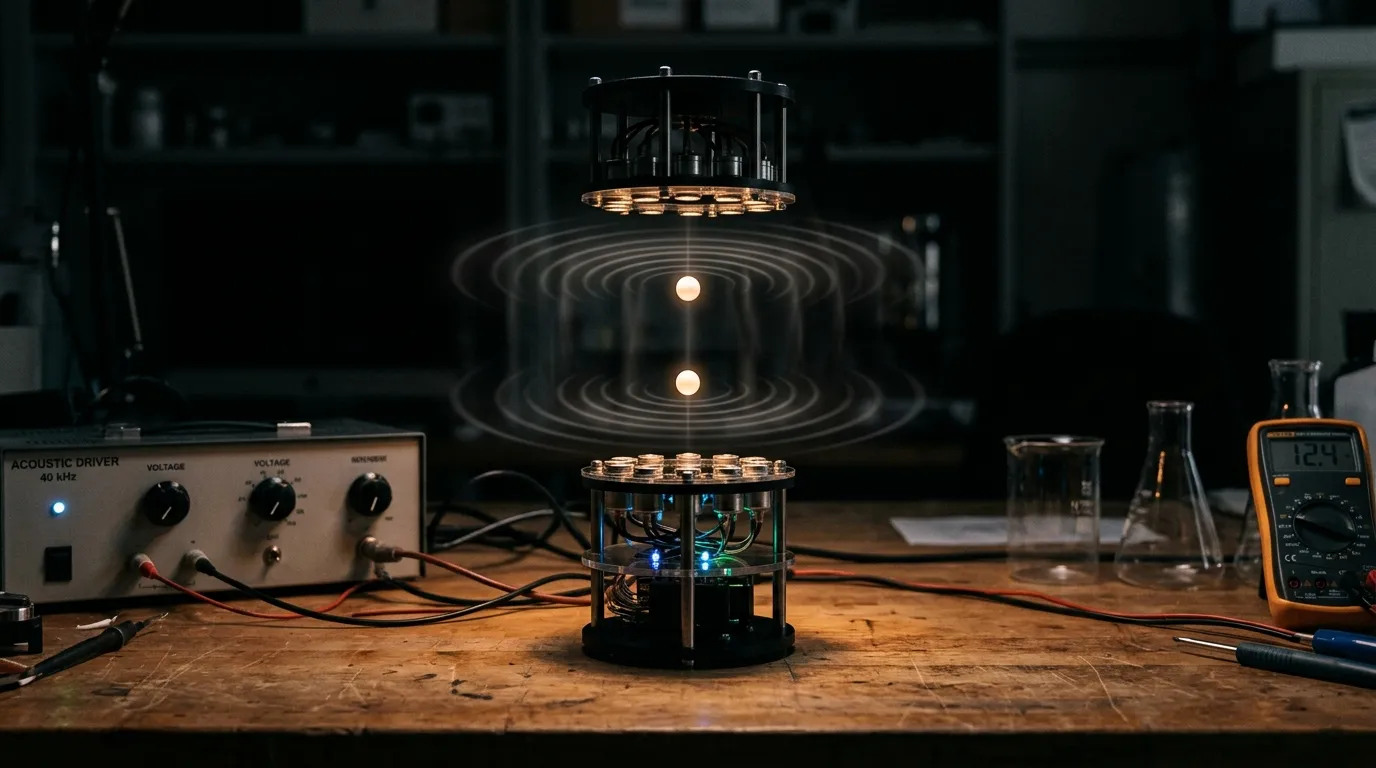
Then a graduate student at New York University levitated two specks of Styrofoam on sound waves, and the specks started ticking like a clock that nobody wound. The larger bead pushed the smaller one around more than the smaller one pushed back. Newton's Third Law, in this system, simply did not apply. What the researchers had built, on a device small enough to hold in one hand, was a time crystal: one of the strangest objects in modern physics, and the first one you can see with your naked eyes.
The Idea That Shouldn't Work
The concept of a time crystal originated as a thought experiment by Frank Wilczek, a Nobel Prize-winning physicist at MIT. In 2012, Wilczek asked a question that sounded almost absurd: ordinary crystals are atoms repeating a pattern in space, from table salt to hexagonal diamond, a material harder than the regular version. Could a system repeat a pattern in time, spontaneously, without anything driving the rhythm?
The idea was immediately controversial. Regular crystals break spatial symmetry because their atoms settle into a lattice instead of spreading out uniformly. A time crystal would break temporal symmetry, establishing a periodic motion in its lowest-energy state. Physicists Haruki Watanabe and Masaki Oshikawa showed in 2015 that Wilczek's original version, a time crystal in thermal equilibrium, was impossible. The concept seemed dead.
But in 2016, theorists proposed a workaround: discrete time crystals, systems driven by an external periodic force that respond at a different frequency than the driving force. The following year, two teams made it real. Mikhail Lukin's group at Harvard used nitrogen-vacancy centers in diamonds, and Christopher Monroe's group at the University of Maryland used chains of trapped ytterbium ions. Both published in the same issue of Nature in March 2017. Time crystals existed.
They were also, without exception, quantum systems operating at exotic temperatures and scales, invisible to the naked eye and requiring millions of dollars in equipment to detect.
Styrofoam, Sound, and Spontaneous Ticking
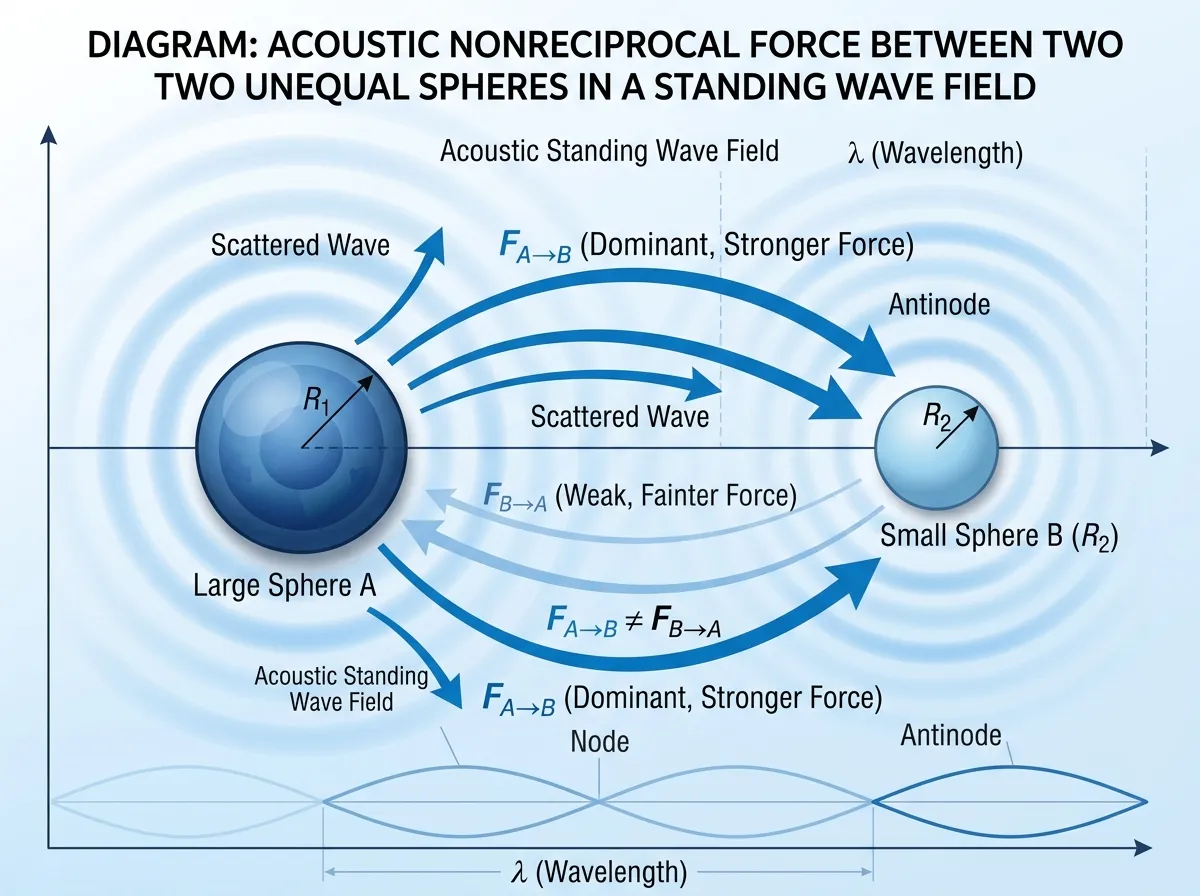
The NYU experiment, published in Physical Review Letters in February 2026, took a radically different approach. David Grier, a professor of physics and director of NYU's Center for Soft Matter Research, along with graduate student Mia Morrell and undergraduate Leela Elliott, built a device roughly one foot tall. A speaker array generates a standing sound wave powerful enough to suspend small objects against gravity. They placed two polystyrene beads, ordinary packing Styrofoam, about one to two millimeters in diameter, into the acoustic field.
Because the beads are slightly different sizes, they scatter the sound waves differently. The larger bead deflects more sound toward the smaller one than vice versa. This creates an asymmetric interaction: the forces between them are not equal and opposite.
Morrell offered an analogy in the university's press release: "Think of two ferries of different sizes approaching a dock. Each one makes water waves that push the other one around, but to different degrees, depending on their size."
That asymmetry turns out to be the engine of something remarkable. The beads begin to oscillate, bobbing back and forth in a steady rhythm without any external periodic force telling them when to move. The standing wave is static. No clock drives the oscillation. The beads select their own frequency, drawing energy from the acoustic field to sustain their motion against air friction. They tick for hours.
"Time crystals are fascinating not only because of the possibilities, but also because they seem so exotic and complicated," Grier said. "Our system is remarkable because it's incredibly simple."
Why Newton's Third Law Breaks
The phrase "breaks Newton's Third Law" tends to make physicists flinch. The third law is not a suggestion. But the key word in the NYU paper's title is "nonreciprocal," and understanding what that means explains why this isn't a violation of fundamental physics so much as a demonstration of something physics already accommodates but rarely produces.
Newton's Third Law holds rigorously for direct contact forces. When you push a wall, the wall pushes back with exactly the same magnitude. But when two objects interact through a mediating field, like sound waves in air, the field itself can absorb or supply the difference. The acoustic field acts as an energy reservoir. Particle A pushes particle B more than B pushes A, and the "missing" reciprocal force goes into (or comes from) the wave field.
This is not a loophole. It is a genuine consequence of wave-mediated interactions. The total momentum of the system, beads plus acoustic field, is still conserved. But from the perspective of the two beads alone, the forces are unbalanced. That imbalance is what allows them to harvest energy from a static field and sustain oscillations that would otherwise die out from friction.
The paper identifies four distinct dynamical states accessible to the two-particle system: passive states where the beads sit still, ordinary oscillations, and two "emergently active" steady states that break time-translation symmetry. These last two are the time crystals. In one, the beads move together. In the other, they move in opposition, like masses on an invisible spring.
The Hydrogen Atom of Time Crystal Research
Grier has called this system potentially the "hydrogen atom" of time crystal research. The comparison is deliberate. The hydrogen atom is the simplest atomic system, one proton and one electron, and solving its quantum mechanics opened the door to understanding everything more complex. Two beads in a sound field may serve the same function for time crystals: a minimal model simple enough to study exhaustively and rich enough to reveal fundamental principles.
Previous time crystals required lasers, cryogenic cooling, trapped ions, or superconducting circuits. The NYU system uses polystyrene beads that cost fractions of a cent, a speaker array, and works at room temperature in open air. This accessibility matters, for the same reason that understanding the tiny crystalline thorns that destroy batteries from the inside required studying the simplest possible version of the problem. When exotic physics requires a multimillion-dollar laboratory, only a handful of research groups worldwide can study it. When it requires a trip to the hardware store, the field can expand dramatically.
The simplicity also makes the underlying mechanism transparent. In quantum time crystals, the physics is tangled up with decoherence, entanglement, and measurement problems. In the NYU system, the physics is classical mechanics and acoustics. You can see what's happening. You can change the bead sizes and watch the system respond. You can turn the sound off and watch it stop.
"The key point is that time crystals select their own frequency without being told what to do by any external force," Grier said. "We're hoping that studying a minimal model will provide access to the deepest insights into the spontaneous emergence of clocks in more general and more complex manifestations."
From Physics to Biology
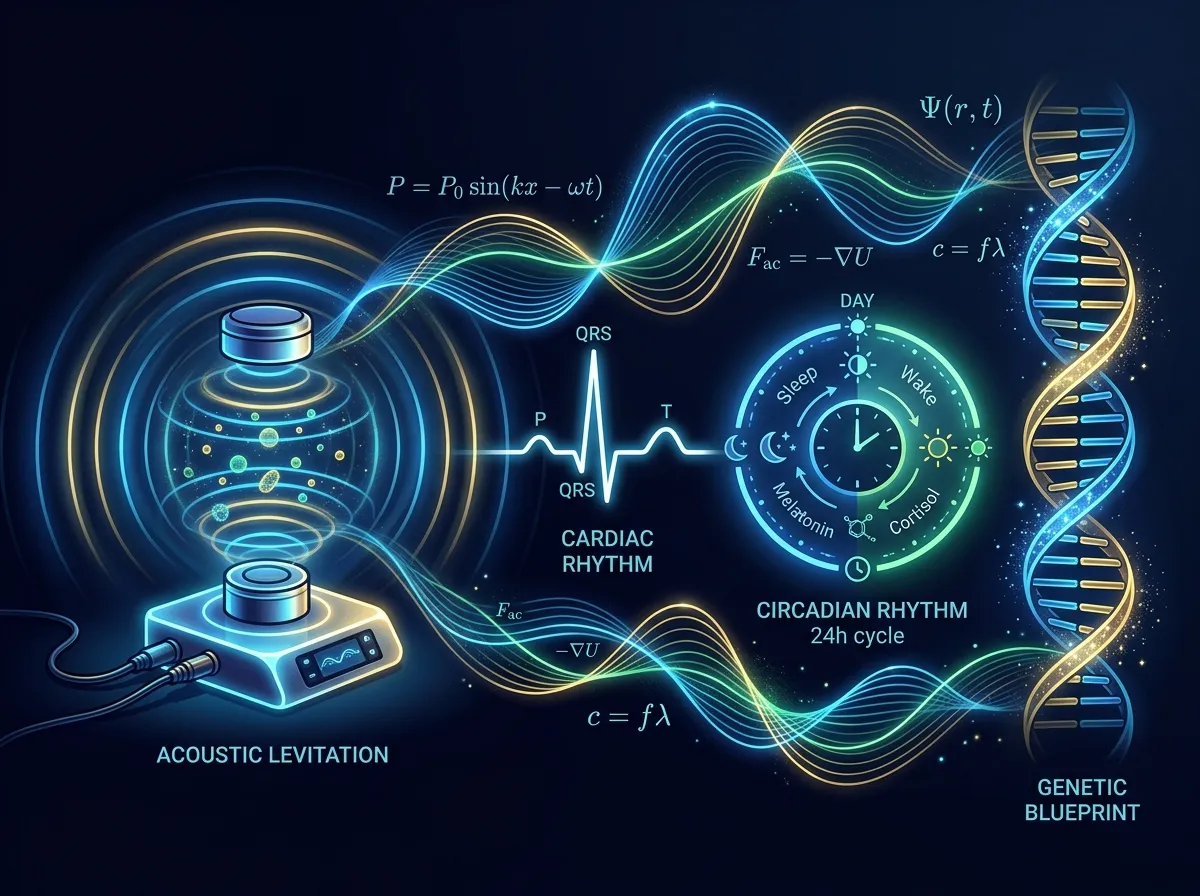
The implications extend well beyond acoustics, and this is where the cross-disciplinary connections get interesting. Nonreciprocal interactions, where A influences B more than B influences A, turn out to be common in systems that generate their own rhythms.
Your heart contains pacemaker cells in the sinoatrial node that fire spontaneously, establishing the rhythm that coordinates cardiac contraction. These cells influence each other through electrical signals, but the coupling is not symmetric. Some cells drive the rhythm more than others. The mechanism is different from sound waves pushing Styrofoam beads, but the mathematical structure is strikingly similar: asymmetric interactions harvesting energy from a reservoir (in this case, metabolic processes) to sustain oscillations that persist for a lifetime.
Circadian rhythms follow a related pattern. The molecular feedback loops that generate your body's 24-hour clock involve nonreciprocal interactions between proteins and genes. The clock protein PERIOD inhibits its own production, but the inhibition and production operate on different timescales, creating the asymmetry that sustains the cycle.
Even financial markets may share this architecture. Cyclic trends in asset prices, the boom-and-bust patterns that economists have documented for centuries, involve participants of different sizes whose actions affect the market asymmetrically. A pension fund and a day trader both respond to price movements, but their impacts on the market are not remotely equal.
The NYU system does not explain any of these phenomena directly. But it provides a laboratory model where the same mathematical principles operate in a system simple enough to study with precision. If the same equations govern ticking Styrofoam beads and ticking pacemaker cells, understanding one illuminates the other.
Where This Leads
The most striking aspect of the NYU discovery is not the exotic physics. It is the ordinariness of the materials. Time crystals were proposed by a Nobel laureate, debated for years, and first created in systems that required extraordinary technological sophistication. The fact that the same phenomenon emerges from packing foam and speakers suggests that time-crystalline behavior may be far more common in nature than anyone suspected.
If nonreciprocal wave-mediated interactions can spontaneously produce clocks, and these interactions are present in biological, chemical, and economic systems, then time crystals may not be rare curiosities. They may be a ubiquitous feature of systems with asymmetric coupling and energy reservoirs. The heartbeats, circadian clocks, and metabolic oscillations that permeate living systems may all be manifestations of the same underlying physics.
The open question is whether this minimal two-particle model can be extended to larger systems. What happens with ten beads? A hundred? Does the complexity scale gracefully, or do new phenomena emerge? Grier's group is reportedly working on these questions now.
This pattern, where something assumed to be exotic turns out to be hiding in plain view, echoes discoveries across science, from the realization that a nearby galaxy had been shattered by a cosmic collision to the growing recognition that nature's rhythms may share deeper mathematical roots than anyone suspected. For physicists, the work is a reminder that the boundaries between "exotic" and "everyday" physics are often thinner than they appear. For everyone else, it is a reminder that the natural world is stranger and more beautiful than intuition suggests. Two specks of Styrofoam, vibrating on sound waves, have just become the simplest clock that physics has ever produced, and nobody told them to start ticking.
Sources
- NYU: Scientists discover levitating time crystals that you can hold in your hand
- ScienceDaily: This floating time crystal breaks Newton's Third Law
- Physical Review Letters: Nonreciprocal Wave-Mediated Interactions Power a Classical Time Crystal
- arXiv preprint: Morrell, Elliott, & Grier (2026)
- Newsweek: Physics time crystals defy Newton's Third Law