
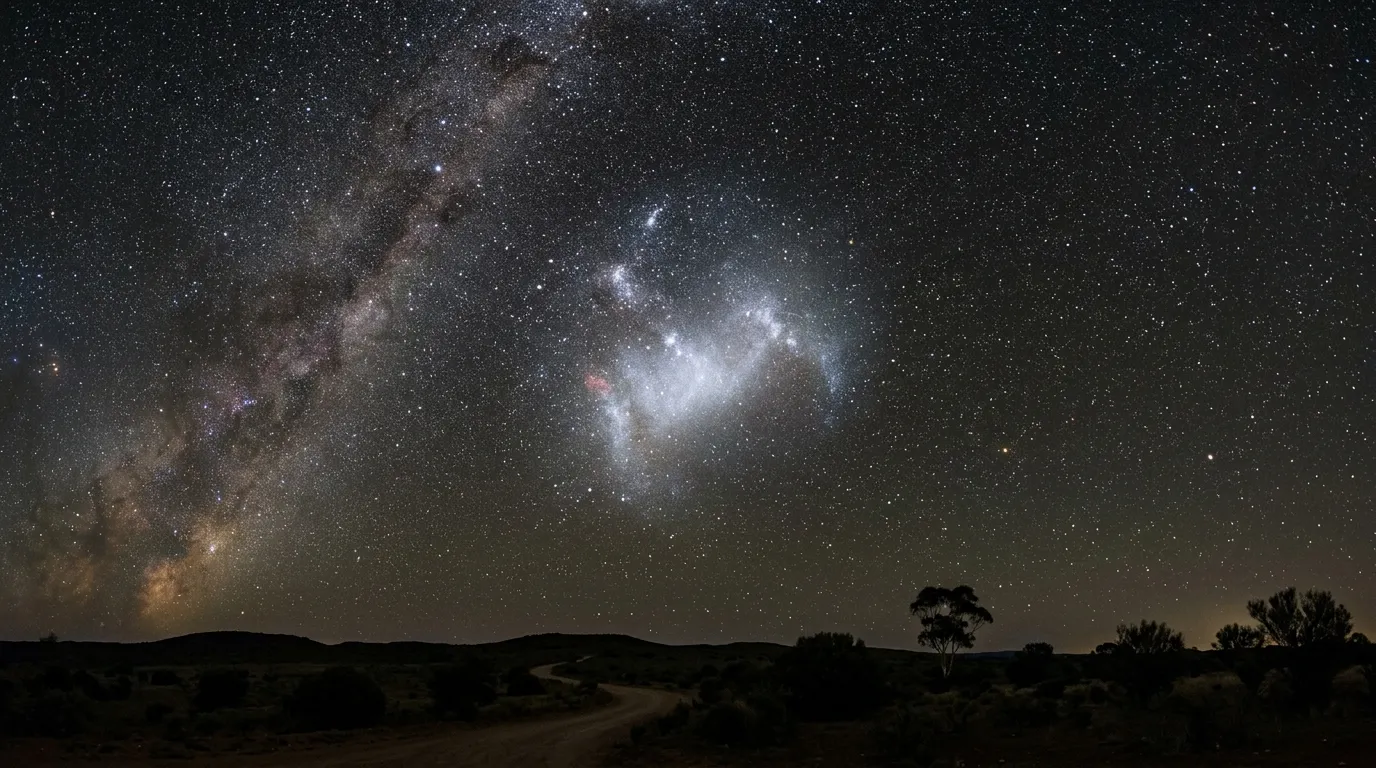
If you have ever stood under the night sky in the Southern Hemisphere, you have probably seen the Small Magellanic Cloud without realizing what you were looking at. It appears as a faint, fuzzy patch of light, a smudge against the darkness that ancient navigators used as a compass marker and modern astronomers treated as one of the most convenient laboratories in the universe. Sitting roughly 200,000 light-years from Earth, the SMC is one of the Milky Way's closest galactic neighbors: small enough to study in detail, gas-rich enough to be interesting, and seemingly simple enough to serve as a textbook example of how dwarf galaxies work.
That textbook example just got torn up. A team of astronomers at the University of Arizona announced on March 19, 2026, that the Small Magellanic Cloud is not the orderly little galaxy it appeared to be. Its stars move in chaotic patterns, refusing to orbit the galaxy's center in any recognizable way. Its gas and stars tell contradictory stories about what the galaxy is doing. And the reason, the team found, is that the SMC slammed directly into its larger sibling, the Large Magellanic Cloud, roughly 100 million years ago. The collision didn't just damage the galaxy. It shattered its internal structure and left it in a state of ongoing transformation that astronomers are now watching unfold in real time.
"We are seeing a galaxy transforming in live action," said Himansh Rathore, a graduate student at Steward Observatory and lead author of the study published in The Astrophysical Journal. "The SMC gives us a unique, front-row view of something very transformative of a process that is critical to how galaxies evolve."
A Textbook Galaxy With a Hidden Problem
For decades, the Small Magellanic Cloud occupied a comfortable spot in astronomy's reference library. Because it contains relatively few heavy elements (metals, in astronomical terminology), it resembles the kinds of galaxies that populated the early universe, when stars had not yet forged heavier atoms through billions of years of nuclear fusion. Researchers studying galaxy formation and evolution frequently used the SMC as a stand-in for those ancient systems, a nearby proxy for conditions that otherwise exist only billions of light-years away, too distant to examine in fine detail.
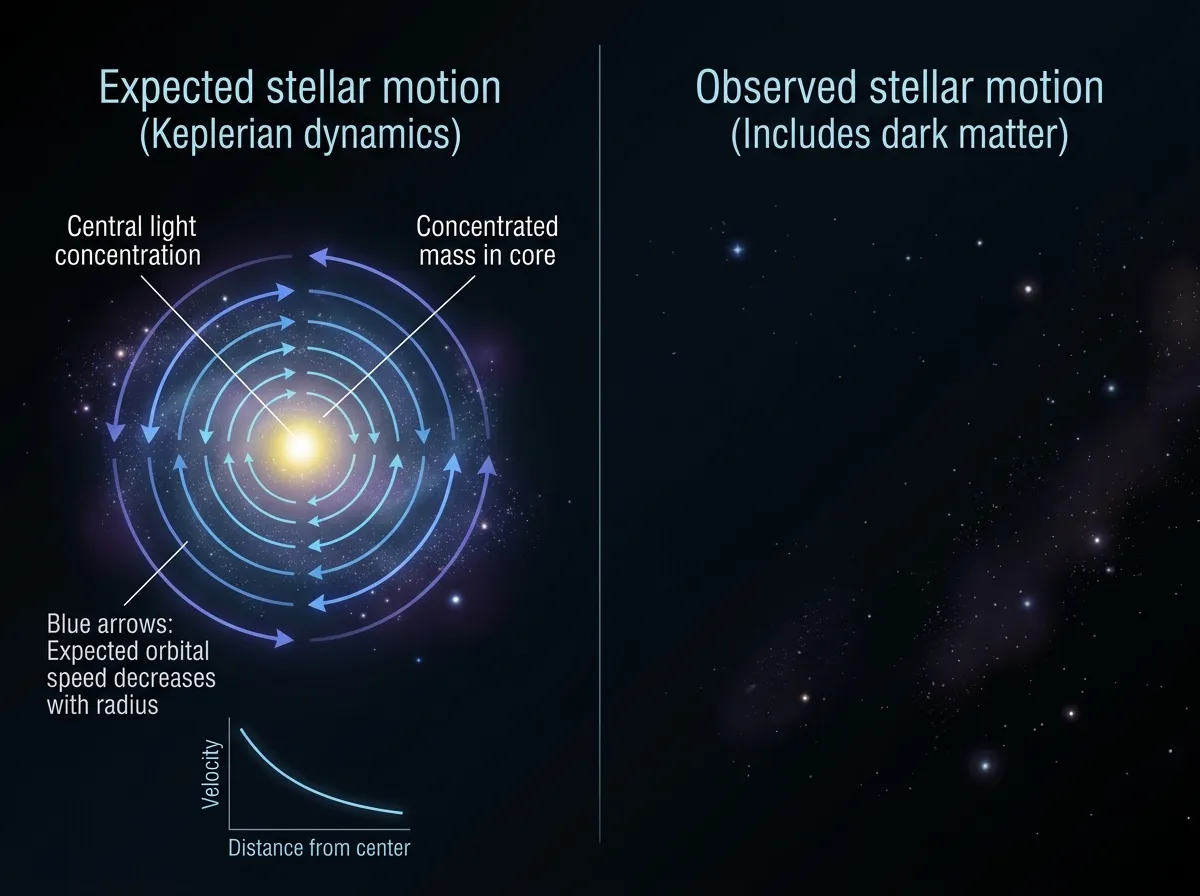
But there were oddities that never quite fit the tidy picture. Observations over the past two decades revealed that the SMC's stars don't behave the way they should in a stable dwarf galaxy. In a normal system, stars orbit the galactic center in roughly predictable patterns, the same way planets orbit a star. The SMC's stars, however, move in disordered, chaotic trajectories. They appear to have been stirred, as if some enormous force scrambled the galaxy's gravitational architecture and nothing has settled back into place.
The galaxy's gas told a different and equally confusing story. When astronomers measured the motion of hydrogen gas across the SMC, it appeared to be rotating, a normal behavior for a gas-rich galaxy. But if the gas was rotating, why weren't the stars? The two components of the same galaxy seemed to be doing fundamentally different things, and no single explanation could reconcile them.
How Two Galaxies Crashed Through Each Other
Rathore and his collaborators, including University of Arizona astronomy professor Gurtina Besla, Roeland P. van der Marel, and Nitya Kallivayalil, built computer simulations to test what could have produced the SMC's bizarre behavior. They modeled the gas content, stellar mass, and known positions of both the Small and Large Magellanic Clouds, then ran two scenarios forward through hundreds of millions of years of simulated time.
In the first scenario, the control model, the two galaxies maintained a safe distance of roughly 100,000 light-years from each other. They orbited in the same general region of space, influenced by each other's gravity, but never came close enough for a direct encounter. In this version of events, the SMC remained orderly. Its stars continued orbiting its center, its gas rotated normally, and its structure stayed intact.
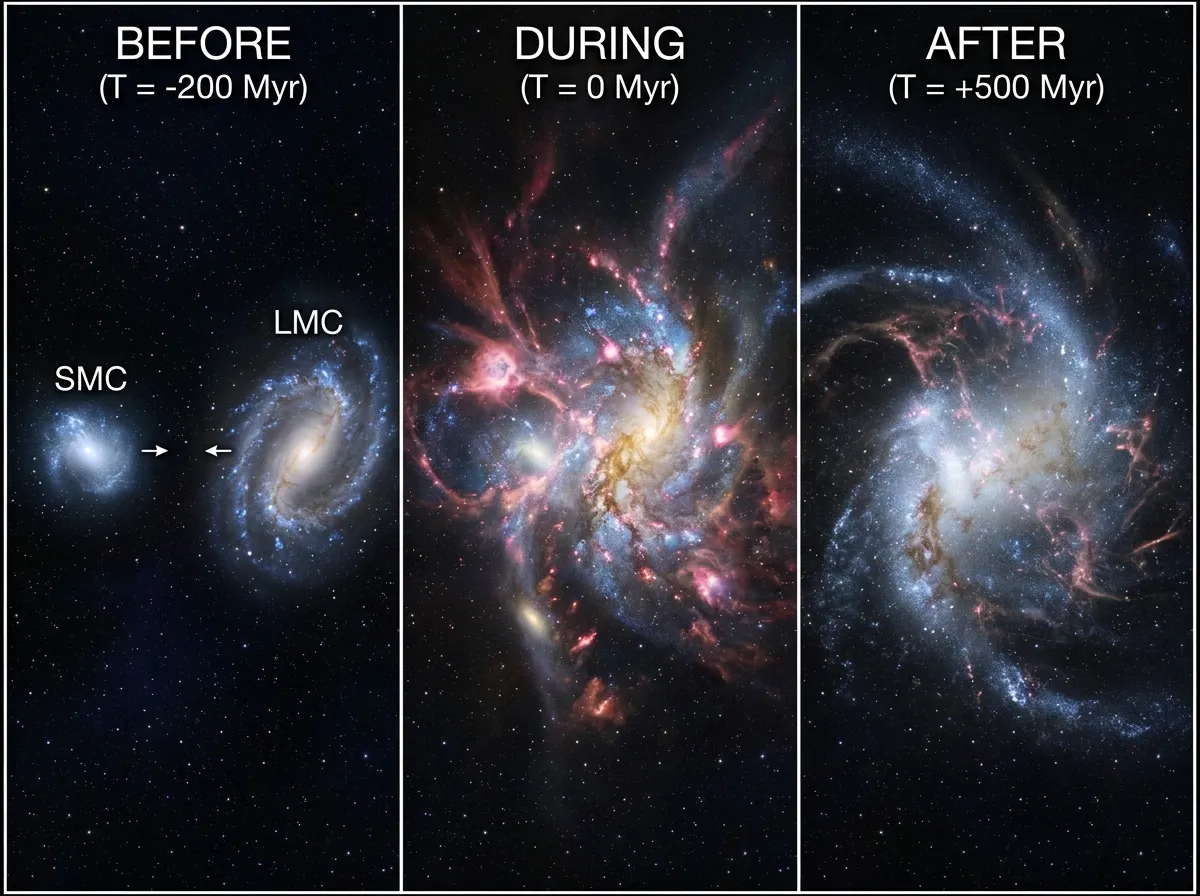
In the second scenario, the collision model, the galaxies slammed into each other approximately 100 million years ago. They didn't just pass nearby, they drove through each other's cores, a process that sounds catastrophic and was. The gravitational forces during the passage scrambled the SMC's stellar orbits, injecting so much energy into the system that stars were flung onto random trajectories. The gas experienced an even more dramatic transformation. Gravitational pressure from the much larger LMC stripped the gas of its rotation entirely, flattening the orderly circular motion into something far more chaotic.
Only the collision scenario reproduced what astronomers actually observe. The control model, where the two galaxies keep their distance, produced a perfectly normal SMC that looks nothing like the real one. "The SMC went through a catastrophic crash that injected a lot of energy into the system," Besla explained. The collision didn't simply bump the galaxy off course. It fundamentally rewired how its stars and gas move.
The Illusion of Rotation
One of the most striking results from the simulations involves the apparent rotation of the SMC's gas. For years, astronomers observed what looked like gas rotating across the face of the galaxy and assumed this meant the SMC was, at some level, still a normally functioning system. The collision simulations revealed something more subtle: the rotation is an illusion.
When the two galaxies collided, the impact stretched the SMC dramatically along one axis. A tidal tail of stars and gas was pulled out of the galaxy's body, and this tail happens to point almost directly along our line of sight from Earth. The result is that the SMC has an unusually large depth, extending much further in the direction we are looking than it does across the sky. Stars and gas in this elongated structure are moving radially outward from the collision, not orbiting a center. But because the elongation is aligned with our viewing angle, the outward motion mimics the signature of rotation when projected onto the two-dimensional sky. The galaxy isn't spinning. It is expanding and deforming, and the geometry of our vantage point makes it look like orderly rotation.
This finding carries an uncomfortable implication for previous research. Studies that relied on the apparent gas rotation to estimate the SMC's mass, structure, or dark matter content may have been working from a false premise. The galaxy's gas was not tracing a gravitational potential well in the usual sense. It was tracing the aftermath of a catastrophe, and the numbers derived from that motion need to be reconsidered.
A Galaxy Transforming Before Our Eyes
What makes the SMC's story so remarkable is that the transformation is not something that happened and finished long ago. One hundred million years sounds like an enormous span of time by human standards, but in galactic terms it is recent. Galaxies operate on timescales of billions of years. A collision that happened 100 million years ago is like an injury that occurred seconds ago for a creature with a century-long lifespan. The SMC is still reeling.
The simulations suggest that the collision may be converting the SMC from a gas-rich, irregular dwarf galaxy into something more like an ellipsoidal or spheroidal dwarf galaxy, a puffed-up, gas-poor system with no organized rotation. If this transformation continues, the SMC will eventually look nothing like the galaxy that navigators saw from the decks of their ships. It will have lost much of its gas to tidal stripping, its stars will settle into a pressure-supported cloud rather than an organized disk, and it will become one more quiet, featureless dwarf satellite of the Milky Way.
This transition from gas-rich irregular to gas-poor spheroidal is one that astronomers believe has happened to many dwarf galaxies throughout the universe, but catching one mid-process is extraordinarily rare. Most of the spheroidal dwarfs we see in the Local Group have already completed their transformation. The SMC offers something no other nearby galaxy currently provides: a front-row seat to the process while it is still underway.
The LMC did not escape unscathed either. In a related study published in 2025, the same research group showed that the collision left a visible scar on the larger galaxy. The LMC's central bar, a dense, elongated structure of stars running through its core, is tilted out of the galaxy's plane. In a normal barred galaxy, the bar sits flat within the galactic disk. The LMC's bar is angled, warped by the gravitational forces of the collision. The tilt angle even provides information about the LMC's dark matter content, adding a new tool for studying an invisible substance that physicists are pursuing through entirely different methods, from proposed axion detectors in fusion reactors to direct-detection experiments buried underground.
Rewriting the Reference Books
The discovery that the SMC is a collision survivor, not a stable dwarf galaxy, has consequences that extend well beyond the Magellanic system itself. For decades, the SMC has been used as a calibration point in astronomy. Its low metallicity made it a convenient analog for early-universe galaxies. Researchers studying star formation, chemical enrichment, and galaxy structure in the distant cosmos frequently compared their observations to SMC benchmarks, assuming the nearby galaxy represented a "normal" example of its class.
"It is not a 'normal' galaxy by any means," Besla stated plainly.
If the SMC's structure, gas dynamics, and stellar kinematics are all products of a recent collision rather than long-term equilibrium, then the measurements astronomers have taken from the SMC over the years carry an asterisk. Star formation rates in the SMC may be influenced by collision-driven gas compression rather than intrinsic galactic processes. The galaxy's apparent depth and extent are shaped by tidal stretching rather than its natural geometry. Even its chemical evolution may have been altered by gas mixing during the collision event.
This does not necessarily mean all SMC-based research is invalid. But it does mean that using the SMC as a baseline requires understanding which of its properties are intrinsic and which are collision artifacts. Michele De Leo, an astronomer at the University of Bologna who was not involved in the study, noted that understanding the SMC "is a step in the direction of solving the puzzle of complex interactions between galaxies." The galaxy has not become less useful to science. It has become useful in a different way, as a laboratory for studying galactic collisions rather than galactic equilibrium.
The broader pattern here echoes discoveries across astronomy: objects we assumed were simple turn out to be products of violent histories. The mysterious "little red dots" that appeared in James Webb Space Telescope images were initially baffling until they were identified as infant black holes wrapped in cocoons of gas and dust, objects that only made sense once their chaotic formation history was understood. The universe, it turns out, rarely produces anything as clean and simple as a textbook example.
What This Means
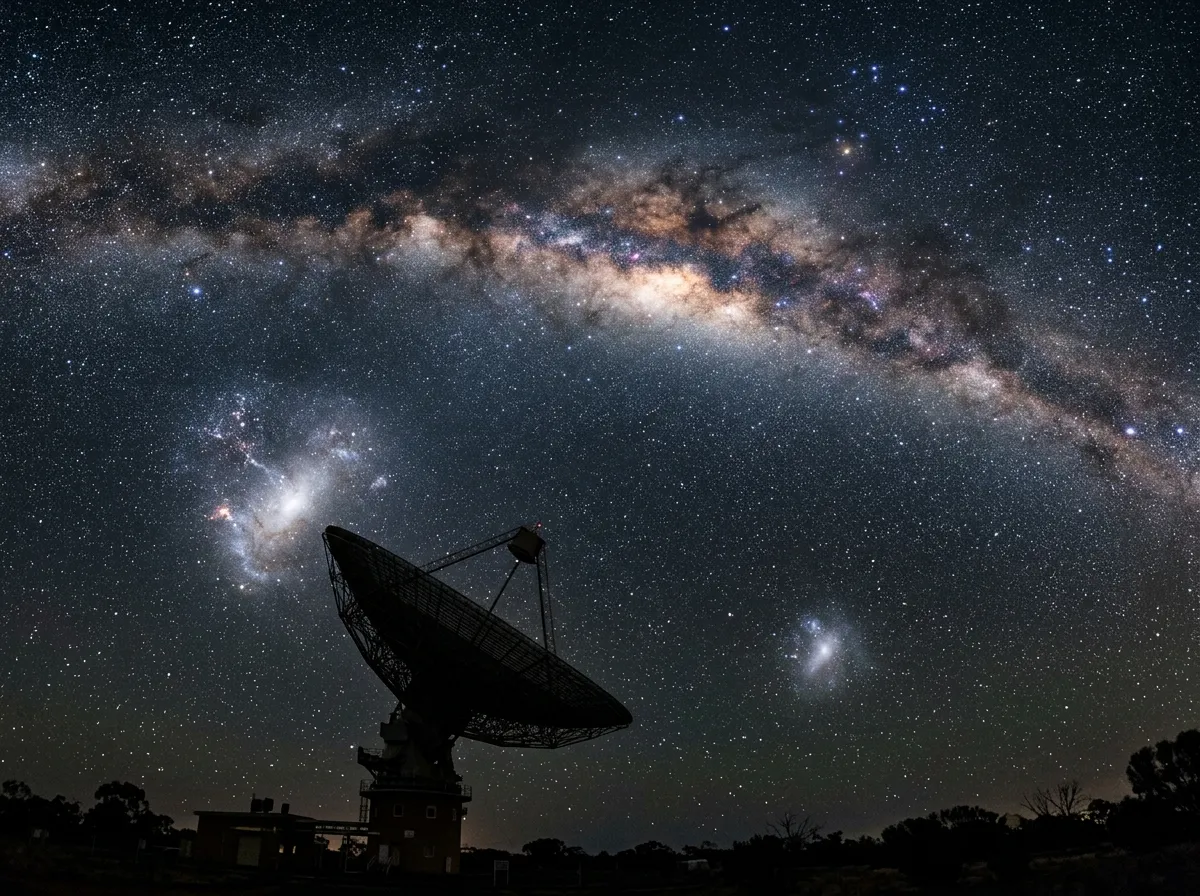
The Small Magellanic Cloud has been a fixture of the southern sky for as long as humans have looked up. Ferdinand Magellan's crew recorded it in the 1500s, giving it the name it still carries. Aboriginal Australians incorporated it into their sky stories thousands of years before that. For the past century, professional astronomers treated it as one of the most reliable benchmarks in extragalactic science, a small, nearby, relatively simple galaxy that could anchor our understanding of far more distant and complex systems.
That narrative has now been replaced by something messier and more interesting. The SMC is not a stable reference point. It is a galaxy in crisis, still recovering from a collision that scattered its stars, stripped its gas of rotation, and stretched its body into a shape that tricks observers into seeing order where there is none. The collision with the LMC roughly 100 million years ago did not just damage the SMC. It set the galaxy on a new evolutionary path, one that may end with it transforming into an entirely different type of galaxy over the coming hundreds of millions of years.
For astronomers, the immediate task is to revisit decades of SMC-based calibrations and determine which conclusions still hold and which need revision. For the rest of us, the discovery is a reminder that proximity does not equal simplicity. The galaxy next door, close enough to see with the naked eye, was hiding one of the most dramatic transformation stories in our cosmic neighborhood. And the collision that caused it, ancient by human reckoning, is still playing out. The SMC is not a relic of the past or a stable feature of the present. It is a galaxy caught in the act of becoming something else entirely, and we happen to be alive at the right moment to watch.
Sources
- ScienceDaily: Astronomers discover nearby galaxy was shattered by cosmic crash
- Scientific American: Something extremely weird is happening to our galactic neighbor
- AAS Nova: Disrupted Dwarf Galaxy: Investigating the History of the Small Magellanic Cloud
- University of Arizona News: A galaxy next door is transforming, and astronomers can see it happening
- The Astrophysical Journal: A Galactic Transformation (Volume 1000, Article 50)