
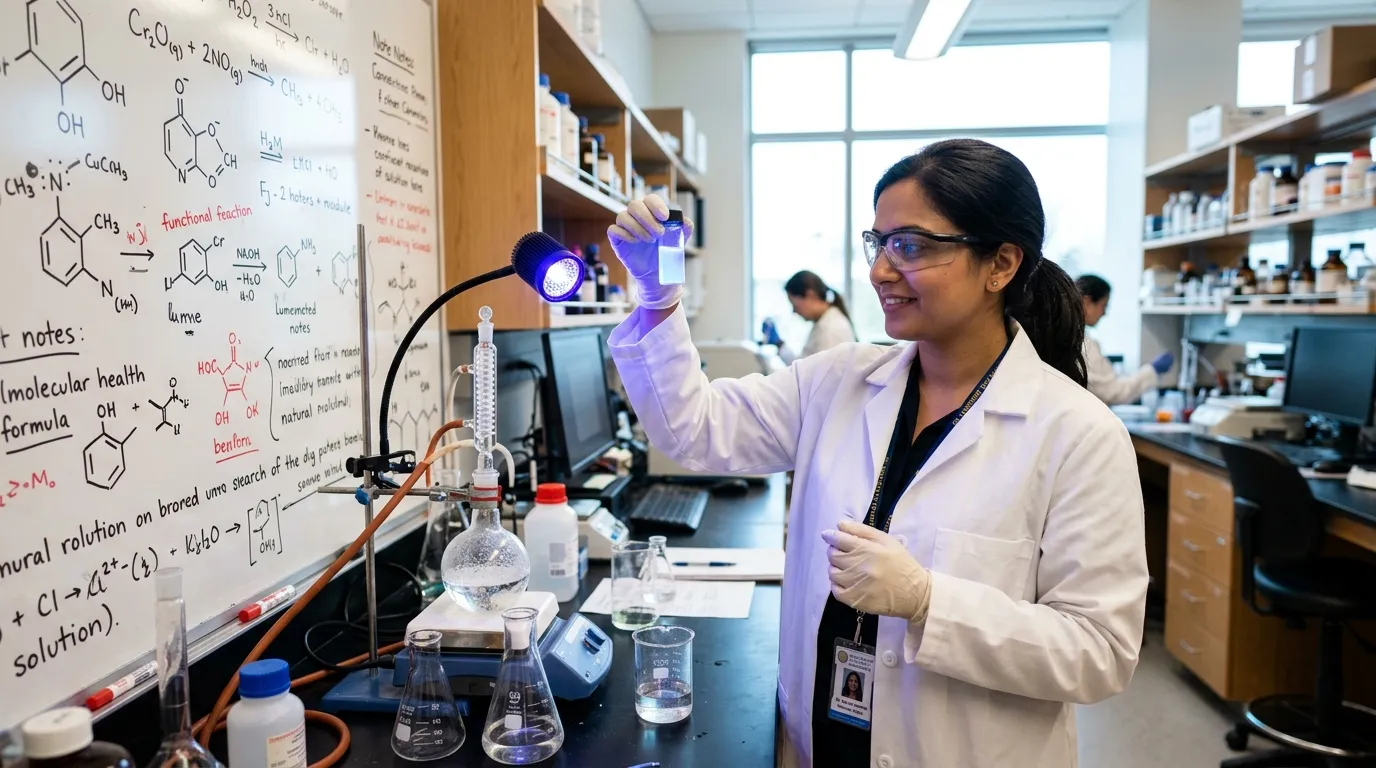
David Vahey was having a bad week in the lab. The PhD researcher at Cambridge's Yusuf Hamied Department of Chemistry had been testing a photocatalyst, a light-activated chemical that was supposed to drive a specific reaction. It wasn't working. He tried different conditions, adjusted variables, ran the experiment again. Nothing.
Then he did something that every chemistry student is taught to do but that rarely produces anything interesting: he ran a control test. He removed the photocatalyst entirely, just to confirm that the reaction couldn't proceed without it. It proceeded anyway. In fact, it worked better.
"Failure after failure, then we found something we weren't expecting in the mess," Vahey later told Cambridge's press office. He called it "a diamond in the rough." What he had stumbled onto was a new type of chemical reaction that reverses one of the oldest and most widely used processes in organic chemistry: the Friedel-Crafts alkylation. And it could change the way pharmaceutical companies build drugs.
The Control Test That Refused to Fail
To understand why Vahey's accidental discovery matters, you need to understand what was supposed to happen and what actually did.
In the original experiment, Vahey was using a photocatalyst to try to attach new chemical groups to aromatic rings, the hexagonal carbon structures that appear in the vast majority of drug molecules. Photocatalysts work by absorbing light and transferring that energy to drive chemical reactions that wouldn't happen on their own. When the catalyst failed repeatedly, removing it was meant to be a formality, a baseline measurement confirming that the catalyst was necessary.
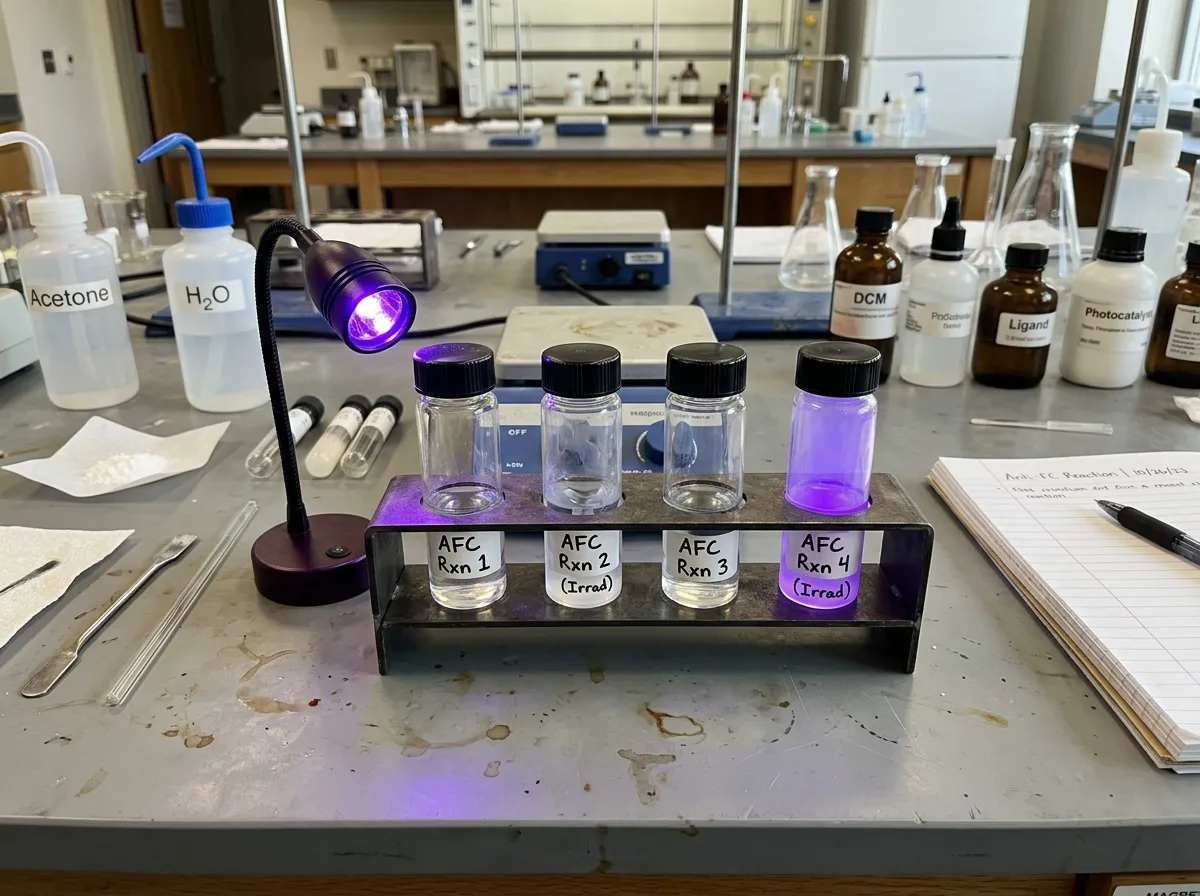
Instead, the reaction ran cleanly under nothing but LED light at room temperature. No metal catalyst. No harsh chemicals. No extreme heat or pressure. Just light, the starting materials, and a process that nobody had predicted would work.
Rather than dismissing the anomaly as contamination or a flawed setup, Vahey dug in. He and his supervisor, Professor Erwin Reisner, spent months characterizing what was actually happening at the molecular level. What they found was a self-sustaining chain reaction: once the LED light kicked things off, the reaction generated its own reactive intermediates that kept the process going, forging new carbon-carbon bonds under conditions so mild they seemed almost implausible.
The results were published in *Nature Synthesis* on March 12, 2026.
Friedel and Crafts Built This Reaction in 1877. Nobody Thought to Flip It.
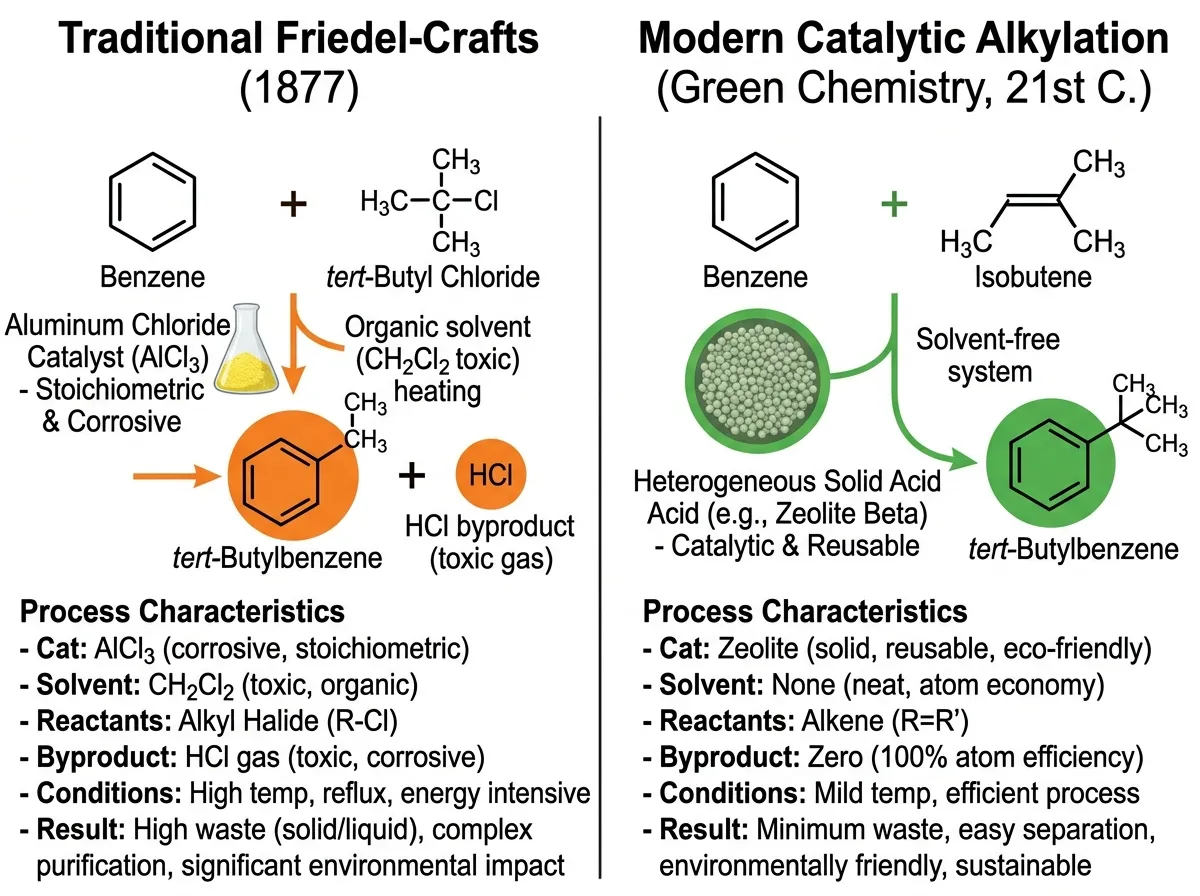
The Friedel-Crafts alkylation is one of the foundational reactions in organic chemistry. Developed by French chemist Charles Friedel and American chemist James Mason Crafts in 1877, it provides a way to attach new carbon groups to aromatic rings using strong acid catalysts, typically aluminum chloride or similar Lewis acids. The reaction has been taught in every undergraduate organic chemistry course for over a century, and it remains one of the most commonly used transformations in industrial chemistry.
But Friedel-Crafts has a problem that has persisted for its entire 149-year history: it's aggressive. The strong acid catalysts required are toxic, corrosive, and indiscriminate. They don't just modify the part of the molecule you want to change. They tend to react with everything in sight, which makes them useful for building simple molecules from scratch but terrible for modifying complex ones that are nearly finished.
This limitation has shaped the entire logic of pharmaceutical manufacturing. Drug companies build molecules in a forward direction: start with simple building blocks, add complexity step by step, and save the delicate final modifications for reactions gentle enough not to destroy what you've already assembled. The Friedel-Crafts reaction, powerful as it is, gets used early in this sequence because it's too rough for the later stages.
What Vahey and Reisner discovered is essentially the inverse. Their "anti-Friedel-Crafts" reaction forms the same type of carbon-carbon bond, but it does so under conditions so gentle that it can be applied to fully assembled drug molecules without damaging their existing architecture. It's the chemical equivalent of being able to swap a single brick in a finished building without touching the rest of the structure.
An LED Lamp and a Chain Reaction
The mechanism behind the new reaction is elegant in its simplicity, which is part of what makes it so surprising that nobody found it sooner.
When the starting materials are exposed to LED light, they form what chemists call an electron donor-acceptor complex. One molecule donates an electron, the other accepts it, and the light provides just enough energy to trigger this exchange. Once that initial bond forms, the process generates reactive intermediates that go on to trigger the next reaction, and the next, and the next. It's a chain reaction that sustains itself without any external catalyst.
The technical term the team used is "electron donor-acceptor photoinitiation," and the key insight is that the reaction is highly selective. It modifies one specific site on a molecule while leaving the rest untouched, a property chemists call "high functional-group tolerance." For drug molecules, which can contain dozens of sensitive chemical groups that would be destroyed by traditional Friedel-Crafts conditions, this selectivity is the entire point.
Professor Reisner, who leads the research group and holds a chair in Energy and Sustainability at Cambridge, framed the discovery in terms of methodology as much as chemistry. "Recognizing the value in the unexpected is probably one of the key characteristics of a successful scientist," he said. The comment was directed at Vahey's decision to investigate the anomalous control test rather than repeating it or writing it off.
Why Changing One Atom Can Take Months
The practical significance of this discovery becomes clear when you understand what pharmaceutical chemists actually do during the years-long process of developing a new drug.
Most drug candidates don't fail because the core molecule doesn't work. They fail because of secondary problems: the drug gets broken down too quickly in the liver, it doesn't dissolve well enough in the bloodstream, it binds to unintended targets and causes side effects. Fixing these problems typically requires small, precise modifications to the molecule's structure, adding a fluorine atom here, swapping a methyl group there, adjusting the three-dimensional shape of a particular region.
With traditional chemistry, making even one of those small changes often means going back to the beginning and rebuilding the entire molecule from scratch. "Scientists can spend months rebuilding large parts of a molecule just to test one small change," Vahey explained. A drug molecule that took two years to construct might need to be disassembled and reassembled to test a single structural variation, with no guarantee the modification will solve the problem.
This is the bottleneck that late-stage functionalization, the ability to modify finished molecules directly, is meant to address. The concept has been a goal of medicinal chemistry for decades, but achieving it requires reactions gentle enough to work on complex molecules without destroying them. Most reactions capable of forming carbon-carbon bonds, the backbone of organic chemistry, are too harsh for that purpose. Friedel-Crafts is a textbook example of this limitation.
The anti-Friedel-Crafts reaction sidesteps the problem entirely. Because it operates at room temperature under LED light with no metal catalyst, it can modify drug molecules at the final stage of development. In principle, this means a chemist could take a finished drug candidate, make a targeted structural change in a single step, and test the modified version within days rather than months. If the lab-grown esophagus breakthrough showed what's possible when you rebuild biological structures from scratch, this discovery suggests we might not always need to rebuild at all.
AstraZeneca Came Knocking
The Cambridge team didn't develop this reaction in isolation. Collaborators at Trinity College Dublin contributed machine learning models that helped predict which molecules would respond well to the new reaction, while pharmaceutical giant AstraZeneca assisted in evaluating whether the process could scale to industrial manufacturing.
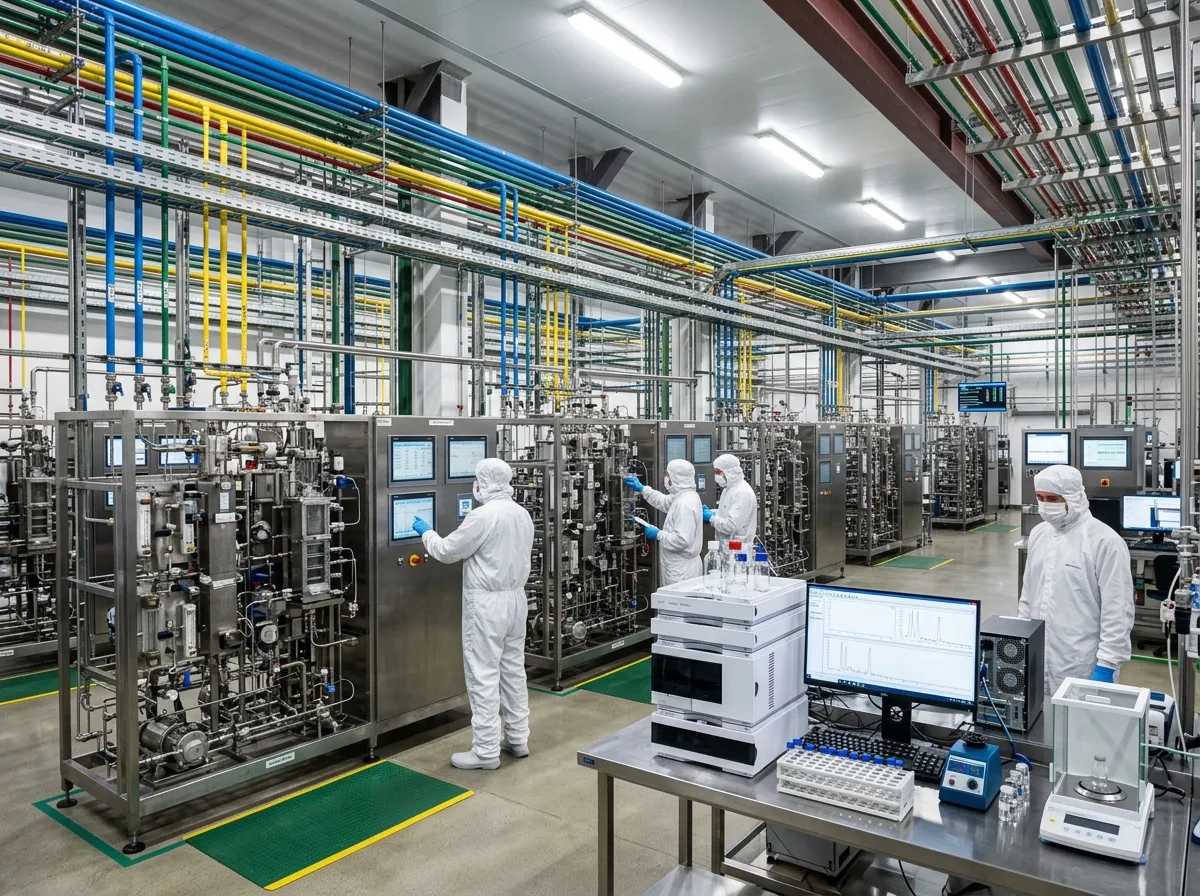
That last point matters enormously. Academic chemistry discoveries frequently work beautifully in a university lab and then fall apart when companies try to produce them at scale. Heat, pressure, exotic catalysts, and sensitive reagents all create problems when you move from milligram quantities to kilograms. The anti-Friedel-Crafts reaction avoids most of these scaling headaches because its requirements are so minimal: an LED light source and the starting materials. The team has already demonstrated that the reaction adapts to continuous flow systems, the industrial method where chemicals are pumped through reactors in a steady stream rather than mixed in individual batches.
The environmental implications are significant too. Traditional Friedel-Crafts reactions generate substantial chemical waste, including spent metal catalysts that require specialized disposal. A light-driven process that uses no catalyst and operates at room temperature reduces both the chemical waste and the energy consumption of pharmaceutical manufacturing. At a time when the industry is under growing pressure to reduce its environmental footprint, that's an advantage that goes beyond pure chemistry.
The connection to other recent breakthroughs in molecular science is worth noting. Just as researchers working on Alzheimer's treatment have found ways to target specific protein interactions without disrupting surrounding cellular machinery, Vahey's reaction achieves something analogous at the molecular level: surgical precision in a field that has historically relied on brute force. And like the discovery that lithium dendrites are far stronger than expected, this finding emerged from looking more carefully at something scientists thought they already understood.
What This Means
The story of the anti-Friedel-Crafts reaction is, at one level, a story about a single chemical process. But it carries implications that extend well beyond the lab bench where Vahey ran his fateful control test.
Pharmaceutical development is one of the most expensive and failure-prone industries on the planet. Bringing a single drug from initial discovery to approved medication costs an average of $2.6 billion and takes roughly 10 to 15 years, according to a widely cited 2020 analysis by the Tufts Center for the Study of Drug Development. A meaningful fraction of that cost is spent on synthesizing and testing molecular variants, the exact bottleneck that late-stage functionalization addresses. If the anti-Friedel-Crafts reaction proves as versatile as early results suggest, it could compress the optimization phase of drug development from months to weeks for certain classes of molecules.
There are caveats, of course. The reaction has been demonstrated on a range of drug-like molecules, but "a range" is not "all." Certain molecular architectures may not respond to the new conditions. The chain-reaction mechanism, while self-sustaining, needs more study to understand its limits and failure modes. And scaling from Cambridge's lab to AstraZeneca's manufacturing plants will surface problems that can't be predicted from bench-scale experiments alone.
But the core achievement is real. For 149 years, one of organic chemistry's most useful reactions has been locked behind conditions too harsh for delicate work. A PhD student's failed experiment has unlocked a gentler version that works precisely where the original can't. Sometimes the most significant discoveries don't come from having the right answer. They come from paying attention when the wrong answer turns out to be more interesting.
Sources
- Failed experiment leads to surprise drug development breakthrough - Phys.org, March 2026
- A lab mistake at Cambridge reveals a powerful new way to modify drug molecules - ScienceDaily, March 13, 2026
- Failed experiment by Cambridge scientists leads to surprise drug development breakthrough - EurekAlert!, March 2026
- Light-Driven Reaction May Transform Drug Design - Technology Networks, March 2026