

Isle-aux-Grues has roughly 140 permanent residents, three dairy farms, and no winter ferry. The island sits in the St. Lawrence River about 75 kilometers east of Quebec City, seven kilometers long and two wide, accessible only by small aircraft once the river ice becomes too unpredictable for boats. The cheese cooperative makes a soft-ripened wheel called Le Riopelle, named after the painter Jean-Paul Riopelle, who died there in 2002. Another cheese is simply called Le Mi-Careme, named after the event that defines the island's identity more than any other.
Every March, at the midpoint of Lent, more than 90% of the island's population puts on elaborate handmade costumes and masks, then spends a week going door to door in groups of five to ten, performing choreographed routines and trying not to be recognized by their own neighbors. The hosts serve toffee, fudge, and drinks. They study the visitors' walks, gestures, and voices. They guess. If they guess correctly, the identified person cannot wear the same disguise the following evening. By the end of the week, identities have been revealed in cascading laughter, and then on Sunday, the mi-caremes attend church Mass still in costume. It is called Mi-Careme, literally "mid-Lent," and it is one of the last places in North America where this centuries-old French tradition endures.
A Medieval Break From Piety
The tradition traces back to medieval France, where it emerged as popular contestation against the strict Lenten fasting rules instituted at the Council of Benevent in 1091. Forty days without meat, eggs, or dairy was a long time, and by the twentieth day, practical concerns converged with the human desire for a party. Eggs could not be stored for more than three weeks without spoiling, so Mi-Careme provided an occasion to consume them in crepes and bugnes (fried pastries). A ritualistic personification developed: Mi-Careme was imagined as an old woman symbolically sawed in half, representing the old year and winter.
In Paris, the festival became elaborate. It was the feast of the laundresses, the charcoal dealers, and the water carriers. Working-class women elected queens, dressed in costumes, and hosted balls while float parades filled the streets. Photographer Paul Geniaux documented the early 1900s celebrations in images now held by the Musee d'Orsay. The Church, predictably, was not thrilled. An 1885 ecclesiastical mandate prohibited "all disguises, masks and processions under penalty" of sanctions. The celebrations endured regardless, at least until World War II killed them in Paris. (They were revived in 2009 as the Carnaval des Femmes.)
Mi-Careme crossed the Atlantic with French colonists in the 1600s. It flourished in eastern Canada's French-speaking communities: the Magdalen Islands, Quebec's North Shore, parts of New Brunswick, and isolated Acadian settlements in Cape Breton. Many communities adopted it after the Great Deportation (le Grand Derangement, 1755-1763), when the British expelled thousands of Acadians from the Maritimes, scattering them across the continent. The tradition became a thread of continuity in communities that had lost nearly everything else.
The Four Communities That Kept It Alive
Today, only four Canadian communities still celebrate Mi-Careme: Isle-aux-Grues, Natashquan on Quebec's remote North Shore, Fatima in the Magdalen Islands, and Cheticamp on Cape Breton Island in Nova Scotia. Each version is distinct, shaped by the geography and character of its community.
At Natashquan, roughly 1,000 kilometers from Quebec City and home to around 250 winter residents, the tradition has been celebrated continuously since the village's founding in 1855. Residents place scarecrows outside their homes or hang red lights to signal that les mi-caremes are welcome. The village is also the birthplace of legendary Quebec poet and singer Gilles Vigneault, who composed "Mon pays" and "Gens du pays," Quebec's unofficial anthems. His line about the tradition captures something essential: "We lost Lent, but kept the middle."
At Cheticamp on Cape Breton's Cabot Trail, Acadian settlers have celebrated without interruption since 1785, making it the longest continuously observed Mi-Careme in Canada. Monique Aucoin, who has participated for 68 years and is president of the local Societe Mi-Careme, put it simply: "The week of Mi-Careme was a great week to work because nobody was sick. It's like endorphins." The community opened a dedicated Mi-Careme Centre in 2009, born from a period of crisis after the 1994 cod fishery closure. Displaced fish plant workers, mostly women over 55, received museum training and learned traditional dances, theater, and storytelling to become the center's interpreters. The boutique has sold roughly 10,000 locally made masks.
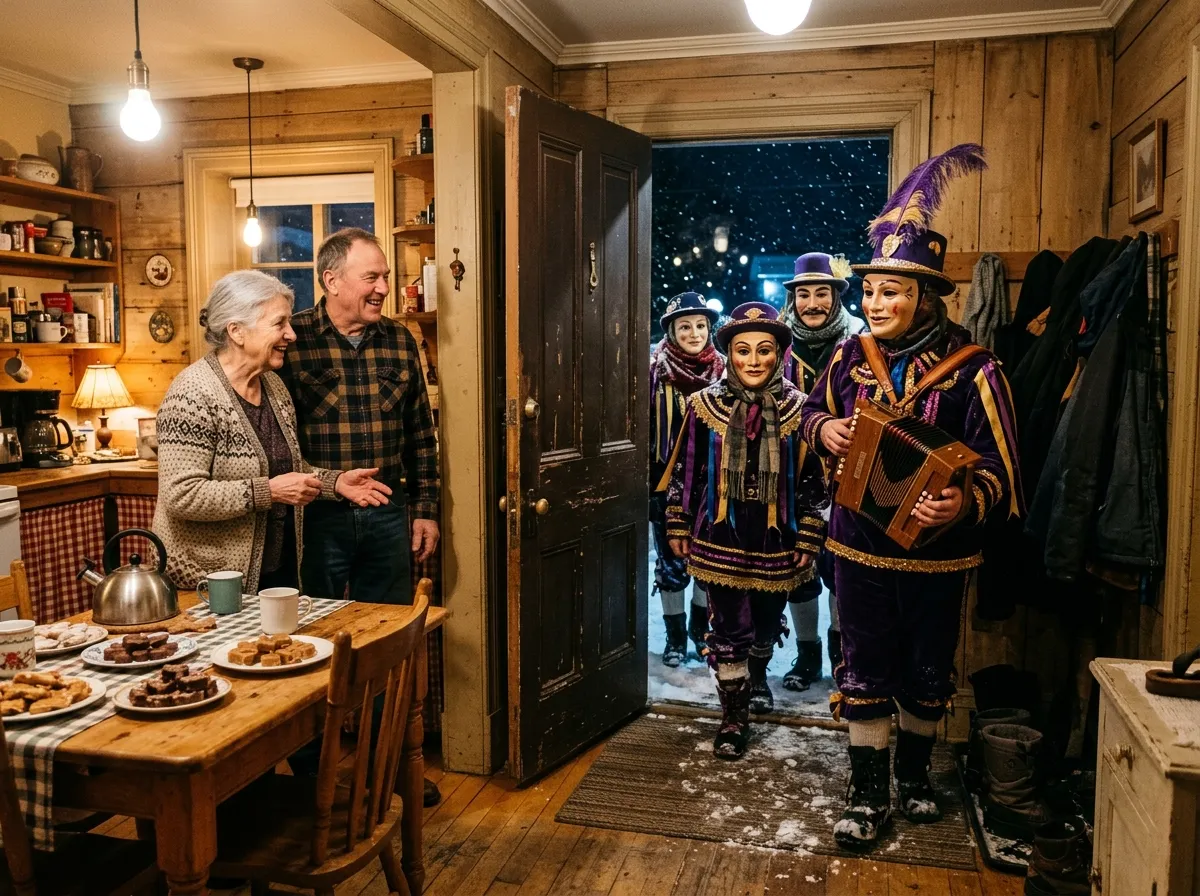
At Fatima in the Magdalen Islands, Jacques Aucoin has been receiving mi-caremes in his garage for three decades. Up to 500 people parade through on a single evening. His partner Jeanne Arseneau helps prepare the traditional homemade wine, described as "sweet and formidable," that functions like champagne at New Year's. Isabelle Cummings, vice-president of Fatima's Mi-Careme committee, recalled her most treasured memory: "Seeing my grandmother at 85 years old, sitting with my young girls, all together, all my family in the house, playing guitar, singing, having fun. Priceless."
The Revolt That Saved It
Isle-aux-Grues nearly lost the tradition in 1960, and the reason was exclusion. Until that year, Mi-Careme participation was exclusively male. Women were prohibited by the clergy from evening activities, despite being the ones who made their husbands' costumes in total secrecy, covering their windows so no one could see their work. In 1960, the women revolted against their exclusion, and the tradition simply stopped.
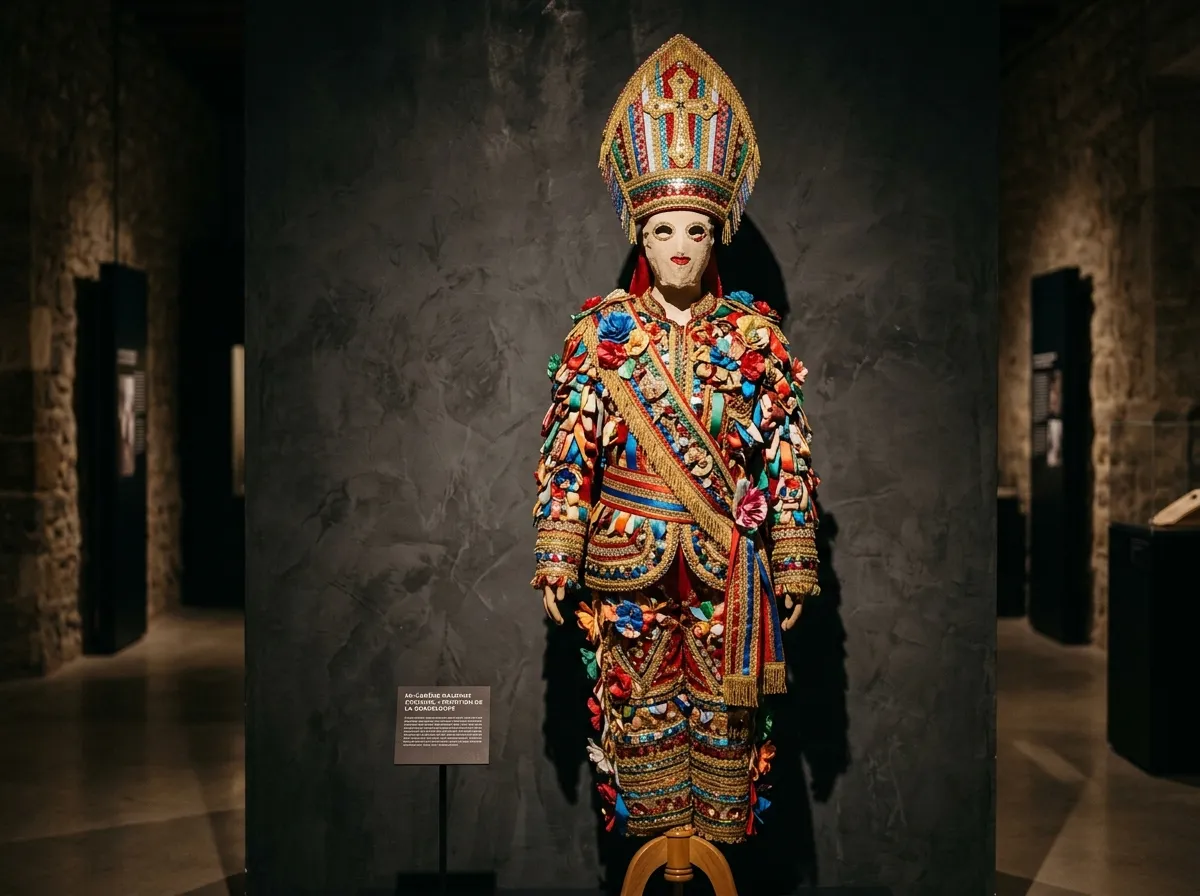
The interruption lasted fifteen years. In 1976, a parish priest and parishioners revived it with one significant change: women could now participate fully. The transformation was immediate. Costumes became increasingly elaborate and valued. What had been simple disguise, old clothing stuffed with padding (called "guenilloux"), evolved into themed group productions created over months of secret preparation. The celebration expanded from a few evenings of anonymous mischief into a full-week costumed festival. The traditional galonne, a men's suit covered in multicolored ribbons, braided trims, sequins, and paper flowers, topped with a hat shaped like a bishop's mitre, now shares space with Steampunk, Pharaonic, and Disco themes.
Ethnologist Martine Roberge of Universite Laval, who has studied Mi-Careme extensively, argues in a 2020 paper that the festival is a "renewed practice" rather than a preserved relic or an invented tradition. The women's inclusion was not a break from authenticity but an adaptation that saved it. Roberge identifies female leadership in costume fabrication as essential to the tradition's continuation. The isolation of the communities, she notes, has paradoxically protected them from the over-commercialization that has transformed other cultural traditions into tourist commodities.
What Makes It Different From Carnival
Mi-Careme is often compared to Mardi Gras and Carnival, but the comparison misses something fundamental. Mardi Gras occurs before Lent begins. It is the last hurrah before penance. Mi-Careme occurs during Lent, twenty days into the fast. It is a sanctioned rupture within the period of penitence itself, a deliberate crack in the austerity rather than an alternative to it. The relationship to the calendar is not incidental; it is the point. The pleasure of Mi-Careme is sharpened by the discipline that surrounds it.

The masquerade element also works differently. At Carnival, masks create anonymity in a crowd of strangers. At Mi-Careme on an island of 140 people, masks create anonymity among people who know each other intimately. The challenge is not to disappear into a mass but to become unrecognizable to your own neighbor, the person who sees you at the post office, at the cheese cooperative, at Mass every Sunday. Participants change their gait, their posture, their voice. They rehearse gestures that belong to no one. The game is not performance for an audience but deception within a community, and the unmasking is not a reveal for strangers but a rediscovery among people who thought they knew each other completely.
The tradition's geographic range extends beyond Canada. In Brazil, the term "micareta" derives from French mi-careme, describing out-of-season carnival celebrations. Guadeloupe, Martinique, and Saint-Martin celebrate with "deboules," parades of revelers in red and black. But the Canadian communities represent the tradition's most intact form, preserved by the same forces that preserved it in medieval France: small populations, shared hardship, and the human need to break loose in the middle of what is supposed to be the most austere season of the year.
Why It Matters
Quebec was the first Canadian province to recognize intangible cultural heritage at the legislative level, passing a Cultural Heritage Act in 2012 that included provisions inspired by UNESCO's convention for safeguarding such traditions. Mi-Careme is listed on the Quebec Cultural Heritage Registry. Historian Georges Arsenault, whose 2007 book La Mi-Careme en Acadie is the definitive account, has documented how the tradition adapted at each crisis point: the Deportation, industrialization, the Church's relaxation of Lenten rules after Vatican II, the cod fishery collapse.
Each time, someone decided it mattered enough to keep. The women of Isle-aux-Grues decided it in 1976 by insisting on inclusion. Jacques Aucoin decided it in Fatima by opening his garage. The displaced workers of Cheticamp decided it by learning to become museum interpreters for a tradition they had practiced their whole lives.
What survives in these four communities is not a museum exhibit. It is a living practice that nearly 100% of residents participate in, that children learn from the age of 13 or 14, and that brings former residents back from the mainland every March. It is a tradition that requires no spectators because the audience and the performers are the same people. In an age when cultural heritage is increasingly something consumed rather than practiced, Mi-Careme is a reminder that some traditions survive not because they are preserved by institutions but because the people who live them refuse to let go.
Sources
- Canadian Geographic: "Celebrating Mi-Careme in the Magdalen Islands" - Detailed account of the Fatima celebration with Jacques Aucoin and Isabelle Cummings quotes
- Martine Roberge, "Les festivites de la mi-careme: un divertissement populaire renouvele," Recherches sociographiques, Vol. 61, No. 1 (2020) - Academic analysis of Mi-Careme as renewed practice
- NUVO Magazine: "The Historic Festival of Mi-Careme" - Overview of all four communities and Monique Aucoin's testimony
- Quebec Cultural Heritage Registry: Mi-Careme - Official intangible heritage listing
- Historic Nova Scotia: "The Mi-Careme Centre" - Cheticamp centre origins and community response to cod fishery closure