
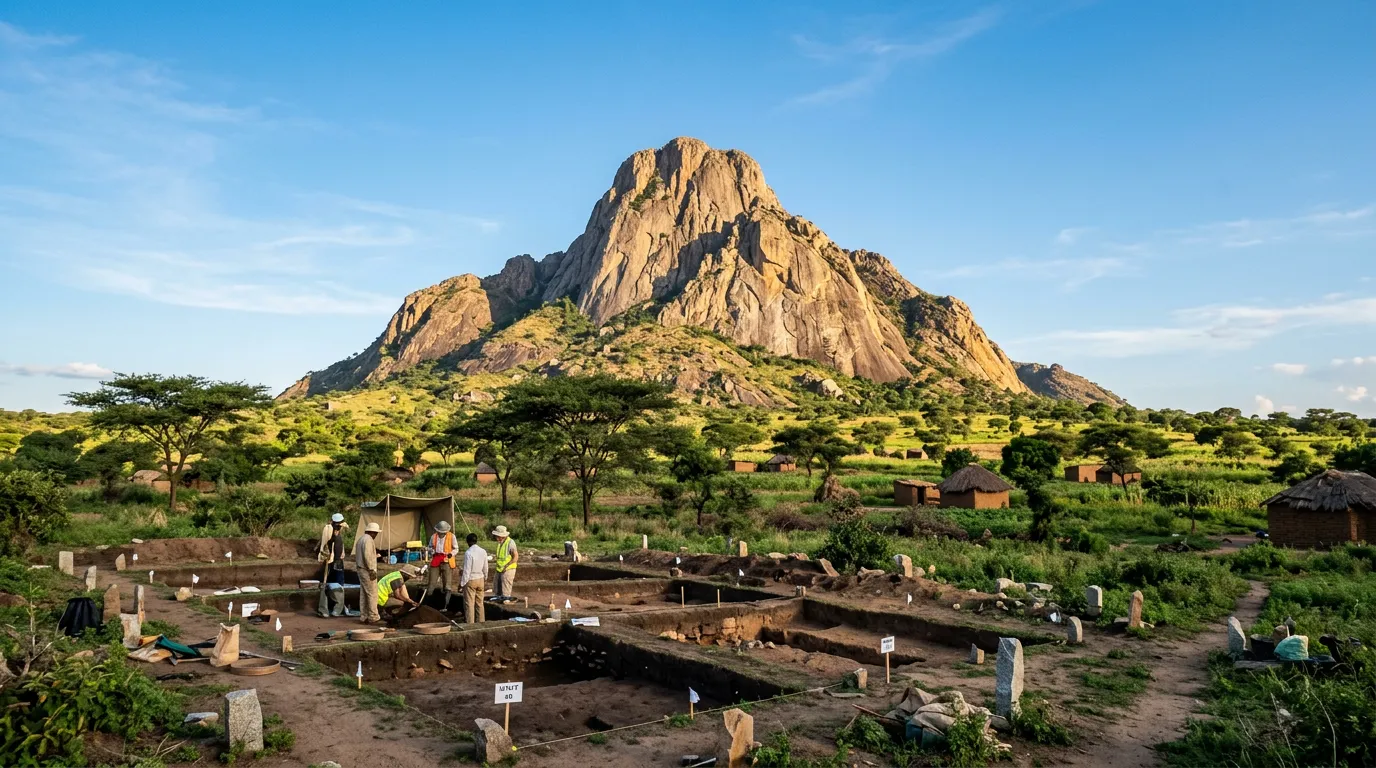
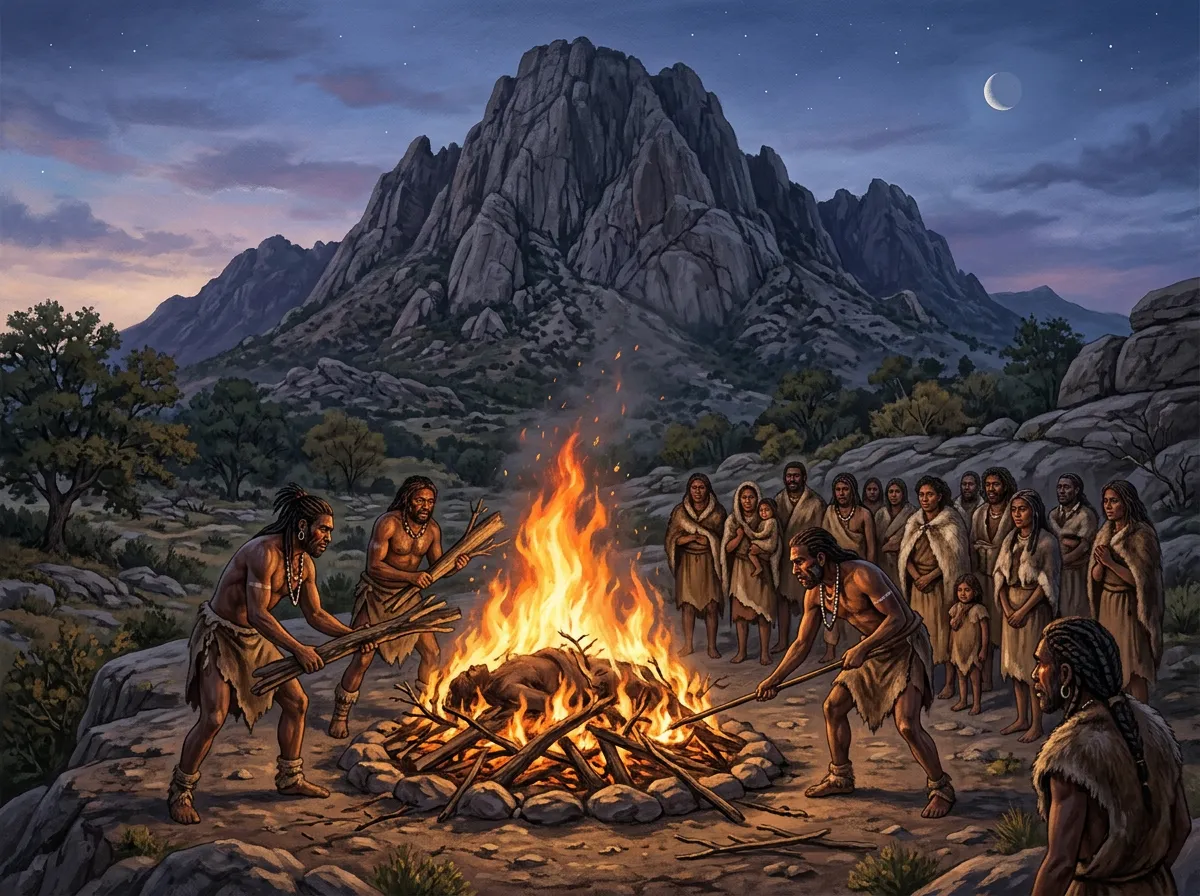
About 9,500 years ago, in what is now northern Malawi, a community of hunter-gatherers gathered at the base of Mount Hora and built a pyre. They collected approximately 30 kilograms of deadwood and grass, arranged it carefully, and placed the body of a small woman on top. She was an adult, somewhere between 18 and 60 years old, and she stood just under five feet tall. They lit the fire and tended it for hours, maintaining temperatures above 500 degrees Celsius until her bones calcined white. Then, at some point either before or after the burning, her head was removed. It was never placed on the pyre. No fragments of skull or teeth have been found among the 170 bone pieces recovered from the site. Other people buried at the same location over the centuries received standard inhumation, their bodies placed in the earth without fire. This one woman was different. Nobody knows why.
The discovery, published in Science Advances by a team led by Jessica Cerezo-Roman of the University of Oklahoma and co-authored by Yale paleoanthropologist Jessica Thompson, is the earliest known intentional cremation in Africa. It predates the previous oldest African cremation, found among Elmenteitan pastoralists in Kenya, by more than 6,000 years. It is also the oldest known in situ cremation pyre containing adult remains found anywhere in the world, meaning the actual structure of the fire, not just the burned bones, survived intact in the archaeological record. That combination of age, preservation, and ritual complexity makes the Hora-1 pyre one of the most significant funerary discoveries in decades.
The Archaeology of Fire and Bone
The Hora-1 site sits at the base of Mount Hora, a prominent granite inselberg that would have been a visible landmark for communities living across the surrounding landscape. Archaeologists have known about the site since the 1950s, when early excavations recovered human remains from multiple burial contexts. But the cremation pyre was not identified until recent re-excavation and analysis applied modern techniques, including radiocarbon dating, bone histology, and fuel analysis, to material that earlier researchers had partially documented but not fully understood.
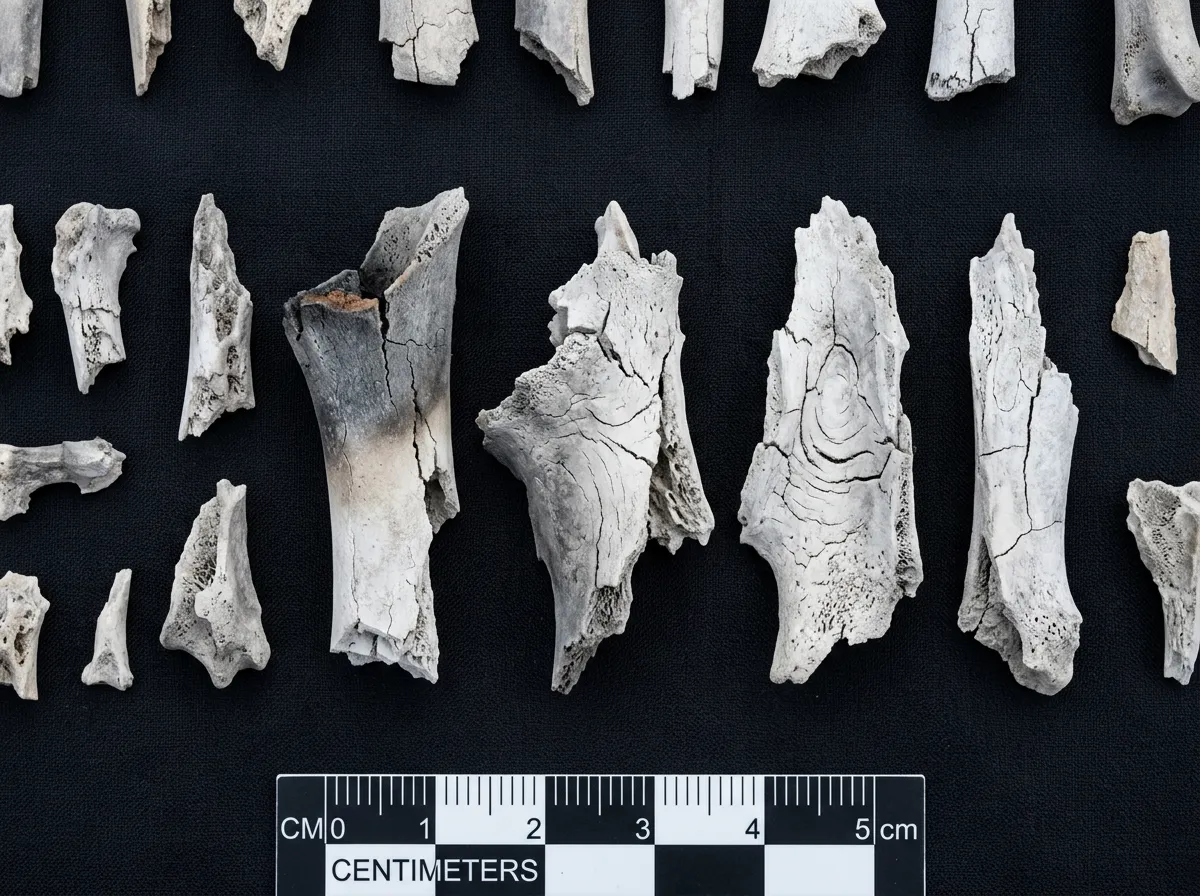
The 170 bone fragments recovered from the pyre came predominantly from arms and legs. Their condition tells a detailed story about the fire itself. The bones exhibit the characteristic warping, cracking, and color changes that result from burning at high temperatures while still containing moisture and organic material, confirming that the body was cremated while relatively fresh rather than after decomposition. The sustained temperatures above 500 degrees Celsius indicate that the fire was not simply lit and left to burn. Someone tended it, adding fuel and managing airflow to maintain the intensity needed for effective cremation.
Stone tools were found within the pyre debris, raising the possibility that they were placed deliberately as funerary objects. Whether these tools held personal significance for the deceased or served some ritual function during the cremation is impossible to determine from the physical evidence alone. But their presence in the pyre, rather than scattered around the site, suggests intentional inclusion.
The Missing Head
The most striking detail of the Hora-1 cremation is the absence of cranial and dental remains. In a complete cremation, skull fragments and teeth are among the most recognizable and durable elements. Their total absence from a pyre that preserved 170 other bone fragments strongly suggests that the head was not present when the body was burned. This could mean the head was removed before cremation, a practice documented in various cultures across time periods and geographies, or that it was removed after death but before the funerary rite began.
Head removal in mortuary contexts is not unique to this site. Neolithic communities in the Levant, particularly at sites like Jericho and Ain Ghazal dating to roughly 8,000-9,000 years ago, practiced skull removal and plastering, creating modeled portraits of the dead that were displayed and eventually buried separately from the body. These practices are generally interpreted as ancestor veneration, a way of keeping the identity of the dead present in the community. Whether the Hora-1 head removal served a similar purpose is unknown, but the parallel is suggestive. It implies that the community that cremated this woman may have engaged in a multi-stage funerary process: separating the head, possibly for continued ritual use, and cremating the body in an elaborate public ceremony.
Jessica Thompson, the Yale co-author, framed the discovery's significance in terms of labor and spectacle: "Not only is this the earliest known cremation in Africa, it was such a spectacle that we have to re-think how we view group labor and ritual" in ancient hunter-gatherer communities. Building and tending a pyre large enough to cremate a human body is not a casual act. It requires gathering substantial fuel, organizing participants, and maintaining the fire for hours. In a small hunter-gatherer band, this would have been a community-wide effort, something that occupied the group's collective attention and labor for an extended period.
Why Cremation Matters for Understanding Ancient Minds
Burial practices are among the most informative archaeological evidence for understanding how past communities thought about death, identity, and the afterlife. The choice to bury, cremate, expose, or otherwise treat a dead body reflects beliefs about what happens after death and what the living owe to the dead. In communities that leave no written records, funerary practices are often the clearest window into cognitive and social complexity.
The Hora-1 cremation is significant in this context because it demonstrates intentional ritual behavior of a kind that requires planning, coordination, and shared understanding among community members. You do not build a pyre, maintain it for hours, and remove a head unless you have a specific set of beliefs about what the process accomplishes. The effort involved, estimated at a minimum of several hours of active fire management in addition to the time spent gathering fuel, rules out accident or convenience. This was a deliberate, culturally structured response to death.
What makes the Hora-1 case particularly interesting is its uniqueness at the site. Other burials at Mount Hora used standard inhumation. The cremation was an exception, applied to one individual, which suggests that either this woman's identity or the circumstances of her death required a different treatment. Did she hold a special social role? Was her death unusual in some way, through violence, disease, or some other factor that the community believed required purification by fire? The physical evidence cannot answer these questions, but raising them is itself a form of progress. It demonstrates that hunter-gatherer communities tens of thousands of years ago possessed the cognitive capacity for nuanced, differentiated responses to individual deaths, treating each person not as interchangeable but as someone whose specific circumstances warranted specific rituals.
Cremation in the Ancient World: A Global Timeline
Before the Hora-1 discovery, the global timeline of cremation looked relatively straightforward. The oldest known cremation in the world, dating to approximately 11,500 years ago, comes from the Ushki Lake site in Kamchatka, Russia, where a child was cremated and buried with stone tools and beads. In North America, cremation evidence at the Marmes Rockshelter in Washington state dates to roughly 10,000 years ago. In Australia, the Mungo Lady cremation is approximately 40,000 to 42,000 years old, though its classification as intentional cremation has been debated by some researchers.
In Africa, the record was sparse before this discovery. The earliest confirmed cremation was from Njoro River Cave in Kenya, associated with the Elmenteitan pastoral tradition and dating to approximately 3,300 years ago. The Hora-1 pyre pushes the African record back by more than 6,000 years, into a period when the continent's inhabitants were exclusively hunter-gatherers with no evidence of animal domestication or agriculture. This is significant because cremation has often been associated with more complex societies, settled communities with the surplus labor and cultural infrastructure to develop elaborate funerary rites. The Hora-1 evidence suggests that this association underestimates what mobile, foraging communities were capable of.
The geographic distribution of early cremation sites, spanning from Siberia to Australia to Central Africa, also complicates models of cultural diffusion. It is tempting to imagine that cremation was invented once and spread outward, but the evidence does not support that. The practice appears to have been independently developed by communities separated by tens of thousands of kilometers and thousands of years. The peaceful civilization at Peñico in ancient Peru demonstrated a similar pattern, where sophisticated social organization emerged independently in places that had no contact with the supposed "cradles of civilization." Cremation at Hora-1 reinforces the point: complex ritual behavior is not a product of any single culture or region. It is a recurring feature of human communities that encountered death and chose to respond with meaning.
The Deeper Question
The woman cremated at Mount Hora 9,500 years ago left no name, no written record, no monument beyond a scatter of calcined bone fragments at the base of a granite mountain. Everything we know about her comes from what the fire did to her remains and what the community chose to place in the pyre. She was small. She was an adult. Her head was not burned with her body. She was the only person at the site to receive this treatment.
These facts are enough to generate a dozen hypotheses and insufficient to confirm any of them. Was she a leader, a healer, an outcast, a victim of unusual circumstances? The honest answer is that we do not know and may never know. But the question itself, the fact that her community's treatment of her body was so distinctive that it is still recognizable nearly 10,000 years later, tells us something about the people who built that pyre. They were not simply surviving. They were creating meaning around death, investing labor and intention in rituals that distinguished one person from another, and engaging with questions about mortality that humans are still trying to answer.
The fire they built has been out for 95 centuries. The questions it raises are still burning.
Sources
- Ancient cremation pyre offers glimpse of tropical hunter gatherers' mortuary practices - Yale News
- Earliest Cremation in Africa 9,550 Years Ago Discovered in Malawi - Haaretz
- Groundbreaking discovery reveals Africa's oldest cremation pyre and complex ritual practices - University of Oklahoma
- Oldest known cremation in Africa poses 9,500-year-old mystery about Stone Age hunter-gatherers - The Conversation