
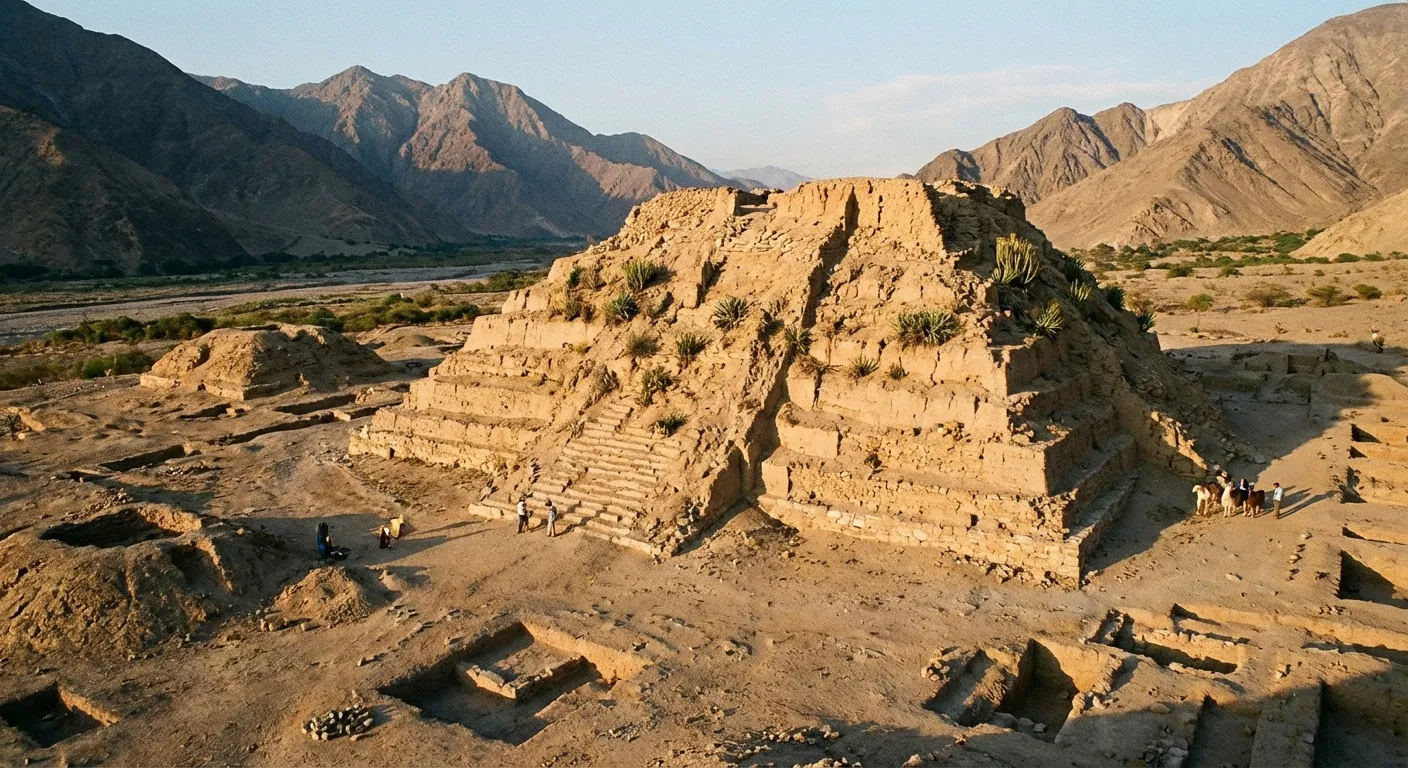
In July 2025, Peruvian archaeologist Ruth Shady unveiled a discovery that challenges assumptions about how ancient civilizations developed. The site is called Peñico, a 3,800-year-old city in Peru's Supe Valley. It contains 18 structures including ceremonial temples and residential compounds, evidence of sophisticated urban planning and complex society. But what makes Peñico remarkable is not what archaeologists found. It is what they did not find: no defensive walls, no fortifications, and no weapons.
Peñico belongs to the Caral civilization, a culture that flourished in coastal Peru more than a millennium before the Maya and over two thousand years before the Inca. The Caral built monumental architecture, developed complex administrative systems, and established trade networks spanning from the coast to the Amazon. How did they manage it? What held their society together without the usual instruments of coercion? The answers emerging from the Supe Valley are forcing archaeologists to rethink fundamental assumptions about the origins of complex society.
The Oldest Civilization in the Americas
The Caral civilization, sometimes called Norte Chico, emerged around 3000 BCE and lasted for nearly two millennia. This makes it contemporaneous with ancient Egypt, where the recent discovery of Thutmose II's tomb has reshaped our understanding of the Valley of the Kings, and Mesopotamia, developing in parallel with the earliest complex societies on other continents. But while those civilizations left famous monuments and written records, Caral remained virtually unknown until the late 20th century.
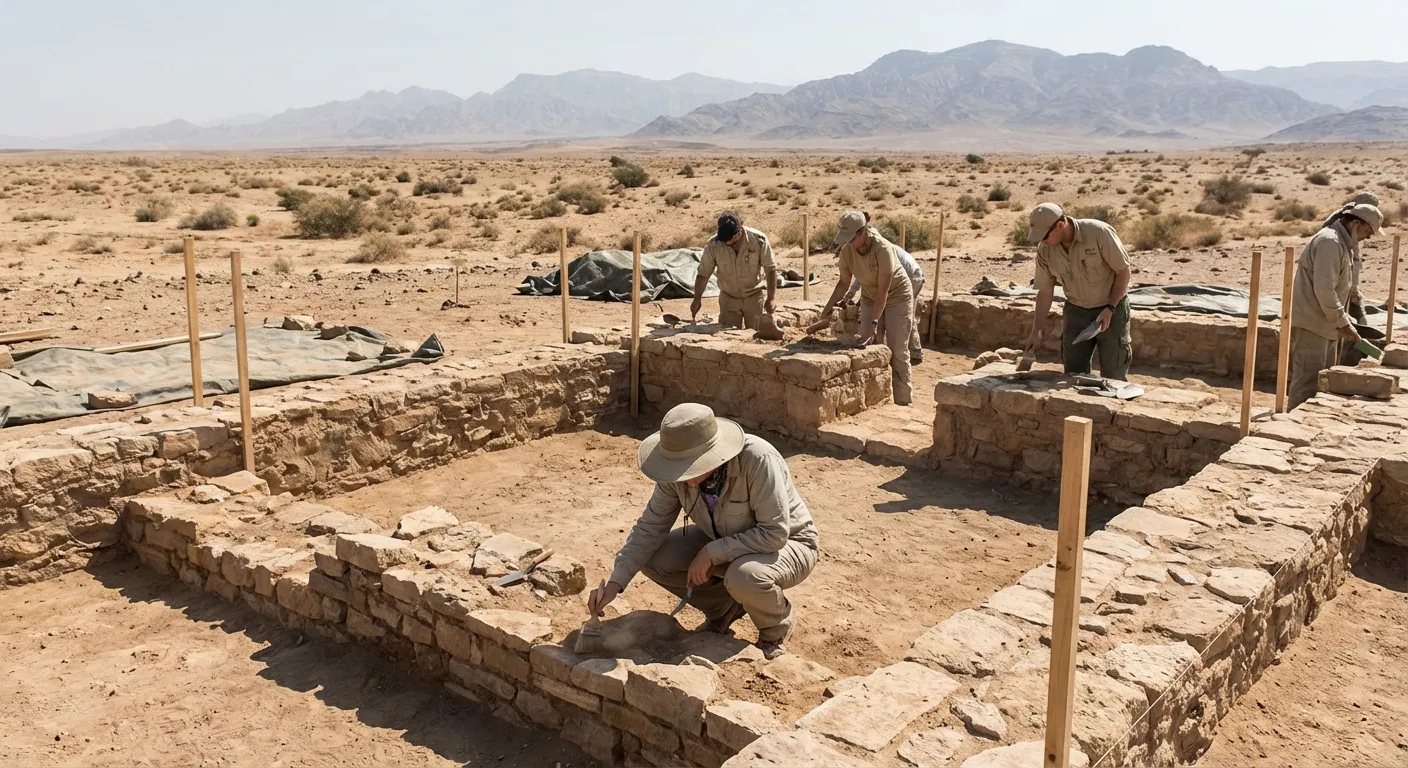
The discovery was made possible by Ruth Shady, an archaeologist from San Marcos University in Lima who has spent decades excavating sites in the Supe Valley. Her work at Caral, the largest and most famous of the Norte Chico sites, revolutionized understanding of Peruvian history. The discovery of Peñico extends this work, revealing yet another urban center from this enigmatic civilization.
Other early civilizations of comparable age left telling markers of organized violence. Egyptian fortresses lined the Nile, Mesopotamian city-states raised siege walls, and Indus Valley settlements stored arsenals. Archaeological sites from this era typically contain skeletal remains showing signs of violent death and art depicting battles. Caral sites show none of this. The pyramids and plazas were built for ceremony and commerce, creating a stark contrast with every other early civilization known to archaeology.
A Society Built on Trade
If not warfare, what held Caral society together? The evidence points to an economy based on exchange. The coastal Caral communities had access to abundant seafood, particularly anchovies and sardines. Inland communities grew cotton and produced textiles. These goods moved through trade networks connecting coast and highlands, creating mutual dependence rather than competition.
Cotton appears to have been particularly important. While other early civilizations developed around grain agriculture, Caral focused on cotton, which could be traded for food from fishing communities. This interdependence may have made warfare counterproductive. Why conquer a trading partner when cooperation benefits everyone?
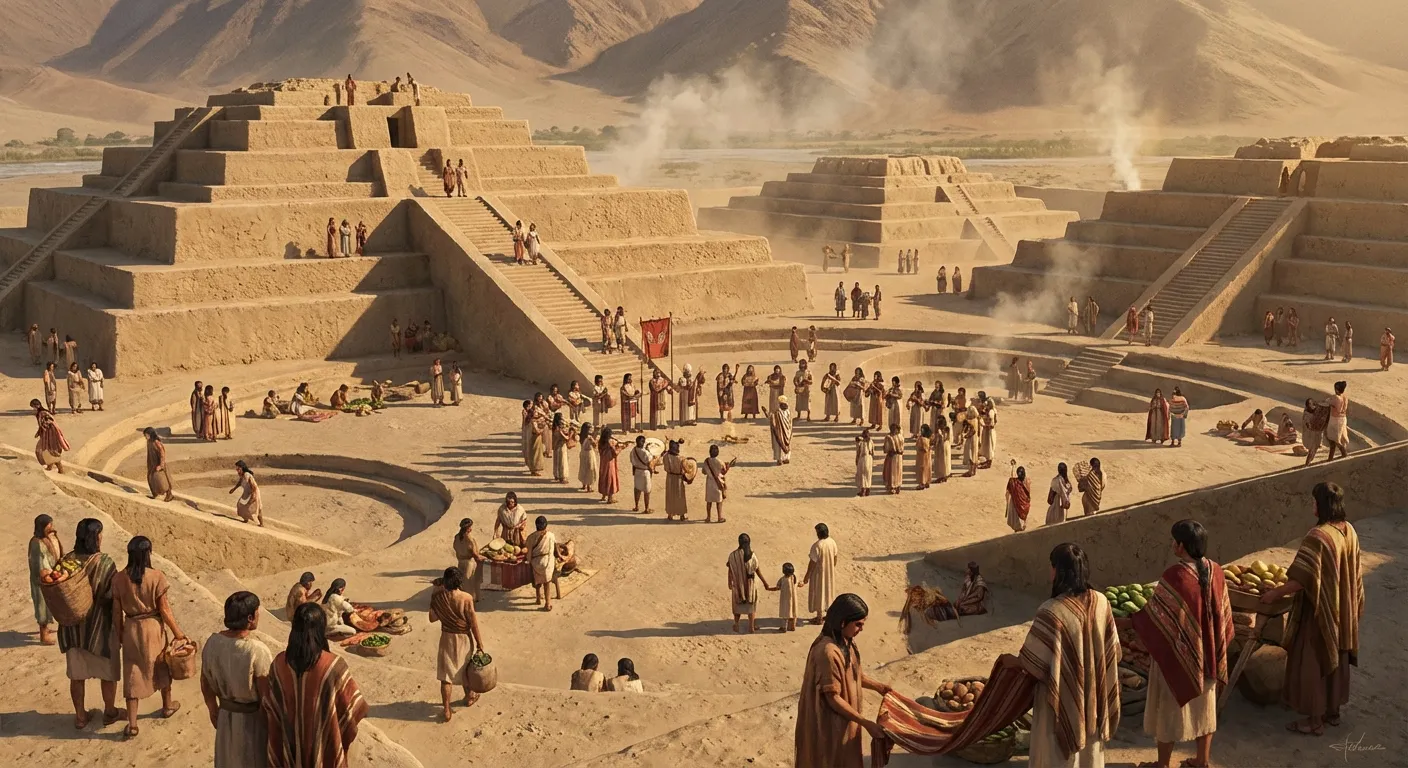
The trade networks extended remarkably far. Archaeologists have found shells from the coast at highland sites and goods from the Amazon at coastal settlements. Peñico and other Supe Valley sites appear to have served as nodes in this network, places where goods were exchanged and rituals performed to cement social bonds. The pyramids and plazas were not fortresses but marketplaces and temples.
The Role of Religion and Music
Ceremonial architecture dominates Caral sites. The pyramids are not tombs, as in Egypt, but platforms for rituals. The sunken circular plazas found at multiple sites appear to have hosted gatherings where communities came together for shared ceremonies. Religion, in this context, was social glue, creating shared identity and trust among people who might never meet otherwise.
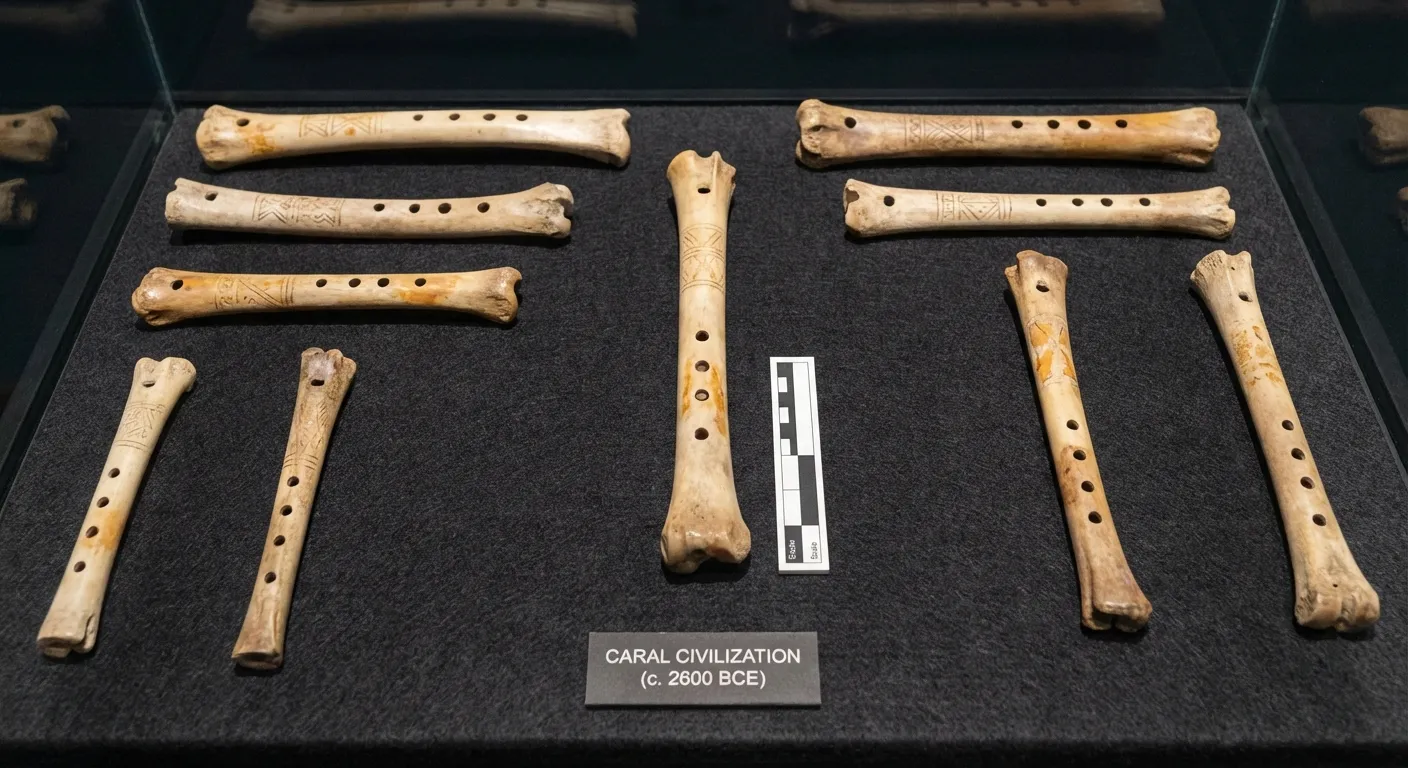
Music may have played a central role. Archaeologists have found bone flutes and other instruments at Caral sites. Some researchers suggest that musical performance was part of the ceremonial life that held this civilization together, creating emotional bonds and shared experiences that transcended economic exchange.
This is speculative, but it fits the evidence. In a society without coercion, without armies to enforce compliance, something must have motivated cooperation. Religion and ritual are powerful motivators, capable of creating solidarity among strangers. If the Caral managed to build cities and trade networks without warfare, they must have developed alternative mechanisms for social cohesion.
What Happened to Caral
The Caral civilization declined around 1800 BCE, a decline that appears to have been gradual rather than catastrophic. No evidence suggests they were conquered. Instead, climate change may have played a role. The region experienced significant environmental shifts during this period, including El Niño events that could have disrupted the fishing and agriculture on which the economy depended.
The people did not disappear. Their descendants continued to live in Peru, and elements of Caral culture may have influenced later civilizations. But the distinctive pattern of peaceful urban development did not continue. Later Peruvian societies, from the Moche to the Inca, practiced warfare and maintained armies. Whatever conditions allowed Caral to thrive without weapons did not persist.
This raises uncomfortable questions. Was Caral peaceful because of something special about its people, its environment, or its moment in history? Could its model be replicated? Or was the absence of warfare a temporary anomaly, a window of opportunity that closed as populations grew and resources became scarce?
Challenging Assumptions About Civilization
The standard narrative of civilization emphasizes competition and conquest. States arise, according to this view, when some groups dominate others, extracting labor and resources through force. War is not an aberration but a driver of social complexity, forcing societies to develop administration, taxation, and military technology.
Caral challenges this narrative without necessarily refuting it. Perhaps the Norte Chico region was unusual: isolated enough to avoid external threats, rich enough in resources to make trade more attractive than raiding. Perhaps Caral represents not an alternative path to civilization but an exception made possible by unique circumstances.
Yet even as an exception, Caral is important. It forces theorists to account for a case where monumental construction, administrative hierarchy, and long-distance exchange networks all developed without a military catalyst. If warfare were truly a prerequisite for complexity, Caral should not exist. The fact that it does suggests the standard model conflates a common path with the only possible one.
The Larger Pattern
The discovery of Peñico adds to a growing understanding of the Caral civilization and its significance for human history. Each new site reveals more about how these ancient Peruvians lived, traded, and worshiped. Collectively, the evidence paints a picture of a complex society that found a different way to organize itself.
This matters beyond archaeology. The Caral evidence forces a reconsideration of what motivates large-scale cooperation. Most political theories, from Hobbes to modern game theory, treat coercion or the threat of it as the glue that holds complex societies together. Caral suggests a different mechanism: mutual economic dependence reinforced by shared ritual. The cotton-for-fish exchange made neighboring communities more valuable alive and prosperous than conquered and subjugated. Religion then elevated pragmatic trade relationships into something sacred and enduring.
The lesson is not that we should return to the past or that modern societies can simply adopt Caral's model. The world has changed, and the conditions that made Caral possible may be gone forever. But knowing that peaceful complexity is historically possible expands our sense of what humans can achieve. When we assume conflict is inevitable, much as hindsight bias makes past events seem predetermined, we stop looking for alternatives. Peñico, rising from the Peruvian desert after 3,800 years, suggests we should keep looking.