
Every battery you have ever used follows the same basic rule: the bigger it gets, the longer it takes to charge. A phone battery charges in an hour. A laptop battery takes two. An electric vehicle battery takes anywhere from thirty minutes to several hours depending on the charger. Scale up the storage capacity and the charging time scales up with it. This relationship feels so obvious that it barely registers as a rule at all. It is simply how energy storage works.
Except that it isn't. Not if the battery operates under quantum mechanical rules instead of classical ones. A team of Australian physicists from CSIRO, RMIT University, and the University of Melbourne has built the world's first proof-of-concept quantum battery, a device that does something no conventional battery can do: it charges faster as it gets larger. The research, published in Light: Science & Applications in March 2026, demonstrates all three essential functions of a battery (charging, storage, and discharge) in a single quantum device for the first time. And the physics behind it challenges some deep assumptions about how energy behaves at the smallest scales.
What a Quantum Battery Actually Is
A conventional battery stores energy through chemical reactions. Lithium ions shuttle between electrodes, electrons flow through a circuit, and the whole process is governed by electrochemistry. A quantum battery doesn't use chemistry at all. It stores energy in the quantum states of molecules, specifically in the way those molecules interact with trapped light.
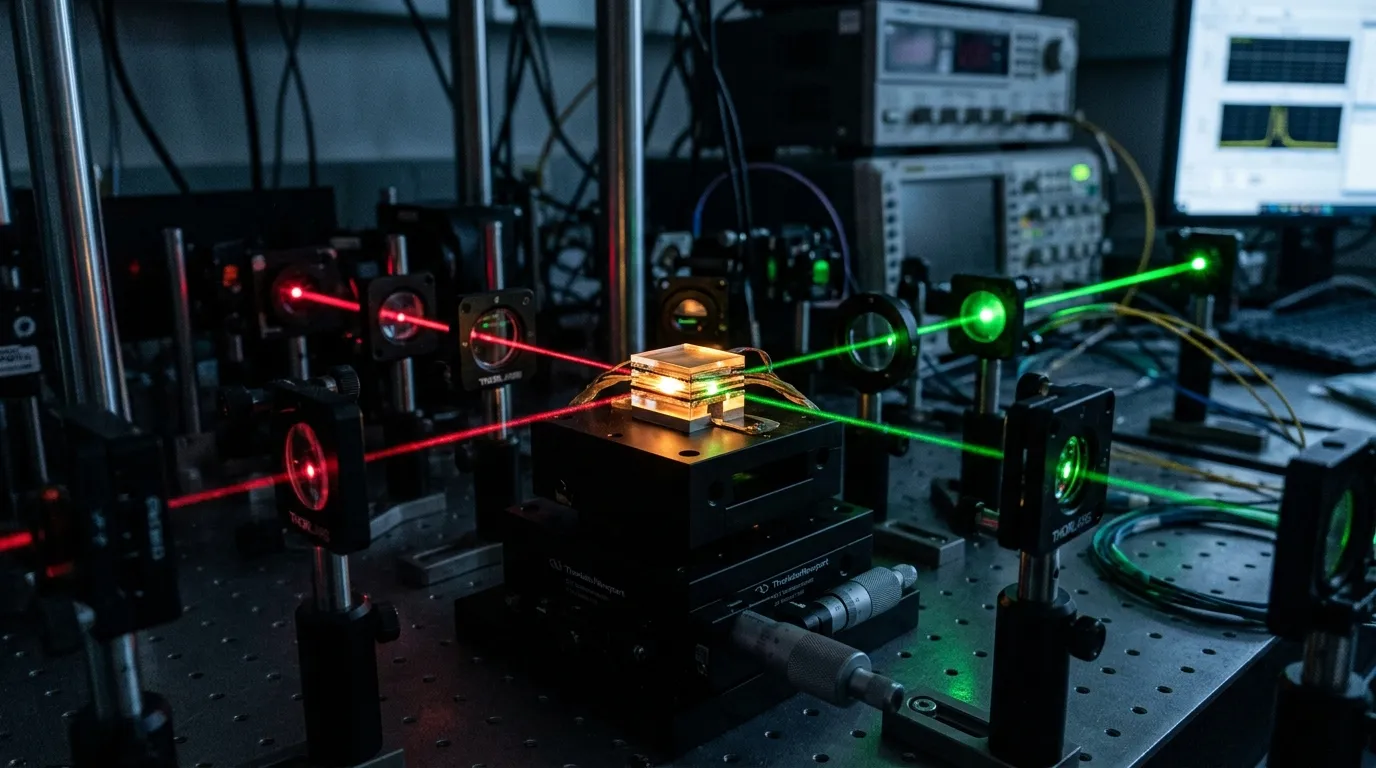
The Australian team's device is built from what physicists call an organic microcavity, a structure that Dr. James Quach of CSIRO describes as "a kind of tiny, complicated multi-layer sandwich of several different materials that traps light in a particular way." At its core are organic semiconductor molecules sandwiched between highly reflective mirrors. When laser light enters the cavity, it bounces back and forth between the mirrors, interacting with the organic molecules repeatedly. Those interactions push the molecules into excited quantum states, and that excitation is the stored energy.
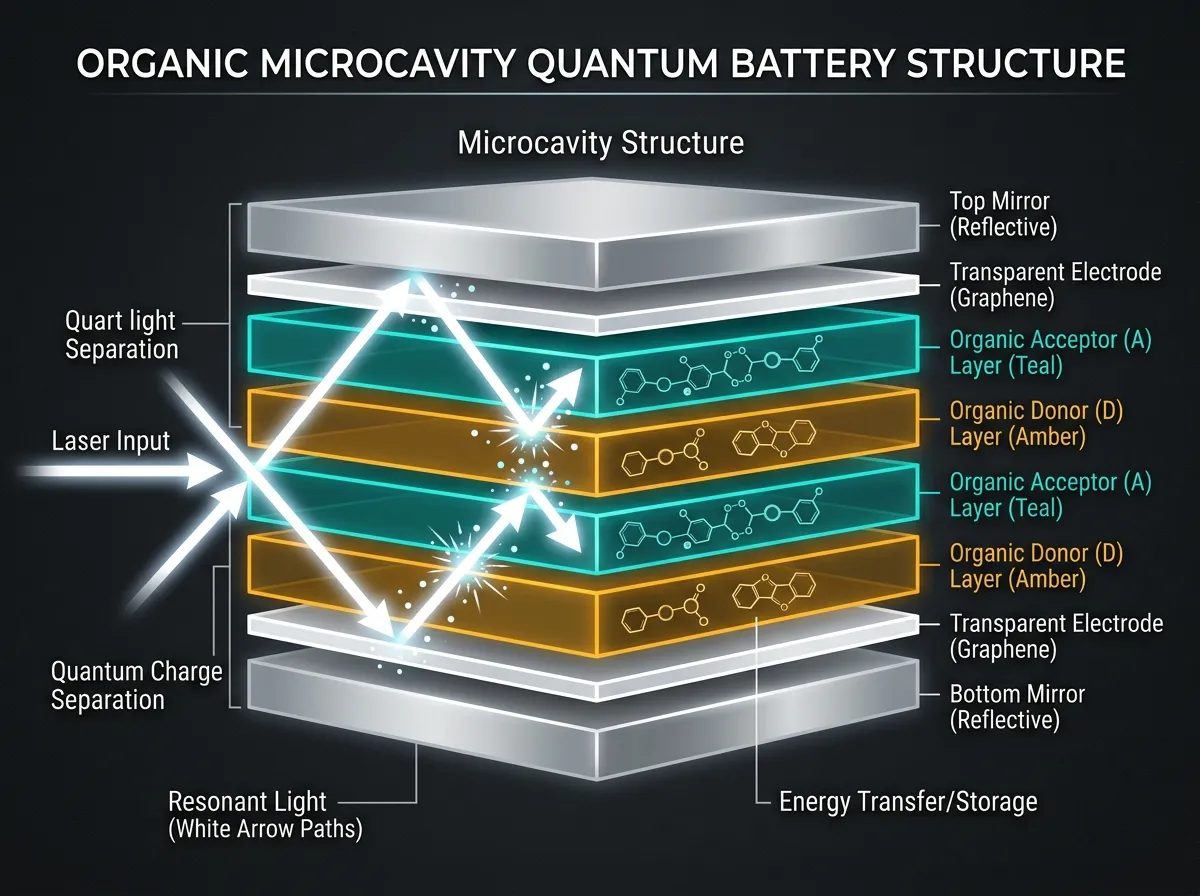
This is where the device diverges from anything in your phone or car. In a classical system, each storage unit charges independently. Adding more units means more total charging work. But in a quantum system, the storage units don't behave independently. They become entangled, correlated in ways that have no classical equivalent. And when quantum systems are correlated, they can absorb energy collectively, in a single coordinated event, rather than one molecule at a time.
Physicists call this phenomenon superabsorption, and it is the key to everything that makes quantum batteries counterintuitive.
The Physics of Superabsorption
Superabsorption is the mirror image of a better-known quantum effect called superradiance, which describes how a group of excited atoms can emit light collectively, producing a burst of radiation far more intense than the same atoms would produce individually. Superradiance was predicted theoretically by physicist Robert Dicke in 1954 and has been observed experimentally in various systems since the 1970s.
Superabsorption works the same way, but in reverse. Instead of emitting light faster together, a group of quantum systems absorbs light faster together. The key insight is that the absorption rate doesn't just increase linearly with the number of molecules. It increases superextensively, meaning the charging power per molecule actually grows as you add more molecules. The mathematical relationship follows a specific scaling law: the charging time decreases proportionally to 1 divided by the square root of N, where N is the number of storage units. Double the size of the battery and the charging time drops to about 70% of what it was. Quadruple it and the time halves.
"It is as if each unit somehow knows there are other units around, and their presence makes the unit charge faster," Quach said. This isn't metaphor. The molecules genuinely are influenced by each other's quantum states through the confined photon field in the microcavity, which mediates coherent interactions between them.
This is the opposite of what happens with conventional battery architectures, where scaling up introduces new problems: heat management, internal resistance, degradation at electrode interfaces. In a quantum battery, scaling up is the solution, not the problem.
What the Prototype Actually Does
The 2026 breakthrough builds on earlier work by the same team. In 2022, Quach and colleagues demonstrated superabsorption in an organic microcavity, showing that the collective charging effect was real. But that earlier device could only charge. It couldn't store energy for any useful duration, and it couldn't discharge it as electrical current. It was proof that the quantum effect existed, but not that it could form the basis of a functional battery.
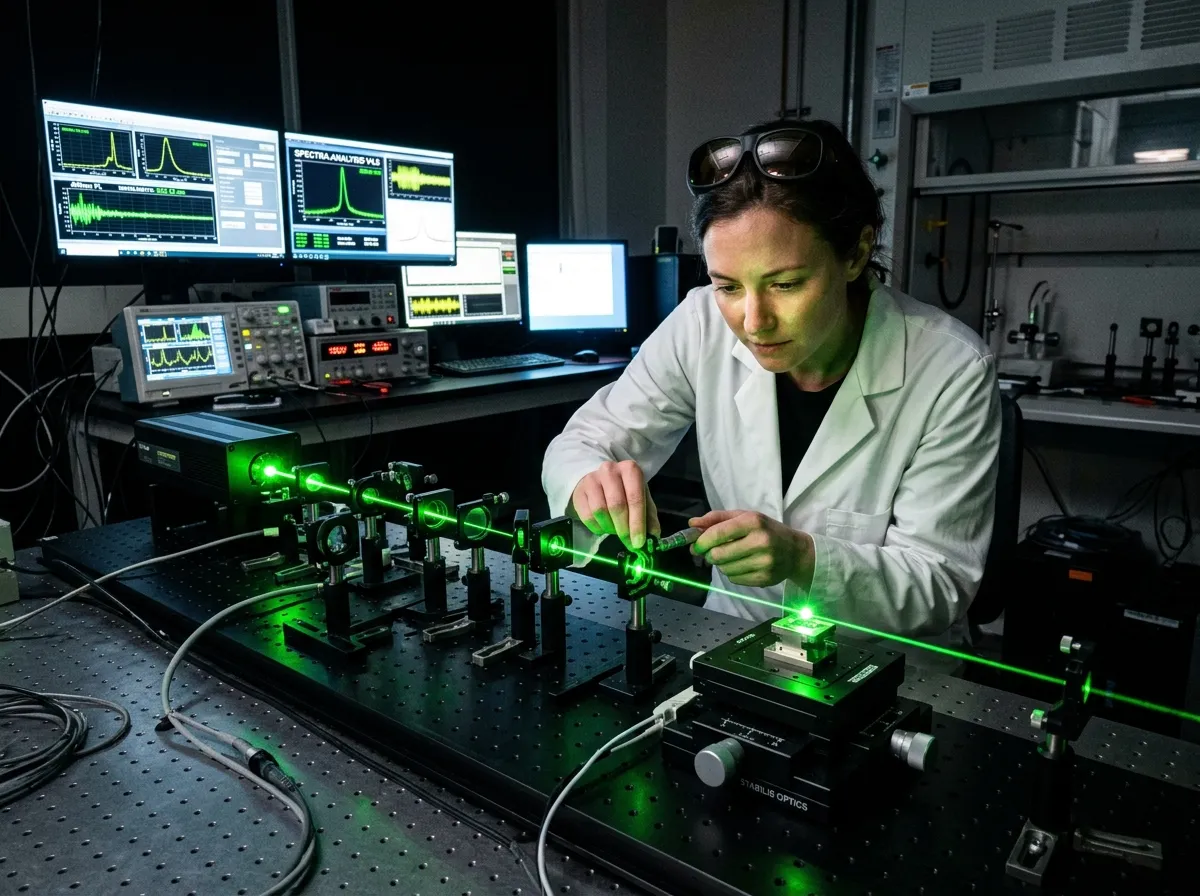
The new prototype closes both gaps. By adding additional layers to the microcavity structure, the team created a device that can charge via laser, retain the stored energy, and then release it as measurable electrical current. It is the first quantum device to complete this full charge-store-discharge cycle.
The performance numbers, in absolute terms, are humble. The battery stores a few billion electron-volts of energy, which Quach acknowledges is "very small and not enough to power anything useful." It retains that energy for nanoseconds. But the storage duration is six orders of magnitude longer than the charging time, a ratio that demonstrates genuine energy retention rather than a fleeting excitation that dissipates immediately. And the device operates at room temperature, a significant practical advantage over many quantum technologies that require cooling to near absolute zero.
Daniel Tibben, a PhD candidate at RMIT and co-author of the study, emphasized the counterintuitive finding: "Our study found quantum batteries charge faster as they get larger, which is not how today's batteries work."
The Wright Brothers Comparison
The researchers themselves draw an analogy to the Wright Brothers' first flight at Kitty Hawk in 1903. That flight lasted 12 seconds and covered 120 feet. It was, by any practical measure, useless as transportation. Nobody was going to fly from New York to London on a machine that stayed airborne for 12 seconds. But it proved that heavier-than-air powered flight was physically possible, and the engineering improvements that followed over the next decades transformed the world.
The quantum battery's nanosecond storage time occupies a similar conceptual space. The physics works. The full cycle has been demonstrated. The scaling advantage is real and experimentally confirmed. What remains is engineering: extending storage times from nanoseconds to microseconds, then to milliseconds, then to the seconds and minutes that would make the technology practically useful.

Quach is clear-eyed about the challenge: "The next step for quantum batteries right now is extending their energy storage time. If we can overcome that hurdle, we'd be that bit closer to commercially viable quantum batteries." CSIRO is actively seeking development partners to push the technology toward practical applications, with wireless device charging and ultra-fast electric vehicle charging identified as the most promising early targets.
Why This Matters Beyond Batteries
The significance of this result extends beyond energy storage into fundamental physics. Superabsorption has been theoretically predicted for decades, but demonstrating it in a functional device that completes a full energy cycle is new. It validates a class of quantum effects, collective quantum phenomena, that physicists have long suspected could have practical applications but struggled to harness outside of carefully controlled laboratory conditions.
The same collective quantum behavior that drives superabsorption in batteries could, in principle, enhance other energy technologies. Organic photovoltaic cells, which convert sunlight into electricity using organic semiconductors similar to those in the quantum battery, might benefit from superabsorptive effects to capture light more efficiently. Quantum sensors could exploit the same scaling advantage to become more sensitive as they grow larger. Professor Daniel Gomez of RMIT, a co-author on the study, described the work as part of "a rapidly growing interdisciplinary field" that sits at the intersection of quantum physics, materials science, and electrical engineering.
There is also a deeper conceptual point. Classical physics teaches that systems become less efficient as they grow. Friction increases. Heat dissipates. Complexity introduces failure modes. Quantum mechanics doesn't always play by those rules. Under the right conditions, quantum systems can become more ordered, more coordinated, and more efficient as they scale. The quantum battery is a concrete demonstration of this principle, a device where bigger literally means faster.
The Deeper Question
The quantum battery prototype can't power your phone. It can't power a watch. It can barely power itself for longer than the blink of an eye. But it does something that no one had ever done before: it takes energy in, holds it, and lets it out again, all using quantum mechanical principles that operate by rules fundamentally different from the chemistry in every battery on the planet.
The question this raises isn't really about batteries. It's about whether quantum mechanics can be harnessed to build machines that get better as they get bigger, devices where scale is an advantage rather than an obstacle. If the answer turns out to be yes, and this prototype suggests that it might be, the implications will reach far beyond how we charge our phones. They will reshape how we think about the relationship between size, speed, and efficiency in every engineered system that handles energy.
For now, the quantum battery sits in a lab in Melbourne, glowing faintly under a laser, storing a few billion electron-volts for a few billionths of a second. It is tiny, fragile, and impractical. But it is also, in its own quiet way, impossible by classical standards. And that is exactly what makes it worth watching.
Sources
- CSIRO: Australian Scientists Achieve Energy Storage and Quantum Battery Breakthrough
- RMIT University: Scientists Take Major Step Towards a Working Quantum Battery
- CSIRO: A World-First Quantum Battery Charges Faster When It Gets Bigger
- ScienceDaily: World's First Quantum Battery Could Enable Ultra Fast Charging