

Something strange is happening in 2026. After more than a decade of social media growth, of compulsive checking and constant posting, of documenting every meal and broadcasting every thought, people are starting to pull back. Not everyone, and not completely, but enough that trend forecasters have given the phenomenon a name: the social exit. It's a quiet rebellion against the culture of constant connectivity, a growing recognition that being perpetually online might be costing us something we didn't know we were losing.
The numbers tell part of the story. According to data from GWI and research by NYU social psychologist Jonathan Haidt, daily social media usage, which climbed from 90 minutes in 2012 to 143 minutes by 2024, has started declining for the first time. The curve isn't dramatic, but it's bending in a direction it has never bent before. More significant than the average is the composition. Young adults, the demographic that drove social media's rise, are leading the retreat. They're not abandoning digital tools entirely, but they're renegotiating their relationship with platforms that once commanded their attention for hours each day.
What's driving this shift isn't a single cause but an accumulation of smaller disenchantments. The algorithms that once felt like helpful curators now feel manipulative. The social comparison that once motivated self-improvement now feels exhausting. And a generation that grew up equating online presence with identity is discovering that the equation never quite balanced. The costs were always there; it just took a decade of paying them before enough people noticed the bill.
The Performance Problem
The social exit didn't begin as an ideology. It began as a feeling, one that crystallized around specific moments. You're at a concert and realize you've watched half of it through your phone screen. You're at dinner and catch yourself framing the plate before tasting the food. You finish a hike and feel a flicker of anxiety because you forgot to photograph the summit. In each case, the act of documenting has subtly colonized the experience being documented, turning lived moments into raw material for content.
This wasn't always how it felt. In social media's early days, sharing felt natural, an extension of the human impulse to connect and communicate. But as platforms grew and algorithms optimized for engagement, sharing became a performance. Every post was an audition for attention, every like a verdict on your social worth. The authentic self-expression that initially drew people to these platforms gradually transformed into careful brand management, even for people who would never use that phrase to describe what they were doing.

The exhaustion from this constant performance builds slowly and often unconsciously. You might not notice the mental load of crafting posts, anticipating reactions, and managing your digital image until you step away and feel its absence. Many people describe their first extended break from social media as revelatory, not because they missed nothing but because they didn't realize how much cognitive bandwidth the performance had been consuming. The relief of not thinking about what to post, not wondering how posts are being received, turns out to be significant.
The social exit represents a critical mass of people reaching this realization and acting on it. They're not necessarily making dramatic declarations or deleting accounts, though some do. More often, they're simply posting less, checking less, caring less about platforms that once commanded their attention. The performance isn't worth the admission price anymore, and they're quietly leaving the theater.
The Analog Revival
Part of what makes 2026's social exit distinctive is where people are directing the attention they reclaim. Rather than simply consuming different digital content, many are turning to analog alternatives. Vinyl records are outselling CDs. Film cameras are experiencing a genuine revival among younger photographers. Book clubs, not the performative kind that exist mainly for Instagram photos, but actual reading and discussion groups, are multiplying. The appeal isn't nostalgia for its own sake but a quality of experience that digital alternatives don't provide.
Analog activities share characteristics that distinguish them from their digital counterparts. They're typically slower, requiring sustained attention rather than the rapid switching that digital platforms encourage. They're often more social, bringing people together physically rather than connecting them through screens. They're less optimized, not designed by teams of engineers to maximize engagement and capture attention. And they're more present-tense, anchoring people in immediate experience rather than pulling them toward documentation and broadcast.

The vinyl revival is instructive. Records are objectively inferior to digital music in many ways: more expensive, less portable, requiring dedicated equipment, vulnerable to damage. Yet vinyl sales have grown for seventeen consecutive years and show no signs of slowing. The appeal isn't the audio fidelity, which vinyl purists defend but which blind tests suggest most listeners can't actually detect. The appeal is the ritual: choosing a record, handling the physical object, watching it spin, accepting that you'll listen to a whole album rather than skip from track to track. The limitation is the point. It creates a container for attention that streaming cannot.
Similar dynamics drive the return to physical books, handwritten journals, film photography, and other analog practices. Each involves constraints that seem like drawbacks but function as features. They slow things down, demand presence, and resist the constant interruption that defines digital experience. For people exhausted by the always-on quality of connected life, these constraints feel like relief rather than burden.
The New Social Rituals
The social exit is not only changing individual habits; it's generating new collective rituals. Friends meet and stack their phones in the center of the table, a visible commitment to being present with each other rather than with their devices. Dinner parties feature phone baskets at the door. "No screens" has become a social norm for certain gatherings, a boundary that would have seemed unnecessary just a few years ago. What's notable is that these rituals are not imposed from above. They emerge organically, spreading through friend groups the way fashion trends once did.
These new rituals reflect a recognition that attention is the scarcest resource in relationships. When everyone at a table might check their phone at any moment, no one can count on having anyone else's full attention. The conversation fragments, the connection thins, and everyone experiences a vague dissatisfaction that's hard to name. By explicitly removing phones, groups create the conditions for the kind of deep engagement that social connection requires but that constant connectivity undermines.
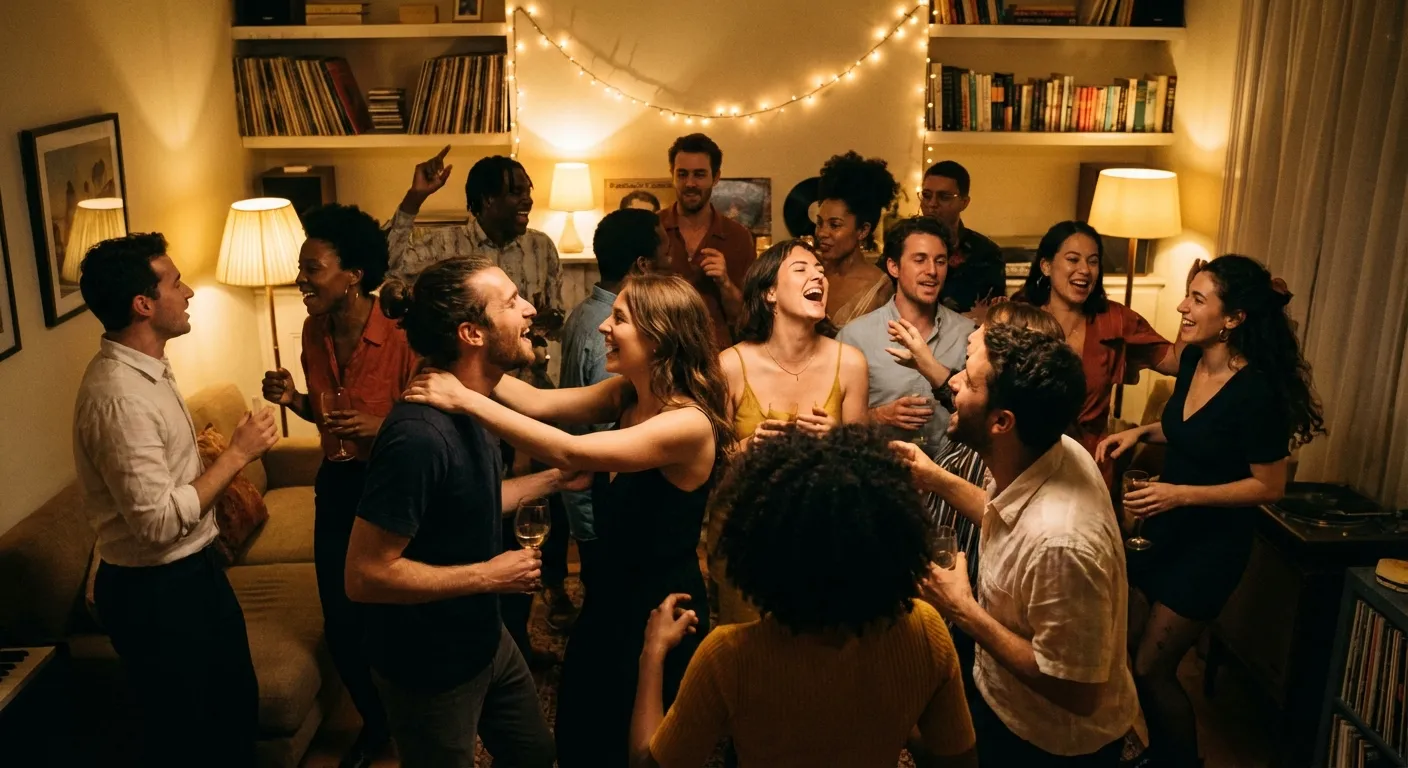
The trend connects to broader conversations about what social media has done to community. The platforms promised to bring people together, and in some ways they did. But they also hollowed out the kinds of local, embodied community that humans evolved to need. You might have thousands of followers but no one to help you move. You might know what hundreds of acquaintances had for breakfast but have no idea what your neighbors believe or fear or hope for. The social exit partly represents a rebalancing, a recognition that online connection, however valuable, cannot fully substitute for physical presence. The resurgence of analog activities like vinyl records and handwritten journals reflects this same impulse toward tangible, embodied experience.
This doesn't mean abandoning digital tools entirely. Most people participating in the social exit still use smartphones, still have social media accounts, still communicate through digital channels. The shift is more subtle: using these tools deliberately rather than compulsively, treating them as utilities rather than habitats, maintaining connection without surrendering attention. The goal isn't disconnection but a healthier relationship with connection, one that leaves room for the unmediated experiences that digital life tends to crowd out.
The Quiet Spirituality
Beneath the practical critiques of social media lies something harder to articulate: a sense that constant connectivity might be impoverishing our inner lives in ways we don't fully understand. The social exit has a quietly spiritual dimension, a recognition that attention is not just a resource to be optimized but a faculty that shapes who we become. Where we direct our attention determines what we notice, what we value, and ultimately what we are. Surrendering that attention to platforms designed to capture and hold it might be surrendering something essential.
As former Google design ethicist Tristan Harris has argued, the problem is not individual willpower but the design of systems optimized to exploit psychological vulnerabilities. This helps explain why practices like meditation and contemplative reading are growing alongside the social exit. Both involve training attention away from the scattered, reactive mode that digital platforms encourage and toward the focused, receptive mode that deeper experience requires. They're not escapes from reality but methods for encountering reality more fully, for being present to what's actually happening rather than perpetually distracted by what might be happening elsewhere.
The connection between digital overwhelm and spiritual seeking isn't new. Writers and thinkers have warned about attention and technology for decades, and the current moment echoes earlier concerns about television, radio, and even the printing press. What's different now is the intensity and pervasiveness of the demand on attention. Earlier technologies occupied specific times and places. Social media colonizes every moment, every context, through devices we carry constantly and check compulsively. The spiritual response represents a recognition that this colonization has costs that more practical critiques don't fully capture.
For some, this spiritual dimension takes religious forms, a return to contemplative traditions that predate and resist digital culture. For others, it's entirely secular, a matter of protecting mental space and cultivating presence without any supernatural framework. What unites these responses is a sense that human flourishing requires something that perpetual connectivity erodes: the capacity to be alone with one's thoughts, to sit with silence, to pay attention to what doesn't demand attention.
Where This Leads
Where does a diffuse cultural shift like this actually lead? Social media isn't going away. The platforms that captured our attention will continue evolving, finding new ways to hold it. Digital tools will become more integrated into daily life, not less. Predicting the end of social media in 2026 would be as naive as predicting the end of television in 1975.
Yet the more relevant question may not be whether social media survives but what form it takes. Cultural change often works not through dramatic collective action but through the accumulation of individual choices that gradually shift norms and expectations. Each person who renegotiates their relationship with a platform exerts a small gravitational pull on the people around them. Over time, those pulls add up, reshaping not just user behavior but the business models and design choices of the platforms themselves.
The social exit also connects to broader questions about how recommendation algorithms shape our information environment and how we might reclaim agency within systems designed to capture our attention. Understanding how these systems work, how they're designed to feel personalized and even omniscient, is part of developing a healthier relationship with them. The goal isn't ignorance of technology but informed engagement, using digital tools for our purposes rather than being used by them for theirs.
There's also a connection to our relationship with the natural world. The deep ocean remains largely unexplored, and the night sky continues turning overhead, but fewer of us notice because our attention is elsewhere. The social exit partly represents a turn back toward the physical world, a recognition that screens, however compelling, show us only a fraction of what exists and that what they show is heavily mediated by commercial interests. Stepping away from screens is also stepping toward something: toward nature, toward presence, toward the unmediated reality that humans inhabited for most of our history.
The social exit is already showing up in platform economics. Meta's 2025 earnings report revealed that daily active usage among 18-to-29-year-olds on Instagram declined for the second consecutive quarter, and Snap's average revenue per user in North America dropped 8 percent year over year as advertisers followed the retreating attention. These are not catastrophic numbers, but they represent a structural shift: the demographic cohort that platforms depend on for growth is spending less time and generating less ad revenue. The platforms are responding predictably, by making their products stickier through AI-generated content feeds and by expanding into markets where smartphone adoption is still rising. But in mature markets, the growth-through-engagement model is hitting a ceiling that more aggressive algorithms cannot raise.
This means the social exit is less a cultural mood and more an economic force. As usage declines among high-value demographics, advertising dollars will migrate toward platforms and formats that command deeper, more sustained attention, which favors newsletters, podcasts, and long-form video over infinite-scroll feeds. The individuals putting down their phones are making a choice that, in aggregate, reshapes the incentive structures of the companies competing for their attention. The most likely outcome over the next five years is not that social media disappears but that it bifurcates: compulsive, algorithm-driven platforms serving users who remain, and a growing ecosystem of slower, subscription-funded alternatives serving those who left. The social exit is not a rejection of digital life but a market correction, and like all market corrections, it will permanently change the landscape it emerged from.
Sources
- The Anxious Generation by Jonathan Haidt - Research on social media's effects on mental health and attention
- Global social media usage trends - GWI data on declining daily usage among younger demographics
- Humane Technology and the attention economy - Center for Humane Technology on design ethics and digital wellbeing
- Screen time and wellbeing research - Nature Human Behaviour on digital media and psychological outcomes