
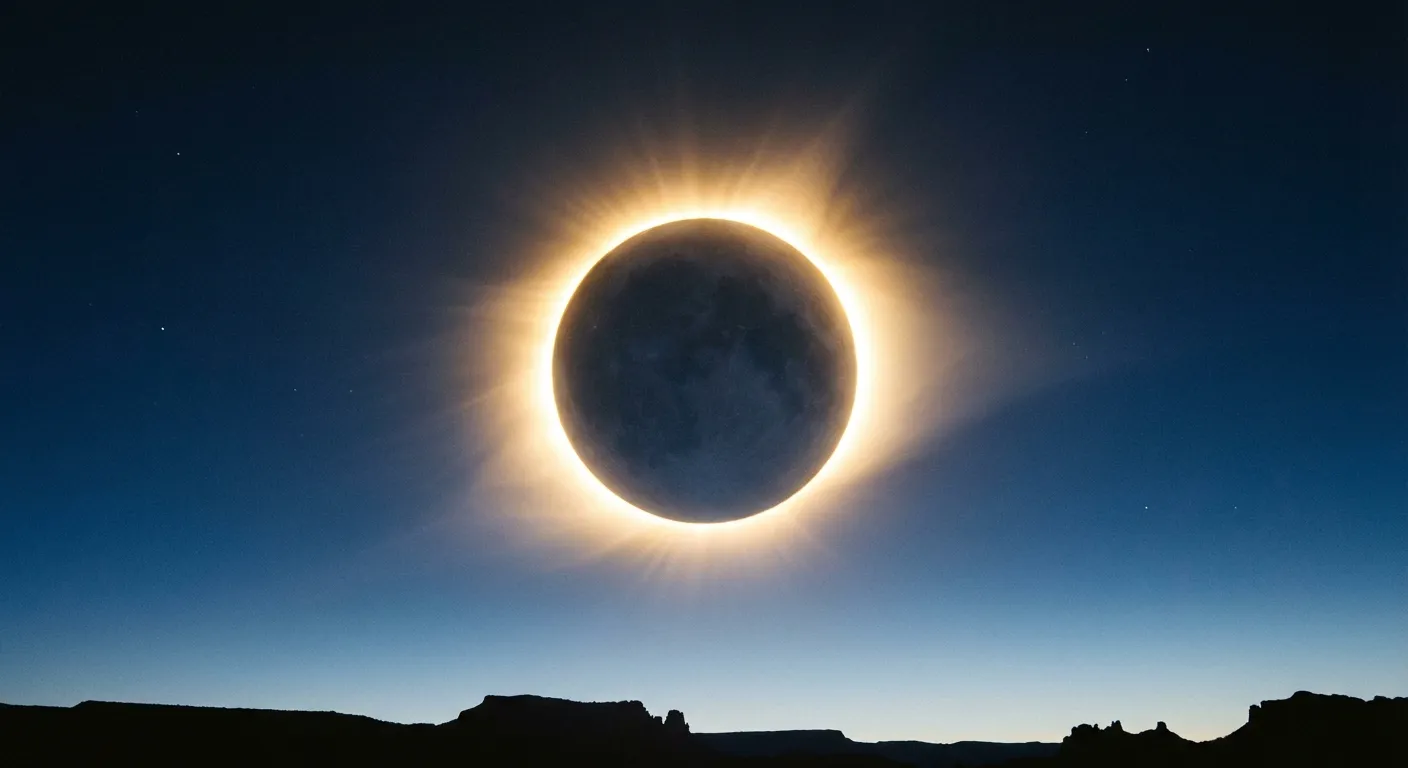
On February 17, 2026, the Moon will slide between Earth and the Sun, blocking 96 percent of the solar disc for observers in a narrow path across Antarctica. Because the Moon will be slightly too far from Earth to cover the Sun completely, a brilliant ring of sunlight will remain visible around the lunar silhouette, an annular eclipse that transforms the Sun into a circle of fire in the sky. Almost no one will see it in person, since the path of annularity crosses one of the most remote regions on the planet.
But the event connects to something much larger than a single celestial alignment over ice. Solar eclipses have shaped human civilization in ways that stretch far beyond astronomy. They have ended wars, inspired religious revelations, validated scientific theories, and terrified populations into believing the world was ending. The same phenomenon that ancient peoples interpreted as a dragon devouring the Sun is the phenomenon that proved Einstein right.
Understanding how eclipses have functioned across human cultures, from omen to instrument to spectacle, reveals something about the relationship between what we see in the sky and what we believe about our place beneath it.
The Oldest Fear
To a person with no astronomical knowledge, a solar eclipse is genuinely terrifying. The Sun, the most reliable feature of daily existence, begins to disappear in the middle of the day. The light changes quality, becoming eerie and flat. Temperatures drop. Animals behave strangely, with birds roosting and insects beginning their evening chorus. If the eclipse is total, stars appear in a darkened sky while the Sun's corona, invisible under normal conditions, blazes around a black void where the Sun used to be.
Every culture that recorded its observations developed an explanation for this phenomenon, and nearly all of those explanations involved something eating the Sun. In Chinese tradition, the eclipse was caused by a celestial dragon (or sometimes a heavenly dog) consuming the solar disc. The Chinese word for eclipse, "shi," derives from the word for "to eat." The prescribed response was to make noise, banging pots, drums, and gongs, to frighten the creature into releasing the Sun.
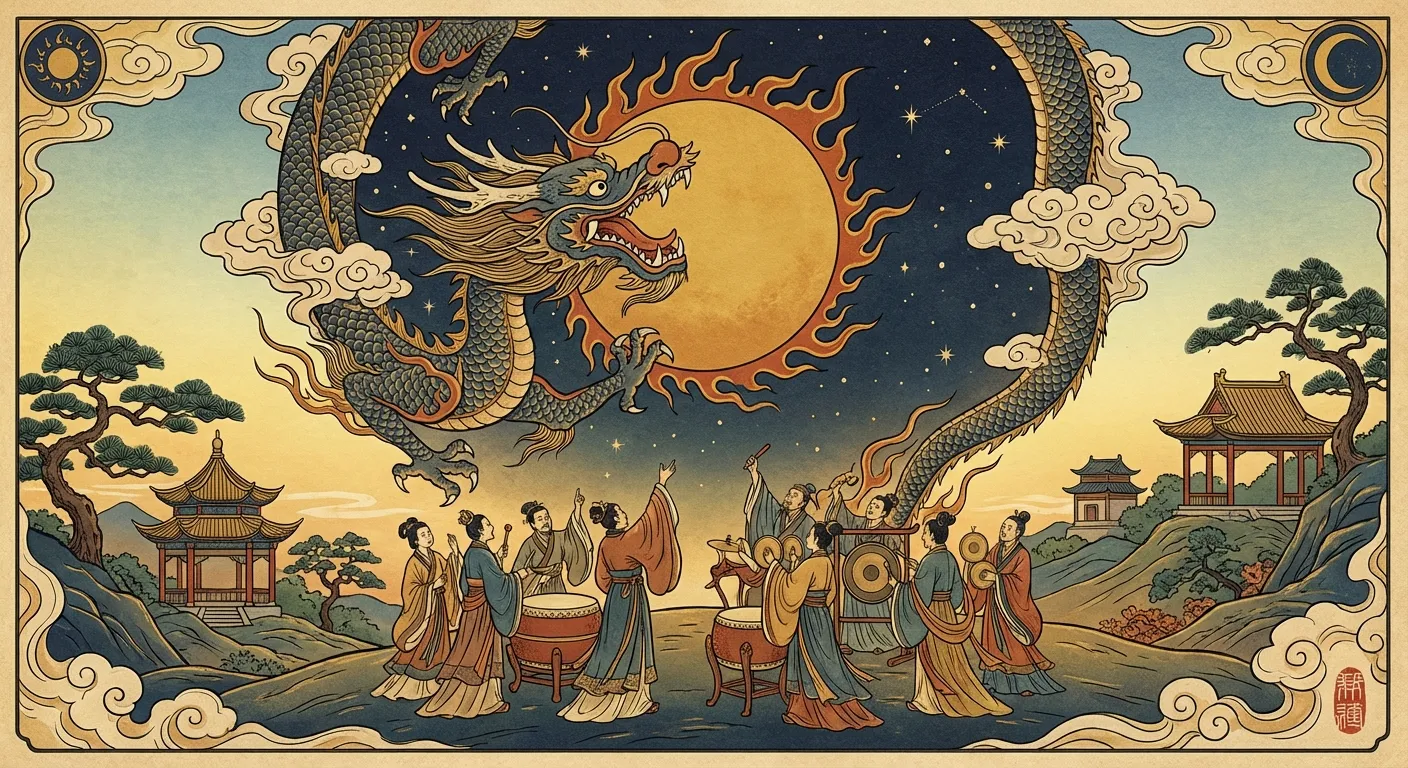
Norse mythology attributed eclipses to the wolves Skoll and Hati, who ceaselessly pursued the Sun and Moon across the sky. An eclipse occurred when one of the wolves caught its prey. If both wolves succeeded simultaneously, it would herald Ragnarok, the end of the world. The Hindu tradition features the demigod Rahu, beheaded by Vishnu for stealing the elixir of immortality, whose severed head eternally pursues the Sun and Moon, swallowing them periodically before they pass through his severed neck and reappear.
In Aztec cosmology, a solar eclipse, especially one occurring on the date 4 Ollin in their calendar, could signal the end of the current world age. The Aztec response included blood sacrifice, intended to strengthen the Sun for its battle with the forces of darkness. Women who were pregnant were kept indoors during eclipses, as exposure was believed to cause birth defects.
What unites these diverse traditions is not their specific content but their emotional register: terror. An eclipse, to people who didn't understand the mechanics of orbital geometry, was evidence that the cosmic order could fail. The Sun was not permanent. The forces of chaos were real. And the appropriate response was action: ritual, noise, prayer, sacrifice.
When an Eclipse Stopped a War
The transition from eclipse-as-omen to eclipse-as-data begins with the Babylonians. By the eighth century BCE, Babylonian astronomers had accumulated centuries of observational records and noticed that eclipses follow repeating patterns. After a sequence of 223 lunar months, approximately 18 years and 11 days, an almost identical series of eclipses occurs. They called this the Saros cycle, and it allowed them to predict when eclipses would happen with reasonable accuracy, even if they couldn't predict exactly where they would be visible.
This predictive power had political consequences. In 585 BCE, according to the Greek historian Herodotus, a solar eclipse occurred during a battle between the Lydians and the Medes, two powers fighting for control of Anatolia. The sudden darkening of the sky so alarmed both armies that they laid down their weapons and negotiated peace. Ancient tradition credits the Greek philosopher Thales of Miletus with predicting this eclipse, though the claim is debated. Whether or not Thales actually made the prediction, the story illustrates an emerging idea: that eclipses could be foreseen, which meant they were natural events governed by knowable rules rather than arbitrary acts of divine wrath.
The Greek philosopher Anaxagoras, born around 500 BCE, appears to have understood the basic mechanism: a solar eclipse happens when the Moon passes between Earth and the Sun, casting its shadow on Earth's surface. This explanation required recognizing that the Sun is far away, the Moon is closer, and both are physical objects rather than divine beings. The idea was radical enough that Anaxagoras was reportedly charged with impiety for suggesting the Sun was a hot stone rather than a god.
The progression from Babylonian pattern recognition to Greek mechanism represents one of the great intellectual transitions in human history: the shift from "what happens" to "why it happens." Eclipses were the same phenomenon throughout, but the framework for understanding them changed from mythology to astronomy, from divine narrative to physical explanation.
The Eclipse That Proved Einstein Right
The most famous eclipse in the history of science occurred on May 29, 1919. Albert Einstein's general theory of relativity, published in 1915, made a specific prediction about eclipses: light from distant stars passing close to the Sun should be bent by the Sun's gravity, causing the stars to appear slightly displaced from their true positions. The effect would be tiny, about 1.75 arcseconds, and would only be measurable during a total eclipse, when the Sun's glare is blocked and the stars near it become visible.

British astronomer Arthur Eddington organized two expeditions to observe the eclipse, one to the island of Principe off the west coast of Africa and another to Sobral, Brazil. The expeditions photographed the star field around the Sun during totality, then compared those positions to photographs of the same stars taken months earlier when the Sun was elsewhere. The measured displacement matched Einstein's prediction.
The result made Einstein a global celebrity overnight. Newspapers around the world ran headlines about the theory of relativity. A scientific revolution that had been confined to academic journals became public knowledge because of an eclipse. The Sun's disappearance revealed something fundamental about the nature of space and time.
Eclipses continued to serve as scientific instruments throughout the twentieth century. The Sun's corona, the outermost layer of its atmosphere, is only visible during total eclipses (or with specialized instruments called coronagraphs). Eclipse observations revealed that the corona is far hotter than the Sun's surface, a paradox that puzzled physicists for decades and is still not fully resolved. The composition of the corona, analyzed through spectroscopy during eclipses, led to the discovery of helium in 1868, an element identified in the Sun before it was found on Earth.
The Mechanics of Coincidence
The fact that solar eclipses occur at all is, from one perspective, a cosmic coincidence of remarkable precision. The Sun is approximately 400 times larger than the Moon but also approximately 400 times farther away. This near-perfect ratio means the Moon appears almost exactly the same size as the Sun in Earth's sky, allowing it to cover the solar disc precisely during a total eclipse.
No other planet in our solar system experiences eclipses like Earth's. Mars has two moons, but both are too small to cover the Sun's disc. Jupiter's moons create eclipses visible from space but not the dramatic sky-darkening events Earth experiences. The match between apparent solar and lunar size is specific to our planet, our Moon, and our current epoch.
And it's temporary. The Moon is slowly receding from Earth, moving about 3.8 centimeters farther away each year due to tidal interactions. As it retreats, it appears smaller in Earth's sky. In roughly 600 million years, the Moon will be too distant to completely cover the Sun, and total eclipses will cease. Annular eclipses, like the one on February 17, will become the only type visible. Eventually, even annular eclipses will become rare as the Moon continues its outward migration.
This means humanity exists in a window of geological time during which total eclipses are possible. Earlier in Earth's history, when the Moon was closer, it appeared larger than the Sun and eclipses would have been more frequent and longer-lasting. In the far future, when the Moon is farther away, total eclipses will be impossible. We happen to live in the epoch when the apparent sizes match almost exactly, creating eclipses that are both scientifically useful and visually spectacular.
February 17 and the Ring of Fire
The annular eclipse of February 17, 2026, belongs to Saros series 121, a cycle that began with a partial eclipse on April 25, 944 CE, and will continue producing eclipses through the 23rd century. This particular eclipse will trace a path across Antarctica, beginning at 11:42 UTC and ending at 12:41 UTC. At maximum eclipse, the Moon will cover 96 percent of the Sun's surface area, leaving a ring of sunlight roughly 4 percent of the Sun's full brightness.
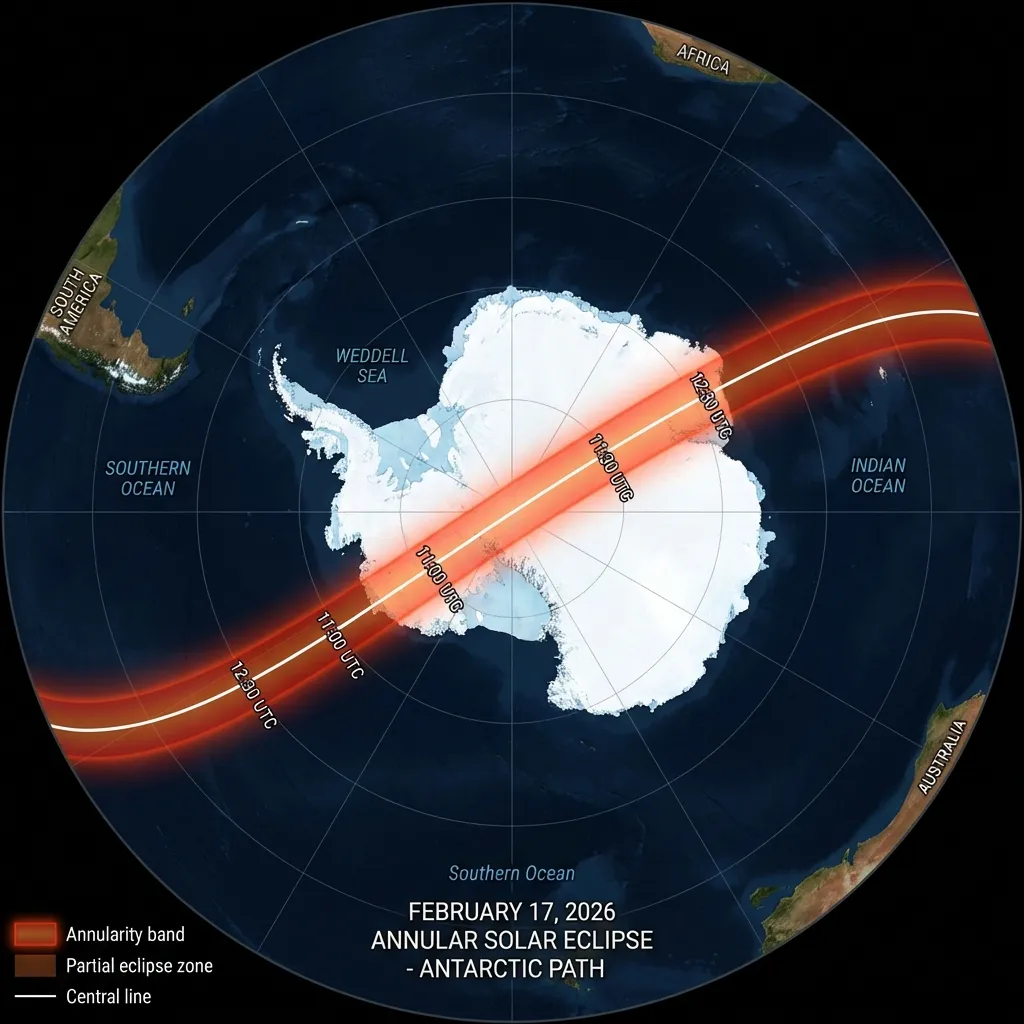
Because the path of annularity falls across one of the least populated regions on Earth, this eclipse will be observed primarily by researchers at Antarctic stations and a handful of dedicated eclipse chasers willing to travel to extreme locations. The experience, for those who witness it, will be distinctly different from a total eclipse. The sky will not go fully dark. The corona will not be visible. But the ring of fire, with its geometrically perfect circle of light, has its own haunting beauty.
For most of the world, the eclipse will be a media event rather than a visual one. But it prefigures a more accessible eclipse: a total solar eclipse will be visible from parts of Europe, North Africa, and northern Asia on August 12, 2026, just six months later. That event will draw millions of viewers and, if skies are clear, produce the dramatic visual spectacle that total eclipses are famous for.
A Thread Through Human History
The annular eclipse of February 17 will last less than an hour from first contact to last. Almost nobody will see it. It will not stop a war, inspire a religion, or confirm a theory of physics. By the standards of historically consequential eclipses, it will be minor.
But it connects to every eclipse that came before it. The same orbital mechanics that placed the Moon between Sun and Earth on February 17, 2026, placed it there on May 28, 585 BCE, when the Lydians and Medes stopped fighting. The same geometry aligned on May 29, 1919, when Eddington's photographs validated general relativity. The physics hasn't changed. Only the observers have.
What has changed, dramatically, is what humans do with the observation. A culture that sees a dragon eating the Sun and a culture that sees gravitational lensing of starlight are looking at the same event through radically different conceptual frameworks. The eclipse doesn't care which framework you use. It happens regardless. But the framework determines whether you bang a drum or rewrite physics.
That transition, from omen to instrument, from fear to understanding, is one of the defining stories of human civilization. Eclipses compress this story into a single, recurring event visible to the naked eye. Every few years, the same ancient spectacle plays out in the sky, and humanity's response to it reveals where we stand on the long arc from myth to knowledge.
The ring of fire will appear over Antarctica on February 17. For a few minutes, the Sun will wear a golden crown. Then the Moon will continue its orbit, the ring will close, and ordinary daylight will return. The cosmos will have performed, for the uncountable time, a demonstration of mechanics so precise that no human engineer could replicate it. Whether anyone watches or not, the show goes on.