
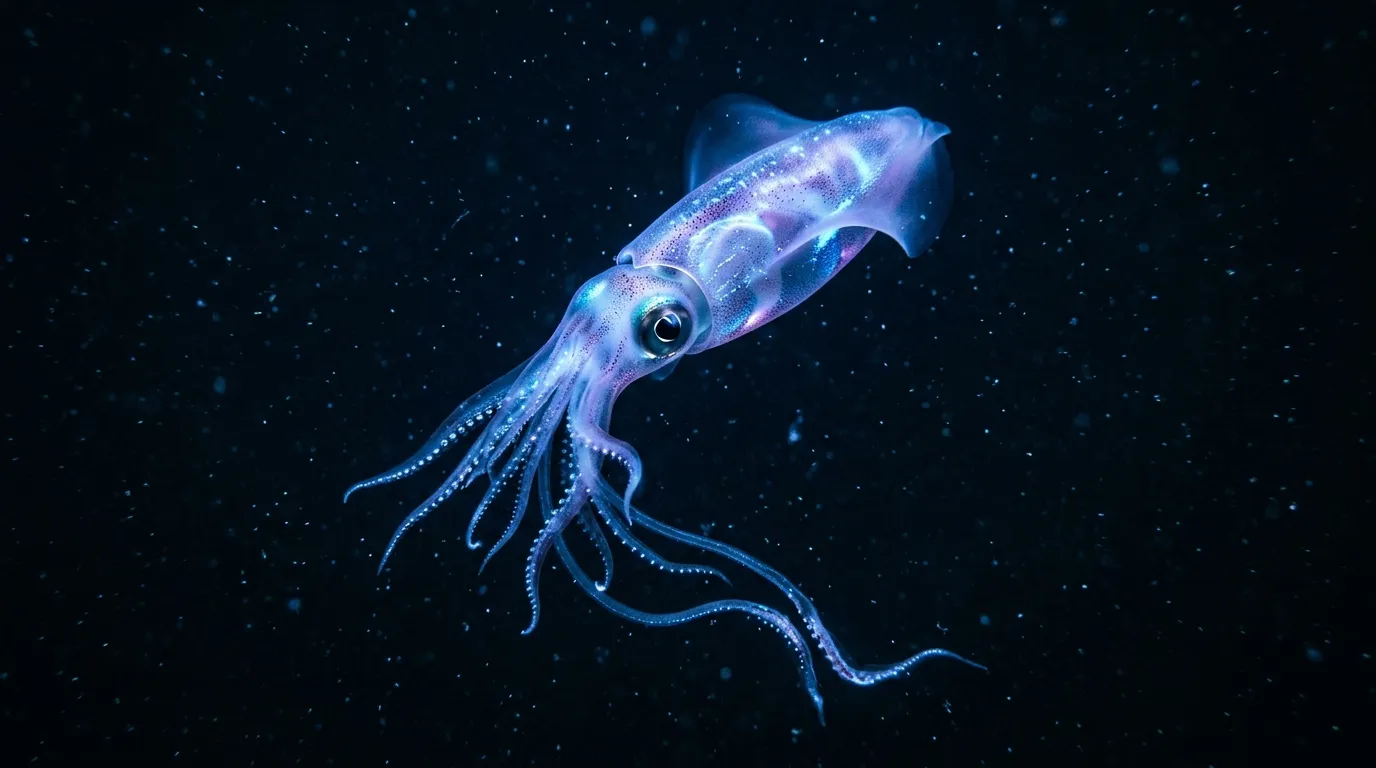
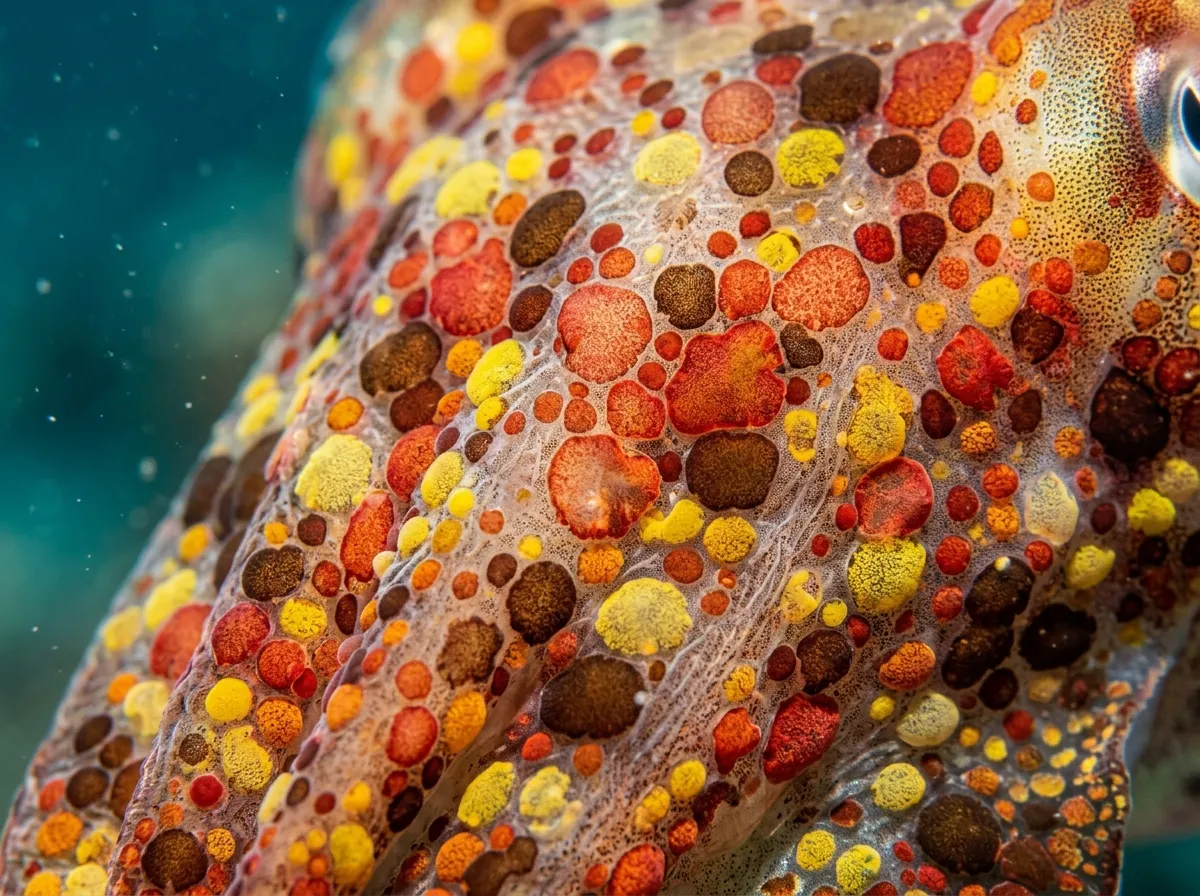
Squid are among the strangest animals on the planet. They have three hearts, blue blood, a brain shaped like a donut wrapped around their esophagus, and skin that can change color faster than a chameleon's. Some species are the size of your thumb. Others, like the giant squid, grow tentacles longer than a school bus. They can taste with their suckers, jet-propel themselves through water at 25 mph, and edit their own RNA on the fly, something virtually no other animal does.
What scientists couldn't figure out, despite decades of trying, was how they got this way. The fossil record for squid and cuttlefish is notoriously poor because their soft bodies rarely preserve in stone. And the few molecular studies that attempted to trace their evolutionary history kept producing contradictory results, with different genes telling different stories about when and where these animals originated.
A team led by researchers at the Okinawa Institute of Science and Technology has finally cracked the mystery, and the answer turns out to be one of the most dramatic evolutionary stories in the animal kingdom: a 100-million-year fuse that burned in silence before detonating into the astonishing diversity we see today.
Three Genomes That Rewrote the Family Tree
The study, published in Nature Ecology & Evolution, combined three newly sequenced squid genomes with existing datasets to build the most comprehensive evolutionary tree ever constructed for decapodiforms, the group that includes all squid and cuttlefish. Previous attempts to map their family relationships relied on fragments: a gene here, a mitochondrial sequence there. The results were messy. Different analytical methods produced different trees, and nobody could agree on when the major lineages split apart or which groups were most closely related.
The breakthrough came partly from brute computational force and partly from one very unusual animal. The ram's horn squid (Spirula spirula) is the sole surviving member of an ancient lineage that sits near the base of the cephalopod family tree. Its genome, sequenced for the first time in this study, acted as a kind of evolutionary anchor point. "It helped correct earlier assumptions and strengthened the new evolutionary model," explained co-author Dr. Fernando A. Fernandez-Alvarez of the Spanish Institute of Oceanography.
Squid genomes are enormous, often twice the size of the human genome, which is part of why they've been so difficult to sequence. Advances in long-read sequencing technology finally made it feasible to assemble these massive genomes with enough accuracy to resolve the deep evolutionary relationships that shorter reads had scrambled.
The result was a family tree with clear dates and clean branching patterns, something cephalopod biologists had been chasing for decades. And what that tree revealed was unexpected.
The Long Fuse
The conventional assumption was that squid diversified gradually over time, branching into new species at a more or less steady rate as they colonized different ocean habitats. The genome data tells a completely different story.
Roughly 100 million years ago, during the mid-Cretaceous period, the major lineages of squid and cuttlefish split from one another in the deep ocean. And then, for tens of millions of years, almost nothing happened. The lineages existed, but they didn't branch. They didn't radiate into new forms. They sat in what amounted to evolutionary stasis, deep beneath the ocean surface, while the world above them changed dramatically.
"Following initial lineage splits in the Cretaceous, we don't see much branching for many tens of millions of years," explained Dr. Gustavo Sanchez, the study's lead author and a staff scientist in OIST's Molecular Genetics Unit. "However, in the K-Pg recovery period, we suddenly see rapid diversification."
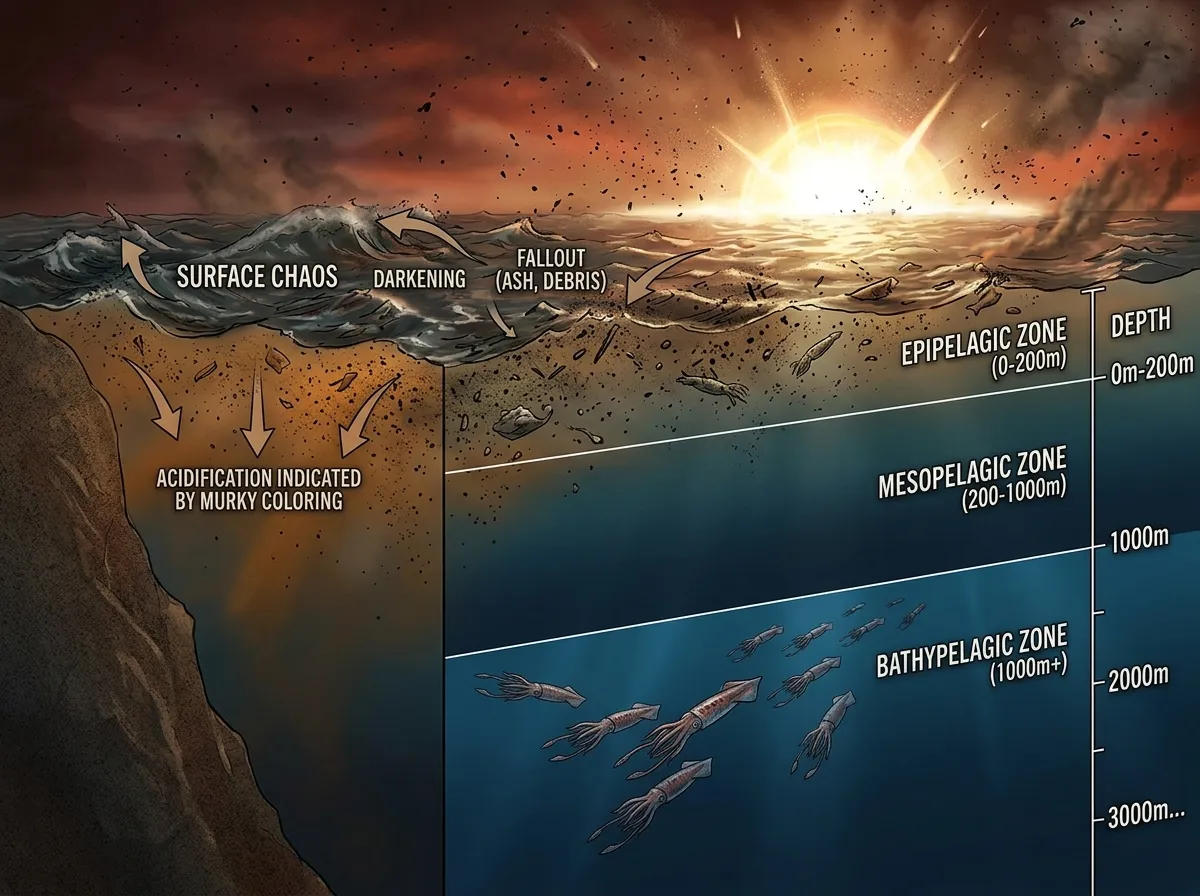
The K-Pg event he's referring to is the Cretaceous-Paleogene mass extinction 66 million years ago, the same asteroid impact that killed the dinosaurs. That catastrophe wiped out roughly 75% of all species on Earth, including most of the marine reptiles and ammonites that had dominated the oceans for over 100 million years. The shallow seas experienced intense acidification that would have destroyed the calcified shells of many marine organisms.
But the squid ancestors were already in the deep ocean, in oxygen-rich waters far below the worst of the surface devastation. They survived not because they were tough, but because they were already living in what amounted to a bomb shelter.
After the Apocalypse, an Empty Ocean
What happened next is a textbook case of adaptive radiation, the same evolutionary mechanism that turned a handful of finch species into Darwin's famous variety on the Galapagos Islands, but playing out across the entire world ocean over millions of years.
When the dust settled from the K-Pg extinction and ocean chemistry slowly recovered, the shallow-water ecosystems that had been dominated by ammonites, marine reptiles, and other Mesozoic predators were essentially vacant. Coral reefs began to rebuild. New fish species radiated into the gaps. And the squid lineages that had been sitting in deep-water stasis for 30 to 40 million years suddenly had an enormous, mostly empty world of shallow-water habitats to colonize.
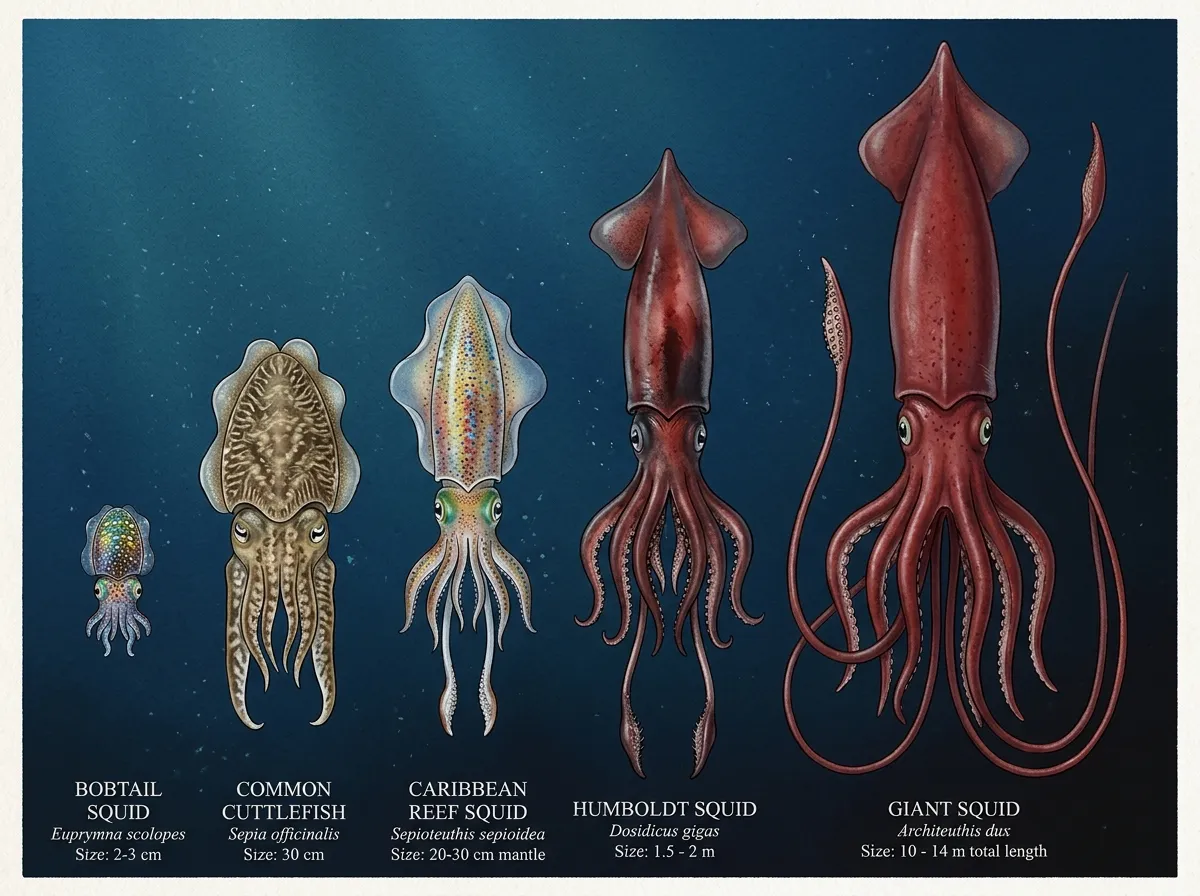
The genome data shows that this is exactly when the branching accelerated. Species proliferated rapidly as different lineages adapted to different niches: reef squid that hunt in tropical shallows, Humboldt squid that patrol the deep scattering layer, cuttlefish that developed some of the most sophisticated camouflage systems in the animal kingdom, bobtail squid that formed symbiotic partnerships with bioluminescent bacteria. The diversity that had been suppressed for tens of millions of years erupted in what Dr. Sanchez and his colleagues call a "long fuse" pattern: a slow burn of genetic divergence followed by an explosive radiation of form and function.
This pattern, stasis followed by rapid diversification after an extinction event, has been theorized before. But the squid study is one of the clearest genomic demonstrations of it in the animal kingdom. "Earlier reconstructions were prone to biased signals," Dr. Sanchez noted. "Whole genome data now provide a cleaner, more consistent picture."
Why Genomes Succeed Where Fossils Fail
One of the reasons cephalopod evolution has been so difficult to study is that squid and cuttlefish leave terrible fossils. Unlike their shelled relatives, the nautiluses and ammonites, most modern cephalopods have reduced or eliminated their hard structures entirely. A squid's internal "pen" is a thin, flexible strip of chitin that rarely survives fossilization. Cuttlefish have the cuttlebone, which preserves better, but even that record is fragmentary.
This means the conventional tools of paleontology, digging up bones and shells and arranging them chronologically, simply don't work for most of the group's history. Molecular phylogenetics, building family trees from DNA rather than fossils, has been the primary alternative. But until recently, the available genetic data was limited to small fragments of the genome, and different fragments told different stories.
The OIST team's approach of using whole genomes resolved these contradictions. With billions of base pairs to compare rather than thousands, the statistical noise that had plagued earlier studies was overwhelmed by the signal. Prof. Daniel Rokhsar, head of the Molecular Genetics Unit at OIST and a co-author of the study, has called the approach a "genomic lens" that allows researchers to see deep evolutionary history with a clarity that individual genes can't provide.
The practical implications go beyond academic interest. Squid genomes contain the blueprints for some of biology's most remarkable innovations: the chromatophore system that enables instant color change, the giant axon that revolutionized neuroscience in the 20th century, and the RNA editing machinery that allows cephalopods to modify their own proteins without changing their DNA. Understanding when and how these features evolved requires exactly the kind of resolved family tree that this study provides.
What This Means
The squid evolution study does something rare in biology: it turns a frustrating gap in the fossil record into a clear narrative. For decades, the absence of squid fossils meant that their evolutionary history was essentially a blank page between their presumed origin and their current diversity. The OIST team filled that page with a story that is both simple and profound: these animals originated in the deep ocean, waited out the worst mass extinction in 200 million years, and then radiated into the ecological space that the extinction created.
The "long fuse" pattern has implications beyond cephalopods. If the same dynamic applies to other soft-bodied marine groups that leave poor fossil records, including jellyfish, worms, and many crustaceans, then the post-extinction recovery of the world's oceans may have been driven by organisms we can barely see in the geological record. The species that inherited the Earth after the asteroid weren't just the ones that survived; they were the ones that had been waiting, in deep water, for an opportunity that took 30 million years to arrive.
For researchers like Sanchez, Fernandez-Alvarez, and Rokhsar, the immediate next step is using this resolved family tree to trace the evolution of specific cephalopod innovations. When did chromatophores first appear? Did RNA editing evolve once or multiple times? How did the giant axon, used by neurobiologists from Hodgkin and Huxley onward to understand how nerve impulses work, come to be?
The genomes now exist to answer those questions. It just took a five-year global collaboration, three newly sequenced genomes, and one very rare deep-sea squid with a coiled shell to get there.
Sources
- Nature Ecology & Evolution: Rapid Mid-Cretaceous Diversification of Squid and Cuttlefish - Original research paper by Sanchez, Fernandez-Alvarez, Rokhsar et al.
- ScienceDaily: How Squid Survived Earth's Biggest Extinction - Research summary with quotes from lead authors
- Earth.com: Squid Evolution Mystery Finally Solved With New Genomes - Detailed coverage of the "long fuse" pattern and genome methodology
- Phys.org: 100 Million Years Ago, an Evolutionary Fuse Was Lit - Deep-sea refugia and post-extinction radiation analysis